
How RoboSense RS-Helios 32 Is Redefining Robot Perception, Navigation, and Obstacle Avoidance
The robotics industry is currently experiencing one of its most significant technological transformations in decades. From autonomous mobile robots (AMRs) operating in warehouses to unmanned delivery vehicles navigating urban environments, robots are becoming increasingly intelligent, autonomous, and capable of handling complex real-world scenarios without direct human intervention.
However, there is one challenge that continues to limit the performance of many robotic systems: environmental perception.
A robot can only make intelligent decisions if it accurately understands the environment around it. While advances in artificial intelligence, machine learning, and computing power have dramatically improved robot decision-making capabilities, perception remains the foundation upon which all autonomous functions depend.
For many years, 2D LiDAR sensors dominated the robotics market. They were relatively affordable, easy to integrate, and capable of providing basic obstacle detection for indoor navigation. Yet as robotics applications become more demanding, engineers are increasingly discovering that traditional 2D LiDAR systems simply cannot provide the level of environmental awareness required by modern autonomous platforms.
As a result, a growing number of robotics companies are transitioning to 3D LiDAR sensors, particularly 32-beam systems such as the RoboSense RS-Helios 32.
Available through Lidarseek, the RS-Helios 32 combines high-resolution 3D perception, long-range detection, industrial-grade reliability, and advanced obstacle recognition capabilities, making it one of the most compelling solutions for robotics, autonomous vehicles, industrial automation, and intelligent transportation systems.
Product Link:
The Hidden Problem With Most Robot Navigation Systems
When discussing autonomous robots, many people focus on AI algorithms, path planning software, or machine learning models. While these technologies are undoubtedly important, they all rely on one critical input: accurate environmental data.
Imagine asking a human to navigate through a crowded warehouse while blindfolded.
No matter how intelligent that person may be, they would struggle to avoid obstacles or choose efficient routes.
The same principle applies to robots.
Without sufficient perception capabilities, robots cannot:
- Detect obstacles accurately
- Predict human movement
- Understand complex environments
- Generate reliable maps
- Navigate safely
Many traditional robots still depend on cameras or 2D laser scanners. Although these sensors can work reasonably well in controlled environments, they begin to show significant weaknesses when deployed in dynamic, real-world settings.
For example, a camera may struggle under low-light conditions, direct sunlight, or changing weather. A 2D LiDAR scanner may fail to detect elevated obstacles, hanging objects, or uneven terrain.
These limitations create blind spots that can significantly impact operational efficiency and safety.
This is precisely why many robotics manufacturers are now investing in advanced 3D LiDAR sensor technology.
Why 3D LiDAR Sensors Are Becoming the New Standard
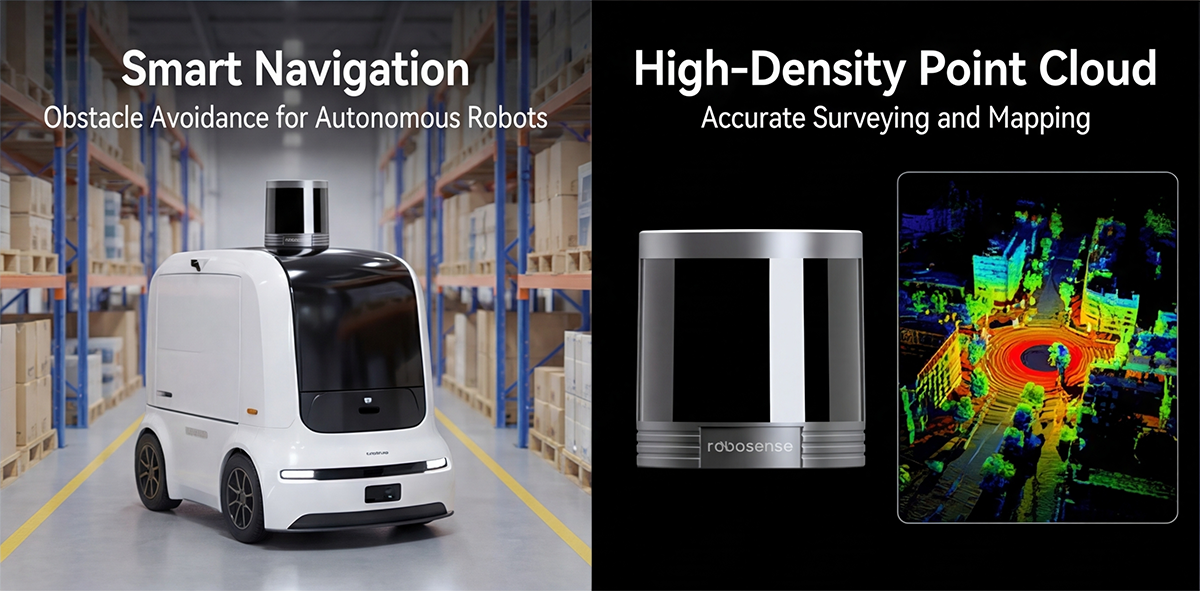
Unlike traditional sensing technologies, a 3D LiDAR sensor continuously scans the surrounding environment using laser pulses to generate a highly detailed three-dimensional point cloud.
Instead of seeing only a single horizontal slice of the world, robots equipped with 3D LiDAR gain a complete spatial understanding of their environment.
This capability enables robots to:
- Detect obstacles at different heights
- Identify moving objects
- Build detailed 3D maps
- Improve localization accuracy
- Enhance route planning
- Operate safely in dynamic environments
As autonomous systems become more sophisticated, these capabilities are no longer optional—they are becoming essential.
The increasing adoption of autonomous warehouse robots, smart factory automation, delivery robots, and autonomous vehicles has accelerated demand for reliable 3D LiDAR sensors worldwide.
Among the available solutions, the RoboSense RS-Helios 32 has emerged as one of the most widely discussed products due to its unique combination of performance, reliability, and deployment flexibility.
What Makes the RoboSense RS-Helios 32 Different?
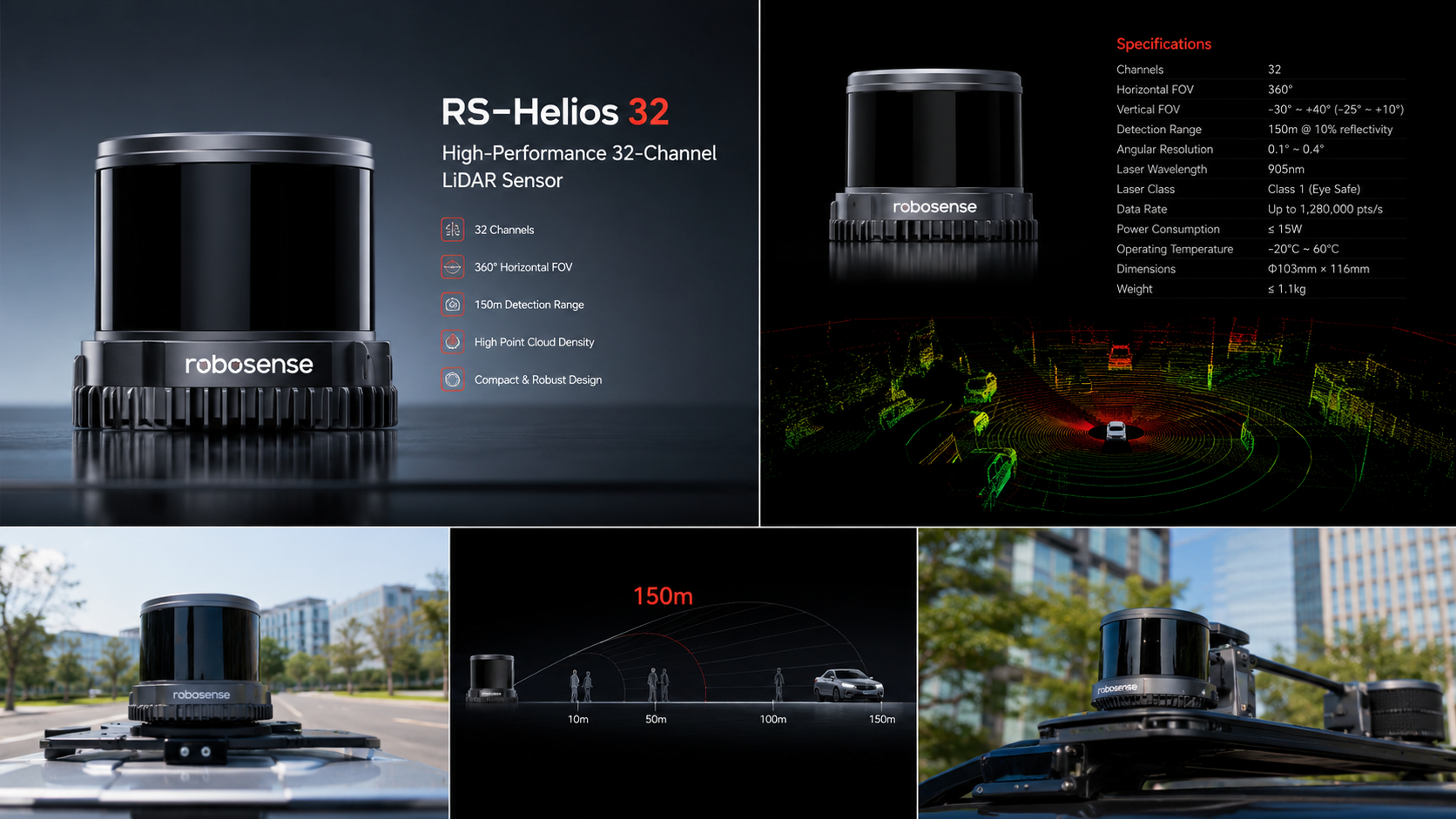
The RoboSense RS-Helios 32 is a high-performance 32-beam 3D LiDAR sensor designed specifically for demanding perception applications.
Unlike entry-level LiDAR systems, the RS-Helios 32 provides dense point cloud data capable of capturing complex environmental details with exceptional accuracy.
Key specifications include:
| Feature | Specification |
|---|---|
| Channels | 32 |
| Detection Range | Up to 150m |
| Horizontal FOV | 360° |
| Vertical FOV | Up to 70° |
| Angular Resolution | Up to 0.1° |
| Laser Class | Class 1 Eye Safe |
| Wavelength | 905nm |
| ROS Compatibility | Yes |
These characteristics make the sensor suitable for a wide range of applications including:
- Autonomous Mobile Robots (AMRs)
- Automated Guided Vehicles (AGVs)
- Service Robots
- Delivery Robots
- Warehouse Automation
- Industrial Automation
- Smart Transportation
- Autonomous Driving Research
Warehouse Automation Is Driving Massive Demand for Robot LiDAR
One of the fastest-growing sectors in robotics is warehouse automation.
The global rise of e-commerce has forced logistics providers to process larger volumes of inventory while reducing operational costs and delivery times.
To meet these demands, companies are increasingly deploying autonomous mobile robots capable of transporting goods without human assistance.
However, warehouse environments are rarely static.
Workers move constantly.
Forklifts cross aisles unexpectedly.
Pallets are relocated throughout the day.
Temporary obstacles appear without warning.
For robots to operate safely and efficiently in such environments, they require continuous situational awareness.
This is where the RoboSense RS-Helios 32 excels.
Its high-density 3D point cloud enables robots to detect obstacles earlier, identify changes in the environment, and adjust navigation paths in real time.
Robotics Solution:
Why Obstacle Avoidance Is More Important Than Speed
Many robot manufacturers focus heavily on increasing travel speed.
However, real-world deployments reveal that obstacle avoidance often has a greater impact on productivity than maximum velocity.
A fast robot that frequently stops due to navigation errors is ultimately less productive than a slightly slower robot with superior perception capabilities.
The RS-Helios 32 helps solve this challenge by providing detailed environmental data that improves obstacle detection and classification.
Robots equipped with advanced 3D LiDAR can distinguish between:
- Humans
- Vehicles
- Equipment
- Structural objects
- Temporary obstacles
This allows more intelligent decision-making and smoother navigation.
The result is improved operational efficiency, reduced downtime, and enhanced workplace safety.
Outdoor Robot Navigation Presents Even Greater Challenges
Indoor environments are relatively controlled.
Outdoor environments are not.
Delivery robots and autonomous service robots must cope with:
- Rain
- Dust
- Uneven terrain
- Pedestrians
- Cyclists
- Parked vehicles
- Construction zones
In such conditions, perception quality becomes a critical success factor.
The RoboSense RS-Helios 32 offers robust long-range detection capabilities that allow robots to identify hazards well before they become immediate threats.
This additional reaction time improves navigation safety and supports more reliable autonomous operation.
How Automotive LiDAR Technology Is Influencing Robotics
One of the most exciting developments in recent years is the convergence of automotive LiDAR and robotics LiDAR technologies.
Originally developed for autonomous driving applications, automotive-grade LiDAR systems were designed to meet exceptionally high requirements for:
- Reliability
- Accuracy
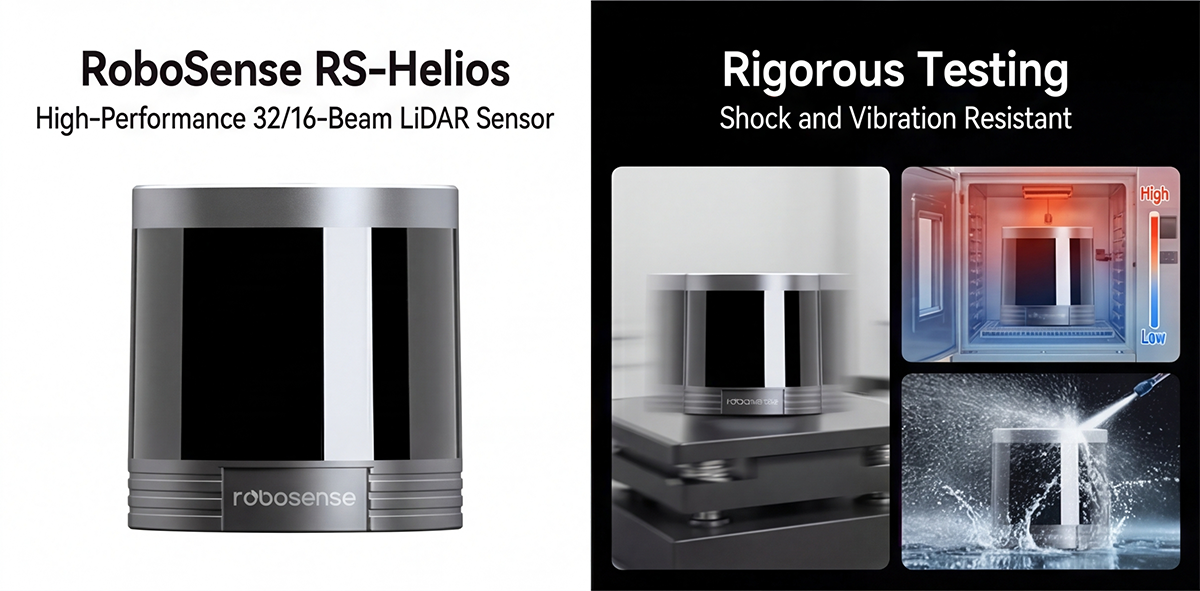
- Environmental resistance
- Real-time processing
As these technologies mature, they are increasingly being adopted by robotics companies seeking automotive-level performance.
The RS-Helios 32 benefits from RoboSense’s extensive experience in automotive LiDAR development, providing robotics engineers with access to technologies previously reserved for autonomous vehicle programs.
Autonomous Driving Solution:
Why Engineers Looking to Buy LiDAR Sensors Are Choosing 32-Beam Systems
When engineers search for terms like:
- Buy LiDAR Sensor
- Robot LiDAR
- 3D LiDAR Sensor
- LiDAR for Robotics
they are no longer simply comparing specifications.
Instead, they are evaluating how effectively a sensor can support real-world deployment.
A 32-beam LiDAR provides a practical balance between:
- Point cloud density
- Cost efficiency
- Processing requirements
- Detection performance
For many robotics applications, this balance makes 32-beam systems one of the most attractive options available today.
Explore More LiDAR Products
In addition to the RoboSense RS-Helios 32, engineers can explore a wide range of professional LiDAR solutions through the Lidarseek online store.
Popular categories include:
- 2D LiDAR Sensors
- 3D LiDAR Sensors
- Automotive LiDAR Sensors
- Robot LiDAR
- Drone LiDAR Systems
- Mapping LiDAR Solutions
Recommended RoboSense Video
To better understand how RoboSense technology is being deployed in real-world autonomous systems, watch videos from the official RoboSense channel:
Frequently Asked Questions
What is a 3D LiDAR sensor?
A 3D LiDAR sensor uses laser pulses to generate a three-dimensional representation of the surrounding environment.
Why is 3D LiDAR better than 2D LiDAR?
3D LiDAR provides height information, allowing robots to detect elevated obstacles and generate more accurate maps.
Is the RS-Helios 32 suitable for warehouse robots?
Yes. It is widely used in AMRs, AGVs, and logistics automation applications.
Can the RS-Helios 32 be used outdoors?
Yes. It supports both indoor and outdoor deployments.
Does it support ROS?
Yes. The sensor supports ROS integration for robotics development.
What industries use robot LiDAR?
Logistics, manufacturing, autonomous vehicles, smart cities, agriculture, and service robotics.
Is LiDAR affected by lighting conditions?
LiDAR is significantly less affected by lighting changes than cameras.
Can LiDAR detect moving objects?
Yes. It can detect and track dynamic obstacles in real time.
Is RS-Helios 32 suitable for SLAM?
Absolutely. Its dense point cloud data supports advanced SLAM algorithms.
Can it be used on delivery robots?
Yes. It is highly suitable for autonomous delivery platforms.
Why are more robotics companies adopting 32-beam LiDAR?
Because it provides an excellent balance of performance, reliability, and deployment flexibility.
Where can I buy the RoboSense RS-Helios 32?
How does LiDAR improve obstacle avoidance?
It provides accurate distance measurements and 3D environmental perception.
Can LiDAR work at night?
Yes. LiDAR performance is largely independent of ambient lighting.
What is the future of robot LiDAR?
As robots become more autonomous, LiDAR will continue to play a central role in perception, navigation, and safety systems.
Conclusion
The future of robotics belongs to systems that can perceive, understand, and interact with the world in increasingly intelligent ways. As industries continue to automate logistics, manufacturing, transportation, and service operations, the demand for reliable perception technology will only grow stronger.
The RoboSense RS-Helios 32 represents a significant step forward in this evolution. By combining high-density 3D perception, robust obstacle detection, long-range sensing, and industrial-grade reliability, it provides the capabilities that modern autonomous robots require to operate safely and efficiently.
For organizations seeking a future-ready LiDAR solution, the RS-Helios 32 offers a compelling combination of performance and flexibility that can support everything from warehouse automation and mobile robotics to advanced research and autonomous transportation projects.
Product Page:
https://lidarseek.com/product/robosense-rs-helios-32
Robotics Solutions:
https://lidarseek.com/robotics
Shop LiDAR Products:
https://lidarseek.com/shop









