
How the Hesai JT128 Ultra-Hemispherical 3D LiDAR Is Transforming Robot Navigation, Obstacle Avoidance, and Embodied AI
Featured Product
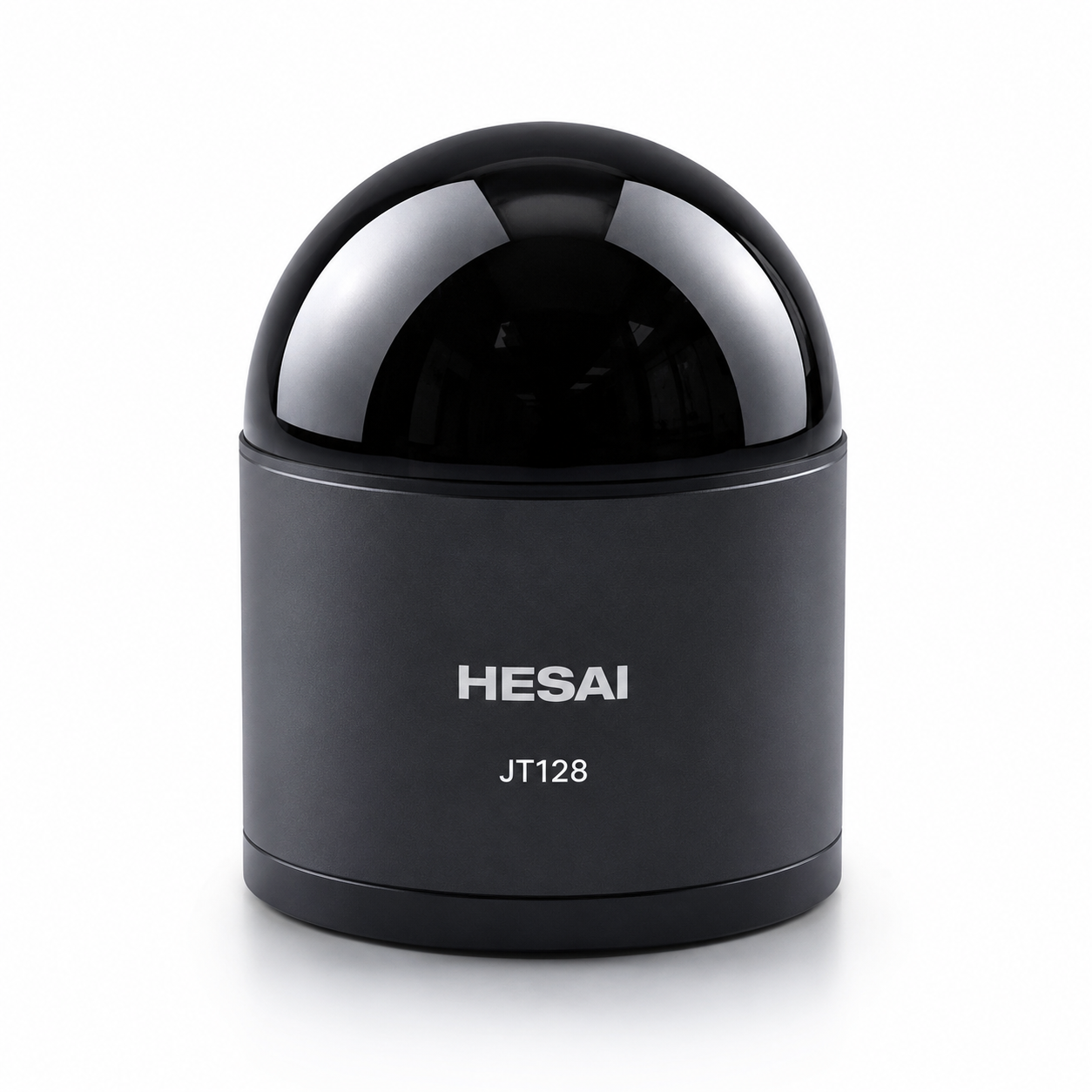
Hesai JT128 Ultra-Hemispherical 3D LiDAR
Product Page:
Explore More LiDAR Sensors:
https://lidarseek.com/shop
Introduction
The robotics industry is entering a completely new era.
For decades, robot developers focused primarily on navigation algorithms, localization systems, and motion control. While these technologies remain critical, a growing number of robotics companies are discovering that the biggest limitation is no longer software.
The real challenge is perception.
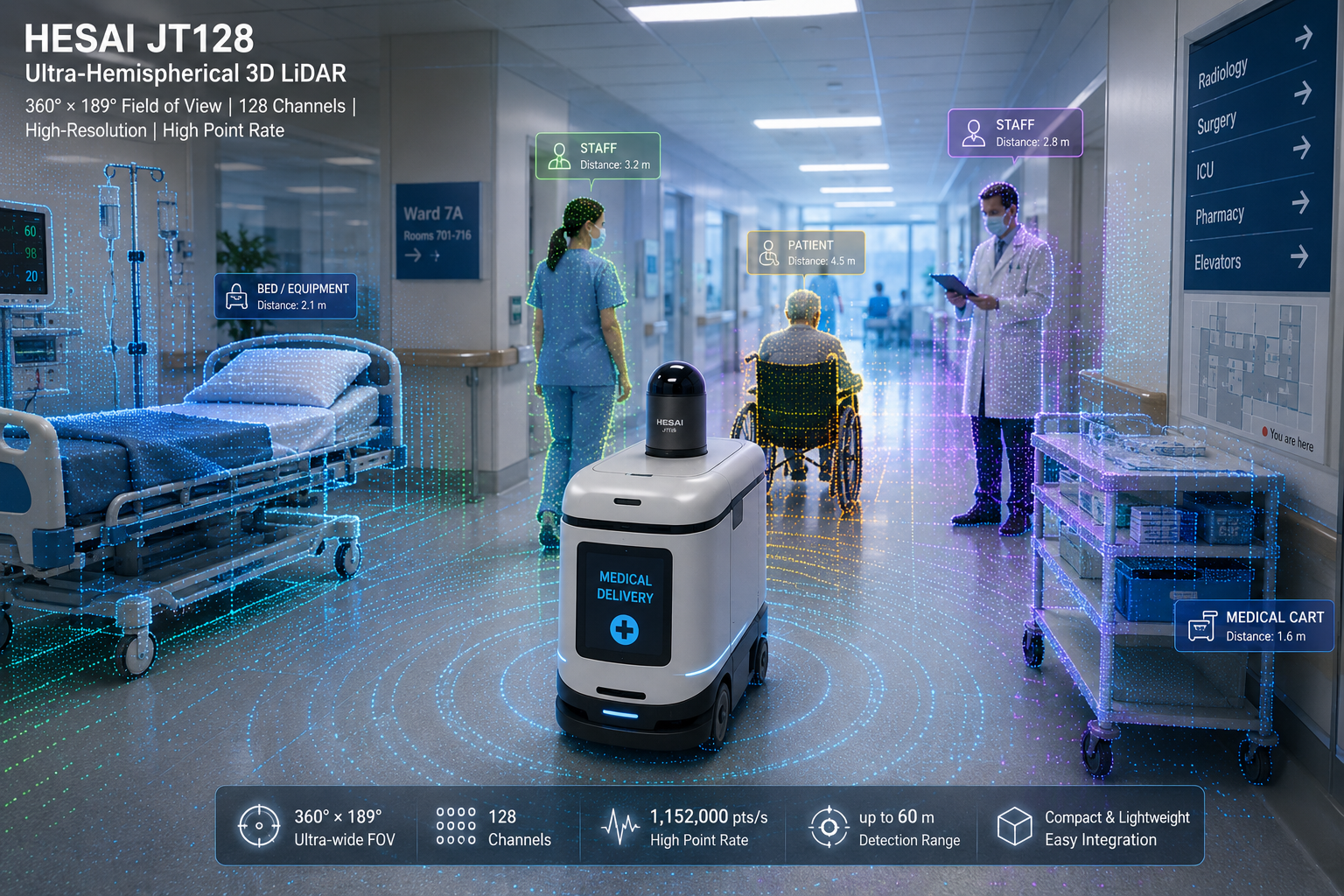
Modern robots are expected to operate in airports, hospitals, shopping malls, hotels, warehouses, factories, and public spaces where conditions change continuously. These environments contain moving people, carts, furniture, glass walls, hanging objects, stairs, shelves, and countless dynamic obstacles.
A robot can only make intelligent decisions based on what it can perceive.
If critical information is missing, even the most advanced AI system will make mistakes.
This reality is driving a major shift toward high-density 3D LiDAR solutions that provide richer environmental awareness and more complete spatial understanding.
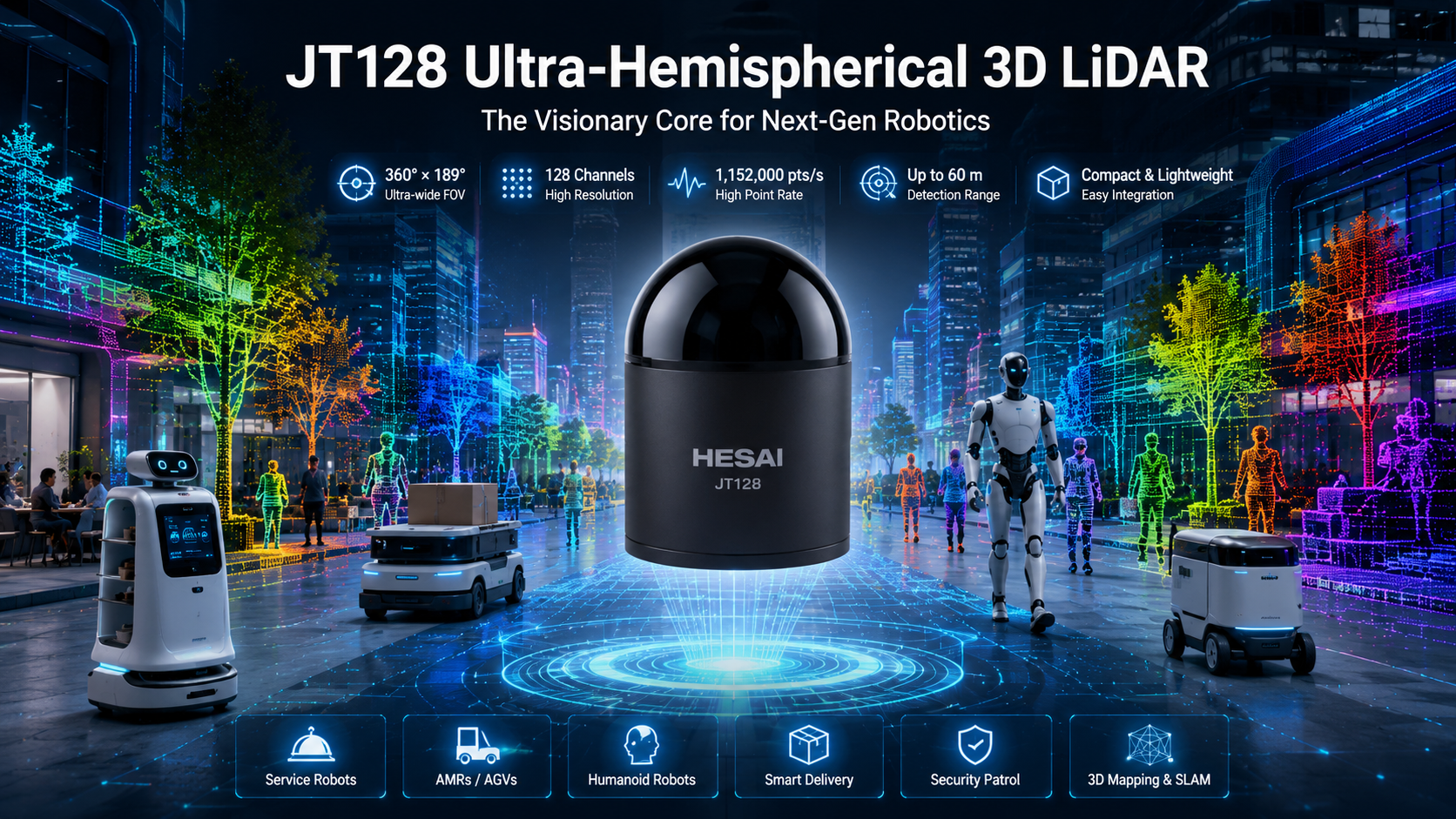
Among the most innovative products addressing this challenge is the Hesai JT128 Ultra-Hemispherical 3D LiDAR, a sensor specifically engineered for robotics applications that require near-complete environmental visibility.
Why Traditional Robot Sensors Are Becoming a Bottleneck
Many robots currently deployed rely on combinations of:
- 2D LiDAR
- RGB Cameras
- Depth Cameras
- Ultrasonic Sensors
- Infrared Sensors
Although these technologies can support basic navigation, they often struggle in highly dynamic environments.
Consider a service robot operating inside a busy shopping center.
The robot must simultaneously identify:
- Customers approaching from multiple directions
- Children moving unpredictably
- Shopping carts
- Chairs and tables
- Glass barriers
- Temporary displays
- Hanging signs
Traditional sensing systems frequently leave blind zones that reduce perception accuracy.
These blind zones create operational risks.
The result can include:
- Navigation failures
- Mapping inconsistencies
- Increased collision risk
- Reduced deployment efficiency
- Poor customer experience
As robots become more intelligent, perception quality becomes increasingly important.
Product Overview: Hesai JT128 Ultra-Hemispherical 3D LiDAR
The Hesai JT128 was designed specifically for robotics, autonomous systems, and intelligent automation.
Key specifications include:
- 128 Channels
- 360° Horizontal Field of View
- 189° Vertical Field of View
- Up to 1,152,000 points per second
- Compact Design
- Lightweight Construction
- High-Density Point Cloud Generation
- Excellent Near-Field Detection
- SLAM Optimization
Unlike many LiDAR sensors originally designed for automotive applications, JT128 focuses on delivering comprehensive environmental awareness required by modern robotics systems.
👉 View JT128 Specifications
Why 360° × 189° Coverage Changes Everything
Most LiDAR discussions focus on range.
However, for robotics applications, coverage is often more important than distance.
Service robots rarely need to see 300 meters ahead.
What they truly need is complete awareness of their immediate surroundings.
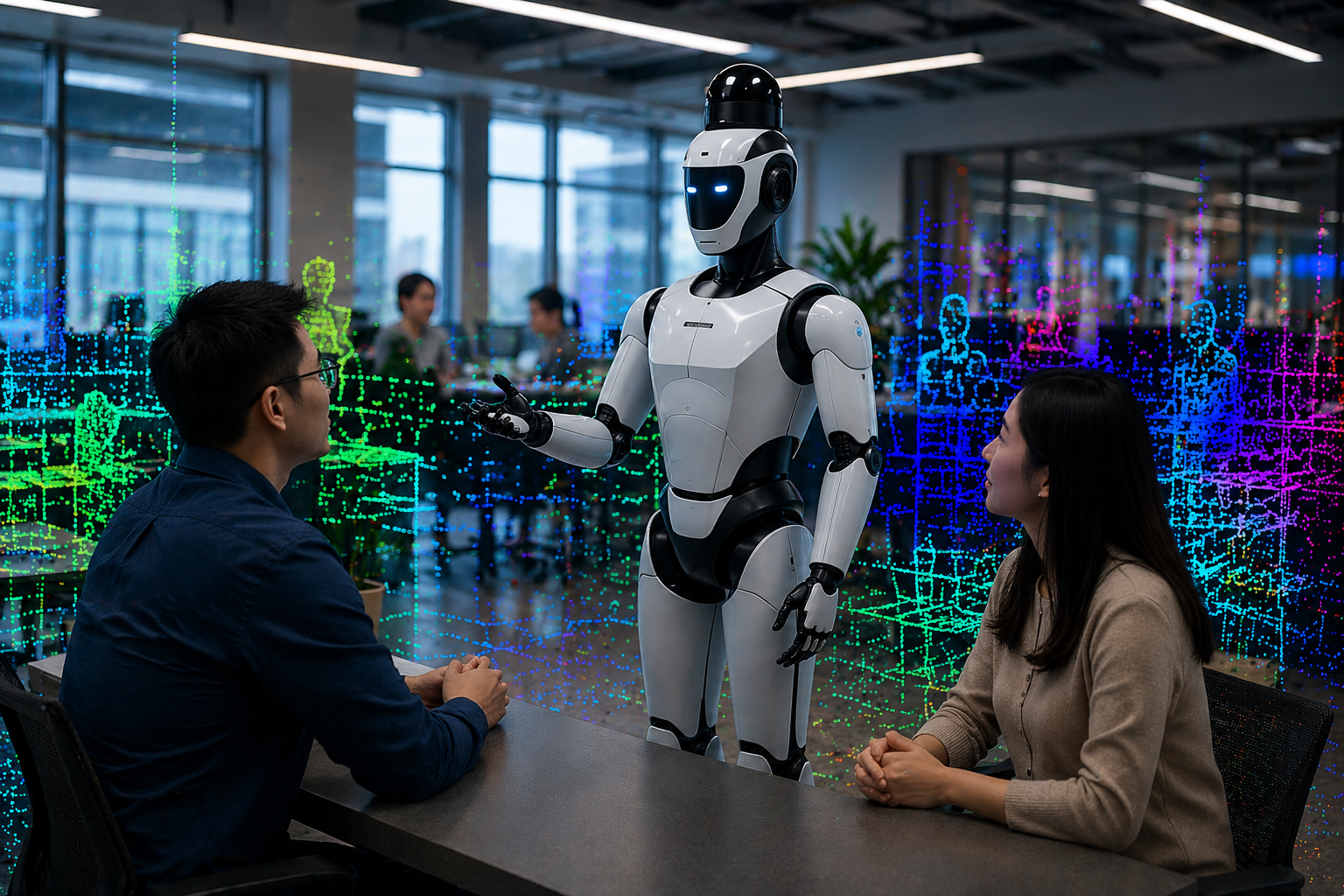
The JT128‘s ultra-hemispherical perception allows robots to simultaneously detect:
- Floor obstacles
- People
- Furniture
- Walls
- Overhead structures
- Hanging signs
- Shelving systems
This dramatically improves:
- Navigation reliability
- Human safety
- Obstacle avoidance
- Localization accuracy
- Environmental mapping
For many robotics applications, broader visibility directly translates into better operational performance.
The Rise of Embodied AI Is Increasing Demand for Advanced LiDAR
One of the hottest trends in robotics today is embodied intelligence.
Unlike traditional robots that execute predefined instructions, embodied AI systems continuously:
- Observe
- Learn
- Adapt
- Interact
To achieve this level of intelligence, robots require a constant stream of accurate environmental data.
Poor perception creates poor decisions.
High-quality perception enables:
- Better object recognition
- Improved motion planning
- Human-aware navigation
- Advanced interaction capabilities
The JT128 provides dense spatial data that helps embodied AI systems better understand and respond to the physical world.
Why More AMR Manufacturers Are Choosing JT128
Warehouse automation continues to expand globally.
Modern AMRs and AGVs must navigate:
- Narrow aisles
- Dynamic traffic
- Human workers
- Forklifts
- Pallet storage systems
A single navigation error can create:
- Delivery delays
- Inventory damage
- Safety concerns
- Increased operational costs
The JT128′s high-density point cloud generation and ultra-wide field of view provide the environmental awareness necessary to support reliable autonomous navigation.
For logistics companies, improved perception often results in measurable productivity gains.
Customer Success Story
How a Robotics Startup Reduced Navigation Errors by 43% Using JT128
A robotics company developing autonomous service robots encountered persistent challenges during real-world deployments.
Their original perception stack included:
- 2D LiDAR
- RGB Cameras
- Ultrasonic Sensors
Although the robots performed well in controlled environments, deployment performance dropped significantly in crowded public locations.
Common issues included:
- Localization drift
- Human avoidance failures
- Mapping inconsistencies
- Missed obstacles
After upgrading to the Hesai JT128, the company observed significant improvements in:
- Navigation consistency
- Dynamic obstacle detection
- Human tracking reliability
- Mapping accuracy
The development team also reduced integration complexity because fewer supplementary sensors were required.
This illustrates a growing trend within the robotics industry:
Better perception often produces greater performance gains than software optimization alone.
JT128 vs Livox MID-360
One of the most common questions from robotics developers is:
“Which LiDAR should I choose for my robot?”
| Feature | Hesai JT128 | Livox MID-360 |
|---|---|---|
| Coverage | Excellent | Good |
| Vertical FOV | 189° | Smaller |
| Human Detection | Excellent | Good |
| Service Robots | Excellent | Good |
| Humanoid Robots | Excellent | Moderate |
| Point Cloud Density | Excellent | Good |
| Environmental Awareness | Excellent | Good |
For robots operating in crowded, dynamic environments, broader environmental coverage often delivers superior performance.
Why Procurement Managers Prefer Complete LiDAR Solutions
Choosing the right LiDAR sensor involves much more than comparing specifications.
Procurement teams must evaluate:
Technical Support
Will the supplier provide guidance during integration?
Scalability
Can production requirements be supported in the future?
Global Logistics
Can products be delivered worldwide?
Product Selection Flexibility
Can alternative LiDAR solutions be recommended if requirements change?
At LidarSeek, customers gain access to a wide range of professional LiDAR solutions from leading manufacturers.
This simplifies sourcing while reducing project risk.
Explore More Products
Why Buy JT128 from LidarSeek?
LidarSeek specializes in professional LiDAR solutions for:
- Robotics
- Autonomous Vehicles
- Industrial Automation
- Smart Transportation
- Mapping & Surveying
- Smart City Projects
Benefits include:
✓ Global Shipping
✓ Technical Consultation
✓ Fast Product Selection Assistance
✓ Multi-Brand LiDAR Portfolio
✓ B2B Project Support
Whether you’re purchasing a single development unit or planning large-scale deployment, our team can help identify the right solution.
Request a JT128 Project Evaluation
Every robotics project is unique.
Our engineering specialists can help determine whether JT128 is suitable for your application.
Simply provide:
- Application Type
- Desired Detection Range
- Installation Location
- Operating Environment
- Quantity Requirement
We will recommend the most appropriate LiDAR solution for your project.
Request Technical Information
Browse All LiDAR Sensors
Submit an RFQ
Recommended Video
To help visitors better understand LiDAR technology and robotics applications, embed a video from the RoboSense YouTube channel:
https://www.youtube.com/@RoboSenseLiDAR
Frequently Asked Questions
1. What is the Hesai JT128?
The JT128 is a 128-channel ultra-hemispherical 3D LiDAR designed specifically for robotics and automation.
2. What makes JT128 different from traditional robot LiDAR?
Its 360° × 189° field of view dramatically reduces blind spots.
3. Is JT128 suitable for service robots?
Yes. It is optimized for robots operating in dynamic human environments.
4. Can JT128 support SLAM?
Yes. Its dense point cloud generation makes it highly suitable for mapping and localization.
5. Is JT128 suitable for AGVs and AMRs?
Absolutely.
6. Can JT128 be used outdoors?
Yes.
7. Why is vertical field of view important?
It allows robots to detect both floor-level and overhead obstacles simultaneously.
8. Is JT128 suitable for humanoid robots?
Yes. It provides the environmental awareness required by embodied AI systems.
9. Can JT128 improve obstacle avoidance?
Yes. More environmental data enables better path planning and collision avoidance.
10. Can JT128 replace multiple sensors?
In many deployments, it can reduce reliance on overlapping perception systems.
11. What industries benefit from JT128?
Logistics, healthcare, hospitality, retail, manufacturing, security, and research.
12. Where can I buy JT128?
13. Where can I compare other LiDAR products?
14. How can I request a quotation?
Conclusion
The future of robotics belongs to systems capable of understanding their environments with unprecedented accuracy.
As service robots, autonomous mobile robots, warehouse automation platforms, and embodied AI systems become more sophisticated, comprehensive environmental perception will become a competitive necessity.
The Hesai JT128 Ultra-Hemispherical 3D LiDAR represents a new generation of robotic sensing technology designed specifically for these challenges.
Its combination of ultra-wide coverage, high-density point cloud generation, compact form factor, and robotics-focused architecture makes it one of the most compelling LiDAR solutions available for next-generation autonomous systems.
Whether you are developing a prototype, conducting research, or preparing for large-scale deployment, JT128 provides the perception capabilities needed to build safer, smarter, and more capable robots.
Ready to Upgrade Your Robot’s Perception?
👉 Get JT128 Specifications
👉 Browse Professional LiDAR Sensors
👉 Request a Project Consultation









