
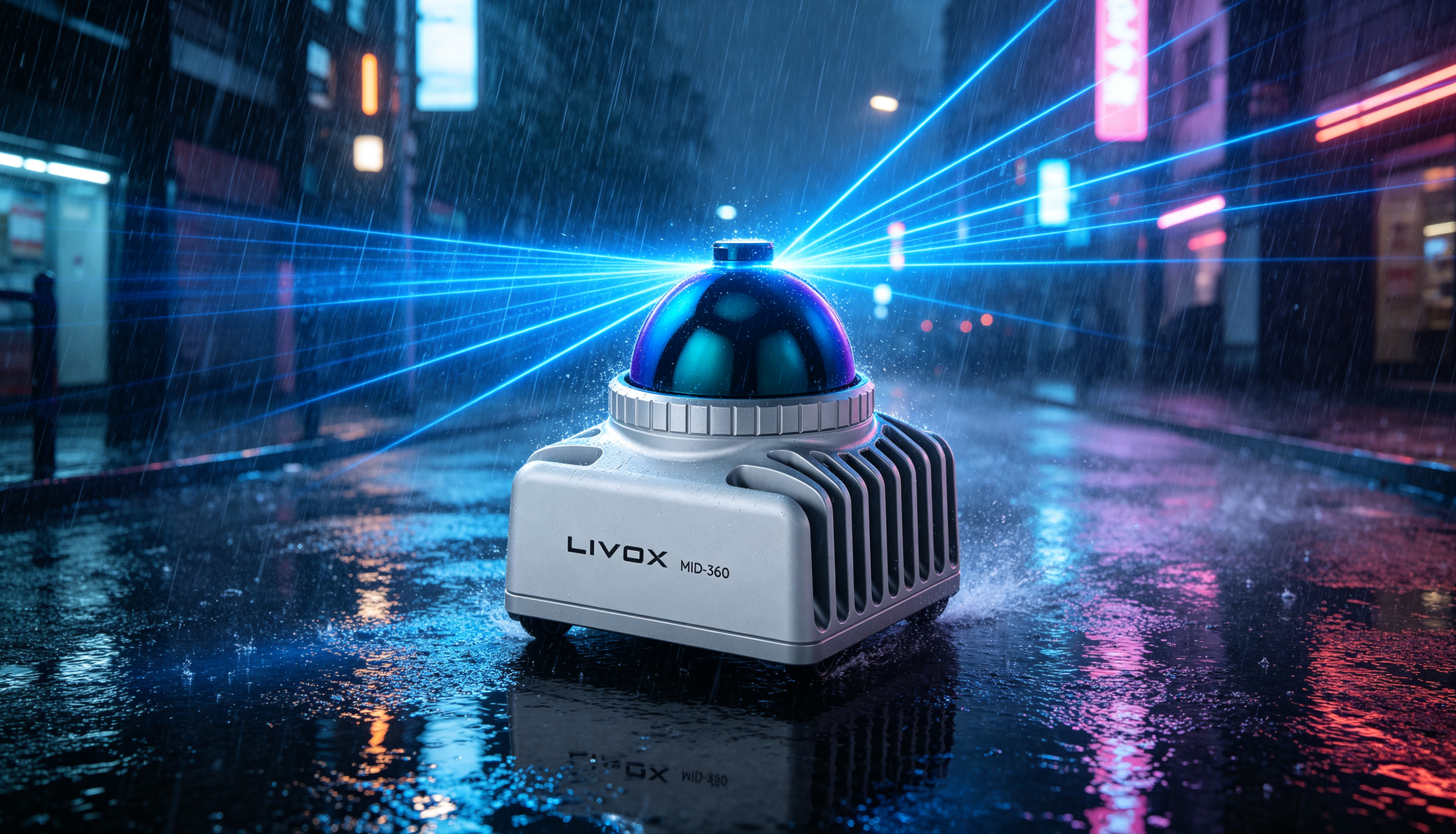
Introduction: The Shift from Automation to Autonomous Intelligence
The robotics industry is experiencing a transformation unlike anything seen in previous decades. Traditional automation focused on predefined movements and fixed operating environments. Today’s robots, however, are expected to perceive, understand, and interact with dynamic surroundings in real time. Whether navigating a warehouse filled with moving workers, delivering supplies in a hospital, or performing inspections inside industrial facilities, modern robots require an unprecedented level of environmental awareness.
At the center of this transformation lies one technology that has rapidly become indispensable: 3D LiDAR sensors.
While artificial intelligence and advanced computing often dominate industry discussions, the reality is simple: AI is only as effective as the data it receives. For autonomous robots, that data comes from sensors. Among these sensors, LiDAR has emerged as one of the most reliable and accurate methods for environmental perception.
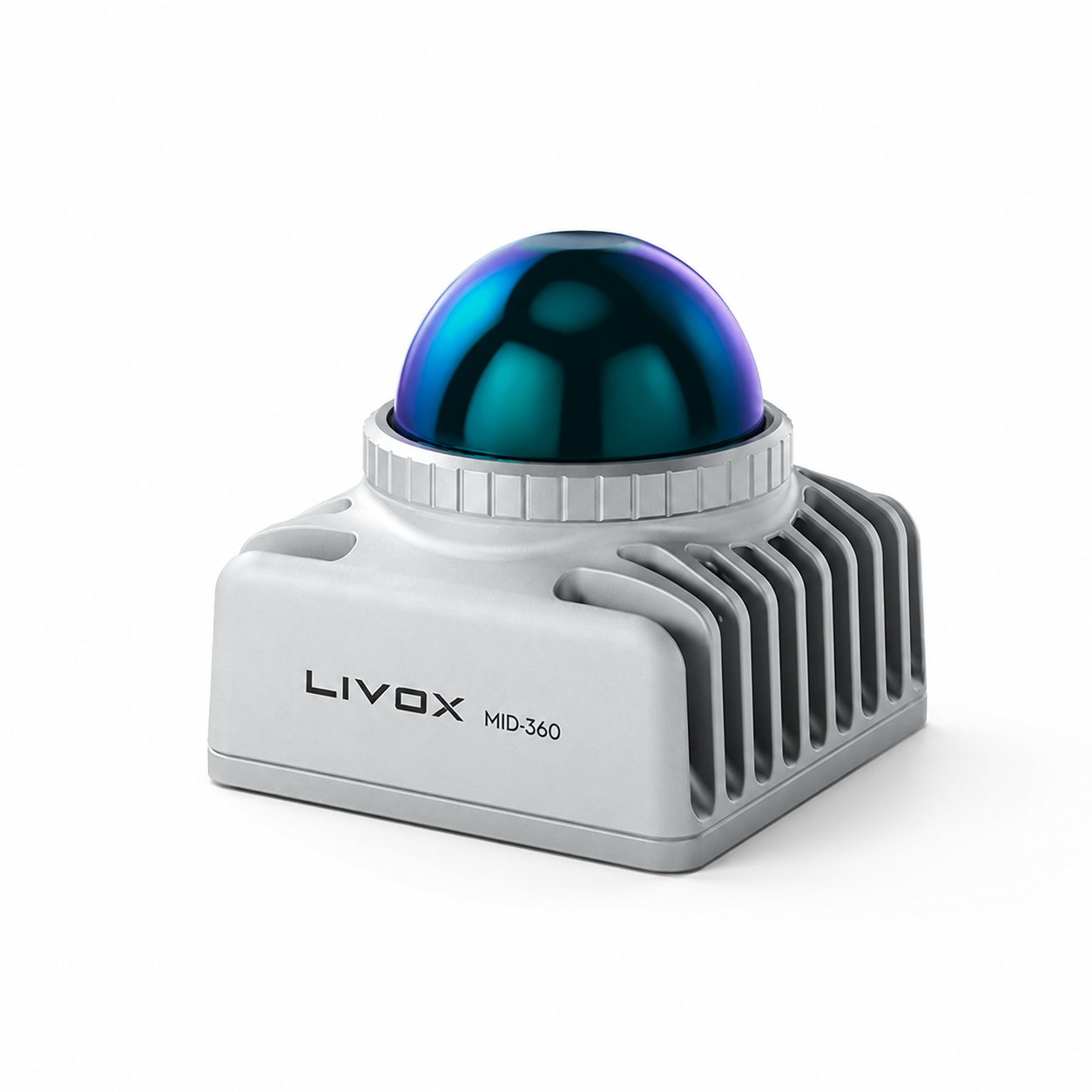
The Livox MID-360 represents a new generation of compact, high-performance LiDAR technology designed specifically for robotic navigation, mapping, and autonomous operation.
Featured Image
Why 360° Environmental Awareness Is Replacing Traditional Robot Navigation
For years, many robotic systems relied on:
- Cameras
- Ultrasonic sensors
- Infrared sensors
- 2D laser scanners
- Wheel encoders
Although these technologies remain useful, they each possess significant limitations.
Cameras depend heavily on lighting conditions. Shadows, glare, fog, and darkness can dramatically impact performance. Ultrasonic sensors offer only limited distance information. Traditional 2D LiDAR systems generate flat environmental maps that fail to capture critical vertical information.
Modern robotic applications require something far more advanced.
They need:
- Full environmental awareness
- Real-time obstacle detection
- Dynamic path planning
- Accurate localization
- High-density mapping
This is where the Livox MID-360 3D LiDAR sensor creates substantial value.
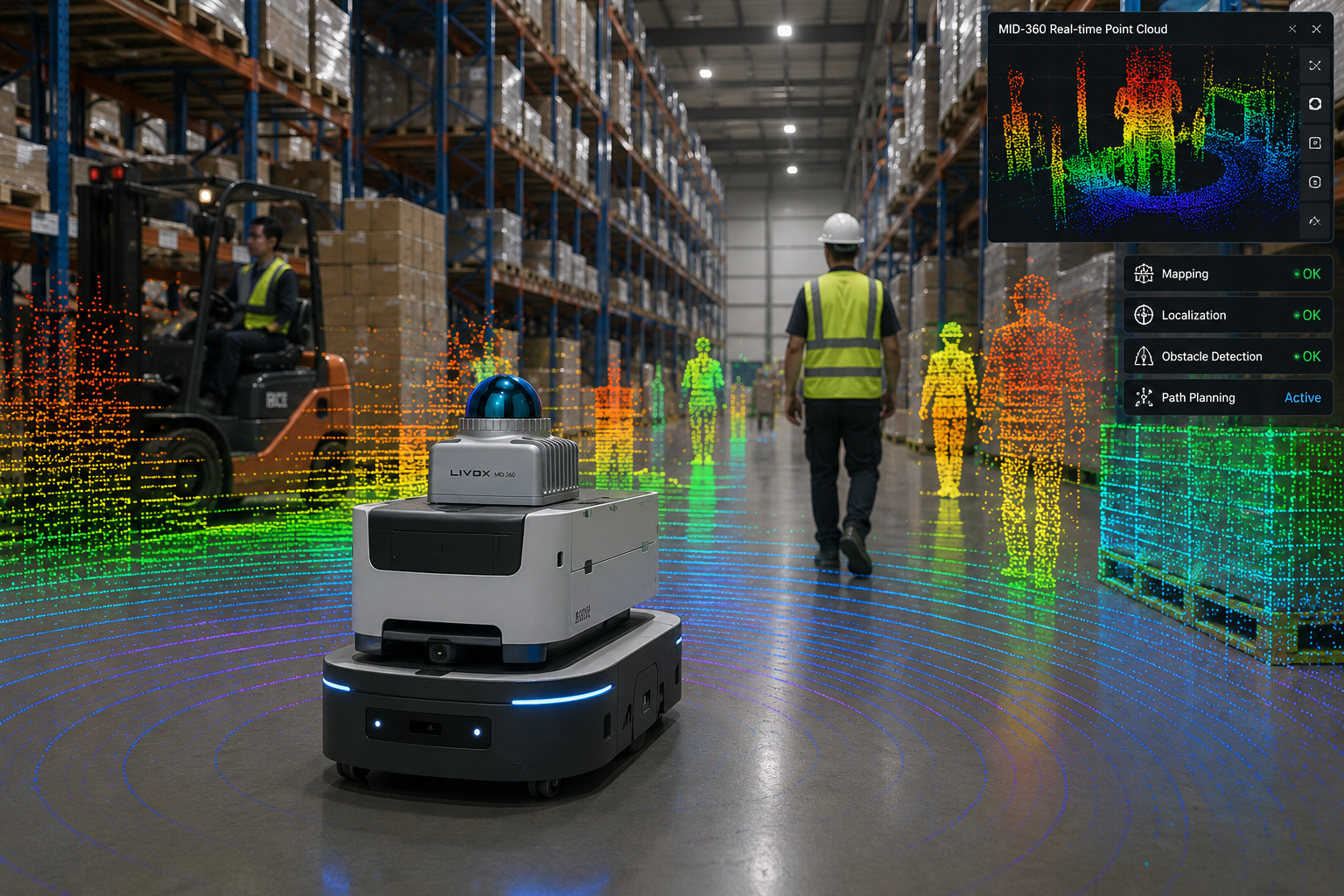
Unlike traditional perception systems, the MID-360 generates rich three-dimensional point cloud data that allows robots to understand their surroundings with remarkable precision.
Related Product👉
The Hidden Challenge in Modern Robotics: Understanding Space
Most people think navigation is simply about avoiding obstacles.
In reality, autonomous navigation is fundamentally about understanding space.
Consider a logistics robot operating inside a fulfillment center.
It must continuously answer questions such as:
- Where am I?
- What objects surround me?
- Which pathways remain accessible?
- Are obstacles moving or stationary?
- Has the environment changed?
The ability to answer these questions determines whether a robot operates safely and efficiently.
The Livox MID-360 provides the high-quality spatial information necessary to solve these challenges.
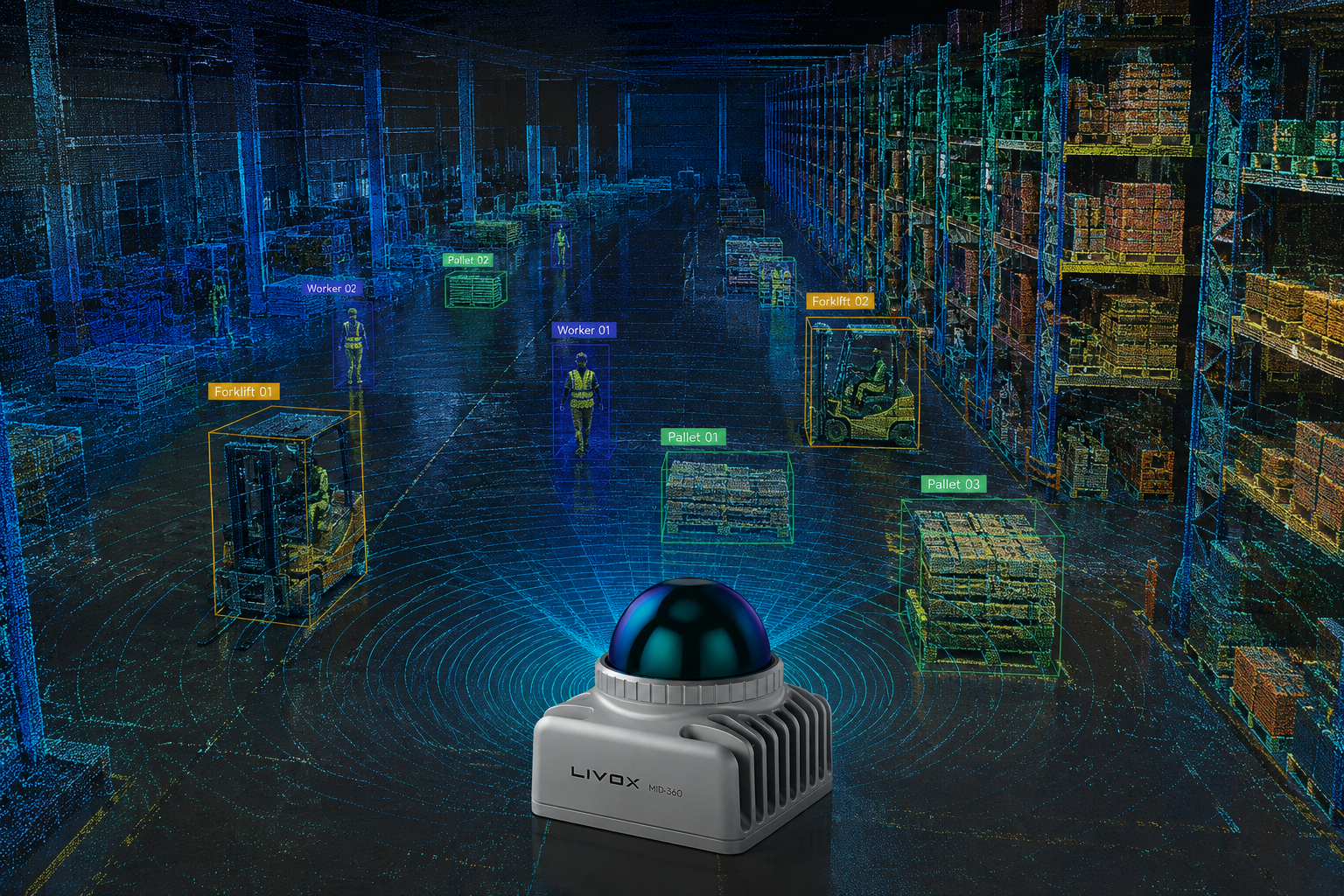
Its comprehensive perception capability enables robots to create highly detailed environmental models that improve:
- Localization
- Mapping
- Obstacle avoidance
- Route optimization
- Multi-robot coordination
This capability is becoming increasingly important as robotic deployments scale from dozens of units to thousands
How Livox MID-360 Is Transforming Autonomous Mobile Robots (AMRs)
Autonomous Mobile Robots (AMRs) have become one of the fastest-growing segments in robotics.
Unlike Automated Guided Vehicles (AGVs), which follow predefined routes, AMRs can:
- Navigate independently
- Adapt to changing environments
- Optimize routes dynamically
- Avoid unexpected obstacles
These capabilities require advanced perception systems.
The Livox MID-360 enables AMRs to:
Accurate SLAM Mapping
Simultaneous Localization and Mapping (SLAM) allows robots to create maps while simultaneously determining their own position.
High-quality LiDAR data significantly improves SLAM performance by providing stable environmental reference points.
Dynamic Obstacle Avoidance
Warehouses rarely remain static.
Workers move.
Forklifts change positions.
Inventory layouts evolve.
The MID-360 continuously updates environmental information, allowing robots to respond immediately to changing conditions.
Improved Fleet Coordination
As organizations deploy hundreds of robots simultaneously, environmental awareness becomes essential for fleet management systems.
The sensor’s point cloud data helps robots coordinate movements while minimizing congestion
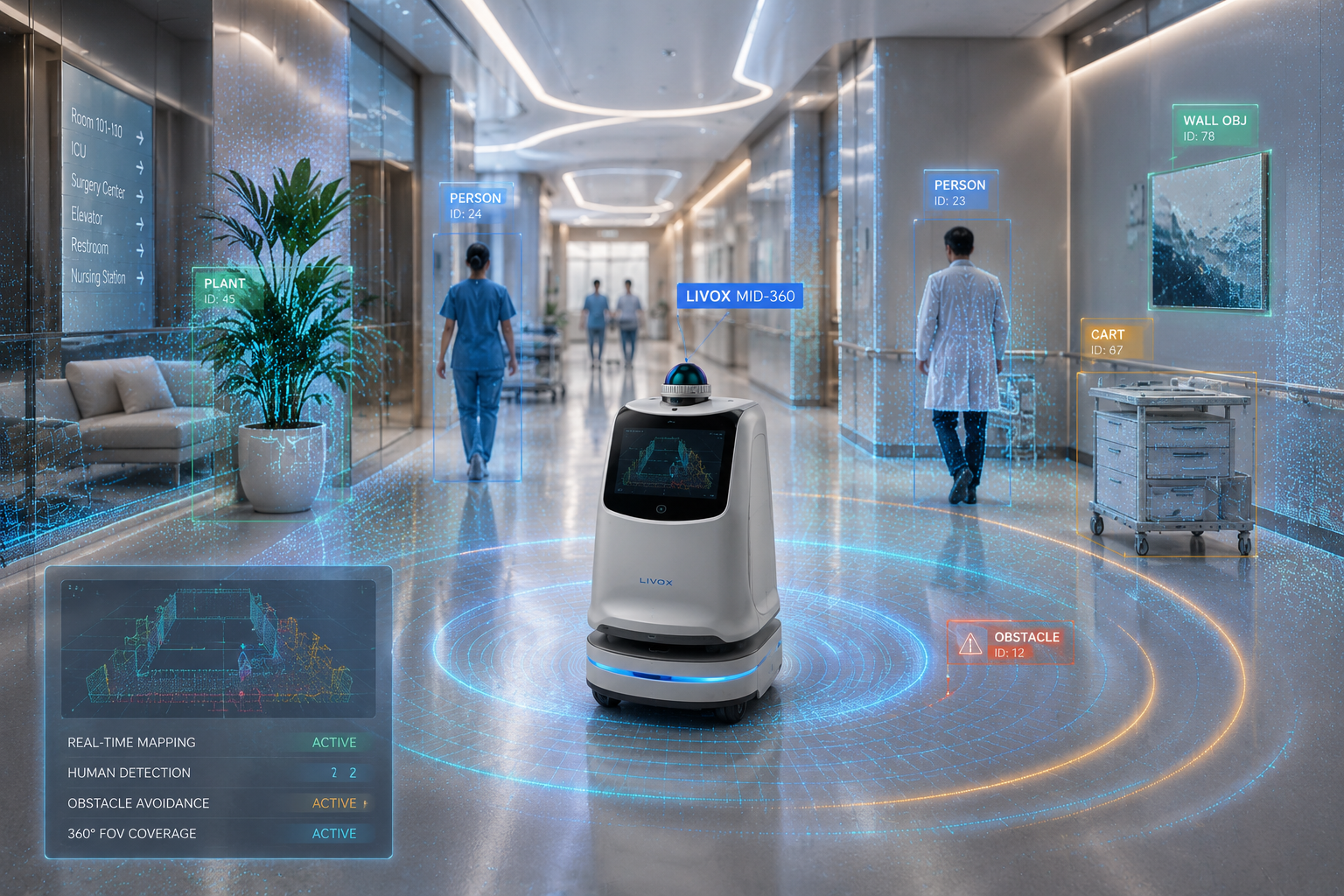
Why Service Robots Need Better LiDAR Than Ever Before
Service robots operate in environments fundamentally different from industrial settings.
Examples include:
- Hospitals
- Hotels
- Airports
- Shopping malls
- Office buildings
- Universities
These environments introduce unique challenges.
Unlike warehouses, human behavior is unpredictable.
People stop unexpectedly.
Groups form.
Furniture moves.
Lighting conditions vary dramatically.
The Livox MID-360 enables service robots to maintain safe operation by continuously monitoring surroundings and updating navigation decisions in real time.
This improves:
- Passenger safety
- Navigation accuracy
- Operational reliability
- User experience
As service robotics adoption increases globally, LiDAR-based perception is becoming a critical competitive advantage.
Smart Factories Require Smarter Perception
Industry 4.0 is driving the convergence of:
- Robotics
- Artificial Intelligence
- Industrial IoT
- Digital Twins
- Predictive Analytics
In this new manufacturing environment, robots must operate as collaborative participants rather than isolated machines.
The Livox MID-360 supports this transition by providing reliable environmental perception for:
- Mobile inspection robots
- Autonomous transport systems
- Collaborative robotics
- Factory mapping platforms
By generating accurate 3D representations of production environments, robots can better understand operational conditions and make informed decisions.
This results in:
- Higher productivity
- Reduced downtime
- Improved worker safety
- Greater operational flexibility
Digital Twins: The Unexpected Growth Opportunity for LiDAR
One of the most exciting developments in robotics is the rise of digital twins.
A digital twin is a virtual representation of a physical environment.
Using LiDAR-equipped robots, organizations can continuously update digital models of:
- Warehouses
- Manufacturing facilities
- Logistics centers
- Campuses
- Infrastructure assets
The Livox MID-360 is particularly valuable in these applications because it enables robots to capture dense spatial information while navigating autonomously.
Digital twins provide measurable benefits:
- Workflow optimization
- Asset tracking
- Maintenance planning
- Safety analysis
- Expansion simulation
As digital transformation accelerates, LiDAR-powered mapping is becoming a strategic investment rather than simply a technical upgrade.
Can Livox MID-360 Support Future Autonomous Vehicles?
Although often discussed within robotics applications, technologies developed for robotic navigation increasingly influence autonomous transportation.
The same perception principles used by warehouse robots are being adapted for:
- Autonomous shuttles
- Delivery robots
- Last-mile logistics vehicles
- Smart mobility platforms
This convergence explains why many buyers researching automotive LiDAR sensor solutions also evaluate advanced robotic LiDAR technologies.
Future autonomous systems will likely share common perception architectures, enabling seamless operation across multiple industries.
Why Businesses Looking to Buy LiDAR Sensors Should Think Beyond Specifications
Many buyers compare LiDAR sensors based only on technical specifications.
However, successful deployments require considering:
- Application requirements
- Integration complexity
- Environmental conditions
- Software ecosystem compatibility
- Scalability
The most successful robotics projects focus on operational outcomes rather than isolated technical metrics.
The Livox MID-360 delivers value because it helps organizations solve practical challenges involving navigation, mapping, perception, and autonomy.
Explore More Professional LiDAR Solutions
Livox MID-360 Product Page
Recommended categories:
- Robot LiDAR
- Industrial LiDAR
- Autonomous Mobile Robot Sensors
- Smart Logistics LiDAR
- Automotive LiDAR Sensor Solutions
- 3D LiDAR Sensor Platforms
Frequently Asked Questions (FAQ)
1. What is the Livox MID-360?
The Livox MID-360 is a compact 3D LiDAR sensor designed for robotic navigation, environmental perception, mapping, and autonomous operation.
2. What industries use Livox MID-360?
Warehousing, logistics, manufacturing, healthcare, smart cities, security, and autonomous mobility.
3. Can MID-360 be used for SLAM?
Yes. It is highly suitable for SLAM-based localization and mapping applications.
4. Is MID-360 suitable for AMRs?
Absolutely. It is widely applicable for autonomous mobile robot navigation.
5. Can service robots use MID-360?
Yes. Service robots benefit from enhanced obstacle detection and environmental awareness.
6. How does LiDAR improve robot safety?
LiDAR provides precise spatial awareness that helps robots detect and avoid obstacles.
7. Can MID-360 operate indoors?
Yes. Indoor navigation is one of its primary use cases.
8. Can it operate outdoors?
Yes. It can support outdoor robotic perception and mapping applications.
9. Why is 3D LiDAR superior to 2D LiDAR?
3D LiDAR captures vertical information, providing richer environmental understanding.
10. Can MID-360 generate digital twins?
Yes. Its point cloud data supports digital twin creation and facility mapping.
11. Is LiDAR important for future autonomous systems?
Yes. High-quality perception is fundamental to advanced autonomy.
12. What makes robot LiDAR different from camera-only systems?
LiDAR directly measures distance and geometry, providing reliable perception regardless of lighting conditions.
13. Can multiple robots share LiDAR-generated maps?
Yes. Shared mapping supports coordinated fleet operations.
14. Is MID-360 suitable for research institutions?
Yes. Universities and research organizations frequently use advanced LiDAR sensors for robotics projects.
15. Where can I buy professional LiDAR sensors?
You can explore professional solutions through:
Conclusion
The future of robotics will not be defined solely by artificial intelligence. It will be defined by perception.
As robots move beyond controlled environments into real-world operations, comprehensive environmental awareness becomes essential. The Livox MID-360 represents a new generation of robot LiDAR, delivering the spatial intelligence required for autonomous navigation, smart logistics, industrial automation, service robotics, and future mobility platforms.
For organizations seeking to deploy reliable, scalable, and intelligent robotic systems, investing in high-quality 3D LiDAR sensors is no longer optional—it is becoming the foundation of competitive advantage.









