

Why LiDAR Has Become a Key Sensor Technology for Autonomous Robots
The rapid development of automation, intelligent manufacturing, and autonomous transportation systems has created a growing demand for reliable environmental perception technologies.
Autonomous robots, Automated Guided Vehicles (AGVs), and Autonomous Mobile Robots (AMRs) must understand their surroundings accurately in order to move safely, avoid obstacles, create maps, and complete tasks efficiently.
Among various sensing technologies, LiDAR (Light Detection and Ranging) has become one of the most widely adopted solutions because of its ability to provide accurate distance measurement, real-time environmental scanning, and reliable operation in complex environments.
For robot manufacturers and system integrators, selecting the right LiDAR sensor is not simply about choosing the product with the longest detection range or highest resolution. The correct sensor depends on multiple factors, including:
- Robot application requirements
- Operating environment
- Navigation method
- Required accuracy
- Integration compatibility
- Cost targets
- Production volume requirements
Choosing an unsuitable LiDAR sensor can lead to navigation instability, poor obstacle detection, increased development time, and higher overall system costs.
This guide explains how engineering teams and purchasing managers can select the most suitable LiDAR sensor for autonomous robots and AGV systems.
1. Understanding the Role of LiDAR Sensors in Autonomous Robots
Chapter Image Recommendation
Image concept:
A diagram showing an autonomous robot with different sensing technologies:
- LiDAR sensor on top
- Camera system
- Ultrasonic sensors
- IMU
- Navigation controller
Highlight LiDAR as the primary environmental perception sensor.
Image prompt:
“Technical illustration of autonomous robot sensor architecture, showing LiDAR, camera, ultrasonic sensor and IMU modules, engineering diagram style, clean industrial design”
LiDAR sensors work by emitting laser pulses and measuring the time required for reflected signals to return.
Based on these measurements, the sensor creates distance information and generates a representation of the surrounding environment.
For autonomous robots, LiDAR provides several critical functions:
1.1 Obstacle Detection
Safety is one of the most important requirements for mobile robots.
In warehouses, factories, hospitals, and commercial environments, robots must detect:
- People
- Machines
- Pallets
- Boxes
- Temporary obstacles
LiDAR enables robots to identify objects in real time and adjust their movement accordingly.
Compared with traditional sensors, LiDAR provides a wider detection area and more accurate distance measurement.
1.2 Mapping and Localization
Many autonomous robots use SLAM (Simultaneous Localization and Mapping) technology.
SLAM allows robots to:
- Build maps of unknown environments
- Determine their own position
- Navigate without fixed tracks or markers
LiDAR is one of the most common sensors used for SLAM because it provides stable geometric information.
For example:
A warehouse AMR equipped with LiDAR can scan shelves, walls, and surrounding structures to create a detailed map and navigate independently.
1.3 Navigation Accuracy Improvement
For industrial applications, navigation accuracy directly affects operational efficiency.
A robot moving materials inside a factory may need to:
- Follow narrow pathways
- Stop at precise locations
- Avoid collisions
- Work continuously for long periods
A suitable LiDAR sensor helps maintain stable positioning performance even in changing environments.
2. Main Types of LiDAR Sensors for Robots and AGV Applications
Chapter Image Recommendation
Image concept:
Comparison infographic:
Left side:
2D LiDAR scanning a flat plane
Right side:
3D LiDAR generating point clouds
Middle:
Application examples
- AGV navigation
- Autonomous robot
- Industrial inspection
Image prompt:
“Professional comparison infographic showing 2D LiDAR versus 3D LiDAR technology, scanning patterns, point cloud visualization, industrial robot applications”
When selecting LiDAR sensors for robotic applications, the first decision is choosing between 2D LiDAR and 3D LiDAR.
2.1 2D LiDAR Sensors
2D LiDAR sensors scan the environment on a horizontal plane.
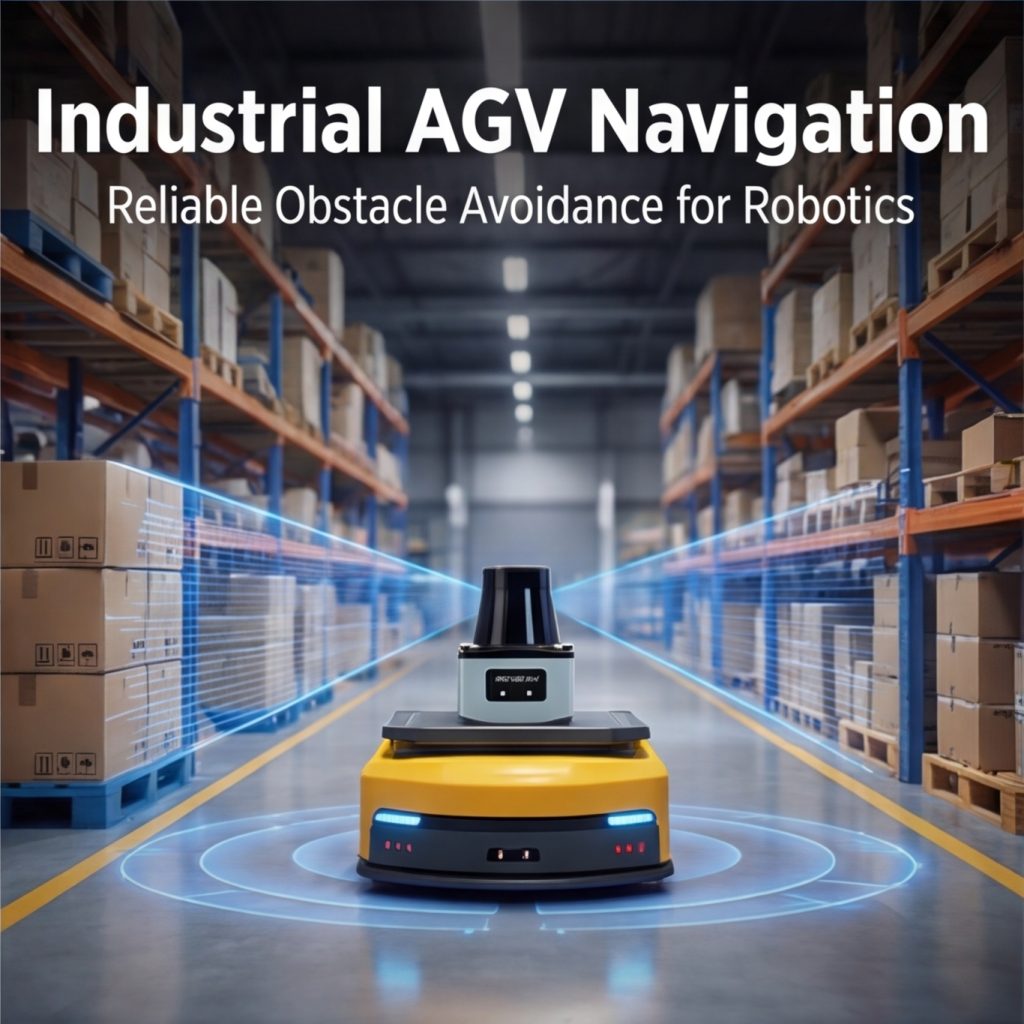
They are widely used in:
- AGV navigation
- Warehouse robots
- Indoor delivery robots
- Industrial automation systems
Advantages of 2D LiDAR:
Lower Cost
Compared with 3D LiDAR, 2D sensors generally provide a more economical solution.
This makes them suitable for large-scale deployment where hundreds or thousands of robots may be required.
Simple Integration
2D LiDAR systems usually have simpler data processing requirements.
They can be integrated easily with:
- Robot controllers
- Navigation software
- ROS platforms
- Industrial automation systems
Reliable Indoor Navigation
For many factory and warehouse environments, robots mainly need horizontal obstacle detection.
A 2D LiDAR sensor can provide sufficient performance while reducing system complexity.
2.2 3D LiDAR Sensors
3D LiDAR captures three-dimensional environmental information and generates point clouds.
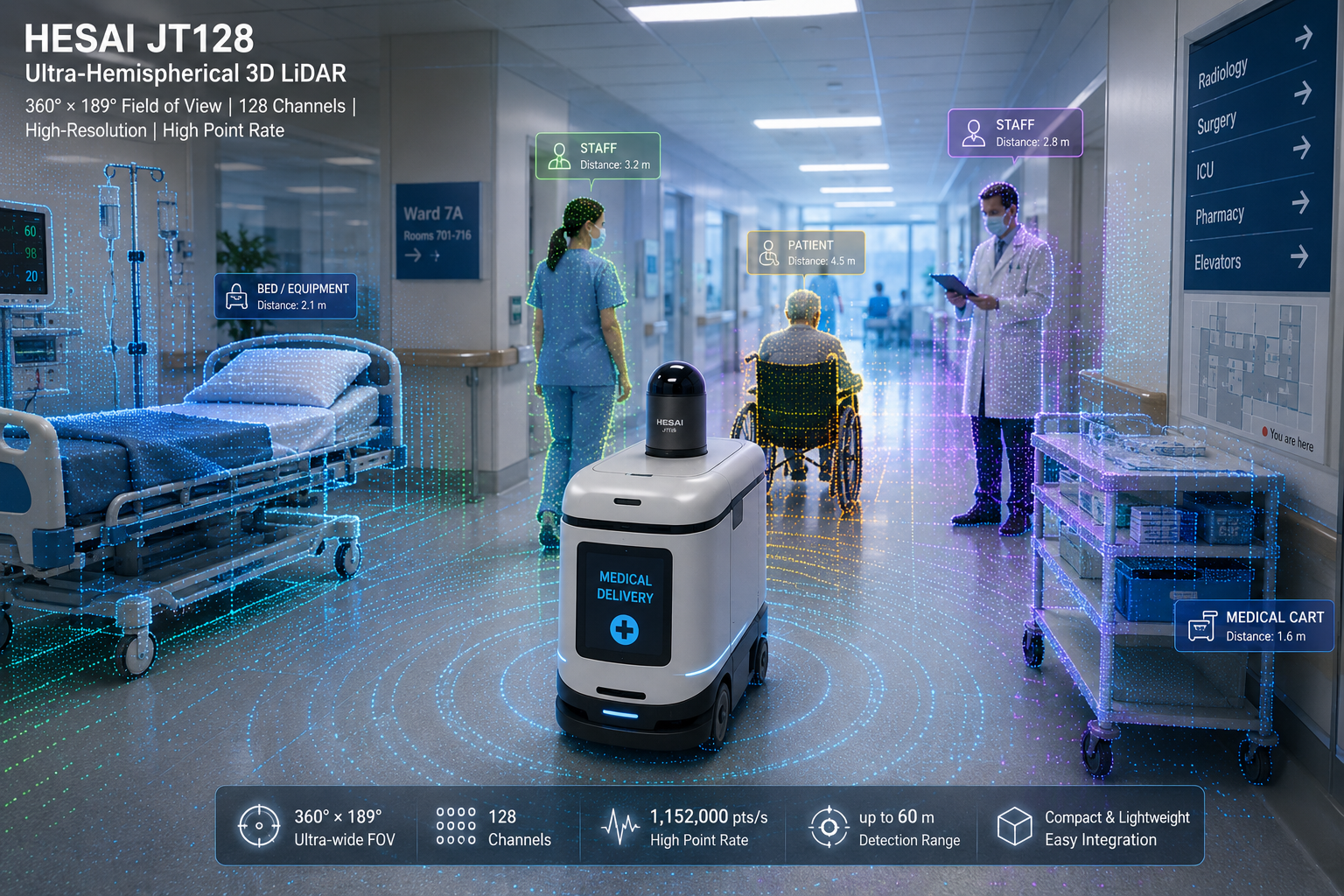
They are suitable for more complex applications such as:
- Autonomous vehicles
- Outdoor robots
- Advanced mobile robots
- Industrial inspection systems
Advantages of 3D LiDAR:
Complete Environmental Understanding
Unlike 2D sensors, 3D LiDAR can detect objects at different heights.
This allows robots to recognize:
- Overhead obstacles
- Uneven terrain
- Complex structures
Better for Advanced Autonomous Systems
3D perception is becoming increasingly important for next-generation robotics.
Applications include:
- Autonomous forklifts
- Outdoor delivery robots
- Agricultural robots
- Construction robots
3. Key Factors When Selecting a LiDAR Sensor for Robots
Choosing a LiDAR sensor requires evaluating technical specifications according to the actual application.
The most important parameters include:
- Detection range
- Accuracy
- Field of view
- Resolution
- Scan frequency
- Environmental protection
- Communication interface
- Software compatibility
4. How to Choose a LiDAR Sensor for AGV and AMR Navigation Systems
Chapter Image Recommendation
Image concept:
A smart warehouse showing different types of autonomous mobile robots:
- Pallet-moving AGV
- AMR picking robot
- Indoor delivery robot
- LiDAR scanning zones around each robot
Include labels showing different requirements:
- Long range detection
- High accuracy positioning
- Safety protection
- Navigation reliability
Image prompt:
“Smart warehouse with different autonomous mobile robots and AGV systems, LiDAR sensors detecting surroundings, industrial automation infographic style, realistic engineering visualization”
Selecting a LiDAR sensor for AGV or AMR systems requires understanding the robot’s operating environment and mission requirements.
Although many LiDAR sensors appear similar from a specification perspective, different applications require different sensing capabilities.
A warehouse transportation robot, for example, may only need reliable indoor navigation, while an outdoor autonomous forklift requires longer detection range and stronger environmental resistance.
Below are the key considerations for AGV and AMR manufacturers.
4.1 Indoor AGV Applications
Indoor AGVs are commonly used in:
- Manufacturing facilities
- Warehouses
- Distribution centers
- Hospitals
- Smart factories
Typical tasks include:
- Material transportation
- Pallet movement
- Assembly line supply
- Inventory handling
For these applications, the most important LiDAR requirements are:
Stable Indoor Detection
Indoor environments usually contain:
- Narrow aisles
- Shelves
- Workers
- Moving objects
The LiDAR sensor should provide stable detection performance in crowded areas.
A suitable sensor should offer:
- Reliable distance measurement
- Wide scanning angle
- Fast response time
High Navigation Accuracy
Many AGVs need to reach specific loading and unloading points.
For example:
A factory AGV transporting components between production lines may need centimeter-level positioning accuracy.
The LiDAR sensor works together with navigation algorithms such as SLAM to improve:
- Position estimation
- Route planning
- Movement stability
Compact Design
Many indoor robots have limited installation space.
Therefore, compact LiDAR sensors are preferred because they allow:
- Flexible mechanical design
- Easier integration
- Lower overall robot size
4.2 AMR Applications
Autonomous Mobile Robots (AMRs) are more flexible than traditional AGVs.
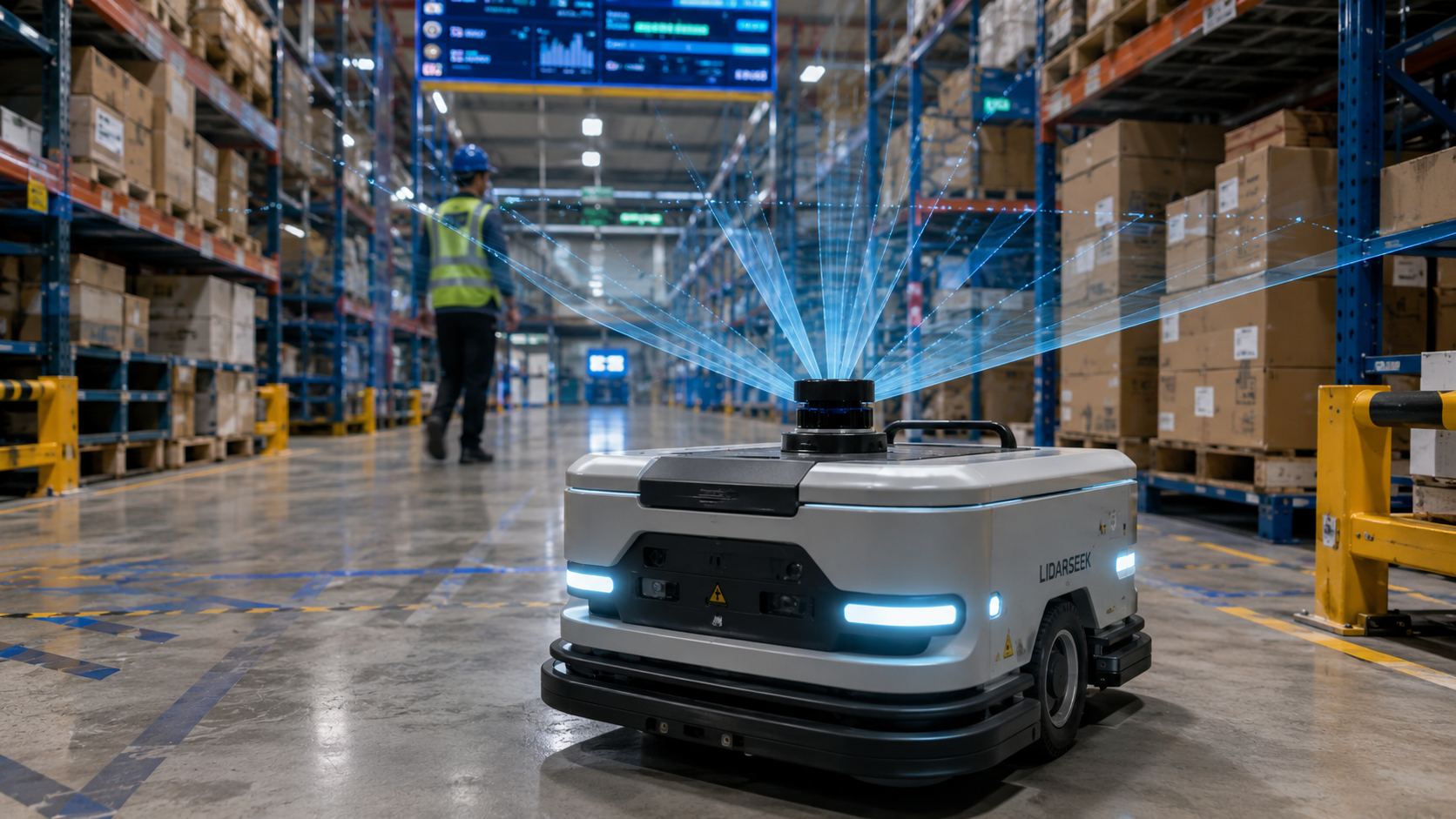
Unlike fixed-path AGVs, AMRs can:
- Create their own routes
- Avoid dynamic obstacles
- Adapt to changing environments
Common AMR applications include:
- Warehouse picking robots
- Logistics robots
- Hospital delivery robots
- Service robots
For AMR systems, LiDAR selection should focus on:
Dynamic Obstacle Handling
AMRs operate in environments where people and objects constantly move.
The LiDAR sensor must quickly detect:
- Walking workers
- Other robots
- Temporary obstacles
High scanning frequency helps robots react faster.
SLAM Compatibility
Most modern AMR systems rely on SLAM algorithms.
When choosing a LiDAR sensor, engineers should check:
- Point cloud quality
- Scan frequency
- Data output format
- Software compatibility
Sensors that integrate smoothly with robotics software can significantly reduce development time.
5. Important LiDAR Specifications Every Buyer Should Understand
Chapter Image Recommendation
Image concept:
A technical specification infographic showing:
- Range
- Accuracy
- Field of view
- Resolution
- Scan frequency
- Communication interface
Image prompt:
“LiDAR sensor specification infographic for robotics engineers, showing detection range, accuracy, field of view, scanning frequency, communication interface, clean technical design”
Many customers focus only on detection range when purchasing LiDAR sensors.
However, range is only one factor.
A professional selection process should evaluate multiple specifications.
5.1 Detection Range
Detection range determines how far the LiDAR sensor can identify objects.
Typical considerations:
Short Range LiDAR
Suitable for:
- Indoor robots
- Small AMRs
- Close-range obstacle avoidance
Advantages:
- Lower cost
- Lower power consumption
- Compact size
Long Range LiDAR
Suitable for:
- Outdoor robots
- Autonomous vehicles
- Large industrial equipment
Advantages:
- Earlier obstacle detection
- Better performance in large environments
The correct range depends on:
- Robot speed
- Working environment
- Safety requirements
A faster robot generally requires longer detection distance because it needs more time to react.
5.2 Accuracy and Measurement Stability
Accuracy determines how precisely the sensor measures distance.
For navigation applications, stable measurement is often more important than maximum theoretical accuracy.
Factors affecting LiDAR accuracy include:
- Surface reflection
- Lighting conditions
- Temperature changes
- Installation angle
Industrial customers should evaluate sensor performance under real operating conditions.
5.3 Field of View (FOV)
Field of view describes the area covered by the LiDAR sensor.
A wider FOV allows robots to observe more of their surroundings.
Examples:
Narrow FOV
Suitable for:
- Directional detection
- Specific inspection tasks
Wide FOV
Suitable for:
- Mobile robot navigation
- Obstacle avoidance
- Warehouse applications
5.4 Scan Frequency
Scan frequency determines how quickly the LiDAR updates environmental information.
Higher scanning frequency helps:
- Moving robots respond faster
- Improve obstacle avoidance
- Maintain navigation stability
For high-speed AGVs and AMRs, scan frequency should be carefully considered.
5.5 Communication Interface
Before purchasing a LiDAR sensor, engineers should confirm compatibility with their control system.
Common interfaces include:
- Ethernet
- UART
- CAN
- USB
Software compatibility is also important.
Many robotics developers prefer sensors that support:
- ROS
- ROS2
- SDK integration
- Open communication protocols
6. LiDAR Sensor Selection Based on Robot Application
Application Comparison Table
| Application | Recommended LiDAR Type | Key Requirements |
|---|---|---|
| Indoor AGV | 2D LiDAR | Stable navigation, cost efficiency |
| Warehouse AMR | 2D/3D LiDAR | SLAM compatibility, obstacle avoidance |
| Autonomous forklift | 3D LiDAR | Long range, complex environment perception |
| Outdoor delivery robot | 3D LiDAR | Weather resistance, dynamic detection |
| Inspection robot | 3D LiDAR | High-resolution point clouds |
| Service robot | Compact 2D LiDAR | Small size, reliable navigation |
7. Why Robotics Companies Should Consider LiDAR Early in Product Development
Chapter Image Recommendation
Image concept:
Engineering team developing a robot prototype:
- CAD model on computer
- LiDAR sensor mounted on robot
- Engineers testing navigation
Image prompt:
“Robotics engineers developing autonomous robot prototype with LiDAR sensor integration, laboratory environment, engineering development process, realistic technology image”
For robot manufacturers, selecting LiDAR during the early design stage provides several advantages.
Faster Product Development
Choosing the right sensor early helps avoid:
- Mechanical redesign
- Software compatibility issues
- Navigation performance problems
Better System Optimization
LiDAR performance affects:
- Robot movement
- Safety systems
- Navigation algorithms
- User experience
Early testing allows engineers to optimize the entire system.
Easier Mass Production
For commercial robots, sensor supply stability is critical.
Manufacturers should consider:
- Production capacity
- Quality control
- Long-term availability
- Technical support
A reliable LiDAR supplier becomes an important partner during product scaling.
8. How to Evaluate a LiDAR Sensor Supplier
When selecting a LiDAR supplier, companies should evaluate more than technical specifications.
Important supplier factors include:
Product Portfolio
A supplier offering multiple LiDAR solutions can better support different applications.
Examples:
- 2D LiDAR
- 3D LiDAR
- Solid-state LiDAR
- Industrial LiDAR solutions
Engineering Support
Robotics projects often require customization.
A professional supplier should provide:
- Technical consultation
- Integration guidance
- Sample testing support
- Application recommendations
Quality and Certification
Industrial customers should check:
- Product reliability
- Manufacturing quality
- Environmental testing
- Certifications
Reliable quality reduces development risks and maintenance costs.
Long-Term Partnership Capability
For companies planning commercial production, supplier stability matters.
Important questions include:
- Can the supplier support volume orders?
- Are replacement units available?
- Can firmware/software support continue?
- Is technical communication efficient?
9. Frequently Asked Questions About LiDAR Sensors for Robots
Q1: Is LiDAR better than cameras for autonomous robots?
LiDAR and cameras serve different purposes.
Cameras provide visual information such as:
- Color
- Texture
- Object recognition
LiDAR provides accurate distance measurement and 3D spatial information.
Many advanced robots combine both technologies.
Q2: What LiDAR is best for AGV navigation?
For most indoor AGV applications, 2D LiDAR provides an effective balance between:
- Performance
- Reliability
- Cost
However, complex environments may require 3D LiDAR.
Q3: Can LiDAR sensors work with ROS?
Many LiDAR sensors support integration with ROS-based robotic platforms.
Before selection, developers should confirm:
- ROS driver availability
- Data format
- SDK documentation
Q4: How do I select the right LiDAR sensor for my robot project?
The best approach is to evaluate:
- Robot type
- Operating environment
- Required range
- Navigation method
- Integration requirements
- Production goals
Conclusion: Choosing the Right LiDAR Sensor Builds Better Autonomous Robots
LiDAR technology has become a fundamental sensing solution for modern autonomous robots, AGVs, and AMRs.
However, the best LiDAR sensor is not necessarily the one with the highest specifications.
The right choice depends on matching sensor capabilities with application requirements.
Before purchasing, robotics companies should carefully evaluate:
- Detection requirements
- Navigation accuracy
- Environmental conditions
- Software compatibility
- Supplier support
By selecting the appropriate LiDAR solution, robot manufacturers can achieve:
- More reliable navigation
- Faster product development
- Better operational performance
- Lower integration risks
Need Help Selecting a LiDAR Sensor for Your Robot Project?
Choosing the right sensor can significantly impact your robot’s performance.
Our engineering team can help you evaluate:
- Robot application requirements
- Suitable LiDAR models
- Integration methods
- Prototype testing solutions
Contact us today to discuss your autonomous robot, AGV, or AMR LiDAR requirements.
Get professional LiDAR sensor recommendations for your project.









