
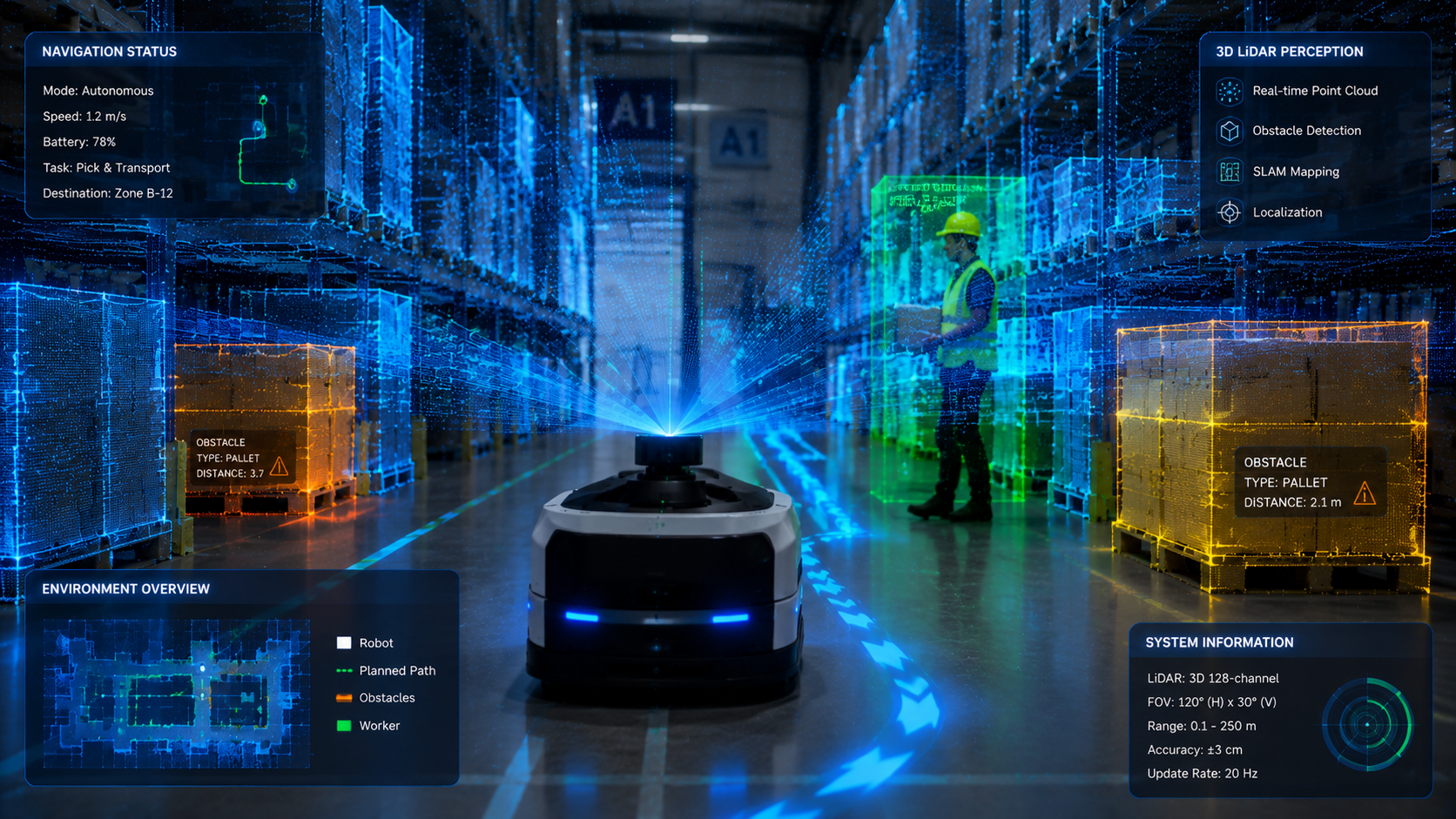
Best LiDAR Sensor for AMR Robots in 2026: Complete Selection Guide
Autonomous Mobile Robots (AMRs) are transforming warehouses, factories, and logistics operations by enabling flexible and intelligent material transportation. Unlike traditional AGVs that rely on fixed paths, AMRs use advanced perception technologies to understand their environment, avoid obstacles, and navigate dynamically.
Among all perception sensors, LiDAR (Light Detection and Ranging) has become one of the most important technologies for AMR navigation because it provides accurate distance measurement, reliable environmental perception, and stable performance in different lighting conditions.
In 2026, choosing the right LiDAR sensor for an AMR robot has become more complex. Engineers must consider:
- Navigation requirements
- Detection range
- Field of view
- Point cloud density
- SLAM compatibility
- ROS support
- Cost efficiency
- Industrial reliability
This guide explains how to select the best LiDAR sensor for AMR robots and introduces suitable LiDAR solutions for warehouse automation, industrial robots, and autonomous systems.
Table of Contents
- What Is an AMR LiDAR Sensor?
- Why Do AMR Robots Need LiDAR?
- 2D LiDAR vs 3D LiDAR for AMR Navigation
- Key Parameters When Choosing LiDAR for AMR Robots
- Best LiDAR Sensor Types for Different AMR Applications
- Recommended LiDAR Sensors for AMR Robots in 2026
- How LiDAR Improves Warehouse Automation
- LiDAR Integration With ROS and SLAM
- Future Trends of AMR LiDAR Technology
- Frequently Asked Questions
What Is an AMR LiDAR Sensor?
An AMR LiDAR sensor is a perception device that allows autonomous mobile robots to measure distances and create a detailed understanding of their surroundings.
LiDAR works by emitting laser pulses and measuring the return time after the laser reflects from objects. The collected measurements generate point clouds that robots use for:
- Mapping
- Localization
- Obstacle detection
- Collision avoidance
- Path planning
Modern AMRs typically combine LiDAR with other technologies including:
- Cameras
- IMU sensors
- Encoders
- AI perception systems
For industrial environments, LiDAR remains a preferred solution because it provides accurate spatial information without depending heavily on ambient lighting conditions.
Why Do AMR Robots Need LiDAR?
AMR robots operate in environments where conditions constantly change:
- Workers walking nearby
- Moving forklifts
- Changing inventory layouts
- Temporary obstacles
- Dynamic warehouse environments
Traditional navigation methods based on fixed routes cannot handle these changes efficiently.
LiDAR enables AMRs to achieve:
1. Real-Time Obstacle Detection
AMRs can detect:
- People
- Pallets
- Machines
- Boxes
- Other robots
This improves operational safety in factories and warehouses.
2. Autonomous Navigation
Using LiDAR-based SLAM (Simultaneous Localization and Mapping), robots can:
- Build maps automatically
- Determine their position
- Plan optimal routes
3. High-Precision Localization
Industrial AMRs require centimeter-level positioning accuracy for:
- Material delivery
- Docking
- Charging
- Machine interaction
2D LiDAR vs 3D LiDAR for AMR Robots
One of the most common questions from robotics engineers is:
Should I choose 2D LiDAR or 3D LiDAR for my AMR robot?
2D LiDAR
2D LiDAR scans a single horizontal plane.
Advantages:
✓ Lower cost
✓ Simple integration
✓ Low processing requirements
✓ Suitable for indoor navigation
Applications:
- Warehouse AMR
- AGV navigation
- Indoor delivery robots
3D LiDAR
3D LiDAR captures three-dimensional point clouds.
Advantages:
✓ Full environmental perception
✓ Detects objects at different heights
✓ Better for complex environments
✓ Supports advanced AI perception
Applications:
- Outdoor AMR
- Autonomous forklifts
- Heavy industrial robots
- Mobile manipulation robots
Comparison Table
| Feature | 2D LiDAR | 3D LiDAR |
|---|---|---|
| Dimension | Single plane | 3D point cloud |
| Cost | Lower | Higher |
| Data volume | Low | High |
| Obstacle detection | Basic | Advanced |
| SLAM capability | Good | Excellent |
| Industrial flexibility | Medium | High |
For simple indoor warehouse robots, 2D LiDAR may be sufficient. However, many next-generation AMRs are moving toward 3D LiDAR because robots require richer environmental understanding.
Key Parameters When Choosing LiDAR for AMR Robots
Choosing a LiDAR sensor should not only depend on price. Engineers should evaluate the following specifications.
1. Detection Range
The required range depends on robot speed and environment.
Typical applications:
| Application | Recommended Range |
|---|---|
| Indoor AMR | 20-50m |
| Warehouse robot | 50-100m |
| Outdoor logistics robot | 100m+ |
Longer detection range allows robots to:
- Detect obstacles earlier
- Improve path planning
- Increase operating speed
2. Field of View (FOV)
A wide FOV allows robots to understand more of their surroundings.
Important values:
- Horizontal FOV
- Vertical FOV
For AMR navigation:
360° scanning is ideal because robots need complete environmental awareness.
3. Point Cloud Density
Higher point density improves recognition of:
- Small obstacles
- Human legs
- Narrow objects
For advanced AMR applications, high-resolution 3D LiDAR provides better perception performance.
4. ROS Compatibility
Most robotics developers use ROS or ROS 2.
A suitable AMR LiDAR should support:
- ROS drivers
- SDK integration
- Point cloud output
- Ethernet communication
Recommended LiDAR Sensors for AMR Robots in 2026
Hesai XT32 LiDAR
The Hesai XT32 is a high-performance 3D LiDAR suitable for robotics, mapping, and industrial automation applications.
Key advantages:
- 32-channel scanning
- 360° horizontal field of view
- High-resolution point cloud
- Long-range detection capability
Hesai lists XT32 as a high-precision 360° mid-range LiDAR with applications including robotics and warehouse automation.
Recommended applications:
✓ Autonomous robots
✓ Warehouse AMR
✓ Industrial inspection robots
✓ Mapping robots
RoboSense LiDAR Solutions
RoboSense provides various LiDAR sensors designed for robotics and autonomous applications.
Suitable applications:
- AMR navigation
- Industrial automation
- Autonomous vehicles
- Smart logistics
Livox MID-360
Livox MID-360 is a compact 3D LiDAR option suitable for robotics developers requiring:
- Lightweight design
- 3D perception
- SLAM applications
How LiDAR Improves Warehouse Automation
Modern warehouses require robots that can work safely around humans and other machines.
LiDAR enables:
Dynamic Navigation
Robots can automatically adjust routes when:
- A worker blocks the path
- Inventory changes
- Another robot approaches
Improved Safety
LiDAR-based perception helps AMRs maintain safe distances and avoid collisions.
Higher Efficiency
With accurate navigation, AMRs can:
- Reduce travel time
- Optimize routes
- Operate continuously
Warehouse and logistics environments are among the fastest-growing applications for industrial LiDAR because they require reliable perception and autonomous movement.
LiDAR Integration With ROS and SLAM
Most AMR developers integrate LiDAR with:
- ROS
- ROS 2
- SLAM algorithms
- Navigation stacks
Common software systems:
- Cartographer
- SLAM Toolbox
- Nav2
A complete AMR perception system usually includes:
LiDAR Sensor
↓
Point Cloud Processing
↓
SLAM Mapping
↓
Navigation Planning
↓
Robot Motion Control
Future Trends of AMR LiDAR Technology in 2026
The future development direction includes:
1. Higher Resolution LiDAR
Robots will require more detailed perception for:
- AI navigation
- Human interaction
- Object recognition
2. AI-Based Sensor Fusion
Future AMRs will combine:
- LiDAR
- Camera
- AI algorithms
- Edge computing
3. Smaller and More Affordable Sensors
Compact LiDAR will accelerate adoption in:
- Service robots
- Delivery robots
- Small autonomous platforms
Frequently Asked Questions (FAQ)
1. What is the best LiDAR sensor for AMR robots?
The best LiDAR depends on the application. For industrial AMRs, 3D LiDAR sensors such as Hesai XT32, RoboSense LiDAR, and Livox MID-360 are commonly considered for advanced perception requirements.
2. Is 2D LiDAR enough for warehouse robots?
For simple indoor navigation, 2D LiDAR can be sufficient. However, 3D LiDAR provides better obstacle detection and environmental understanding.
3. Why do AMRs use LiDAR instead of cameras?
LiDAR provides accurate distance measurement and works reliably under different lighting conditions.
4. Does LiDAR support ROS?
Most industrial LiDAR sensors provide ROS drivers or SDK support for robotics development.
5. How much range does an AMR LiDAR need?
Indoor AMRs usually require 20-50m detection range, while outdoor or high-speed robots may require longer range.
6. Can LiDAR be used for warehouse automation?
Yes. LiDAR is widely used for warehouse AMRs, autonomous forklifts, and logistics robots.
7. What is the difference between AMR and AGV?
AGVs usually follow predefined routes, while AMRs can dynamically navigate using sensors such as LiDAR.
8. Is 3D LiDAR expensive for robotics?
3D LiDAR costs more than 2D LiDAR but provides significantly richer perception data.
9. Which LiDAR is best for SLAM?
3D LiDAR sensors with high point density and 360° scanning are often preferred for SLAM applications.
10. How can I choose the right LiDAR for my robot?
Consider:
- Environment
- Required range
- Accuracy
- FOV
- Software compatibility
- Budget
Conclusion: Choosing the Right AMR LiDAR Sensor
Selecting the best LiDAR sensor for AMR robots requires balancing performance, reliability, integration requirements, and application needs.
For modern autonomous robots in 2026, LiDAR remains a critical perception technology that enables safer navigation, smarter decision-making, and higher automation efficiency.
Whether you are developing:
- Warehouse AMRs
- Industrial robots
- Autonomous vehicles
- Service robots
choosing the right LiDAR solution can significantly improve your robot’s performance.
Need help selecting an AMR LiDAR sensor?
Our engineering team can recommend the most suitable LiDAR solution based on your robot application.









