
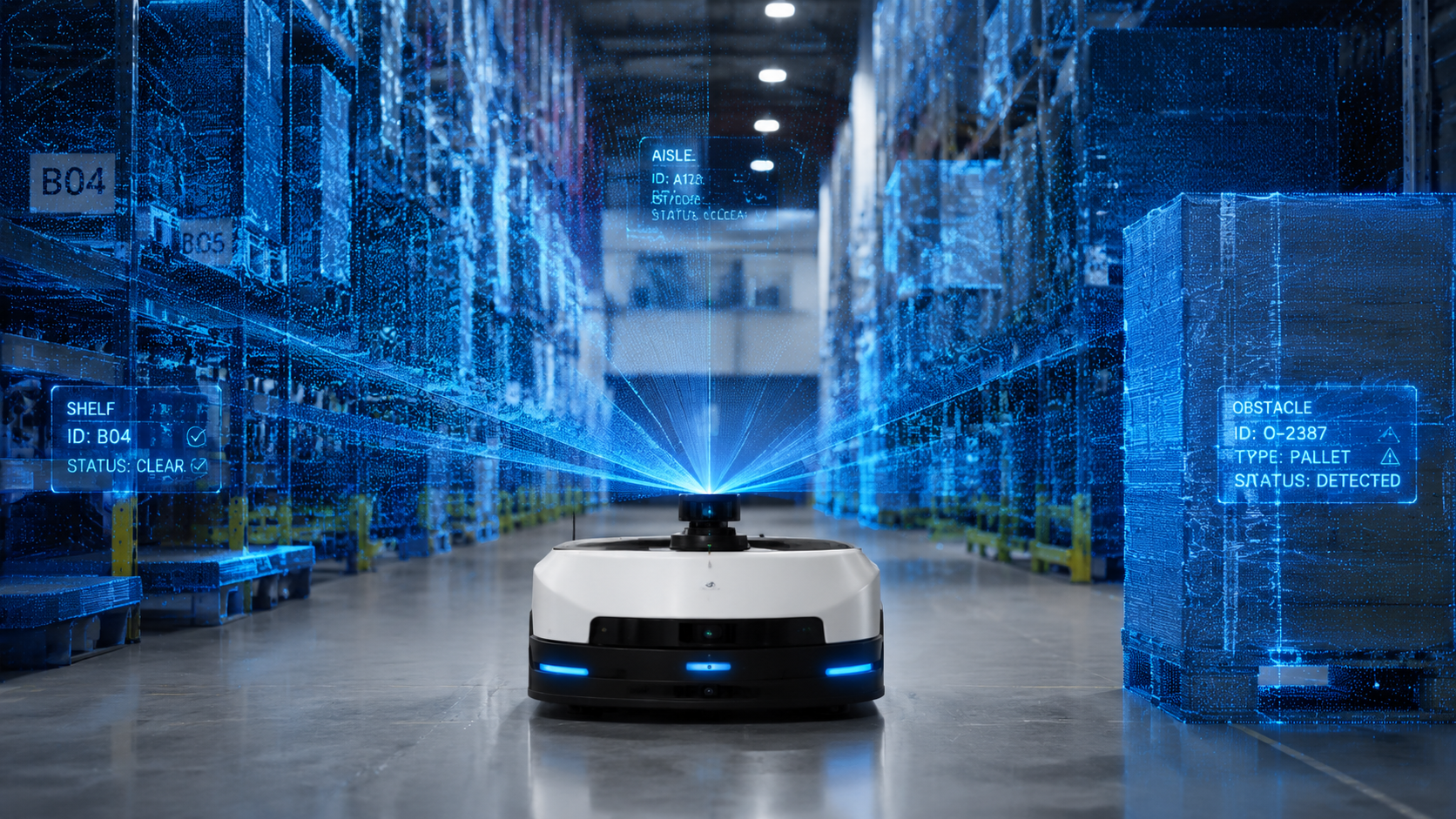
How to Choose a 3D LiDAR Sensor for Autonomous Robots
Autonomous robots are becoming increasingly important in industries such as warehouse automation, manufacturing, logistics, agriculture, inspection, and service robotics.
To operate safely and efficiently, robots need reliable perception systems that allow them to understand their surroundings, detect obstacles, and make intelligent navigation decisions.
Among different perception technologies, 3D LiDAR sensors have become one of the most widely used solutions for autonomous robots because they provide accurate distance measurement and real-time three-dimensional environmental information.
However, selecting the right 3D LiDAR sensor is not always easy.
Different robot applications require different specifications:
- Indoor or outdoor operation
- Short-range or long-range detection
- High-resolution mapping or simple obstacle avoidance
- Low-cost deployment or industrial-grade performance
This guide explains the most important factors engineers should consider when choosing a 3D LiDAR sensor for autonomous robots in 2026.
Table of Contents
- What Is a 3D LiDAR Sensor?
- Why Do Autonomous Robots Need 3D LiDAR?
- Key Factors When Choosing a 3D LiDAR Sensor
- Understanding Important LiDAR Specifications
- 3D LiDAR Applications in Robotics
- Mechanical LiDAR vs Solid-State LiDAR
- Recommended 3D LiDAR Sensors for Autonomous Robots
- How to Integrate LiDAR With ROS and SLAM
- Common Mistakes When Selecting LiDAR
- FAQ
What Is a 3D LiDAR Sensor?
A 3D LiDAR sensor is an advanced perception device that uses laser pulses to measure the distance between the sensor and surrounding objects.
By collecting thousands or millions of distance measurements, the sensor generates a 3D point cloud representing the surrounding environment.
A typical 3D LiDAR system includes:
- Laser transmitter
- Optical receiver
- Scanning mechanism
- Processing unit
- Communication interface
The generated point cloud allows autonomous robots to understand:
- Object distance
- Object shape
- Environmental structure
- Robot position
Compared with traditional sensors, 3D LiDAR provides accurate spatial information even in challenging lighting conditions.
Why Do Autonomous Robots Need 3D LiDAR?
Modern autonomous robots operate in complex and dynamic environments.
Examples include:
- Warehouse robots moving between shelves
- Inspection robots working in factories
- Delivery robots operating outdoors
- Autonomous vehicles navigating roads
3D LiDAR helps robots achieve:
1. Environmental Perception
Robots can detect:
- Humans
- Vehicles
- Equipment
- Obstacles
- Buildings
The three-dimensional point cloud provides richer information than traditional 2D sensors.
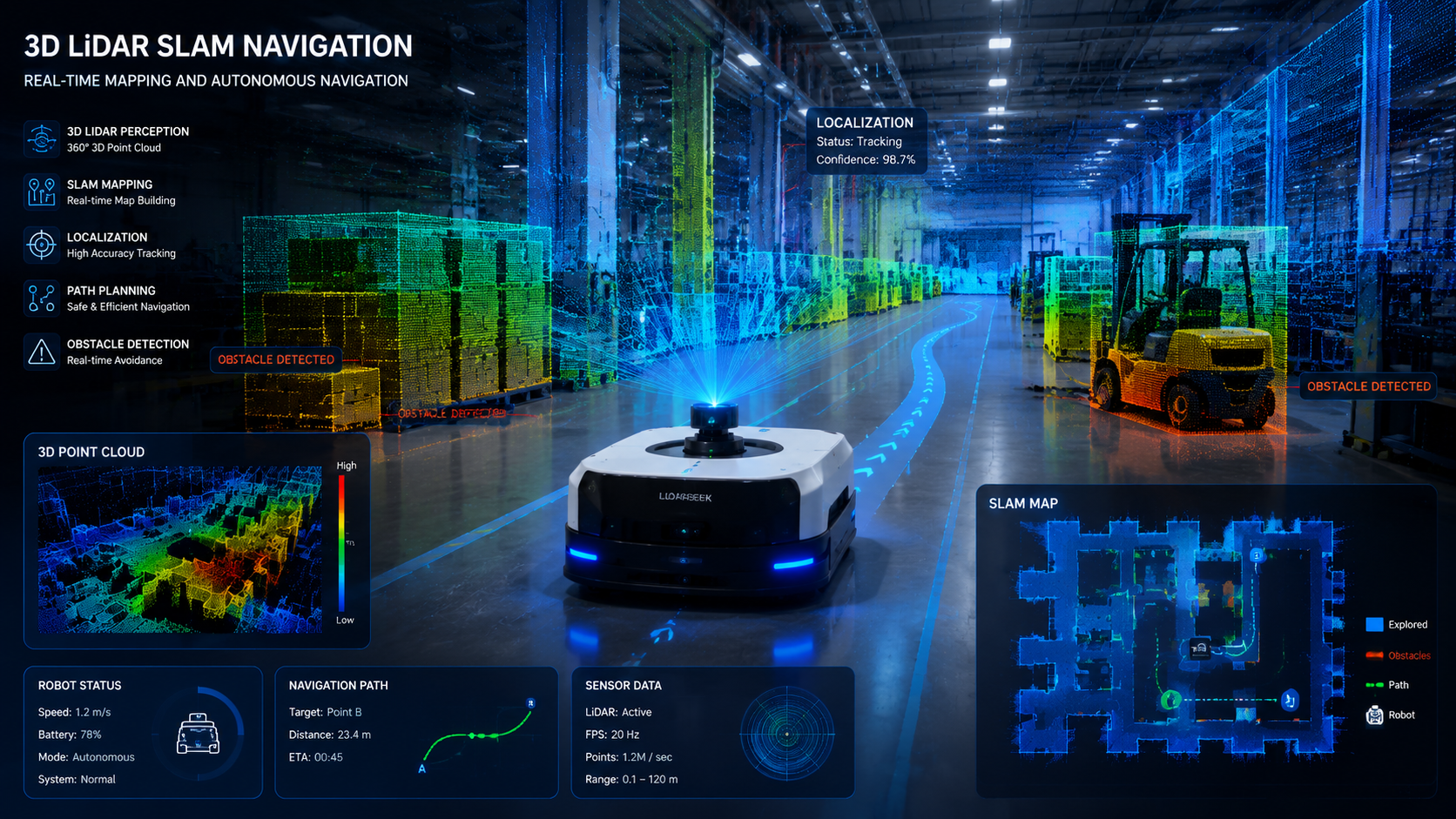
2. SLAM Navigation
SLAM (Simultaneous Localization and Mapping) is a key technology for autonomous robots.
Using LiDAR data, robots can:
- Build maps
- Locate themselves
- Calculate movement paths
- Navigate autonomously
3. Obstacle Avoidance
Unlike cameras that depend on lighting conditions, LiDAR directly measures distance.
This allows robots to detect obstacles:
- Day or night
- Indoor or outdoor
- Low light environments
Key Factors When Choosing a 3D LiDAR Sensor
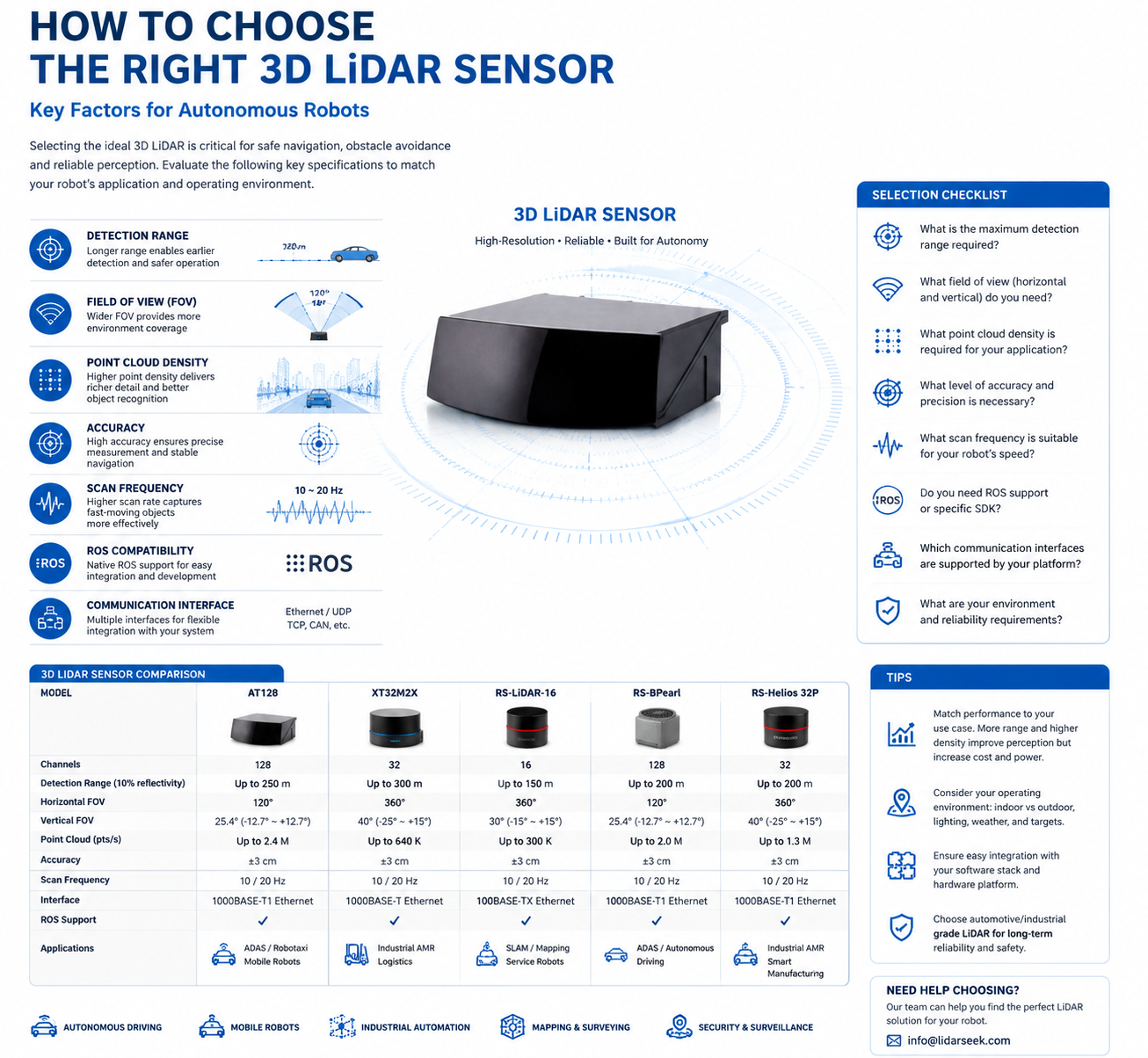
Choosing a LiDAR sensor requires understanding the actual robot application.
The most important factors include:
1. Detection Range
Detection range determines how far the robot can perceive objects.
Different applications require different ranges.
| Application | Recommended Range |
|---|---|
| Indoor service robot | 10-30m |
| Warehouse AMR | 30-100m |
| Outdoor autonomous robot | 100m+ |
| Mapping robot | 100m+ |
A longer range allows robots to:
- Detect obstacles earlier
- Increase operation speed
- Improve safety
However, longer range does not always mean better.
A warehouse robot moving slowly may not need a 200m LiDAR sensor.
Engineers should select range based on actual operating conditions.
2. Field of View (FOV)
Field of view determines how much of the environment the LiDAR can observe.
Important parameters:
Horizontal FOV
Shows the coverage around the robot.
For mobile robots:
360° horizontal scanning is often preferred.
Vertical FOV
Determines the ability to detect objects at different heights.
This is especially important for:
- Uneven environments
- Outdoor robots
- Autonomous vehicles
A wider vertical FOV helps robots detect:
- Low obstacles
- Hanging objects
- Different terrain conditions
3. Point Cloud Density and Resolution
Point cloud density directly affects perception quality.
Higher resolution allows robots to recognize:
- Small objects
- Narrow obstacles
- Complex structures
High-density LiDAR is useful for:
- Autonomous driving
- Mapping
- Industrial inspection
- Advanced robotics
Lower-resolution LiDAR may be sufficient for:
- Basic navigation
- Simple indoor robots
4. Accuracy and Precision
Accuracy determines how close the measured distance is to the actual distance.
Precision determines measurement consistency.
For robotics applications, high accuracy improves:
- Localization
- Mapping
- Navigation
- Object detection
Industrial robots often require stable performance over long operating periods.
5. Scan Frequency
Scan frequency refers to how quickly the LiDAR updates environmental information.
Higher scan frequency is important for:
- Fast-moving robots
- Outdoor platforms
- Dynamic environments
Example:
A slow warehouse robot may work well with a lower scan frequency.
A high-speed autonomous vehicle requires faster updates.
6. Communication Interface
Before purchasing a LiDAR sensor, check compatibility with your robot system.
Common interfaces include:
- Ethernet
- CAN
- USB
- Serial communication
For industrial robots, Ethernet is commonly preferred because it supports:
- High data transmission
- Stable communication
- Long-distance connection
7. ROS and SDK Support
Software compatibility is one of the most important considerations.
A good robotics LiDAR should support:
- ROS
- ROS 2
- SDK development
- Point cloud output
Popular robotics software platforms:
- ROS Navigation Stack
- Nav2
- SLAM Toolbox
- Cartographer
Mechanical LiDAR vs Solid-State LiDAR
When selecting a 3D LiDAR sensor, engineers often compare mechanical and solid-state technologies.
Mechanical LiDAR
Mechanical LiDAR uses rotating components to achieve wide scanning coverage.
Advantages:
✓ 360° perception
✓ Mature technology
✓ High measurement performance
Applications:
- Autonomous vehicles
- Mapping robots
- Industrial robots
Example:
Hesai XT32
Solid-State LiDAR
Solid-state LiDAR has fewer moving components.
Advantages:
✓ Compact size
✓ Better durability
✓ Easier integration
Applications:
- Compact robots
- Consumer robotics
- Embedded systems
Recommended 3D LiDAR Sensors for Autonomous Robots in 2026
Hesai XT32
The Hesai XT32 is a 32-channel 3D LiDAR designed for robotics, mapping, and autonomous applications.
Key features:
- 32-channel scanning
- 360° horizontal FOV
- High-resolution point cloud
- Long-range perception
Suitable for:
✓ AMR robots
✓ Industrial automation
✓ Mapping systems
✓ Autonomous platforms
RoboSense LiDAR Solutions
RoboSense provides 3D LiDAR sensors for:
- Autonomous robots
- Industrial automation
- Smart logistics
- Autonomous driving
Advantages:
- High-resolution perception
- Advanced point cloud performance
- Industrial reliability
Livox MID-360
Livox MID-360 is a compact 3D LiDAR designed for robotics developers.
Advantages:
- Lightweight design
- 3D perception
- SLAM applications
- Easy integration
Suitable for:
- Mobile robots
- Research platforms
- Service robots
How to Integrate 3D LiDAR With ROS and SLAM
A typical autonomous robot perception system works as follows:
3D LiDAR Sensor

↓

Point Cloud Data

↓

SLAM Algorithm

↓

Map Generation

↓

Path Planning

↓

Robot Motion Control
The LiDAR sensor provides environmental information while software algorithms transform the data into navigation decisions.
Common Mistakes When Selecting a 3D LiDAR Sensor
1. Choosing Only Based on Price
The cheapest sensor may not provide:
- Required accuracy
- Software support
- Long-term reliability
2. Ignoring Software Compatibility
A powerful LiDAR is useless if it cannot integrate with the robot platform.
3. Selecting Excessive Performance
Not every robot needs an automotive-grade LiDAR.
Choose based on:
- Speed
- Environment
- Detection requirements
Frequently Asked Questions (FAQ)
1. What is the best 3D LiDAR sensor for autonomous robots?
The best sensor depends on the application. Hesai XT32, RoboSense LiDAR, and Livox MID-360 are commonly used solutions for different robotics requirements.
2. How much does a 3D LiDAR sensor cost?
The cost depends on specifications including range, resolution, channels, and application requirements.
3. Is 3D LiDAR better than cameras for robots?
3D LiDAR provides accurate distance measurement, while cameras provide visual information. Many advanced robots combine both technologies.
4. Does LiDAR work in darkness?
Yes. LiDAR measures distance using laser pulses and does not rely on visible light.
5. What LiDAR is best for SLAM?
3D LiDAR sensors with high point density and wide FOV are commonly used for SLAM applications.
6. Can LiDAR be used outdoors?
Yes. Many industrial 3D LiDAR sensors are designed for outdoor robotics and autonomous vehicles.
7. What FOV does an autonomous robot need?
Many mobile robots benefit from 360° horizontal coverage for complete environmental awareness.
8. Does ROS support 3D LiDAR?
Most robotics LiDAR manufacturers provide ROS drivers or SDK support.
9. How many channels does a robot LiDAR need?
The required channel number depends on the application. Higher channels generally provide denser point clouds.
10. How do I choose the right LiDAR supplier?
Consider:
- Product reliability
- Technical support
- Software ecosystem
- Delivery capability
- Engineering experience
Conclusion
Selecting the right 3D LiDAR sensor is a critical decision when developing autonomous robots.
Engineers should evaluate:
- Detection range
- Field of view
- Resolution
- Accuracy
- Software compatibility
- Application requirements
For AMRs, industrial robots, and autonomous systems, high-quality 3D LiDAR provides the perception foundation required for safe and intelligent operation.
Need help selecting a 3D LiDAR sensor for your robot project?
LidarSeek provides professional LiDAR recommendations for robotics developers, system integrators, and industrial customers worldwide.
Get a Free LiDAR Recommendation →









