
Introduction
Buying LiDAR for a robotics or autonomous vehicle project is very different from buying a standard electronic component.
A LiDAR sensor affects the entire perception architecture.
It can influence:
- Mechanical design
- Computing requirements
- Software development
- Power consumption
- Calibration
- Navigation
- Sensor fusion
- Product cost
For this reason, purchasing decisions should be based on the complete system rather than a single specification.
The Seyond Robin family is particularly interesting because its sensors cover different perception requirements, from wide-angle sensing to compact forward-facing perception.
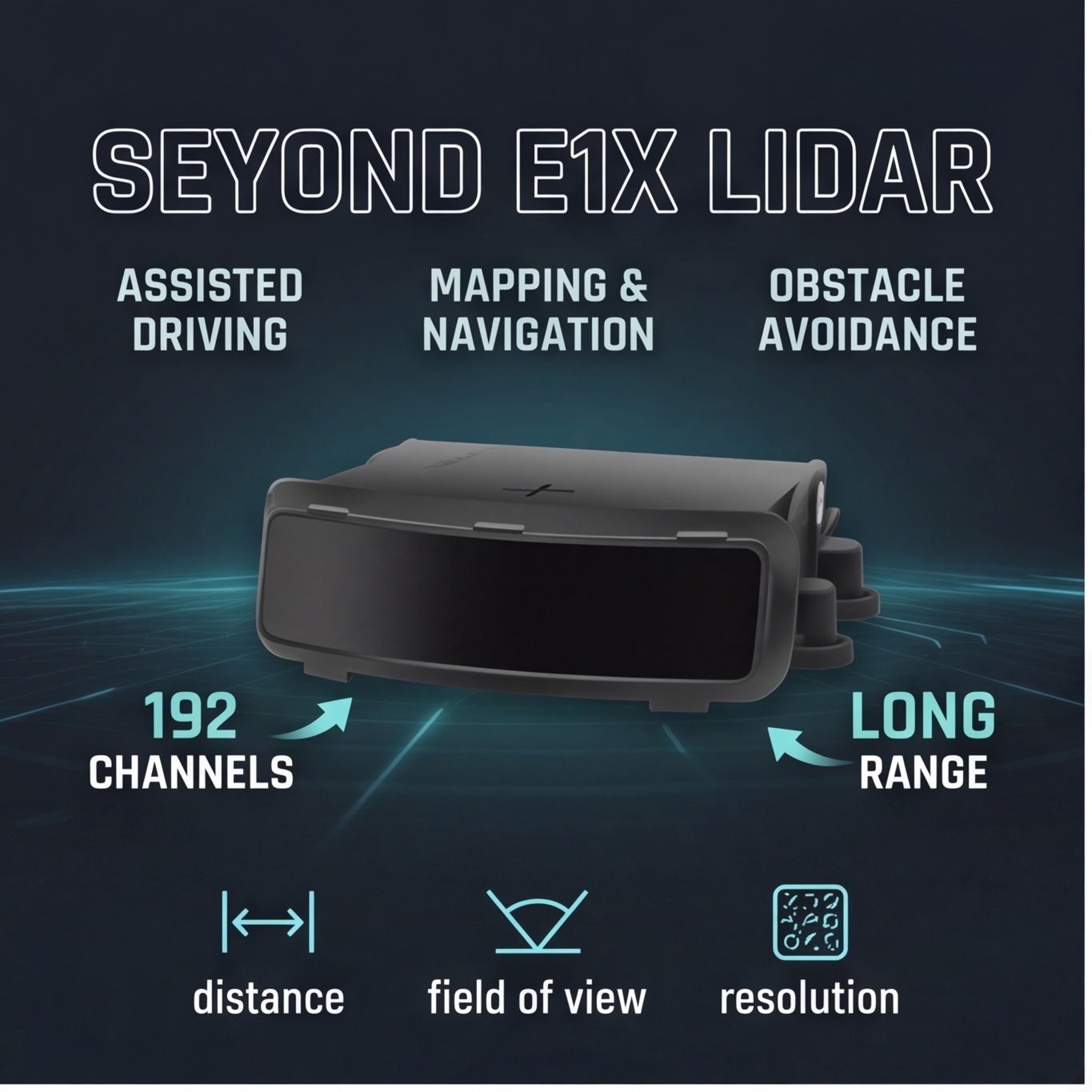
LidarSeek currently lists the Robin W and Robin E1X with displayed prices around $1,725 each, although prices may change according to inventory, promotions and quantity.
This guide explains how buyers should evaluate Robin LiDAR sensors before placing an order.
The objective is not to create another product comparison.
Instead, the focus is on procurement strategy, technical evaluation, sample testing and total project cost.
1. Start With the Application
The first question should never be:
“Which LiDAR is cheapest?”
The first question should be:
“What does my robot or vehicle need to perceive?”
Different applications require different sensing architectures.
For example:
Warehouse AMR
Priority may be:
- Wide FOV
- Near-field detection
- Low power
- Compact design
Outdoor Autonomous Robot
Priority may include:
- Longer forward range
- Environmental robustness
- Dynamic-object detection
Autonomous Vehicle
Priority may include:
- Forward detection
- High resolution
- Sensor fusion
- Automotive integration
Industrial AGV
Priority may include:
- Obstacle detection
- Wide coverage
- Reliability
- Production cost
Application requirements should therefore come before product selection.
2. Define the Required Detection Range
Range is one of the most visible LiDAR specifications.
But buyers should avoid selecting based solely on the maximum number.
A professional specification sheet may include:
- Maximum range
- Range at 10% reflectivity
- Range accuracy
- Minimum range
These values describe different aspects of performance.
For example, Robin W is currently listed at approximately 0.1–150 meters, with 70 meters at 10% reflectivity.
Robin E1X is described as a 200-meter-class sensor at 10% reflectivity, with maximum range figures depending on the specification section.
This illustrates why buyers should understand the meaning behind the numbers.
3. Determine the Field of View
Field of view can be more important than range.
Ask:
Do I need forward perception or broad environmental coverage?
A forward perception system may prioritize horizontal coverage ahead of the vehicle.
A mobile robot may need greater side and vertical awareness.
Robin W is listed with a 120° × 70° FOV, making wide-angle perception one of its most distinctive characteristics.
Robin E1X is listed with 120° × 20°, representing a different perception geometry.
The key procurement lesson is simple:
Choose the FOV based on the environment, not based on which number looks larger.
4. Understand the Minimum Detection Distance
Minimum range is often ignored.
That can be a mistake for small robots.
A robot may operate very close to:
- People
- Shelves
- Pallets
- Walls
- Machines
If the LiDAR cannot measure nearby objects effectively, the perception system may need additional sensors.
Robin W’s listed minimum detection distance of approximately 0.1 meter makes near-field perception an important part of its application profile.
When purchasing, always ask:
What is the practical blind zone under my installation conditions?
5. Evaluate Angular Resolution
Angular resolution affects spatial detail.
It can influence the ability to distinguish:
- Narrow objects
- Adjacent objects
- Edges
- Structural details
Robin W is described with resolution around 0.13° × 0.36° in the detailed parameters, while the product overview emphasizes resolution up to approximately 0.1° × 0.36°.
Robin E1X is described with 0.1°-class resolution.
Again, buyers should verify the exact operating configuration before placing a large order.
6. Point Rate Is Not Everything
A higher point rate sounds better.
But more points also mean more data.
This can increase:
- CPU/GPU usage
- Network bandwidth
- Storage requirements
- Processing latency
Therefore, point rate should be evaluated together with the computing system.
For example, a robotics platform using an NVIDIA Jetson may have a different optimal LiDAR configuration from a vehicle using a dedicated automotive compute platform.
The correct question is:
Can my computing architecture process the LiDAR data fast enough?
7. Consider Frame Rate
Frame rate determines how frequently the LiDAR updates its environment.
Slow-moving indoor robots may not require the same update rate as faster autonomous platforms.
When selecting a sensor, consider:
- Robot speed
- Object speed
- Required reaction time
- Compute capability
Robin W is currently listed with 5, 10 and 20 FPS options, while Robin E1X is listed with 10 and 20 FPS in its product overview.
8. Check Power Consumption
Power consumption becomes critical in battery-powered platforms.
For example, a mobile robot may operate for many hours per day.
Additional sensor power reduces the available energy for:
- Motors
- Computing
- Communication
- Other sensors
Robin W is described with approximately 8W power consumption, while Robin E1X’s detailed specification lists approximately 6W.
When evaluating a multi-LiDAR architecture, calculate the total.
For example:
4 sensors × 6W = 24W
before considering computing and other electronics.
9. Consider Mechanical Size
The sensor needs to physically fit the product.
This is particularly important for:
- Compact robots
- Automotive bumpers
- Delivery robots
- Drones
- Mobile platforms
Robin E1X is listed with dimensions around 31 × 106 × 101 mm.
Robin W is also described as having a compact design suitable for vehicle side panels and bumpers.
Before purchasing, request the latest mechanical drawing.
10. Check the Communication Interface
A LiDAR is only useful if its data can be transferred reliably to the compute system.
Buyers should verify:
- Ethernet
- Data protocol
- UDP packet structure
- IP configuration
- Network bandwidth
- Time synchronization
This is particularly important when multiple sensors share one network.
A high-point-rate LiDAR can generate substantial data traffic.
11. Check ROS and SDK Support
For robotics projects, software integration can be more expensive than hardware.
A LiDAR may have excellent hardware specifications but become difficult to use if:
- Drivers are unavailable
- SDK documentation is poor
- ROS support is limited
- Data protocols are unclear
LidarSeek states that its listed products support ROS systems and mainstream development integration platforms for secondary development.
Still, buyers should confirm the exact software package for the model and version they intend to purchase.
12. Ask for Sample Hardware
A professional LiDAR procurement process should normally include sample evaluation.
A sample allows engineers to test:
- Point cloud quality
- Range
- FOV
- Network communication
- Driver compatibility
- Environmental performance
- Mechanical integration
A product specification sheet cannot answer every engineering question.
Real-world testing is essential.
13. Create a Standard Test Plan
A useful LiDAR evaluation plan should include controlled tests.
Test 1: Range
Use targets at different distances.
Test 2: Reflectivity
Use light and dark targets.
Test 3: Near Field
Place objects close to the sensor.
Test 4: Dynamic Objects
Test people and vehicles.
Test 5: Bright Sunlight
Evaluate outdoor operation.
Test 6: Rain or Dust
If relevant to the project.
Test 7: Vibration
Evaluate mounted operation.
Test 8: Long-Term Operation
Run the sensor for extended periods.
14. Evaluate Total Cost of Ownership
The purchase price is only one part of the cost.
A more complete model is:
Total Cost = Hardware + Shipping + Integration + Computing + Software + Calibration + Maintenance
This is particularly important when comparing LiDARs with different architectures.
A sensor that costs slightly more may reduce:
- Number of sensors
- Engineering hours
- Computing requirements
- Mechanical complexity
That can make it more economical overall.
15. Current Robin Pricing at LidarSeek
LidarSeek currently displays:
Seyond Robin W: approximately $1,725
Seyond Robin E1X: approximately $1,725
These are current website prices and can change according to inventory, promotions and order quantity.
For commercial projects, buyers should request a formal quotation.
This becomes particularly important for:
- 10 units
- 50 units
- 100 units
- 500+ units
Production pricing can differ substantially from single-unit purchasing.
16. How to Request a Better LiDAR Price
When asking for a quote, do not simply write:
“What is your best price?”
Provide useful project information.
For example:
Model: Seyond Robin W
Quantity: 50 units
Application: Autonomous warehouse robot
Country: Germany
Required delivery: November 2026
Development stage: Prototype / production
Required interface: Ethernet
This gives the supplier enough information to provide a more useful quotation.
LidarSeek specifically promotes direct pricing and competitive bulk rates for LiDAR products.
17. Ask About Lead Time
Lead time is critical for engineering projects.
A cheap sensor that arrives two months late can become more expensive than a slightly higher-priced alternative that arrives on schedule.
LidarSeek currently indicates:
- Sample orders: 3–10 days
- Standard orders: 7–15 days
- Custom projects: contact sales
Actual availability should always be confirmed before ordering.
18. International Shipping
For overseas buyers, shipping terms should be clarified before payment.
LidarSeek currently lists:
- DHL
- FedEx
- UPS
- Other shipping options
and:
- DAP
- FOB Shenzhen
- EXW
- FCA China
as available shipping terms.
The buyer should confirm:
- Shipping cost
- Import duties
- Taxes
- Insurance
- Customs responsibility
- Delivery address
19. Warranty and After-Sales Support
LiDAR is an expensive perception component.
After-sales support matters.
Before purchasing, ask:
- What is the warranty?
- How are damaged units handled?
- Is remote technical support available?
- Is replacement available?
- What documentation is provided?
LidarSeek states that it provides one-on-one consultation and after-sales support for its listed products.
20. Certification
Depending on the destination market, buyers may require documentation such as:
- CE
- RoHS
- SGS
- Other compliance documents
LidarSeek’s product page states that the listed product has passed CE, RoHS and SGS certifications.
However, customers should confirm that the documentation applies to the exact model and configuration being purchased.
21. Common LiDAR Buying Mistakes
Mistake 1: Buying Based Only on Range
Longer range does not automatically mean better performance for your application.
Mistake 2: Ignoring FOV
A sensor may have excellent range but insufficient coverage.
Mistake 3: Ignoring Minimum Range
Small robots often need excellent near-field perception.
Mistake 4: Ignoring Power
Multiple LiDAR sensors can create a significant energy budget.
Mistake 5: Ignoring Software
Hardware integration without driver support can become expensive.
Mistake 6: Skipping Sample Testing
Always test before mass production.
Mistake 7: Buying the Cheapest Sensor
The cheapest unit may not have the lowest total project cost.
22. Recommended Procurement Process
A professional procurement workflow can be:
Step 1
Define application requirements.
Step 2
Create a technical specification sheet.
Step 3
Shortlist candidate LiDAR sensors.
Step 4
Request samples.
Step 5
Perform laboratory testing.
Step 6
Perform field testing.
Step 7
Calculate total project cost.
Step 8
Request production pricing.
Step 9
Confirm lead time.
Step 10
Place pilot order.
Step 11
Validate production units.
Step 12
Move to mass production.
23. When Should You Choose a Wide-Angle LiDAR?
A wide-angle sensor can be particularly valuable when:
- Side perception is important
- The robot operates close to obstacles
- Blind zones are a major concern
- You want broad environmental coverage
- You want to reduce sensor count
Robin W’s 120° × 70° FOV makes it worth evaluating for these requirements.
24. When Should You Consider a Forward-Facing LiDAR?
A forward-facing architecture can be more appropriate when:
- Long forward detection is important
- The platform moves at higher speeds
- Detailed forward perception is required
- Packaging space is limited
Robin E1X is positioned around compact forward perception and 200-meter-class detection performance.
25. Why LidarSeek Can Be Useful for Global Buyers
International buyers often need more than a product.
They need:
- Pricing
- Technical support
- Shipping
- Lead-time information
- Product comparison
- Multiple brands
LidarSeek positions itself as a LiDAR sourcing platform with multiple manufacturers and categories, including Seyond, Hesai, RoboSense, Livox and other sensing products.
This can be useful for engineering teams that want to evaluate multiple LiDAR options before selecting a production sensor.
Conclusion
The best LiDAR purchase is not necessarily the sensor with the highest specification or lowest price.
The best sensor is the one that fits the complete system.
For robotics and autonomous vehicle developers evaluating the Seyond Robin family, the decision should consider:
- Detection range
- Field of view
- Minimum detection distance
- Angular resolution
- Point rate
- Frame rate
- Power consumption
- Dimensions
- Interface
- Software
- Environmental conditions
- Price
- Lead time
- After-sales support
LidarSeek currently lists Robin W and Robin E1X at approximately $1,725 each, giving engineering teams a useful starting point for budget planning.
But the most important step remains sample testing.
A LiDAR that performs well on paper still needs to prove that it works inside the actual robot or vehicle.
For that reason, the recommended approach is:
Define → Compare → Sample → Test → Quote → Pilot → Scale
This process can help reduce technical risk and improve the economics of the final perception system.
Frequently Asked Questions
1. How much does Seyond Robin LiDAR cost?
LidarSeek currently lists Robin W and Robin E1X at approximately $1,725 each, although prices can change.
2. Is the website price the final bulk price?
Not necessarily. Production quantity, inventory and project requirements can affect the final quotation.
3. Should I buy one LiDAR or multiple sensors?
It depends on the required perception coverage and vehicle architecture.
4. Is Robin W suitable for AGVs?
Yes. Its wide FOV and near-field capability make it worth evaluating for AGV applications.
5. Is Robin E1X suitable for autonomous vehicles?
It is designed around compact forward perception and can be evaluated for ADAS and autonomous vehicle projects.
6. What should I provide when requesting a quote?
Provide model, quantity, application, destination country, required delivery date and project stage.
7. Can I request sample units?
Yes. LidarSeek currently lists sample-order lead times of approximately 3–10 days, subject to availability.
8. Is international shipping available?
LidarSeek lists DHL, FedEx, UPS and other shipping options.
9. What shipping terms are available?
The product page lists DAP, FOB Shenzhen, EXW and FCA.
10. Does LidarSeek provide technical support?
The product page states that one-on-one consultation and technical support are available.
11. Should LiDAR be tested in the real environment?
Yes. Laboratory testing alone cannot reproduce every real-world condition.
12. How can I get a better production price?
Provide the expected order quantity, project application, delivery schedule and target configuration when requesting a quotation.
13. What is the most important LiDAR specification?
There is no single most important specification. FOV, range, resolution, point rate, power and integration requirements should be evaluated together.
14. Is the cheapest LiDAR always the best option?
No. Total integration cost can be more important than unit price.
15. How long does LiDAR procurement take?
The timeline depends on samples, testing, engineering validation, production quantity and shipping. Buyers should confirm lead time before placing an order.









