
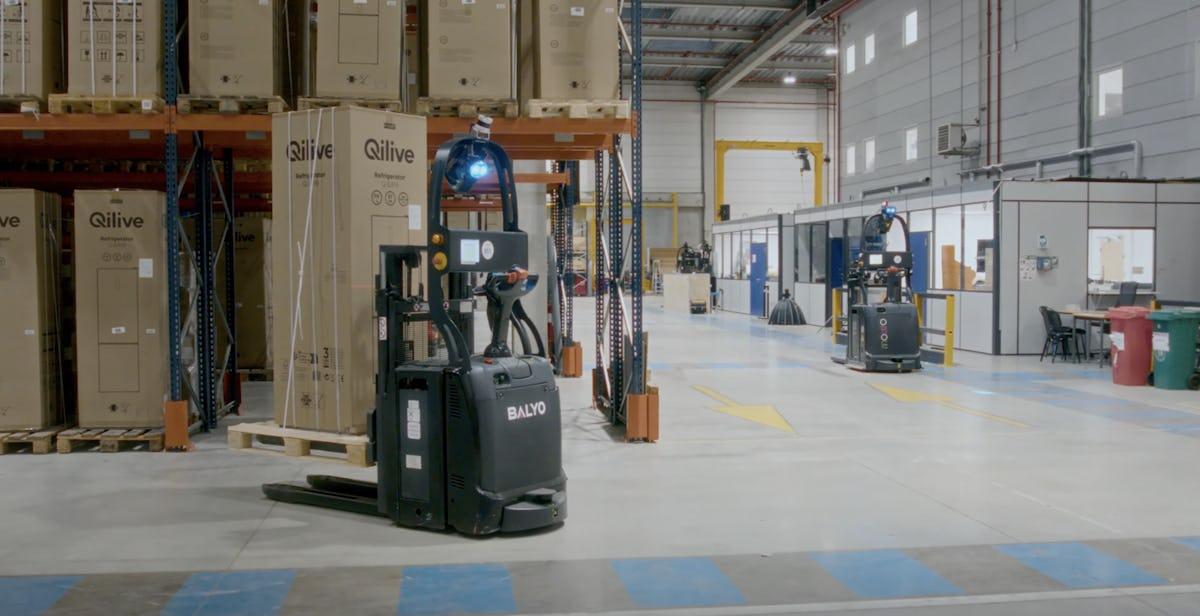
Autonomous forklifts are becoming an important part of modern warehouse automation, smart manufacturing, and intelligent logistics systems.
Compared with traditional manually operated forklifts, autonomous forklifts must continuously perceive their surroundings, identify obstacles, navigate through complex environments, and coordinate with other vehicles and warehouse infrastructure.
LiDAR sensors play an important role in this process.
They provide distance measurements and spatial information that autonomous systems can use for localization, mapping, obstacle detection, and navigation.
However, choosing the right LiDAR for an autonomous forklift is not as simple as selecting a sensor with the longest detection range or highest point cloud density.
A forklift operates in a unique environment. It must navigate narrow aisles, approach pallets, handle different load heights, operate near pedestrians, and move around racks, walls, vehicles, and other industrial equipment.
An unsuitable LiDAR configuration can create blind spots, reduce localization stability, or complicate system integration.
For forklift manufacturers, AGV developers, and warehouse automation integrators, this guide explains seven important factors to consider when selecting LiDAR for autonomous industrial vehicles.
1. Understand the Role of LiDAR in Autonomous Forklifts
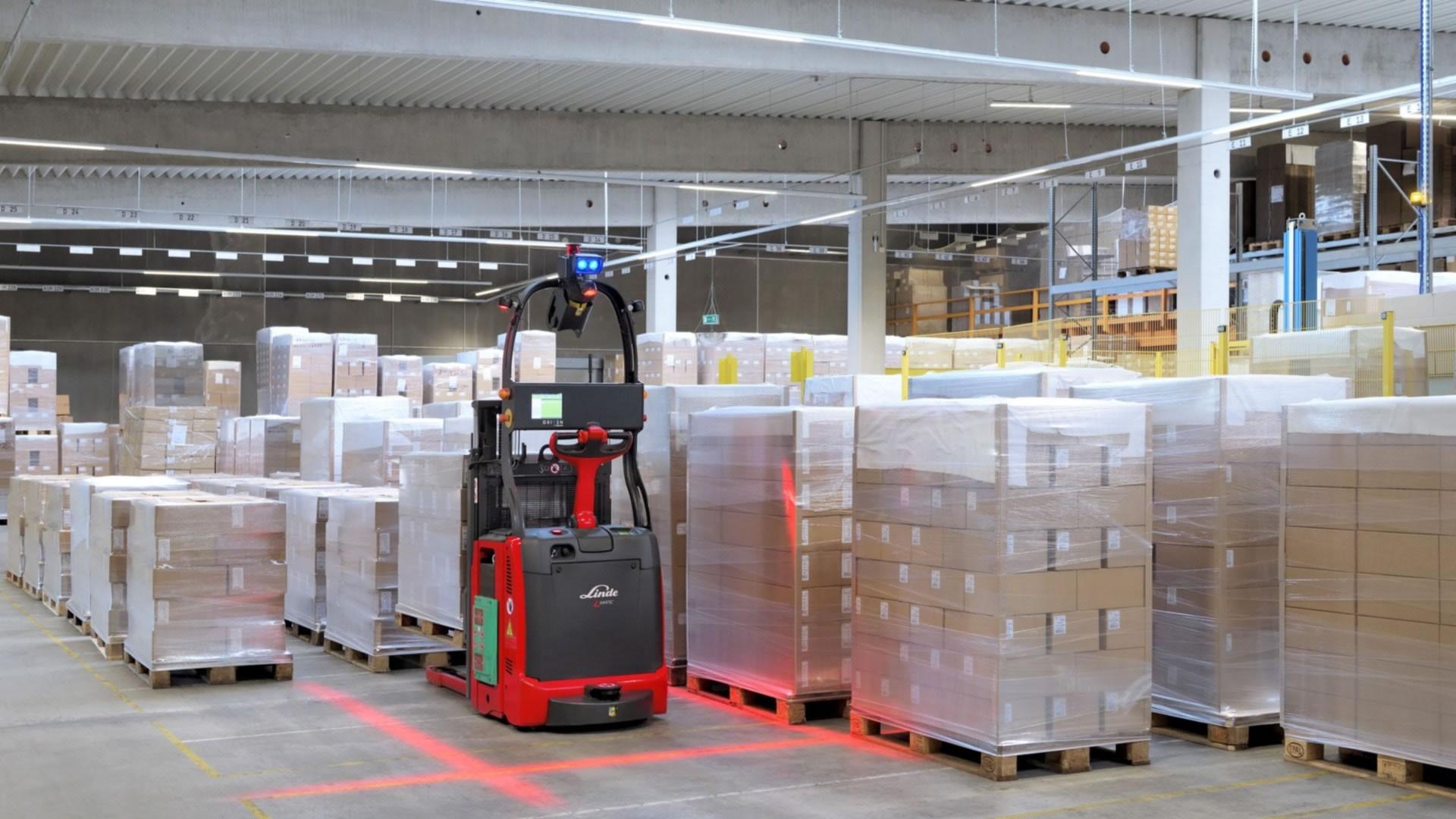
Before selecting a sensor, it is important to understand how LiDAR contributes to the vehicle’s perception system.
A typical autonomous forklift may use LiDAR for several functions.
SLAM and Localization
LiDAR provides environmental measurements that can support simultaneous localization and mapping (SLAM).
The system uses these measurements to estimate the vehicle’s position and understand the surrounding environment.
Obstacle Detection
LiDAR can identify objects such as pallets, shelves, walls, equipment, and other vehicles within its sensing coverage.
Navigation
The point cloud or scan data can be processed by the navigation system to help plan and adjust the vehicle’s route.
Load and Environment Perception
Depending on sensor placement and system design, LiDAR can provide spatial information about pallets, rack structures, and objects around the lifting area.
However, these functions do not necessarily require the same sensor configuration.
For example, a sensor optimized for 360-degree localization may not provide sufficient coverage of the forks or elevated loads.
Therefore, the first step is to define what the LiDAR system must accomplish.
2. 2D vs 3D LiDAR: Which Is Better for Autonomous Forklifts?
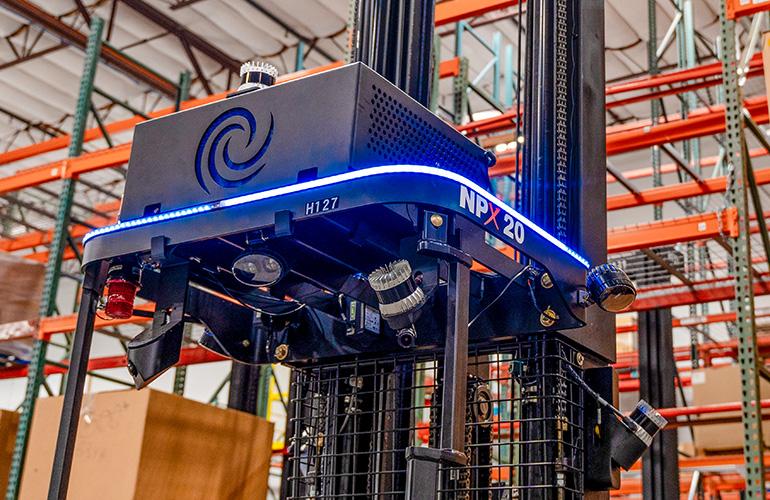
One of the first decisions in forklift LiDAR selection is whether to use 2D or 3D sensing.
Both technologies have practical applications, but their capabilities are different.
2D LiDAR
2D LiDAR measures distances within a scanning plane.
It is commonly used for:
- AGV navigation.
- Industrial vehicle localization.
- Wall and rack detection.
- Basic obstacle detection.
- Established warehouse navigation systems.
Advantages include relatively straightforward data processing, simpler integration, and potentially lower system cost.
However, a single 2D scanning plane cannot describe the complete three-dimensional structure of an object.
Objects positioned above or below the scanning plane may not be detected.
3D LiDAR
3D LiDAR generates spatial point cloud data across horizontal and vertical angles.
It can provide more information about:
- Pallets and loads.
- Objects at different heights.
- Rack structures.
- Uneven surfaces.
- Complex obstacle geometries.
- Three-dimensional environmental features.
This can be particularly useful for autonomous forklifts operating in warehouses with varying load configurations and complex surroundings.
2D vs 3D LiDAR Comparison
| Evaluation Factor | 2D LiDAR | 3D LiDAR |
|---|---|---|
| Data Type | Planar distance measurements | 3D point cloud |
| Navigation | Suitable for many applications | Suitable for advanced navigation |
| Vertical Information | Limited to scanning plane | Available within sensor FOV |
| Obstacle Perception | Depends on mounting height | More spatial information |
| Processing Requirements | Generally lower | Generally higher |
| Integration Complexity | Often simpler | Depends on system architecture |
| Typical Applications | Traditional AGV | Advanced AMR / Autonomous Forklift |
Engineering recommendation: 2D LiDAR may be sufficient for simple navigation tasks in controlled environments. For applications requiring more detailed spatial perception, 3D LiDAR deserves serious consideration.
The final choice should be based on the complete perception and safety architecture, not simply on the number of dimensions.
3. Field of View and Blind Spot Coverage
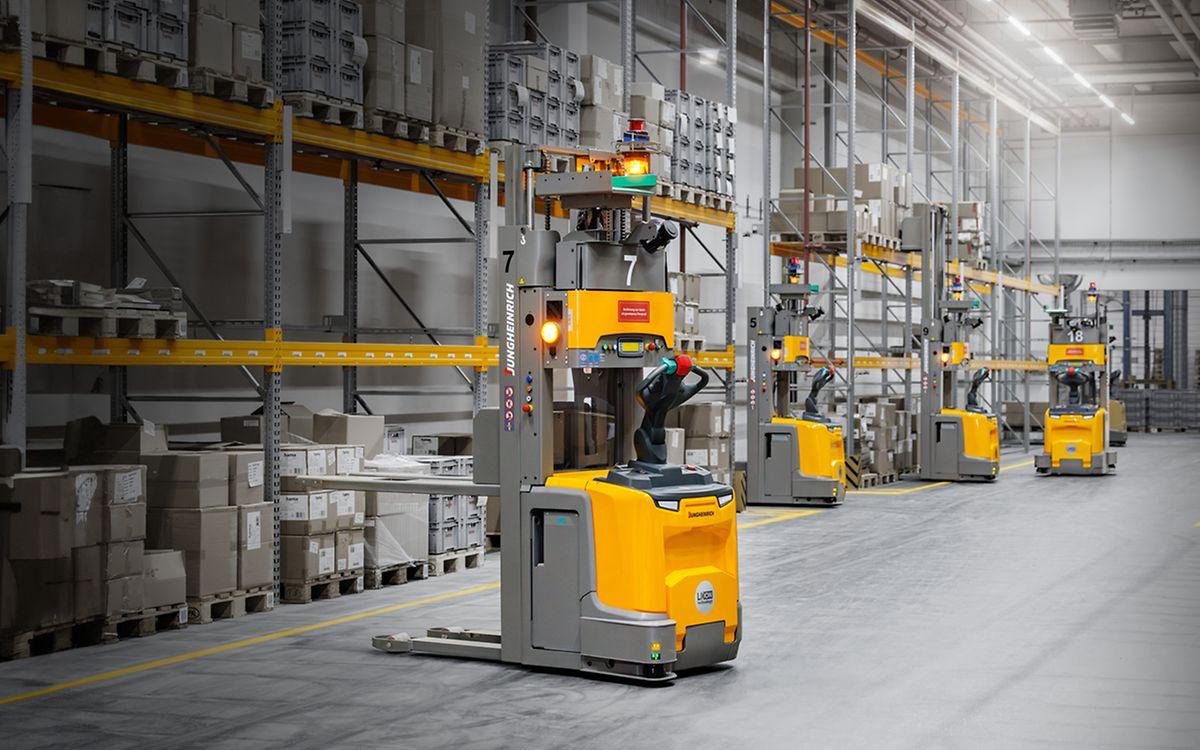
Field of view (FOV) is one of the most important specifications when choosing LiDAR for autonomous forklifts.
A forklift has a different physical structure from a typical mobile robot.
Its mast, forks, carriage, counterweight, cabin, and transported loads can block parts of the sensor’s viewing area.
These obstructions can create blind spots even when the LiDAR itself has a wide field of view.
Engineers should evaluate both horizontal and vertical coverage.
Horizontal FOV
A 360-degree horizontal field of view can be useful for surrounding perception and localization.
However, it does not automatically guarantee that every area around the vehicle is visible.
Vertical FOV
Vertical coverage becomes especially important when detecting objects at different heights.
For example:
- Pallets positioned close to the ground.
- Rack structures.
- Raised loads.
- Obstacles near the lifting mechanism.
- Objects that extend above the scanning plane.
Important Sensor Placement Considerations
Before choosing the model, evaluate possible mounting positions:
- Front-mounted LiDAR for forward perception.
- Rear-mounted LiDAR for reverse movement and rear coverage.
- Top-mounted LiDAR for broader environmental perception.
- Additional sensors for areas blocked by the vehicle structure.
For some vehicles, one 360-degree LiDAR may be sufficient for navigation.
For others, multiple sensors may be needed to provide suitable coverage.
The decision should be supported by a blind-spot analysis using the actual vehicle geometry.
4. Detection Range and Near-Field Performance
A forklift generally operates at relatively low speeds compared with road vehicles.
However, its operating environment can be extremely crowded.
It may need to detect nearby pedestrians, pallets, rack legs, other forklifts, and objects entering its path.
Therefore, maximum detection range should not be the only selection criterion.
Engineers should evaluate three distance ranges.
Long-range perception
Useful for identifying obstacles and understanding the surrounding warehouse environment.
Medium-range perception
Important for navigation, route planning, and movement through aisles.
Near-field perception
Critical for maneuvering, docking, approaching pallets, and moving around nearby objects.
When evaluating a LiDAR, check:
- Maximum detection range at specified reflectivity.
- Minimum measurable distance.
- Near-field blind zones.
- Detection performance across the field of view.
- Measurement accuracy.
- Point cloud quality at different distances.
An important consideration is that a manufacturer’s maximum detection range is usually measured under defined target and environmental conditions.
It should not be interpreted as a guaranteed detection distance for every pallet, pedestrian, or warehouse obstacle.
5. Point Cloud Density and Detection of Pallets and Forks
For autonomous forklifts, point cloud quality can have a direct impact on perception performance.
The system may need to distinguish between:
- Pallets.
- Forklift forks.
- Rack legs.
- Boxes.
- Loads.
- Floor surfaces.
- Nearby industrial vehicles.
The amount and distribution of LiDAR points influence how much geometric information is available to the perception algorithm.
Important specifications include:
Laser Channels
Higher channel counts can provide more vertical measurement layers, depending on the sensor architecture.
Angular Resolution
Angular resolution affects the spacing between measurements.
Point Rate
Point rate indicates how many points the sensor can generate per second.
Frame Rate or Scan Frequency
These specifications influence how frequently the environment is updated.
However, higher point rates do not automatically guarantee better pallet recognition.
Detection performance also depends on target size, distance, reflectivity, scanning pattern, mounting position, and software algorithms.
For example, a narrow pallet leg may be difficult to detect at long distances even with a high-resolution sensor if the scanning pattern does not intersect the target sufficiently.
Engineers should validate point cloud performance using actual warehouse objects rather than relying only on laboratory specifications.
6. Industrial Environment, Dust, Vibration, and Protection
Warehouse and industrial environments can expose LiDAR sensors to conditions that differ significantly from clean laboratory testing.
Potential challenges include:
- Dust from cardboard and packaging.
- Vibration from vehicle movement.
- Mechanical shock.
- Temperature changes.
- Reflections from metallic surfaces.
- Dirt on optical windows.
- Water exposure in certain facilities.
When selecting an industrial LiDAR, examine the following specifications.
| Parameter | Why It Matters |
|---|---|
| IP Rating | Protection against dust and water ingress |
| Operating Temperature | Compatibility with the working environment |
| Vibration Resistance | Stability on moving industrial vehicles |
| Shock Resistance | Resistance to mechanical impacts |
| Power Consumption | Compatibility with vehicle electrical systems |
| Housing Design | Installation and maintenance requirements |
| Connector Protection | Reliability of the complete installation |
An IP rating alone does not establish suitability for every industrial application.
The installation method, connector protection, cable routing, maintenance schedule, and operating conditions must also be considered.
7. ROS, Ethernet, and System Integration
A LiDAR sensor must work with the forklift’s onboard computing and control architecture.
Many autonomous forklift platforms use industrial PCs or embedded computing systems to process sensor data and execute navigation algorithms.
Before purchasing a sensor, confirm the following:
Communication Interface
Check whether the sensor supports the required Ethernet or other communication interface.
SDK and Software Resources
Review the availability of SDKs, configuration tools, sample code, and technical documentation.
ROS / ROS 2 Compatibility
If your platform uses ROS or ROS 2, confirm whether suitable drivers and integration resources are available for the exact sensor model and software version.
Time Synchronization
Accurate timestamps can be important when combining LiDAR data with cameras, IMUs, wheel odometry, and other sensors.
Coordinate Systems
The sensor’s coordinate frame must be correctly calibrated and integrated into the vehicle’s perception architecture.
Computing Requirements
Check the point cloud data rate and processing requirements against the capabilities of the onboard computer.
For NVIDIA Jetson-based platforms or industrial PCs, validate the actual driver, operating system, SDK, and communication compatibility before finalizing the hardware configuration.
A successful integration test should include:
- Data reception.
- Point cloud visualization.
- Timestamp verification.
- Coordinate transformation.
- Motion testing.
- Long-duration operation.
8. Functional Safety: Do Not Confuse Navigation LiDAR with Safety LiDAR
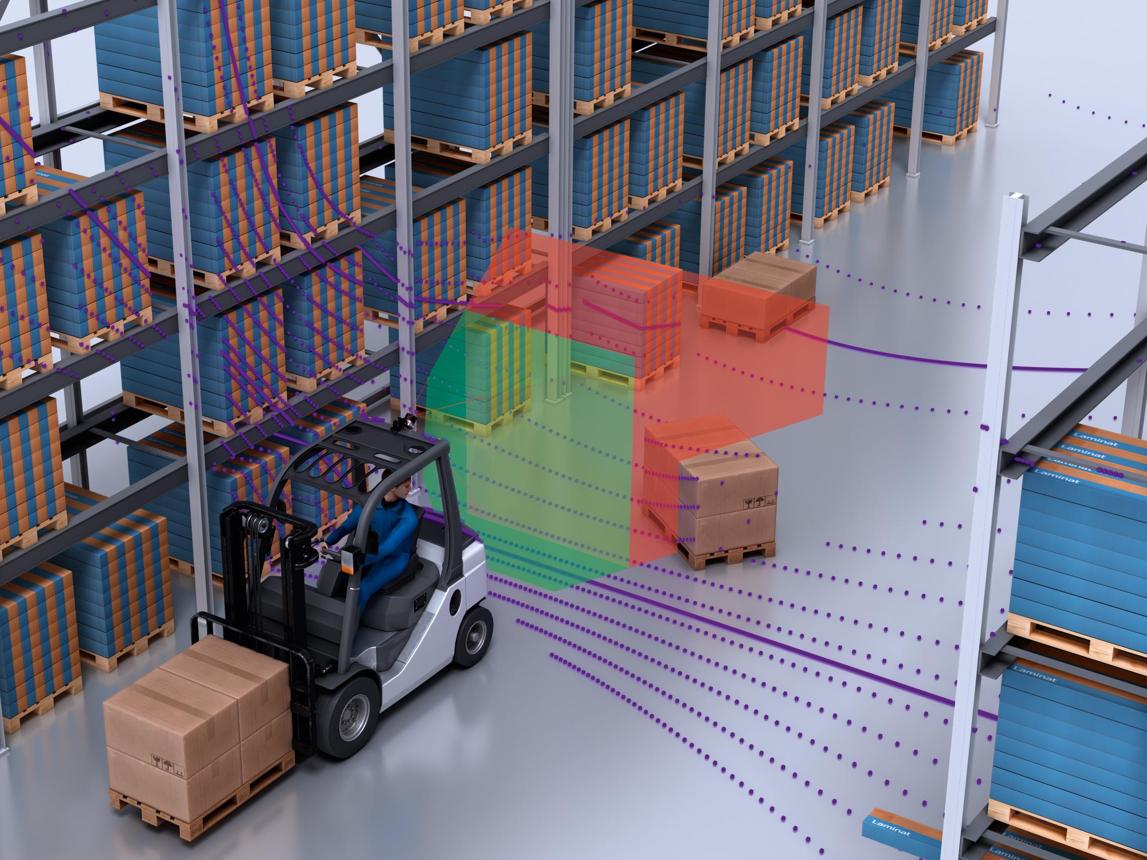
This is particularly important for autonomous forklift manufacturers.
A LiDAR sensor used for navigation or mapping is not automatically a safety-rated protective device.
Industrial vehicles operating near people may require dedicated safety functions, such as personnel detection, protective field monitoring, emergency stopping, and speed reduction.
These functions must be designed and validated according to the applicable machinery and functional safety requirements.
When evaluating safety-related sensing, confirm:
- Whether the exact sensor model has relevant safety certification.
- Whether the complete safety system meets applicable requirements.
- Whether the sensor supports the required protective function.
- Whether the system has been validated for the intended application.
- Whether the manufacturer’s documentation specifies the permitted use.
A standard 3D navigation LiDAR should not be assumed to replace a certified safety laser scanner.
The vehicle’s safety architecture must be evaluated separately from its navigation and perception architecture.
How Many LiDAR Sensors Does an Autonomous Forklift Need?
There is no universal answer.
The number depends on vehicle geometry, operating direction, load dimensions, sensor FOV, blind spots, navigation architecture, and safety requirements.
A basic autonomous forklift may use one primary navigation LiDAR.
A more advanced platform may combine:
- Front navigation LiDAR.
- Rear perception LiDAR.
- Additional 3D LiDAR for spatial awareness.
- Dedicated safety laser scanners.
- Cameras and other complementary sensors.
The objective is not to install as many sensors as possible.
It is to achieve the required perception coverage while controlling system cost, integration complexity, and maintenance requirements.
A sensor coverage study should be completed before finalizing the configuration.
LiDAR Selection Checklist for Forklift OEMs
Before requesting quotations, engineering and procurement teams should prepare the following information.
| Requirement | Information to Confirm |
|---|---|
| Vehicle Type | Counterbalance / Reach Truck / Pallet Truck / AGV |
| Operating Environment | Indoor / Outdoor / Mixed |
| Navigation Method | SLAM / Reflector-Based / Hybrid |
| Sensor Type | 2D / 3D |
| Detection Range | Required operating distance |
| Field of View | Horizontal and vertical coverage |
| Point Cloud | Required density and update rate |
| Mounting | Position, size, and orientation |
| Interface | Ethernet / Other supported interface |
| Software | ROS / ROS 2 / Custom SDK |
| Safety | Separate safety sensing requirements |
| Quantity | Prototype / Pilot / Mass Production |
| Delivery | Required lead time and destination |
Providing these details helps suppliers recommend suitable products and prepare more accurate quotations.
How to Select a LiDAR Supplier for Autonomous Forklift Projects
Product selection is only one part of the purchasing process.
For OEMs and industrial vehicle manufacturers, supplier capabilities also matter.
A suitable supplier should be able to help with:
Multi-Brand Product Sourcing
Compare available solutions from different manufacturers based on your technical requirements.
Application-Based Recommendations
Discuss detection range, FOV, installation requirements, and software integration.
Product Documentation
Obtain available datasheets, manuals, SDK information, and technical resources.
Prototype and Volume Procurement
Discuss small-quantity evaluation, pilot production, and larger purchasing requirements.
Delivery and Supply Planning
Confirm product availability, estimated lead times, and possible batch delivery arrangements.
For projects with long development cycles, product lifecycle information and future sourcing arrangements should also be considered.
Why Work with LIDARSEEK for Industrial LiDAR Sourcing?
LIDARSEEK supplies LiDAR sensors and intelligent perception products for robotics, industrial automation, autonomous systems, and automotive development.
Our multi-brand product portfolio includes solutions from Hesai, RoboSense, Livox, Seyond, and other sensing technology providers.
For autonomous forklift and AGV projects, we can assist with:
- Comparing 2D and 3D LiDAR options.
- Identifying potential sensors for navigation and perception.
- Comparing specifications across manufacturers.
- Providing available product documentation.
- Supporting prototype and bulk procurement inquiries.
- Coordinating international shipping and project quotations.
We understand that different industrial vehicle platforms have different sensing requirements.
Our goal is to help engineering and procurement teams identify suitable products based on their actual applications, technical specifications, and purchasing plans.
Frequently Asked Questions
1. Is 2D LiDAR sufficient for an autonomous forklift?
It can be sufficient for certain navigation applications, particularly in controlled warehouse environments. However, applications requiring three-dimensional obstacle perception or detection at different heights may benefit from 3D LiDAR.
2. Can 3D LiDAR replace a safety laser scanner?
Not automatically. Standard navigation LiDAR is not necessarily safety-rated. Safety-related protective functions require appropriately certified devices and a validated safety system.
3. Is 360-degree LiDAR necessary for autonomous forklifts?
Not in every application. A 360-degree sensor can simplify surrounding perception and localization, but vehicle geometry and mounting obstructions must still be evaluated.
4. Which LiDAR is suitable for warehouse AGVs?
The answer depends on the vehicle, navigation architecture, required coverage, and operating environment. Compact 2D or 3D LiDAR may be suitable for different applications.
5. Can LiDAR detect pallets and low obstacles?
LiDAR can provide measurements of pallets and obstacles when they fall within its effective sensing coverage. Detection depends on sensor placement, vertical FOV, scanning pattern, target reflectivity, distance, and perception software.
6. Can I purchase LiDAR sensors in bulk for forklift production?
Yes. OEMs and industrial vehicle manufacturers can request project-based quotations based on product model, quantity, destination, and delivery schedule. Availability and lead times should be confirmed for each order.
Need LiDAR for Your Autonomous Forklift or AGV Project?
Selecting the right LiDAR can make a significant difference to the perception architecture, integration workload, and overall cost of an autonomous industrial vehicle.
Whether you are developing an autonomous forklift, warehouse AGV, pallet-handling robot, or industrial mobile platform, LIDARSEEK can help you explore suitable LiDAR options from multiple manufacturers.
Send us your application details and purchasing requirements to receive product suggestions and a project quotation.
To help us recommend suitable products, please provide:
- Vehicle type and application.
- Indoor or outdoor operating environment.
- Required detection range and FOV.
- Preferred sensor type: 2D or 3D.
- Computing platform or software requirements.
- Estimated quantity.
- Destination country.
Contact LIDARSEEK
Website: https://lidarseek.com/
Email: lidarseektech@gmail.com
LIDARSEEK – Multi-Brand LiDAR Sourcing and Intelligent Perception Solutions for Global Engineering Teams.









