
Introduction: A Reliable LiDAR Supplier Must Deliver More Than a Good Product
For automotive OEMs, Tier 1 suppliers, robotics manufacturers, and industrial automation companies, selecting a LiDAR sensor is only one part of a successful procurement strategy.
The supplier’s ability to deliver the correct products, maintain consistent documentation, communicate supply changes, and support future purchasing requirements can be equally important.
Consider a typical OEM project.
An engineering team successfully evaluates a 3D LiDAR sensor and approves it for prototype development. The procurement department subsequently places an order for additional units.
At this stage, the purchasing process appears straightforward.
However, as the project progresses, several problems may emerge:
- The next batch has a significantly longer lead time.
- The delivered configuration differs from the approved sample.
- Required accessories are missing.
- Product documentation is incomplete.
- A manufacturer changes the product or discontinues the original model.
- Technical questions remain unresolved during system integration.
These situations demonstrate an important distinction:
A supplier that can fulfill an individual order is not necessarily a supplier that can consistently support an enterprise project.
For professional procurement teams, supplier performance should be measured throughout the purchasing lifecycle rather than judged by the initial quotation or a single successful delivery.
This guide introduces a practical LiDAR supplier performance management framework, including measurable KPIs, calculation methods, evaluation examples, and corrective actions.
It is designed to help OEM procurement managers, supply chain professionals, engineering managers, and system integrators make more informed long-term sourcing decisions.
1. Separate Supplier Performance into Five Management Areas
Before establishing KPIs, procurement teams should identify what they actually need to measure.
A common mistake is combining every purchasing issue into one general supplier rating.
For example, a late shipment, a product defect, and an incomplete commercial invoice are three different problems. They require different investigations and corrective actions.
For LiDAR procurement, supplier performance can be organized into five areas.
| Management Area | Main Evaluation Objective |
|---|---|
| Delivery Performance | Can the supplier meet confirmed shipment commitments? |
| Product and Quality Control | Are the correct products delivered in the approved configuration? |
| Supply Continuity | Can the supplier coordinate availability and future demand? |
| Commercial and Documentation Control | Are purchasing terms and documents accurate? |
| Technical and Service Support | Can issues be communicated and resolved effectively? |
These categories provide a more useful structure than evaluating suppliers based exclusively on price, delivery, or product quality.
They also help procurement teams identify which areas require improvement.
2. Delivery Performance: Measure Confirmed Commitments, Not General Promises
Delivery performance is one of the most visible indicators of supplier reliability.
However, simply recording whether an order arrived late or on time does not provide enough information.
For international LiDAR procurement, there may be several stages between order confirmation and final delivery:
- Purchase order acceptance.
- Inventory allocation or production scheduling.
- Product preparation.
- Shipment dispatch.
- International transportation.
- Customs clearance.
- Final delivery.
Different parties may be responsible for different stages.
A procurement team should therefore distinguish supplier-controlled performance from transportation and destination-related performance.
KPI 1: On-Time Shipment Rate
This measures whether the supplier dispatches products according to the agreed shipment date.
Formula:
On-Time Shipment Rate = (Orders Shipped on or Before Confirmed Date / Total Eligible Orders) × 100%
For example:
A company places 20 LiDAR orders during a reporting period. The supplier dispatches 18 orders within the agreed shipment dates.
The on-time shipment rate is:
18 / 20 × 100% = 90%
This provides a clearer picture of supplier-controlled delivery performance.
KPI 2: Lead-Time Accuracy
Lead-time accuracy measures whether the supplier’s confirmed fulfillment schedule reflects actual performance.
Procurement teams should record:
- Original quoted lead time.
- Confirmed lead time after order acceptance.
- Actual shipment date.
- Reasons for significant delays.
The original estimate and the final confirmed commitment should be kept separate.
For example, an initial quotation may indicate an estimated lead time of three weeks. After checking inventory and manufacturer availability, the supplier confirms a different schedule.
The procurement team should evaluate performance against the agreed commitment, while also monitoring how accurately the initial estimate reflected actual supply conditions.
KPI 3: Delivery Schedule Visibility
A supplier should not only communicate when an order is ready to ship.
For larger projects, procurement teams may need advance visibility into:
- Inventory allocation.
- Expected replenishment.
- Production scheduling.
- Partial shipment arrangements.
- Potential delivery changes.
A useful measurement is the percentage of scheduled delivery milestones for which the supplier provides accurate updates within the agreed reporting timeframe.
Procurement insight: A supplier that communicates a potential delay early gives the purchasing team more time to adjust its production or engineering schedule.
3. Product Quality: Verify the Delivered Configuration Against the Approved Requirement
Product quality in LiDAR procurement involves more than checking whether a sensor powers on.
The delivered product must correspond to the agreed purchasing and engineering requirements.
For example, two sensors may belong to the same product family but have different part numbers, accessories, cable configurations, or firmware requirements.
A mismatch can create unnecessary integration work even when the main sensor itself is functional.
KPI 4: Incoming Product Conformity Rate
A practical measurement is the percentage of inspected units that meet the agreed incoming acceptance criteria.
Formula:
Incoming Conformity Rate = (Units Passing Incoming Inspection / Total Units Inspected) × 100%
The inspection criteria should be defined before shipment.
Depending on the project, these may include:
- Correct manufacturer and model.
- Correct part number or configuration.
- Product identification and serial number information.
- Packaging condition.
- Accessory completeness.
- Required documentation.
- Functional inspection, where applicable.
It is important to distinguish supplier delivery errors from product defects that require manufacturer-level investigation.
For example:
| Issue | Appropriate Investigation |
|---|---|
| Incorrect model delivered | Supplier order fulfillment |
| Missing cable | BOM and packing verification |
| Damaged packaging | Packaging and transportation |
| Functional failure | Technical and quality investigation |
| Missing product identification | Traceability and documentation |
This classification helps prevent inaccurate supplier assessments.
KPI 5: Nonconformance Resolution Time
Identifying a problem is only the beginning.
Procurement and quality teams should also measure how efficiently the supplier coordinates its resolution.
Track:
- Date the issue was reported.
- Date the supplier acknowledged it.
- Date an investigation started.
- Corrective action proposed.
- Final resolution date.
- Whether the issue recurred.
A quick acknowledgment should not be treated as a completed resolution.
Procurement insight: For repeated quality problems, request a documented root-cause analysis and corrective action plan rather than accepting repeated explanations without evidence of improvement.
4. Supply Continuity: Can the Supplier Support the Project Beyond the First Order?
Supply continuity is particularly important when LiDAR procurement moves from engineering evaluation to pilot production and commercial deployment.
A supplier may be able to source a few sensors quickly but encounter difficulties when a project requires a larger quantity.
The evaluation should therefore focus on the supplier’s ability to provide accurate supply information and coordinate future purchasing requirements.
KPI 6: Confirmed Quantity Fulfillment Rate
This measures how much of the agreed order quantity is delivered within the specified fulfillment period.
Formula:
Quantity Fulfillment Rate = (Quantity Delivered Within Agreed Period / Confirmed Order Quantity) × 100%
For example:
An OEM orders 100 sensors under an agreed delivery schedule.
The supplier delivers 60 units within the first scheduled period and the remaining 40 units within the next agreed period.
The procurement team should evaluate the fulfillment rate against each delivery milestone rather than incorrectly treating the first partial shipment as a complete order failure.
KPI 7: Supply Forecast Responsiveness
For repeat orders, procurement teams often provide suppliers with estimated future demand.
The purpose is to improve sourcing visibility and allow suppliers to review inventory, manufacturer availability, and replenishment requirements.
A supplier should be evaluated on its ability to:
- Acknowledge forecast information.
- Identify potential shortages.
- Confirm realistic replenishment schedules.
- Communicate inventory constraints.
- Coordinate possible partial deliveries.
Forecast responsiveness should not be confused with a guaranteed supply commitment.
A demand forecast is planning information unless the parties establish a separate binding purchasing or allocation agreement.
KPI 8: Product Lifecycle Change Management
Product discontinuation, hardware revisions, and successor models can significantly affect long-term procurement planning.
For example, when a manufacturer discontinues a LiDAR model and introduces an upgraded version, procurement teams need to understand whether the new product is suitable for the existing application.
Relevant evaluation criteria include:
- Advance communication of product changes, where information is available.
- Confirmation of the affected model and part number.
- Availability of official replacement documentation.
- Comparison of technical differences.
- Confirmation of remaining supply availability.
- Coordination of engineering review.
A successor model should never be assumed to be a direct replacement without technical verification.
Procurement insight: For critical projects, maintain an approved product list and a formal substitution approval process.
5. Commercial Performance: Evaluate Total Procurement Cost
Unit price is an important purchasing factor, but enterprise buyers should evaluate commercial performance across the entire transaction.
A quotation may appear competitive while excluding important logistics or import-related expenses.
For international LiDAR procurement, review the following:
| Commercial Item | What to Verify |
|---|---|
| Unit Price | Correct model, quantity, and currency |
| Volume Pricing | Consistent quantity-based price structure |
| Quotation Validity | Clear validity period |
| Payment Terms | Agreed payment schedule |
| Freight | Included or excluded |
| Incoterms | Clearly stated delivery responsibilities |
| Import Duties | Responsibility defined |
| Additional Charges | Disclosed before order approval |
KPI 9: Quotation and Invoice Accuracy
This KPI measures whether the commercial documents accurately reflect the approved purchasing conditions.
Track discrepancies involving:
- Product model.
- Part number.
- Quantity.
- Unit price.
- Currency.
- Freight charges.
- Incoterms.
- Payment terms.
A simple measurement is:
Quotation Accuracy Rate = (Transactions Without Commercial Document Discrepancies / Total Transactions Reviewed) × 100%
For international orders, Incoterms should be clearly stated.
For example, under DAP, the seller arranges delivery to the agreed destination, while the buyer generally handles import clearance and applicable import duties and taxes.
Under DDP, the seller assumes the agreed import clearance and duty responsibilities, subject to applicable regulations and the transaction arrangement.
These differences should be reflected clearly in the quotation and purchase order.
Procurement insight: Compare quotations on an equivalent basis. Different delivery terms can make two apparently similar unit prices commercially incomparable.
6. Technical Support: Measure Whether Issues Actually Move Toward Resolution
LiDAR procurement often involves engineering teams, not just purchasing departments.
A sensor may need to work with a specific computing platform, operating environment, software driver, communication interface, and mechanical configuration.
When technical questions arise, communication efficiency can directly affect project progress.
KPI 10: Technical Inquiry Resolution Performance
Instead of measuring only response speed, evaluate the complete support process.
Consider:
| Measurement | What It Indicates |
|---|---|
| Initial Response Time | How quickly an inquiry is acknowledged |
| Technical Response Time | How quickly relevant technical information is provided |
| Resolution Time | How long it takes to reach an agreed solution |
| Documentation Availability | Whether relevant manuals and datasheets are supplied |
| Escalation Efficiency | Whether unresolved issues reach the appropriate technical team |
For example, an inquiry about an Ethernet interface may require the supplier to confirm the official technical documentation or coordinate with the manufacturer.
The supplier should distinguish between confirmed technical information and details that still require manufacturer verification.
This is particularly important when engineering decisions depend on precise specifications.
Procurement insight: Evaluate technical support based on accuracy, clarity, and resolution progress—not simply the number of emails exchanged.
7. Build a Weighted LiDAR Supplier Performance Scorecard
After defining the KPIs, procurement teams can establish a standardized scorecard.
The following is an illustrative model for a general OEM or robotics procurement program.
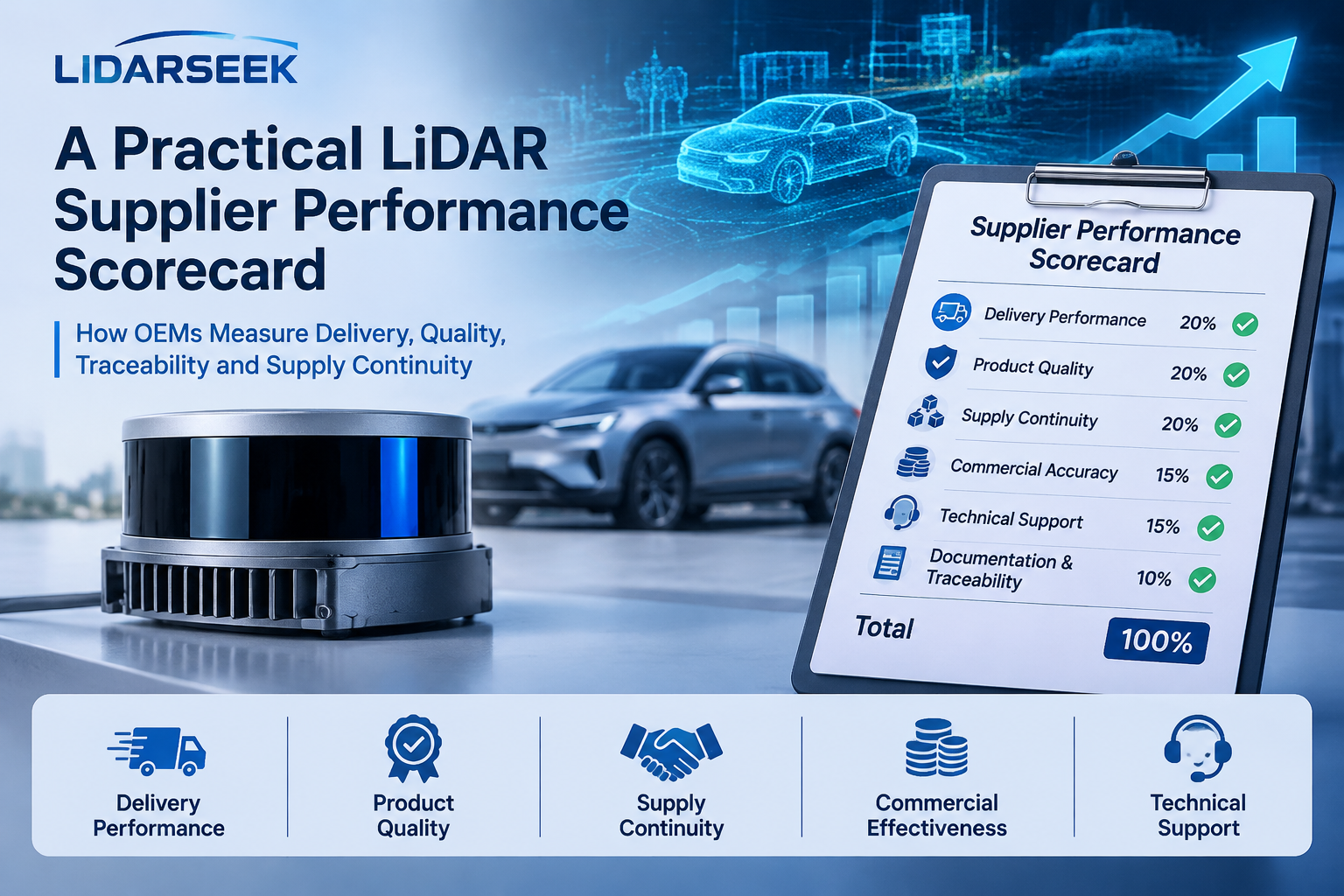
| Performance Category | Suggested Weight |
|---|---|
| Delivery Performance | 20% |
| Product Quality | 20% |
| Supply Continuity | 20% |
| Commercial Accuracy | 15% |
| Technical Support | 15% |
| Documentation and Traceability | 10% |
| Total | 100% |
Companies should adjust the weighting according to their actual purchasing requirements.
For example:
- Automotive production programs may place greater emphasis on quality, traceability, change management, and supply continuity.
- Robotics manufacturers may prioritize integration support, product availability, and delivery flexibility.
- Research and development projects may emphasize technical documentation and sample availability.
Example of a Supplier Performance Calculation
Assume an OEM evaluates a LiDAR supplier using a five-point scale.
| Category | Weight | Rating | Weighted Result |
|---|---|---|---|
| Delivery | 20% | 4 | 16 |
| Quality | 20% | 5 | 20 |
| Supply Continuity | 20% | 3 | 12 |
| Commercial Accuracy | 15% | 4 | 12 |
| Technical Support | 15% | 4 | 12 |
| Documentation | 10% | 5 | 10 |
| Total | 100% | 82/100 |
The calculation is:
Weighted Score = Σ (Category Rating / 5 × Category Weight)
The supplier achieves a score of 82 out of 100.
However, the numerical score should not be the only basis for approval.
For example, a supplier may receive high marks for pricing and delivery while having an unresolved product traceability issue.
Such an issue may require a separate qualification review regardless of the overall score.
A scorecard should support professional judgment, not replace mandatory technical, quality, or compliance requirements.
8. What Should Procurement Teams Do When Supplier Performance Declines?
A performance score is useful only when it leads to corrective action.
If a supplier repeatedly misses delivery commitments or provides incomplete documentation, procurement teams should identify the underlying reason before deciding whether to continue or change the sourcing arrangement.
A practical corrective action process involves four stages.
Step 1: Identify the Specific Performance Gap
Avoid general comments such as:
“The supplier’s delivery performance is poor.”
Instead, identify the actual issue:
- Three out of ten orders missed the confirmed shipment date.
- Inventory allocation was not confirmed before order acceptance.
- Product documentation was incomplete in two consecutive shipments.
Specific evidence makes supplier discussions more productive.
Step 2: Identify the Root Cause
Determine whether the problem originated from:
- Supplier order processing.
- Manufacturer production schedules.
- Inventory shortages.
- Product configuration changes.
- International transportation.
- Customs clearance.
- Incomplete purchasing information.
Not every problem is directly controlled by the supplier.
Accurate classification is essential for fair performance evaluation.
Step 3: Agree on Corrective Actions
Depending on the problem, actions may include:
- Improved inventory confirmation.
- More frequent delivery updates.
- Revised shipment planning.
- Additional incoming inspection.
- Standardized purchasing documentation.
- Improved technical escalation procedures.
- Earlier communication of product changes.
Assign a responsible person and an expected completion date to each action.
Step 4: Verify Whether Performance Improves
Review the same KPI over subsequent orders or reporting periods.
A corrective action should be considered effective only when there is measurable improvement or a documented explanation for why the issue remains unresolved.
This creates a continuous improvement process rather than a one-time supplier review.
9. How to Evaluate Suppliers at Different LiDAR Procurement Stages
A supplier’s performance requirements may change as a project develops.
The same evaluation framework should not necessarily be applied with identical priorities at every stage.
| Project Stage | Main Procurement Priorities |
|---|---|
| Engineering Evaluation | Product availability, technical documentation, sample delivery |
| Prototype Development | Configuration accuracy, technical coordination, repeat availability |
| Engineering Validation | Product consistency, issue resolution, documentation |
| Pilot Production | Quantity fulfillment, delivery planning, supply visibility |
| Mass Production | Supply continuity, cost consistency, traceability, lifecycle management |
| After-Sales Support | Warranty coordination, replacement availability, technical communication |
For example, an engineering team may initially purchase only two or three LiDAR sensors.
At this stage, immediate availability and technical documentation may be more important than volume pricing.
When the project moves into pilot production, purchasing priorities change.
The procurement team may now need to confirm:
- Whether the approved model is still available.
- Whether additional quantities can be secured.
- Whether product configurations remain consistent.
- Whether delivery can be arranged in several batches.
- Whether future purchasing requirements can be supported.
This is why supplier performance management should evolve with the project.
10. A Practical Quarterly LiDAR Supplier Review Template
For companies with recurring LiDAR purchasing requirements, a quarterly supplier review can provide a structured way to monitor performance.
The following information can be included in a supplier review report.
A. Purchasing Summary
- Number of purchase orders.
- Total quantity purchased.
- Total quantity delivered.
- Number of partial shipments.
- Number of outstanding orders.
B. Delivery Summary
- Confirmed shipment dates.
- Actual shipment dates.
- On-time shipment rate.
- Significant delivery deviations.
- Outstanding delivery commitments.
C. Product Quality Summary
- Total units received.
- Units inspected.
- Nonconforming units.
- Reported technical issues.
- Open corrective actions.
D. Commercial Summary
- Quoted prices.
- Approved purchase order values.
- Invoice discrepancies.
- Freight and other charges.
- Payment term compliance.
E. Supply and Technical Support
- Inventory availability.
- Expected replenishment.
- Product lifecycle updates.
- Technical inquiries.
- Outstanding support cases.
F. Improvement Actions
- Identified performance gaps.
- Root causes.
- Agreed corrective measures.
- Responsible parties.
- Target completion dates.
This structure helps procurement teams maintain a consistent record of supplier performance and supports more objective sourcing decisions.
How LIDARSEEK Supports Professional LiDAR Procurement
LIDARSEEK works with international customers sourcing LiDAR products for automotive, robotics, industrial automation, and advanced perception applications.
We understand that purchasing teams need more than a product price.
They often require accurate model identification, product documentation, inventory confirmation, quantity-based quotations, technical coordination, and international shipping arrangements.
Our sourcing coverage includes products from manufacturers such as Hesai, RoboSense, Seyond, and Livox, depending on the requested model and supply availability.
For enterprise purchasing requirements, we can assist with:
Multi-Brand LiDAR Sourcing
Coordinating sourcing options across different LiDAR manufacturers for projects involving multiple product models.
Product and Configuration Confirmation
Helping customers verify requested models, part numbers, product specifications, and applicable accessories.
Quotation and Availability Coordination
Preparing quotations based on specified quantities, delivery destinations, and confirmed sourcing conditions.
Bulk Purchasing Support
Coordinating larger orders and discussing possible batch delivery arrangements based on actual availability.
Technical Documentation and Support
Helping customers obtain relevant product information and coordinating technical inquiries.
International Shipping Coordination
Supporting shipping arrangements and relevant commercial documentation for overseas orders.
We believe that effective procurement starts with clear product requirements, transparent commercial terms, and realistic supply planning.
Whether you are purchasing LiDAR sensors for initial engineering evaluation or coordinating repeat orders for a larger project, our team welcomes the opportunity to review your requirements.
Request a LiDAR Quotation for Your Project
Planning a new LiDAR procurement project?
Send LIDARSEEK your product list, BOM, or RFQ. Our team can help review the requested models, quantities, product availability, estimated lead times, and international delivery options.
To help us prepare an accurate quotation, please include:
- Manufacturer and model.
- Required part number or configuration.
- Purchase quantity.
- Destination country and delivery address.
- Target delivery schedule.
- Preferred shipping terms.
For multi-brand or larger-volume requirements, you can also share your complete purchasing list for review.
Contact LIDARSEEK
Website: https://lidarseek.com/
Email: sales@lidarseek.com
Have an upcoming LiDAR purchasing requirement? Send us your RFQ or BOM to discuss sourcing and quotation options.
Technical and Procurement Disclaimer: KPI definitions and weighting examples in this article are suggested management practices, not universal industry standards. Companies should establish measurement boundaries, acceptance criteria, and supplier obligations according to their own contracts, quality systems, project requirements, and applicable regulations.









