

Buying LiDAR sensors in bulk is a significant decision for robotics manufacturers, system integrators, and industrial automation companies. A sensor may meet the specifications on paper, but that does not necessarily mean it will perform reliably in your actual application.
For companies developing autonomous mobile robots (AMRs), automated guided vehicles (AGVs), autonomous vehicles, and industrial perception systems, even a small compatibility issue can cause unexpected engineering costs, project delays, or production problems.
That is why evaluating a LiDAR sample before placing a bulk order is an important step in the procurement process.
However, testing a sample should involve more than powering on the sensor and checking whether it produces data. Engineering teams should evaluate detection performance, point cloud quality, software compatibility, mechanical integration, environmental suitability, and long-term operating stability. Procurement teams should also verify product availability, delivery schedules, warranty terms, and the supplier’s ability to support future orders.
This guide provides a practical 12-point LiDAR sample testing checklist to help engineering and purchasing teams make better decisions before committing to mass procurement.
Quick Checklist: What Should You Test Before Buying LiDAR in Bulk?
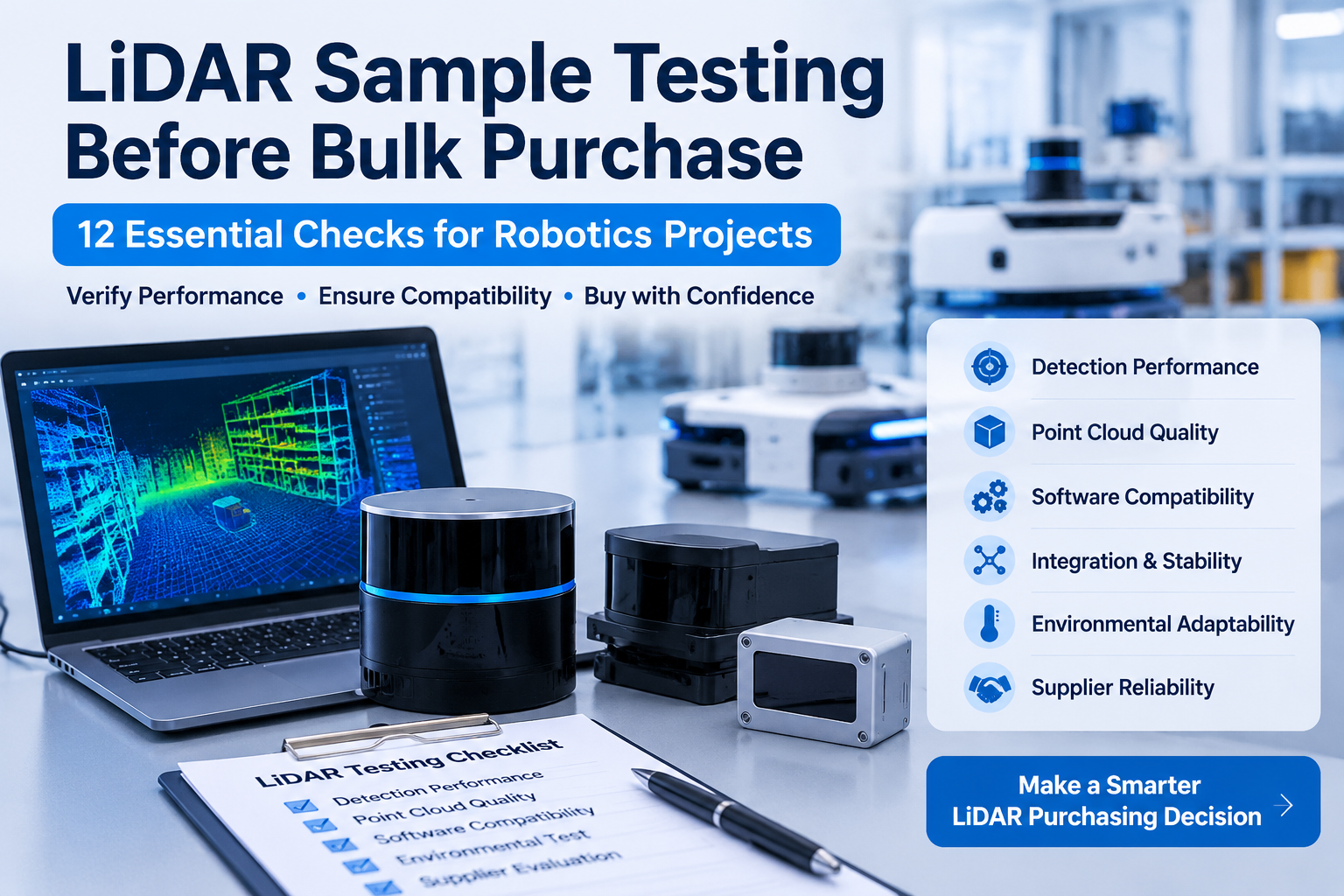
If you are evaluating a LiDAR sensor for a commercial robotics project, start with these 12 areas:
| No. | Evaluation Area | What to Verify |
|---|---|---|
| 1 | Application requirements | Detection range, field of view, resolution and scanning frequency |
| 2 | Detection performance | Actual range under different target reflectivity conditions |
| 3 | Point cloud quality | Data consistency, noise, object visibility and stability |
| 4 | Communication interface | Ethernet, connectors, power and network configuration |
| 5 | Software compatibility | SDK, ROS/ROS 2, operating system and firmware |
| 6 | Computing platform | Compatibility with NVIDIA Jetson or industrial PCs |
| 7 | Environmental performance | Temperature, sunlight, dust, moisture and operating conditions |
| 8 | Mechanical integration | Dimensions, weight, mounting and cable routing |
| 9 | Operating stability | Data continuity, temperature and restart behavior |
| 10 | Total procurement cost | Unit price, shipping, accessories and integration costs |
| 11 | Supplier capability | Stock, MOQ, lead time, warranty and technical support |
| 12 | Bulk delivery readiness | Quantity confirmation, batch deliveries and supply consistency |
The following sections explain how to evaluate each area and what information to request from your LiDAR supplier.
1. Define Your Application Requirements Before Requesting a Sample
The first step is not choosing the most expensive or highest-specification LiDAR. It is identifying what your application actually requires.
Different robotics applications have different sensing requirements. A compact 2D LiDAR designed for indoor navigation, for example, may be suitable for certain AGV applications but insufficient for a robot requiring detailed 3D environmental perception.
Before requesting a sample, document the following requirements:
| Requirement | Questions to Ask |
|---|---|
| Application | Is the sensor intended for AMR, AGV, autonomous driving or industrial automation? |
| Detection range | What is the required operating distance? |
| Field of view | Is 270-degree, 360-degree or another coverage configuration required? |
| Resolution | Is 2D scanning sufficient, or is 3D point cloud data necessary? |
| Scanning frequency | Can the sensor support the system’s movement and perception requirements? |
| Interface | Does the computing system require Ethernet, USB or another interface? |
| Software | Is the project based on ROS, ROS 2, Linux or a proprietary platform? |
| Environment | Will the sensor operate indoors, outdoors or in mixed environments? |
| Installation | What are the size, weight, mounting and power constraints? |
Procurement tip: Prepare a technical requirement sheet before contacting suppliers. It helps suppliers recommend suitable models instead of simply quoting the most popular products.
It also makes quotations from different suppliers easier to compare.
2. Verify Actual Detection Range Under Different Reflectivity Conditions
Detection range is one of the most frequently compared LiDAR specifications. However, the maximum advertised range does not necessarily represent the performance you will achieve in your application.
LiDAR detection performance depends on several factors, including:
- Target reflectivity.
- Object size and surface characteristics.
- Distance and viewing angle.
- Ambient conditions.
- Sensor configuration and measurement methodology.
During sample evaluation, test several representative targets:
- High-reflectivity materials.
- Standard diffuse surfaces.
- Dark or low-reflectivity objects.
- Objects with different sizes and shapes.
Record the distance at which each target is detected consistently.
When comparing two LiDAR models, use similar test conditions and the same target materials whenever possible.
Pay particular attention to the reflectivity conditions used in the manufacturer’s published specifications. A maximum detection range measured at high reflectivity should not be directly compared with another product’s range measured under a different reflectivity condition.
For robotics applications, consistent detection under realistic operating conditions is often more useful than an impressive maximum range figure.
3. Evaluate Point Cloud Quality and Object Visibility
For 3D LiDAR applications, point cloud quality is just as important as detection range.
A sensor may provide a high point rate, but the resulting data must also be useful for the perception system.
During testing, examine:
Point distribution: Are points distributed sufficiently across the field of view to identify relevant objects?
Noise and outliers: Are there unexpected points that could interfere with perception algorithms?
Object visibility: Can the sensor identify the objects that matter to your application at the required distances?
Data consistency: Does the point cloud remain stable when the sensor or target moves?
Measurement reliability: Are there unexpected gaps, interruptions or irregularities in the data?
For AMR and AGV applications, evaluate how well the sensor detects obstacles, shelving, pallets, and moving objects in the intended operating environment.
For autonomous driving or outdoor robotics, additional testing may be necessary to evaluate object visibility at longer distances and under changing environmental conditions.
Do not evaluate point cloud quality using screenshots alone. Whenever possible, test the actual data with the perception software that will be used in the final system.
4. Confirm Communication Interface and Data Transmission
A LiDAR sensor must communicate reliably with the host computer or embedded computing platform.
Before approving a sample, verify:
- Interface type and connector configuration.
- Required supply voltage.
- Power consumption.
- Network settings and IP configuration, if applicable.
- Data transmission stability.
- Communication interruptions or packet loss.
- Access to configuration and diagnostic tools.
For Ethernet-based LiDAR sensors, check the network configuration before investigating software-level problems.
Confirm that the sensor and host computer can communicate using the intended network arrangement.
Also check whether additional accessories, cables, adapters, or power supplies are required.
These details are particularly important when calculating the complete procurement cost for a larger deployment.
5. Check SDK, ROS and ROS 2 Compatibility
Software compatibility can significantly affect the time and cost required to integrate a LiDAR sensor.
Before placing a bulk order, confirm that the manufacturer provides the development resources required by your engineering team.
These may include:
- SDK and API documentation.
- ROS and ROS 2 drivers.
- Installation instructions.
- Sample programs.
- Configuration tools.
- Firmware update procedures.
- Troubleshooting documentation.
Do not assume that every model from the same manufacturer uses identical drivers or software packages.
Verify compatibility for the exact product model, firmware version, operating system and development environment.
If your project uses ROS or ROS 2, test the actual data topics and confirm that the sensor publishes the required data correctly.
A sensor that can establish a connection but cannot integrate smoothly into the existing software environment may create significant additional development work.
6. Test Integration With NVIDIA Jetson or Industrial Computing Platforms
Many robotics projects use NVIDIA Jetson platforms or industrial PCs for perception and autonomous navigation.
If your application uses an embedded computing platform, perform an actual integration test rather than relying only on the supplier’s general compatibility statement.
Check:
- Whether the host computer recognizes the sensor.
- Whether measurement or point cloud data can be received.
- Whether the SDK and driver work with the selected operating system.
- Whether CPU and memory consumption are acceptable.
- Whether data transmission remains stable during extended operation.
- Whether the sensor can operate alongside other connected devices.
For NVIDIA Jetson projects, verify the compatibility of the specific LiDAR model and software package with your Jetson hardware and software environment.
You can also review our NVIDIA Jetson and LiDAR integration resources for additional development considerations.
The goal is to confirm that the LiDAR works as part of the complete robotics system, not simply as an independent device.
7. Evaluate Performance in the Actual Operating Environment
A LiDAR sensor that performs well in a laboratory may behave differently in a warehouse, factory, or outdoor environment.
Testing should reflect the conditions in which the final system will operate.
Indoor AMR and AGV applications
Consider evaluating:
- Warehouse aisles and shelving.
- Narrow passages and corners.
- Reflective surfaces.
- Glass and transparent objects.
- Moving people and vehicles.
- Obstacles at different heights.
- Changes in surrounding conditions.
Outdoor robotics applications
Consider evaluating:
- Direct sunlight.
- Rain and moisture exposure.
- Dust and contamination.
- Temperature variations.
- Mechanical vibration.
- Target detection at the required operating distance.
Always compare test conditions with the manufacturer’s specified operating limits.
For applications with strict environmental or functional safety requirements, additional application-specific validation may be necessary. A LiDAR’s ability to detect an object should not automatically be interpreted as certification for a safety function.
8. Confirm Mechanical Dimensions and Installation Compatibility
Mechanical integration is sometimes overlooked until the engineering team receives the sample.
Before approving a LiDAR model, check:
- Overall dimensions.
- Weight.
- Mounting hole positions.
- Connector orientation.
- Cable length and routing.
- Required installation clearance.
- Cooling and ventilation requirements, if applicable.
Install the sample using the intended mounting arrangement whenever possible.
Check whether the robot’s body, protective housing, cables, or other components obstruct the sensor’s field of view.
For mobile robots, also consider vibration and mechanical movement during normal operation.
A sensor that fits the technical requirements but requires major changes to the mechanical design may not be the most economical choice.
9. Conduct an Extended Operating Stability Test
A short demonstration cannot fully establish whether a sensor is suitable for continuous operation.
Depending on the project, conduct an extended test under representative operating conditions.
Monitor the following:
| Test Item | What to Monitor |
|---|---|
| Data continuity | Unexpected interruptions or missing measurements |
| Communication | Network stability and packet loss |
| Temperature | Operating temperature within specified limits |
| Power | Unexpected consumption or fluctuations |
| Point cloud | Changes in data consistency and noise |
| Restart behavior | Whether the sensor reconnects correctly |
| Software | Driver errors, crashes and configuration problems |
Define the test duration and acceptance criteria before testing begins.
For example, your engineering team may specify a continuous operating test over a certain number of hours, depending on the project’s reliability requirements.
Keep records of the results so that the engineering and procurement teams can make decisions based on actual test data.
10. Calculate Total Procurement Cost Instead of Comparing Unit Prices Alone
Once the sample passes technical evaluation, the next step is commercial evaluation.
The lowest unit price does not always represent the lowest overall project cost.
Consider the following factors:
| Cost Factor | What to Confirm |
|---|---|
| Unit price | Price at sample, small-batch and bulk quantities |
| Shipping | International freight and delivery arrangements |
| Import costs | Customs clearance, duties and applicable taxes |
| Accessories | Required cables, adapters and power supplies |
| Integration | Additional engineering and software development costs |
| Warranty | Coverage period and replacement procedures |
| Technical support | Availability of assistance during integration |
| Lead time | Expected delivery schedule |
| Payment terms | Accepted payment methods and conditions |
For international purchases, clarify the delivery terms before confirming an order.
For example, under DAP (Delivered at Place), the seller arranges delivery to the named destination, while the buyer generally handles import clearance and applicable import duties and taxes.
The quotation should clearly identify the agreed Incoterms, destination, and responsibility for additional local charges.
When comparing quotations, make sure the products, accessories, delivery conditions and warranty terms are comparable.
11. Evaluate the Supplier’s Stock, Lead Time and Technical Support
A technically suitable product is only part of a successful procurement decision.
For OEMs, robotics manufacturers and system integrators, supplier reliability can directly affect production schedules and project delivery.
Before placing a larger order, ask the supplier the following questions.
Product availability and lead time
- Is the exact model currently available?
- How many units are available for immediate shipment?
- Can the required quantity be delivered in one shipment?
- If the full quantity is unavailable, can deliveries be arranged in batches?
- Is the model approaching end-of-life or discontinuation?
Do not rely on a general statement such as “available soon.” Request a quantity-specific availability confirmation and estimated delivery schedule.
Warranty and after-sales support
- What is the warranty period?
- What situations are covered by the warranty?
- How are defective products handled?
- Is technical assistance available during integration?
- Can product manuals and technical documentation be provided?
Software and engineering support
- Are SDKs and drivers available for the exact model?
- Can the supplier help with interface and configuration questions?
- Can compatibility questions be escalated to the technical team?
- Is documentation available before sample purchasing?
Bulk purchasing and future supply
- Are quantity-based quotations available?
- Is there a minimum order quantity (MOQ)?
- Can the supplier support scheduled deliveries?
- Can the same model and configuration be supplied for future orders?
- Will hardware or firmware revisions be communicated?
For projects involving dozens or hundreds of sensors, these questions are just as important as the initial product specifications.
12. Establish Clear Acceptance Criteria Before Approving a Bulk Order
Before moving from sample testing to mass procurement, engineering and procurement teams should agree on what constitutes an acceptable result.
Use the following checklist as a starting point:
| Category | Acceptance Requirement | Status |
|---|---|---|
| Performance | Required detection range achieved | Pass / Fail |
| Coverage | Required field of view confirmed | Pass / Fail |
| Data | Point cloud quality acceptable | Pass / Fail |
| Interface | Communication verified | Pass / Fail |
| Software | SDK and driver compatibility confirmed | Pass / Fail |
| Integration | Works with target computing platform | Pass / Fail |
| Environment | Suitable for intended conditions | Pass / Fail |
| Mechanical | Mounting and dimensions confirmed | Pass / Fail |
| Reliability | Required operating test completed | Pass / Fail |
| Commercial | Price and payment terms agreed | Pass / Fail |
| Availability | Required quantity and lead time confirmed | Pass / Fail |
| Support | Warranty and technical assistance confirmed | Pass / Fail |
For larger deployments, a staged purchasing strategy may help reduce risk:
Stage 1 – Sample evaluation: Purchase initial samples and verify basic performance and compatibility.
Stage 2 – Engineering validation: Complete software, mechanical and application-level testing.
Stage 3 – Pilot deployment: Evaluate the selected configuration in a representative operating environment.
Stage 4 – Production approval: Confirm the final model, firmware, accessories and acceptance criteria.
Stage 5 – Bulk procurement: Arrange quantity-based pricing, confirmed delivery schedules and future supply requirements.
This process helps prevent a situation in which a large order is placed before the engineering team has fully validated the product.
How LIDARSEEK Supports LiDAR Sample Evaluation and Bulk Procurement
Choosing a LiDAR sensor is not simply a matter of comparing detection range, resolution and unit price. The right purchasing decision also depends on application requirements, software compatibility, supply availability and technical support.
LIDARSEEK supplies LiDAR products from multiple manufacturers for robotics developers, OEMs, system integrators and industrial automation companies.
We help customers evaluate suitable products for both initial development and larger procurement requirements.
Our support includes:
- Multi-brand product sourcing: Access to LiDAR products from manufacturers including Hesai, RoboSense, Livox and Seyond.
- Application-based product selection: Assistance in identifying suitable models based on project requirements.
- Sample and bulk quotations: Commercial quotations for evaluation samples and larger quantities.
- Technical documentation: Product manuals, specifications and available development resources.
- Integration assistance: Support with product interfaces, software compatibility questions and technical documentation.
- International procurement: Stock confirmation, estimated lead times and international shipping arrangements.
Whether you are developing an AMR prototype, integrating LiDAR into an industrial robot, or preparing a larger production deployment, we can help you review suitable products and procurement options.
Request a LiDAR Sample or Bulk Purchase Quotation
Planning a LiDAR evaluation or preparing for a bulk purchase?
Send our team the following information:
- Application: AMR, AGV, autonomous vehicle, robotics or industrial automation.
- Preferred model: Your target LiDAR model or required technical specifications.
- Quantity: Number of samples and estimated production quantity.
- Computing platform: NVIDIA Jetson, industrial PC or another system, if applicable.
- Delivery destination: Country and city.
- Project timeline: Expected sample testing and purchasing schedule.
Our team can review your requirements, check suitable product options, and provide a quotation based on availability and delivery conditions.
Request a LiDAR Quote from LIDARSEEK
For technical and procurement inquiries, contact our team at sales@lidarseek.com.
Frequently Asked Questions About LiDAR Sample Testing and Bulk Purchasing
1. Should I test a LiDAR sample before placing a bulk order?
Yes. Sample testing helps verify detection performance, communication, software compatibility, mechanical integration and application suitability before committing to a larger purchase.
2. How many LiDAR samples should I purchase for evaluation?
It depends on the project. One sample may be sufficient for initial interface and software testing. Multiple samples may be needed for comparative evaluations, multi-sensor configurations or pilot deployments.
3. What should I test when evaluating a LiDAR for AMR or AGV applications?
Focus on detection coverage, obstacle visibility, point cloud quality, communication stability, navigation system integration, and performance in the actual warehouse environment.
4. Can LiDAR sensors work with NVIDIA Jetson?
Many LiDAR models can be integrated with NVIDIA Jetson platforms, but compatibility depends on the exact sensor, SDK, driver, operating system and software environment. Always verify the manufacturer’s documentation and test the intended configuration.
5. What information is needed to get a LiDAR bulk purchase quotation?
Provide the product model or technical requirements, required quantity, application, delivery destination and expected purchasing schedule. If you need technical support, also provide your computing platform and software environment.
6. Can I order LiDAR samples before committing to a bulk purchase?
Many suppliers accept sample orders, subject to product availability and commercial conditions. Confirm sample pricing, delivery time and the availability of the same model for future production orders.
7. Can a supplier arrange bulk LiDAR deliveries in multiple batches?
Some suppliers can arrange staged deliveries depending on inventory, production availability and commercial agreements. Confirm the quantity and schedule for each batch before placing the order.
8. What should I compare when choosing between LiDAR suppliers?
Compare product suitability, price, stock availability, lead time, warranty, technical support, documentation, shipping arrangements and the supplier’s ability to support future orders.
9. What is the difference between sample purchasing and bulk purchasing?
Sample purchasing is primarily intended for technical evaluation and prototype development. Bulk purchasing is generally intended for production or larger deployments and may involve different pricing, lead times, payment terms and delivery arrangements.
Need help evaluating a LiDAR model or planning a bulk purchase? Contact LIDARSEEK with your project requirements for product and quotation support.









