
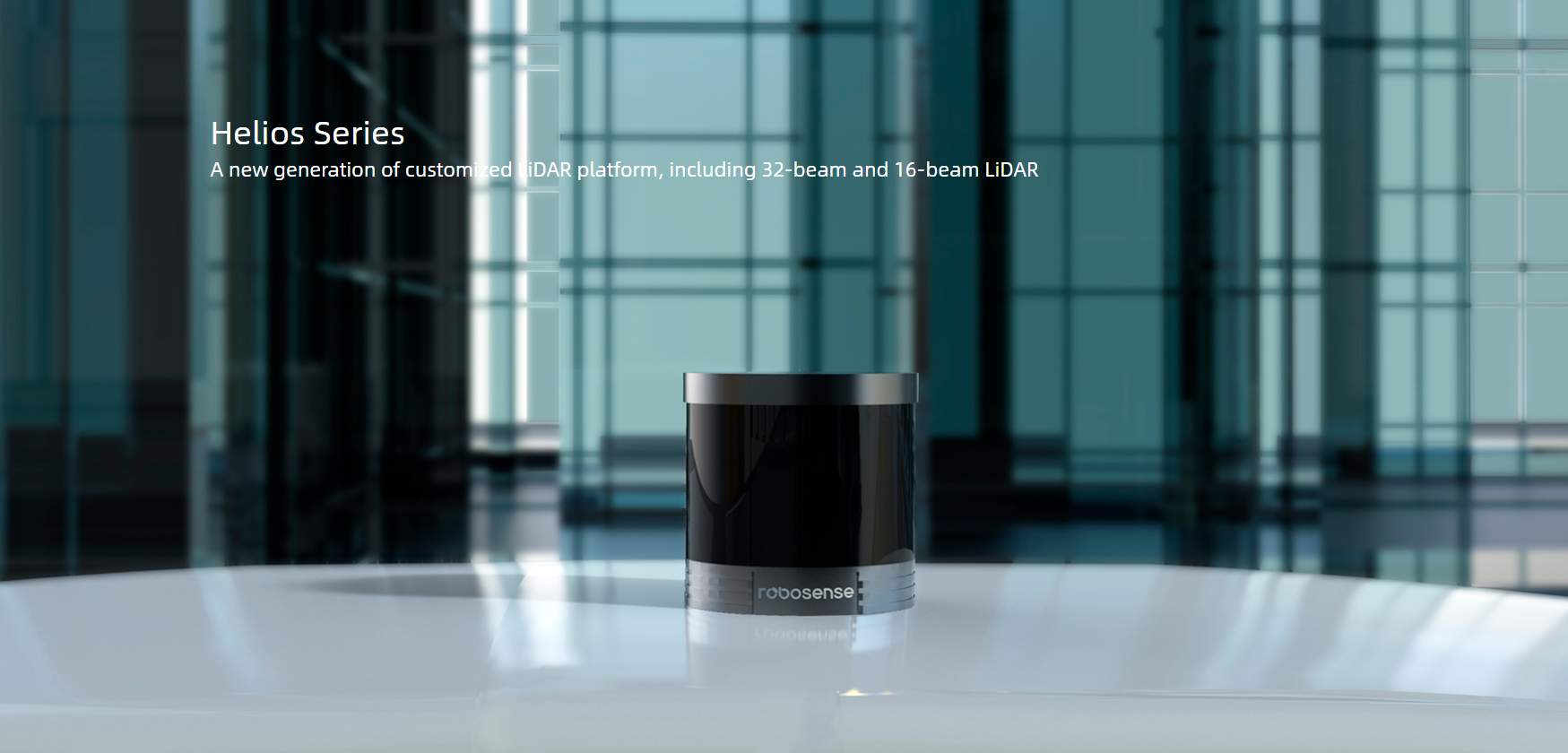
You need a LiDAR solution that matches your unique project demands. RoboSense Helios stands out with advanced integration capabilities, leading-edge performance, and a competitive cost structure. In fast-growing markets like automotive and robotics, understanding these differences ensures you make an informed decision.
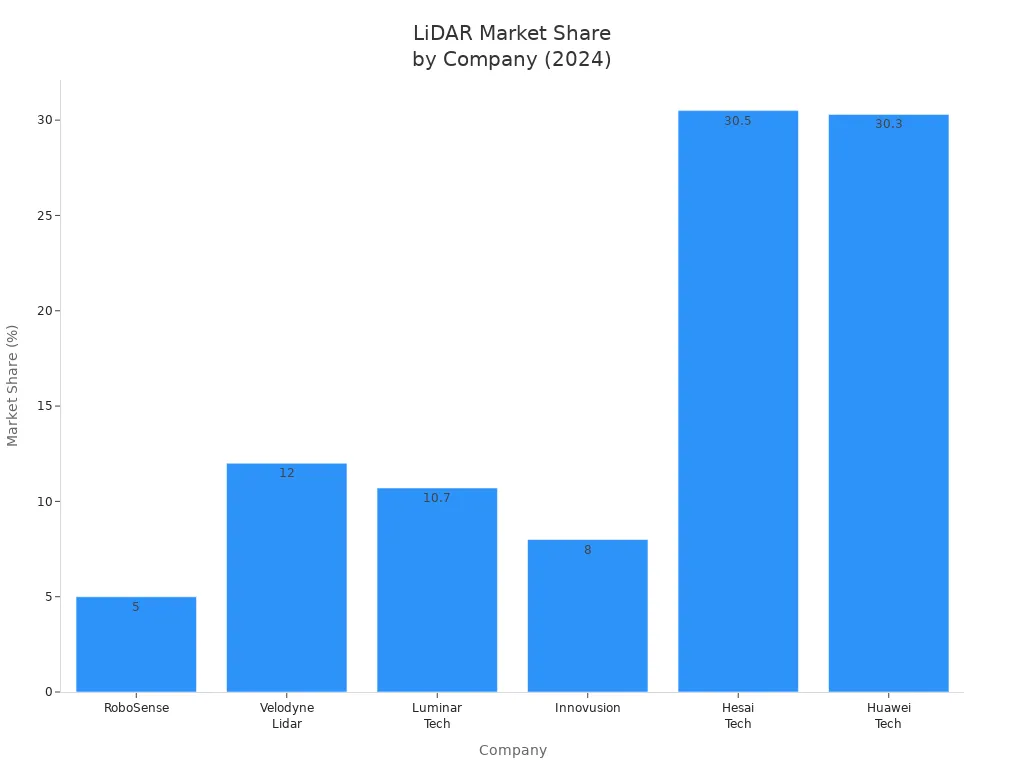
| Company | Market Share | Units Installed |
|---|---|---|
| RoboSense | 5% | 141,157 |
| Hesai Technology | 30.5% | 148,507 |
| Huawei Technologies | 30.3% | 147,849 |
Consider your application’s needs carefully as you explore which LiDAR system fits best.
Key Takeaways
- RoboSense Helios offers customizable line configurations, allowing you to choose between 16-line and 32-line models for different project needs.
- The Helios 32 model provides a wider field of view and higher detail, making it ideal for complex environments like urban areas.
- RoboSense Helios excels in range and accuracy, achieving up to 150 meters with an accuracy of ±2–3 cm, ensuring safe navigation for autonomous vehicles.
- Advanced noise reduction features in Helios help maintain data quality in challenging weather, improving reliability for your applications.
- The modular design of Helios reduces power consumption by up to 60%, extending battery life for mobile robots and electric vehicles.
- RoboSense Helios supports easy integration with various platforms, simplifying setup and reducing deployment time for your projects.
- Competitive pricing for Helios models allows you to maximize your investment without sacrificing essential features.
- Choosing a LiDAR system like RoboSense Helios ensures you have a reliable, high-performance solution tailored to your specific operational needs.
RoboSense Helios and Competitors Overview
Helios Series Highlights
You want a LiDAR solution that adapts to your project’s needs. RoboSense Helios offers a modular design with customizable line configurations. This flexibility allows you to select between 16-line and 32-line models, each tailored for specific environments. The 16-line model provides lower power demand and solid point cloud performance, making it ideal for lighter setups and cost-sensitive projects. The 32-line model delivers richer detail and multiple field of view options, including 26°, 31°, and 70°, which suit both indoor and outdoor applications. You benefit from advanced features like near-field blind spot reduction and robust environmental resistance, ensuring reliable operation in challenging conditions.
Discover more about the advanced features of Helios by visiting {Helios}!
| Feature/Model | Helios 16 | Helios 32 |
|---|---|---|
| Power Demand | Lower | Higher |
| Point Cloud Detail | Solid Performance | Richer Detail |
| Best Use Case | Lighter setups, low-cost option | Larger indoor areas, outdoor structural detail |
| Field of View Configurations | N/A | 26°, 31°, 70° |
Main Market Competitors
When you evaluate LiDAR options, you encounter several established brands. These companies position themselves in unique ways:
- One leading brand focuses on integrating hardware with advanced analytics, creating a strong ecosystem for users. Their products often achieve high safety certifications, which appeals to automotive manufacturers.
- Another major player leverages large-scale manufacturing to deliver high volumes of LiDAR units. This approach supports advanced driving platforms and emphasizes hardware scalability.
- A third competitor, after merging with another industry leader, has expanded its intellectual property and customer base. This move reflects the dynamic nature of the LiDAR market and the ongoing competition for market share.
You see these brands competing on cost, technology, and reliability, each aiming to address the evolving needs of autonomous vehicles, robotics, and smart infrastructure.
Why Compare These LiDARs?
A direct comparison helps you make informed decisions. You need to understand how each system performs in real-world scenarios. RoboSense Helios stands out with high range, very high accuracy, and superior resolution. You also benefit from easy integration, which reduces deployment time and complexity. Other leading brands may offer moderate range and good resolution, but you should weigh these factors against your project’s requirements.
| Feature | RoboSense Helios | Other Leading Brands |
|---|---|---|
| Range | High | Moderate |
| Accuracy | Very High | High |
| Resolution | Superior | Good |
| Integration Ease | Easy | Moderate |
Tip: When you compare LiDAR systems, focus on the features that impact your application most—such as range, accuracy, and ease of integration. This approach ensures you select the best fit for your project.
Key Feature Comparison
Modularity and Customization
Line Distribution Options
You need a LiDAR system that adapts to your specific operational environment. RoboSense Helios delivers this flexibility through its modular architecture and customizable line distribution. For example, the Helios 32 model offers both 70° ultra-wide and 26° vertical field of view (FoV) options. You can select the beam number distribution that best matches your application, whether you require dense coverage for complex urban intersections or focused detection for highway scenarios.
Consider a robotics integrator deploying autonomous delivery vehicles in a city. The team configures Helios 32 with a 70° FoV to maximize coverage below the horizon, reducing blind spots near curbs and obstacles. In contrast, a warehouse automation project might choose the 26° FoV with higher vertical angular resolution for precise object detection on shelving units. This level of customization ensures you always have the right tool for the job.
| Feature | Helios 32 (H32F70) | Helios 32 (H32F26) |
|---|---|---|
| Vertical FoV | 70° ultra-wide | 26° |
| FOV below horizon | 55° | N/A |
| Vertical angular resolution | N/A | Up to 0.5° |
| Perception distance | N/A | Longer than H32F70 |
| Customization options | Beam distribution | Beam distribution |
| Size comparison | 29% smaller | N/A |
| Cost comparison | 60% lower | N/A |
Field of View Flexibility
You often face environments with unique spatial challenges. RoboSense Helios allows you to tailor the field of view to your needs. For instance, the 70° ultra-wide FoV simplifies sensor placement on autonomous shuttles, covering both near-field and far-field zones in a single scan. This reduces the number of sensors required and streamlines installation.
In a real-world deployment for smart city traffic monitoring, engineers selected the 70° FoV to capture both pedestrian crossings and vehicle lanes with one sensor. This approach minimized infrastructure costs and improved data consistency across the network. The ability to configure FoV through web-based tools further enhances your deployment efficiency, letting you adjust settings remotely as project requirements evolve.
Performance Specs
Range and Accuracy
You demand reliable detection at both short and long distances. RoboSense Helios 32 achieves a maximum range of 150 meters with an accuracy of ±2–3 cm. This performance enables safe navigation for autonomous vehicles in mixed traffic conditions and supports precise mapping for surveying applications.
| Model | Maximum Range | Accuracy |
|---|---|---|
| Helios-32 | 150 meters | ± 2 – 3 cm |
| OS1-32 REV6 | 120 meters | ± 0.7 – 5 cm |
| Ruby | 250 meters | ± 3 cm |
| OS1-128 REV7 | 200 meters | ± 0.5 – 5 cm |
In a case study involving highway pilot systems, engineers relied on RoboSense Helios to detect vehicles and obstacles at high speeds. The sensor’s long-range capability and consistent accuracy ensured timely obstacle avoidance, even in low-visibility conditions. This level of performance supports mission-critical applications where safety cannot be compromised.
Vertical Resolution
Vertical resolution determines how well your LiDAR can distinguish objects at different heights. RoboSense Helios-32 provides up to 1.33° vertical angular resolution, which is suitable for most urban and industrial scenarios. While some sensors in the market offer finer resolution, the Helios-32 balances resolution with cost and power efficiency, making it a practical choice for large-scale deployments.
| Sensor | Vertical Angular Resolution |
|---|---|
| RoboSense Helios-32 | Up to 1.33° |
| Ouster OS1-32 | 0.7° |
For example, in a warehouse automation project, the Helios-32’s vertical resolution enabled accurate detection of stacked goods and overhead obstacles. This capability reduced collision risks and improved operational efficiency, demonstrating the practical impact of choosing the right resolution for your environment.
Reliability and Durability
Environmental Resistance
You need sensors that withstand harsh conditions. RoboSense Helios operates reliably in temperatures as low as -40°C and features IP67-rated protection against dust and water. This resilience ensures uninterrupted performance in outdoor environments, from snowy highways to dusty construction sites.
A mining company deployed RoboSense Helios on autonomous haul trucks. The sensors maintained full functionality during heavy rain and dust storms, providing consistent data for navigation and obstacle detection. This durability reduces maintenance costs and downtime, keeping your operations running smoothly.
Automotive-Grade Standards
Safety and compliance are critical in automotive and industrial applications. RoboSense Helios meets stringent automotive-grade standards, including ISO 13849, CE, and RoHS certifications. The system supports fail-safe mode activation, real-time data output, and redundancy for mission-critical operations.
| Metric | Description |
|---|---|
| Obstacle Avoidance Response Time | Under 10ms |
| Fail-Safe Mode Activation | Automatic system disable on fault |
| Redundancy Support | Dual-sensor setups for uptime |
| Real-Time Data Output | Immediate feedback for navigation |
| Certifications | ISO 13849, CE, RoHS |
| Environmental Ratings | IP67 or higher |
| Operating Temperature Range | -40°C to +85°C |
In a public transit pilot, RoboSense Helios enabled buses to operate safely in extreme weather. The system’s rapid response time and robust fail-safe mechanisms protected passengers and vehicles, meeting regulatory requirements and building trust with city authorities.
Tip: When selecting a LiDAR solution, always consider the operational environment and required certifications. This ensures your project meets both performance and safety standards.
Data Quality
Point Cloud Detail
You rely on LiDAR data to make critical decisions in real time. The quality of the point cloud determines how well your system perceives its environment. RoboSense Helios delivers high-density point clouds with precise spatial information. You get detailed object outlines and accurate distance measurements, which are essential for applications like autonomous driving, robotics, and mapping.
A high-quality point cloud helps you distinguish between small obstacles and background clutter. This clarity supports advanced perception algorithms and improves safety. The Helios series achieves this through optimized laser alignment and advanced signal processing. You see sharper edges, smoother surfaces, and fewer gaps in the data. This level of detail allows your system to detect objects at various distances and heights, even in complex environments.
| Feature | RoboSense Helios | Typical LiDAR Systems |
|---|---|---|
| Point Cloud Density | High | Moderate |
| Edge Sharpness | Enhanced | Standard |
| Small Object Detection | Reliable | Variable |
| Data Consistency | Stable | Fluctuates |
Note: High-density point clouds reduce the risk of missed detections and support more robust AI models.
Noise Reduction Features
Environmental noise can degrade LiDAR data, especially in rain, fog, snow, or dusty conditions. You need sensors that filter out this interference to maintain data integrity. RoboSense Helios incorporates advanced noise reduction algorithms that minimize false returns and suppress background noise.
You benefit from features like multi-echo detection and intelligent filtering. These technologies help your system distinguish between real obstacles and environmental artifacts. For example, when operating in heavy rain, the sensor filters out raindrop reflections, ensuring that only relevant objects appear in the point cloud. This capability keeps your perception system reliable, even in challenging weather.
- Key Noise Reduction Features:
- Multi-echo detection for accurate object identification
- Real-time filtering of rain, fog, and dust interference
- Adaptive algorithms that adjust to changing environments
Tip: Consistent data quality in all weather conditions increases the reliability of your autonomous or robotic system.
Power and Integration
Power Efficiency
You want a LiDAR solution that balances performance with energy consumption. Power efficiency becomes crucial when you deploy multiple sensors or operate in battery-powered platforms. RoboSense Helios uses a modular design that reduces overall power demand without sacrificing data quality.
The compact architecture lowers energy requirements by up to 60% compared to previous generations. This efficiency extends operational time for mobile robots and electric vehicles. You can integrate more sensors into your system without overloading the power supply. Lower power consumption also means less heat generation, which improves long-term reliability.
| Metric | RoboSense Helios | Previous Generation |
|---|---|---|
| Power Consumption | Low | Higher |
| Heat Output | Minimal | Moderate |
| Battery Life Impact | Extended | Standard |
Efficient power use translates to longer mission durations and reduced maintenance needs.
Software and Interface Support
Seamless integration is essential for rapid deployment and ongoing system management. RoboSense Helios supports web-based configuration and real-time monitoring. You can adjust sensor parameters remotely, update firmware, and diagnose issues without physical access to the device.
The system offers broad compatibility with industry-standard communication protocols. This flexibility allows you to connect the sensor to a wide range of platforms, from autonomous vehicles to industrial robots. The intuitive interface simplifies setup and reduces the learning curve for your engineering team.
- Integration Highlights:
- Web-based configuration and diagnostics
- Support for multiple communication protocols (Ethernet, CAN, etc.)
- Real-time data streaming for immediate feedback
- Easy firmware updates and remote troubleshooting
When you choose a LiDAR system with robust software support, you streamline both initial deployment and long-term maintenance.
Cost and Value
Pricing Comparison
You want to maximize your investment when selecting a LiDAR system. Pricing plays a critical role in your decision. RoboSense Helios offers competitive retail and OEM pricing, making advanced LiDAR technology accessible for a wide range of applications. The following table summarizes current market prices for popular models:
| Product Name | Price (USD) | Range (m) | Precision (cm) | Features |
|---|---|---|---|---|
| Helios 16 | $1,909.00 | 150 | 1 | 3 optional vertical FOV |
| Helios 32 | $1,918.00 | 150 | 1 | Customized for robots and vehicles |
| RS-Helios-16P | €1,320.00 | 150 | 1 | Multi-beam LiDAR for scene apps |
You see that the price difference between the 16-line and 32-line models remains minimal. This allows you to choose the right configuration based on your project’s technical needs rather than budget constraints. For organizations operating in Europe, the RS-Helios-16P provides an affordable option with VAT included.
Note: Pricing can fluctuate based on order volume, region, and integration requirements. For the latest updates, you can refer to industry news sources or follow discussions on LinkedIn.
Ownership Costs
You need to consider more than just the purchase price. Ownership costs include installation, maintenance, energy consumption, and potential downtime. RoboSense Helios uses a modular design that reduces installation time and simplifies integration. You spend less on labor and system configuration. The energy-efficient architecture lowers operational costs, especially for battery-powered robots and electric vehicles.
Imagine a logistics company deploying a fleet of autonomous forklifts. The company selects Helios 16 for its balance of performance and cost. Over a year, the reduced power consumption and minimal maintenance requirements save thousands of dollars compared to legacy systems. The robust design also means fewer sensor replacements, which keeps your fleet running and avoids costly interruptions.
Tip: Calculate total cost of ownership by factoring in installation, energy, and maintenance. This approach gives you a clearer picture of long-term value.
Support and Warranty
You want reliable support throughout your product’s lifecycle. RoboSense Helios comes with comprehensive warranty coverage and responsive technical support. You receive assistance from initial setup to ongoing operation. The company provides web-based diagnostics and remote firmware updates, which minimize downtime and keep your system current.
A city transit authority recently upgraded its autonomous shuttle program. The team valued the prompt support and clear documentation provided by RoboSense. When a sensor required recalibration, engineers accessed remote troubleshooting tools and resolved the issue within hours. This level of service ensures your projects stay on track and your investment remains protected.
For more details on support policies and warranty terms, you can visit the official RoboSense support page or connect with industry peers on Twitter.
Reliable support and warranty coverage reduce risk and increase confidence in your technology investment.
Application Suitability
Autonomous Vehicles
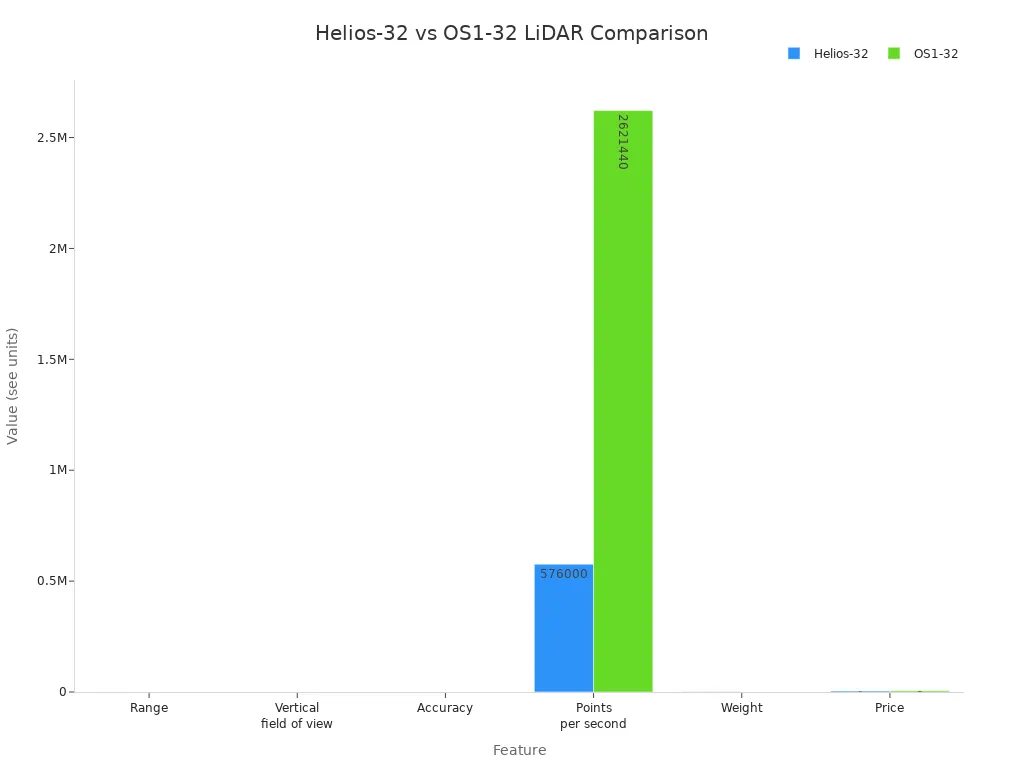
You gain a longer detection range and a wider vertical field of view, which are essential for complex urban and highway scenarios. These advantages help your vehicle detect obstacles, pedestrians, and road features with fewer blind spots. The following chart visually highlights the differences in range and field of view:
Note: A wider field of view reduces the number of sensors needed, streamlining your vehicle’s design and integration process.
Robotics and Automation
You need sensors that adapt to dynamic environments and deliver consistent performance. In robotics and automation, data rate, field of view, and power efficiency are top priorities. RoboSense Helios offers a 360° horizontal field of view and a 30° vertical field of view, ensuring comprehensive coverage for mobile robots and automated guided vehicles. The table below summarizes the main performance metrics:
| Metric | Value |
|---|---|
| Data Rate | 576,000 pts/s (dual return) |
| Range | 150 m (90 m @ 10% NIST) |
| Range Accuracy | ±2 cm (1 m to 100 m) |
| Horizontal Field of View | 360° |
| Vertical Field of View | 30° (-15° ~ +15°) |
| Frame Rate | 10 Hz / 20 Hz |
| Rotation Speed | 600 / 1200 rpm |
| Power Consumption | 11 W |
| Ingress Protection | IP67 |
| Operating Temperature | -30 °C ~ +60 °C |
| Weight | ~900 g |
You benefit from robust ingress protection and a wide operating temperature range, which means your robots can function reliably in warehouses, factories, or outdoor environments. The efficient power consumption supports longer operational cycles, reducing downtime and maintenance.
Mapping and Surveying
You demand high accuracy and dense point clouds for mapping and surveying tasks. Consistent measurements and reliable data quality are essential for creating precise digital models. RoboSense Helios delivers dense and accurate measurements up to 150 meters, supporting both static and dynamic mapping scenarios. Consider these key points:
- You achieve precise and dense measurements, matching the performance of top-tier sensors.
- You receive consistent width measurements for moving vehicles, which improves the reliability of your mapping results.
- You avoid scan pattern inconsistencies, ensuring that your data remains accurate across different environments.
Tip: High-density and accurate point clouds enable you to create detailed maps for infrastructure planning, construction, and asset management.
If you want to explore more about LiDAR applications in these fields, you can find additional resources on Lidar News or connect with industry professionals on LinkedIn.
Smart City and Security
You face unique challenges when deploying LiDAR in smart city and security environments. Urban infrastructure demands sensors that deliver reliable performance, compact form factors, and seamless integration with existing systems. RoboSense Helios addresses these needs with a feature set tailored for city-scale deployments and critical security applications.
You benefit from long-range detection capabilities, with Helios models reaching up to 200 meters. This extended range allows you to monitor wide intersections, busy pedestrian zones, and large public spaces with fewer sensors. High accuracy ensures that you capture precise data for vehicle tracking, crowd management, and perimeter surveillance. You can trust the system to distinguish between moving objects and static infrastructure, which enhances situational awareness for city operators and security teams.
The compact design of RoboSense Helios simplifies installation on streetlights, traffic poles, or building facades. You save valuable space and reduce visual clutter in urban landscapes. The sensor’s robust environmental resistance means you can deploy it outdoors, where it withstands rain, dust, and extreme temperatures. This durability keeps your smart city network operational year-round.
You also gain compatibility with the Robot Operating System (ROS), which streamlines integration with smart city platforms and security management software. This compatibility enables real-time data sharing across multiple systems, supporting applications such as automated incident detection, traffic flow optimization, and emergency response coordination.
The following table summarizes the key features that make RoboSense Helios an ideal choice for smart city and security projects:
| Feature | RoboSense Helios |
|---|---|
| Long Range | 150m, 200m |
| High Accuracy | Yes |
| Compact Design | Yes |
| ROS Compatibility | Yes |
| Ideal for Applications | Road safety, surveillance |
You can leverage these features to enhance road safety by monitoring intersections for red-light violations or near-miss incidents. In security scenarios, you detect unauthorized access or suspicious behavior in real time, enabling faster response and improved public safety.
Tip: When you deploy LiDAR for smart city or security use, prioritize sensors that offer both high accuracy and robust integration options. This approach ensures your investment delivers long-term value and supports future technology upgrades.
For more insights on LiDAR’s role in smart cities and security, you can explore resources from Lidar News or follow industry discussions on LinkedIn.
Recommendations
Performance-Driven Choices
If you prioritize top-tier performance in your LiDAR selection, you should focus on models that deliver long-range detection and high accuracy. RoboSense Helios-32 stands out in this category. You benefit from a detection range of up to 200 meters and precise measurements, which are essential for advanced autonomous driving and robotics. The Helios-32 model forms part of a comprehensive portfolio, giving you flexibility for different project needs. You also gain confidence from RoboSense’s strong reputation, built through innovation and partnerships with over 30 leading automotive suppliers. This makes Helios-32 a reliable choice when your application demands the highest standards in perception and safety.
Tip: For mission-critical projects, always choose a LiDAR system with proven market leadership and robust industry partnerships.
Budget-Focused Options
You may need to balance performance with cost, especially for large-scale deployments or pilot projects. The following table compares popular LiDAR models that offer strong value for budget-conscious buyers:
| Product | Price | Range | Field of View | Points per Second | Design |
|---|---|---|---|---|---|
| RoboSense Helios-32 | €4560 | High | Wide | Moderate | Compact |
| Leading Competitor | €5657.15 | Moderate | Moderate | High | Compact |
You see that RoboSense Helios-32 provides a high range and wide field of view at a lower price point. This allows you to maximize your investment without sacrificing essential features. The compact design also reduces installation costs and simplifies integration.
Note: Always consider both upfront price and long-term value when evaluating LiDAR solutions.
Best Fit by Application
Your application requirements should guide your final decision. The table below highlights how RoboSense Helios compares to other market options across key features:
| Feature | RoboSense Helios | Competitors |
|---|---|---|
| Customizable Field of View | Yes | Varies |
| Performance in Adverse Conditions | High | Varies |
| Point Cloud Density | Adjustable | Fixed |
| Range Precision | High | Varies |
| Size | 29% smaller | N/A |
| Cost | 60% lower | N/A |
| Modular Architecture | Yes | N/A |
You gain flexibility with customizable field of view and adjustable point cloud density. These features help you tailor the sensor to your unique environment, whether you work in autonomous vehicles, robotics, mapping, or smart city projects. The smaller size and modular design make Helios easy to deploy in space-constrained locations. You also benefit from high reliability in challenging weather, which is critical for outdoor and industrial applications.
For further guidance on LiDAR selection, you can explore resources from Lidar News or connect with industry experts on LinkedIn.
Comparison Table
RoboSense Helios vs Competitors
You want to make an informed decision when selecting a LiDAR solution for your project. Comparing RoboSense Helios with other leading models helps you understand the practical differences that impact performance, integration, and value. The table below summarizes key specifications and features, allowing you to evaluate each system based on quantifiable metrics.
| Feature | RoboSense Helios | Competitor Model |
|---|---|---|
| Number of laser beams | 32 | 32 |
| Laser wavelength | 905 nm | 865 nm |
| Range | 150 meters | 120 meters |
| Vertical field of view | 70° (-55° to +15°) | 45° (-22.5° to +22.5°) |
| Vertical angular resolution | Up to 1.33° | 0.7° |
| Horizontal angular resolution | 360° | 360° |
| Accuracy | ± 2 – 3 cm | ± 0.7 – 5 cm |
| Points per second | 576,000 pts/s (Single Return) 1,152,000 pts/s (Double Return) | Up to 2,621,440 pts/s |
| Rotational frequency | 10 or 20 Hz | 10 or 20 Hz |
| Power consumption | 12 W | 14 – 20 W |
| Weight | 1000 g | 447 g |
| Protection rating | IP67 | IP68, IP69K |
| Operating temperature | -30° to +60 °C | -40 °C to +60 °C |
| Price | €4560 incl. VAT | €5657 incl. VAT |
📝 Tip: Focus on the specifications that matter most for your application, such as range, field of view, and power consumption. These factors directly affect system performance and operational costs.
You notice that RoboSense Helios offers a wider vertical field of view and longer detection range. This advantage allows you to cover more area with fewer sensors, which can simplify installation and reduce overall system complexity. The modular design of Helios also supports flexible configuration, letting you tailor the sensor to your environment.
The competitor model provides higher point cloud density, which may benefit applications requiring extremely detailed mapping. However, RoboSense Helios balances data quality with lower power consumption and a compact form factor, making it ideal for mobile platforms and energy-sensitive deployments.
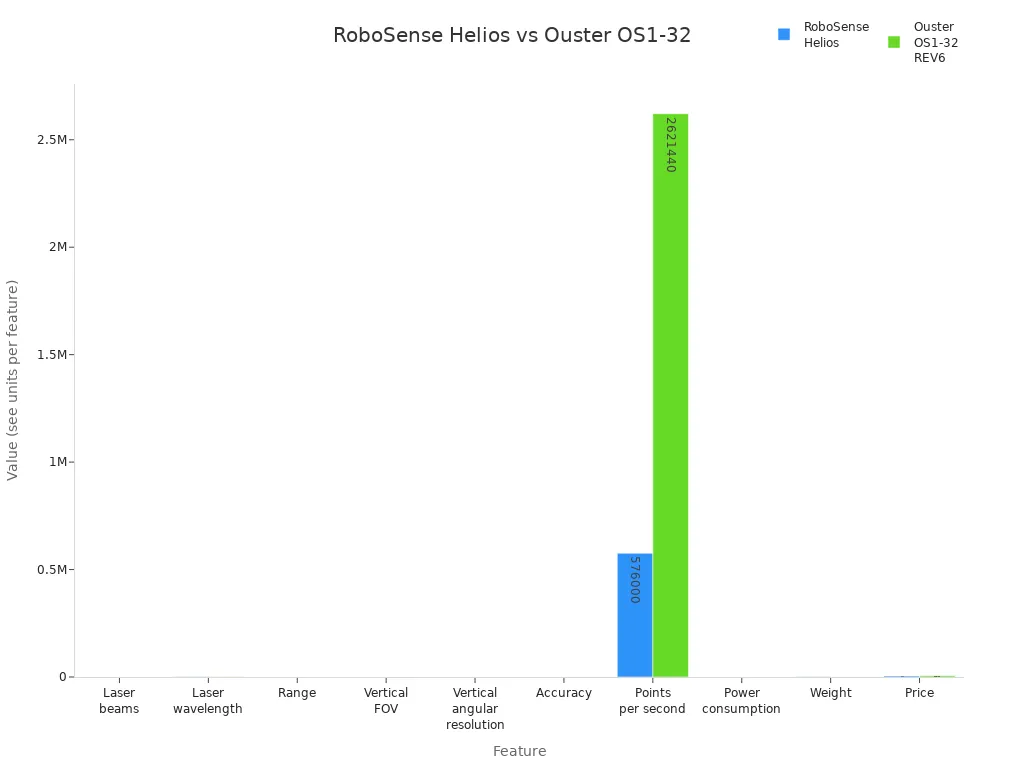
You see from the chart that RoboSense Helios excels in range and vertical field of view, while the competitor model leads in point cloud density and protection rating. Consider your project’s priorities when weighing these differences.
- If you need robust performance in diverse environments, Helios delivers with its wide operating temperature range and IP67 protection.
- For projects where every watt counts, Helios’s lower power consumption helps extend battery life and reduce heat output.
- When budget matters, Helios provides advanced features at a more accessible price point.
For further technical details and industry benchmarks, you can visit Lidar News or follow updates on LinkedIn.
You gain a clear advantage by choosing RoboSense Helios for high-resolution 3D mapping, robust obstacle detection, and reliable performance in diverse environments. The table below highlights key decision factors:
| Consideration | Details |
|---|---|
| Environmental Factors | Match sensor to outdoor or indoor use |
| Ease of Implementation | Evaluate built-in processing and integration |
| Cost | Balance features with your budget |
- For technical details, visit Lidar News or LinkedIn.
FAQ
What makes RoboSense Helios different from other multi-line LiDAR solutions?
You gain modular architecture, customizable field of view, and advanced environmental resistance. These features help you adapt the sensor to your specific application. You also benefit from reduced size and cost.
Learn more at Lidar News.
Can you use RoboSense Helios in extreme weather conditions?
You can deploy RoboSense Helios in temperatures as low as -40°C. The sensor resists dust, water, and strong light interference. This durability ensures reliable operation in harsh environments.
How does the customizable field of view benefit your project?
You select the field of view that matches your needs. Wide vertical coverage reduces blind spots. Precise angular resolution improves object detection. You optimize sensor placement and minimize installation costs.
Is RoboSense Helios compatible with popular robotics and vehicle platforms?
You integrate RoboSense Helios easily with standard communication protocols. The sensor supports web-based configuration and monitoring. You connect it to autonomous vehicles, robots, and smart city systems without complex setup.
What is the typical range and accuracy of RoboSense Helios?
You achieve detection up to 150 meters with accuracy of ±2–3 cm. This performance supports safe navigation and precise mapping in various applications.
How does RoboSense Helios help reduce total ownership costs?
You save on installation and maintenance due to the modular design. Lower power consumption extends battery life. Fewer replacements and remote diagnostics minimize downtime.
Where can you find technical support and product updates?
You access support and updates through the RoboSense official support page.









