
Executive Summary
The pursuit of full autonomy has long been dominated by the quest for longer range—the ability to see farther down the highway. Yet for vehicles and robots operating in the real world, what happens in the immediate vicinity is equally critical. The areas closest to the machine—the blind spots around its fenders, bumpers, and sides—represent some of the most challenging and safety-critical perception scenarios. A pedestrian stepping out from behind a parked car, a cyclist pulling alongside a truck, a low obstacle directly in the path of an autonomous forklift—these are the edge cases that separate a functional system from a truly safe one.
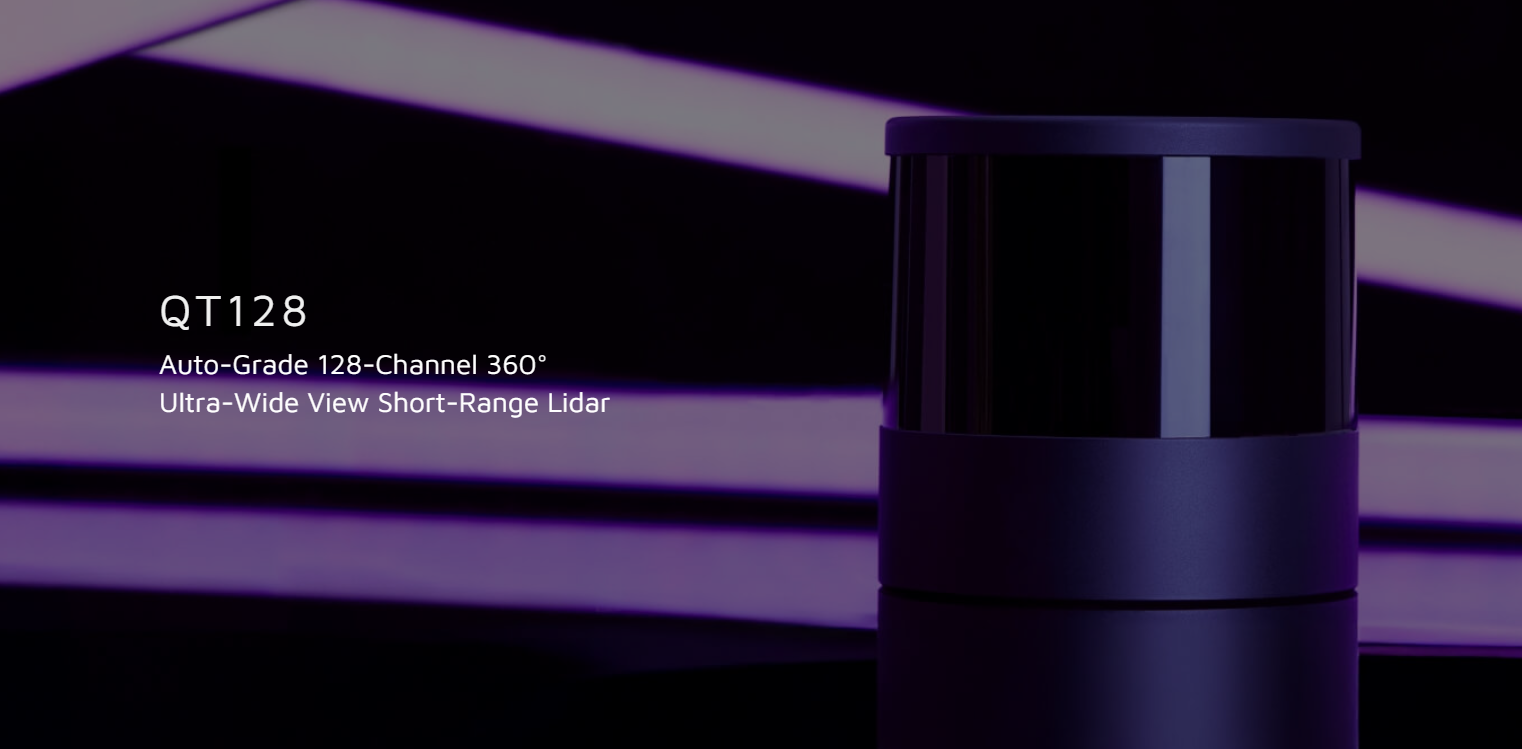
Hesai Technology’s QT128 is engineered specifically to address this challenge. As an automotive-grade 128-channel 360° ultra-wide view short-range LiDAR, the QT128 delivers an extraordinary 105.2° vertical field of view, providing comprehensive coverage of the near-field environment that other sensors cannot see . With 20-meter detection at 10% reflectivity, 1.15 million points per second, and ISO 26262 ASIL B functional safety certification, it is the ideal blind-spot solution for L4 robotaxis, autonomous trucks, and industrial robotics .
This comprehensive report provides an in-depth analysis of the Hesai QT128. We will examine its revolutionary 105° vertical FOV architecture, dissect its key specifications and how they enable true near-field perception, explore its critical role in L4 autonomous vehicle safety, and evaluate its growing adoption in industrial automation through strategic partnerships with companies like CRATUS . For sophisticated clients in Russia, Europe, and North America seeking to eliminate blind spots and achieve true 360° situational awareness, the QT128 represents the gold standard in short-range perception.
1. Introduction: The Blind Spot Imperative in Autonomous Systems
The history of autonomous vehicle development has been characterized by a natural focus on forward perception. After all, the most critical safety scenarios—highway collisions, rear-end accidents, obstacle avoidance—involve what lies ahead. This focus has yielded remarkable progress: today’s forward LiDARs can detect dark-colored vehicles at 200 meters and small obstacles at distances that provide ample reaction time.
Yet as autonomous vehicles graduate from highway piloting to full urban operation, a different set of challenges has emerged. Consider the following scenarios:
- Unprotected Left Turn: A robotaxi must execute a left turn across oncoming traffic, requiring precise awareness of vehicles approaching from multiple directions, including the blind spot to the left-rear where a motorcycle may be approaching.
- Roadside Pickup: A passenger hails a ride from the curb. The vehicle must pull over safely while tracking cars, cyclists, and pedestrians approaching from behind on the right side—a classic blind spot scenario.
- Lane Change in Heavy Traffic: Merging into dense highway traffic requires confidence that no vehicle is lurking in the adjacent lane just beyond the side mirror’s view.
- Low Obstacle Detection: A child’s toy, a fallen branch, or a small animal may be invisible to sensors with narrow vertical FOV, yet pose significant risks if not detected.
Traditional solutions have proven inadequate. Corner radars provide range but lack the angular resolution to precisely locate and classify objects. Side-view cameras offer visual information but struggle in low light and cannot provide accurate 3D positioning. Even short-range LiDARs often lack the vertical field of view to capture the full height of nearby objects—from ground level to vehicle roof height .
Hesai recognized that what the industry needed was not an incremental improvement to existing sensor types, but a purpose-built solution designed from the ground up for near-field blind-spot perception. The QT128 is that solution .
2. QT128: Technical Architecture and Core Specifications
2.1 The 105° Vertical Field of View Advantage
The QT128’s most distinctive and valuable characteristic is its industry-leading 105.2° vertical field of view, spanning from -52.6° to +52.6° . This is not merely an incremental improvement; it represents a fundamental rethinking of what near-field perception requires.
Why 105° Matters:
- Complete Ground-to-Sky Coverage: With 105° vertical FOV, the QT128 simultaneously sees the ground immediately adjacent to the vehicle and captures overhead structures such as traffic lights, signs, and building overhangs. No other short-range sensor in its class offers this comprehensive vertical coverage .
- Pedestrian Detection at Any Height: A pedestrian standing directly next to the vehicle is captured from foot to head, enabling reliable classification and tracking even at the closest ranges where other sensors would see only legs or torso.
- Small Animal Detection: Low-to-the-ground obstacles like small animals, debris, or curbs are detected reliably, eliminating the “ground blind spot” that plagues sensors with narrower vertical FOV.
- Vehicle Profile Capture: When another vehicle pulls alongside, the QT128 captures its full profile—from tire to roof—enabling accurate classification and relative positioning.
2.2 Detailed Technical Specifications
The following specifications are compiled from Hesai’s official documentation and verified by authorized distributors serving European and North American markets .
2.3 Optimized Detection Range for Blind-Spot Applications
The QT128’s detection range of 20 meters at 10% reflectivity is carefully calibrated for its intended role as a blind-spot sensor . This is not a limitation but a deliberate design optimization:
- Matched to Application Requirements: For near-field perception, 20 meters is sufficient to cover adjacent lanes, crosswalks, and intersection approaches. Over-specifying range would increase cost and power consumption without providing meaningful safety benefits.
- Graded Performance by Channel: The sensor’s 128 channels are not uniform. The central channels (9-120) deliver the full 20m @10% performance, while the extreme upper and lower channels (1-8, 121-128) provide 15m @10% . This “foveated” design concentrates performance where it matters most—at the horizon—while maintaining comprehensive coverage at the FOV extremes.
- Zero Blind Spot Near-Field: With an instrumented range starting at just 0.05 meters, the QT128 can detect objects literally touching the sensor housing . This ensures that no obstacle, no matter how close, goes undetected.
2.4 High-Resolution Point Cloud for Reliable Classification
With 1.15 million points per second in single return mode (1.73 million in dual return), the QT128 provides sufficient point density for reliable object classification at close range .
What This Means for Perception:
- Pedestrian Classification: At 10 meters, a pedestrian is captured with dozens of points, enabling the perception stack to distinguish a person from a pole or a bicycle with high confidence.
- Vehicle/Obstacle Discrimination: A car’s shape is clearly distinguishable from a large trash bin or a construction barrier, reducing false positives and enabling appropriate system responses.
- Small Object Detection: Objects as small as 10-15 cm in size are detectable at ranges up to 10-15 meters, ensuring that low-profile hazards are not missed.
2.5 Automotive-Grade Functional Safety: ISO 26262 ASIL B
In April 2023, Hesai announced that the QT128 had obtained ISO 26262 ASIL B Functional Safety Certification, verified by SGS, one of the world’s leading testing and certification organizations .
The Significance of ASIL B Certification:
Functional safety is not merely a technical checkbox; it is a fundamental requirement for any sensor intended for use in safety-critical applications. ISO 26262 is recognized as the world’s most leading automotive functional safety standard, covering the entire product lifecycle—from concept and development through production and operation .
What This Certification Means for Integrators:
- Comprehensive Safety Analysis: Hesai’s R&D team conducted a thorough safety analysis of every internal module, generating thousands of failure analysis reports .
- Dozens of Safety Mechanisms: Multiple safety mechanisms were designed and rigorously verified through fault injection tests .
- Risk Detection and Mitigation: Lidar certified by functional safety can detect potential risks in electronic systems, sending alarms to the autonomous driving system and initiating protections—such as correcting the device, providing mitigation measures, or safely exiting autonomous states to minimize damage .
The QT128’s ASIL B certification means it can support vehicles in meeting the relevant requirements of ASIL D, the highest functional safety level for autonomous driving systems .
2.6 Comprehensive Cybersecurity: ISO 21434 Compliance
Beyond functional safety, the QT128 is developed in compliance with ISO 21434, the international standard for automotive cybersecurity .
Cybersecurity Features:
- Secure Development Process: The entire product development lifecycle follows cybersecurity best practices.
- Data Integrity: Protection against tampering and unauthorized access ensures that the perception data reaching the vehicle’s computing platform is trustworthy.
- Authentication and Encryption: Secure communication protocols prevent malicious interference with sensor operation.
As Hesai’s CTO Xiang Shaoqing stated upon receiving the ASIL B certification: “QT128 received the certification for its functional safety and reliability. This certification is significant for the autonomous driving system to achieve higher-level functions, pass higher-level safety standards, and accelerate mass production” .
2.7 Environmental Ruggedization: IP6K7 & IP6K9K
The QT128 is built to withstand the harshest environmental conditions :
- IP6K7: Complete protection against dust ingress, and protection against temporary immersion in water.
- IP6K9K: Protection against high-pressure, high-temperature washdowns—essential for vehicles that will be cleaned in automatic car washes or exposed to severe weather.
With an operating temperature range of -40°C to +85°C, the QT128 is suitable for deployment in all climates, from Russian winters to desert summers .
2.8 Compact Form Factor and Lightweight Design
Measuring just 83.9 mm in height and weighing only 700 grams, the QT128 is remarkably compact for a 128-channel 360° sensor . This small size and light weight provide exceptional flexibility in vehicle and robot integration:
- Discreet Mounting: Can be integrated into body panels, bumpers, or roof modules without compromising vehicle styling.
- Minimal Payload Impact: For UAV and small robot applications, the 700g weight minimizes impact on flight time and mobility.
- Flexible Positioning: Can be mounted in locations where larger sensors simply wouldn’t fit.
3. Transformative Application Scenarios
The QT128’s unique combination of ultra-wide vertical FOV, 360° coverage, and automotive-grade safety certification makes it applicable across a broad spectrum of applications.
3.1 L4 Robotaxis and Autonomous Ride-Hailing
The QT128 has rapidly become the preferred blind-spot solution for the world’s leading L4 autonomous driving companies .
Why Robotaxi Leaders Choose QT128:
- Comprehensive Blind Spot Elimination: The 105° vertical FOV ensures that no area around the vehicle—from ground level to roof height—goes unobserved. Pedestrians, cyclists, and small obstacles are detected the moment they enter the near-field zone .
- Redundancy with Long-Range Sensors: In a typical robotaxi configuration, QT128s work in concert with long-range sensors like the AT128 to create a comprehensive perception suite. While the AT128 handles distant detection, QT128s manage the critical near-field zone, ensuring safe maneuvering in tight urban environments.
- Proven in Testing: The QT128 has passed over 50 design validation tests, ensuring reliability during long operating hours—essential for commercial robotaxi fleets .
Customer Validation:
At the Xponential 2023 Expo, Hesai showcased the QT128 alongside the AT128 and XT32, highlighting its role as the “ideal blind spot solution for L4 robotaxis and robotrucks” .
3.2 Autonomous Trucking and Heavy-Duty Vehicles
For long-haul trucks, blind spots are a persistent safety concern. The QT128 addresses this challenge directly.
Truck-Specific Advantages:
- Elimination of Large Blind Zones: The 105° vertical FOV captures vehicles, pedestrians, and obstacles that would otherwise be invisible in the truck’s massive blind spots.
- Dock and Yard Maneuvering: When backing into loading docks or navigating tight yard spaces, the QT128’s near-field detection ensures safe operation.
- All-Weather Reliability: With IP6K7/IP6K9K protection and -40°C to +85°C operation, the QT128 is built for the demanding conditions of long-haul trucking.
3.3 Industrial Automation: AGVs and Autonomous Forklifts
Perhaps the most significant emerging application for the QT128 is in industrial automation, where it is transforming the capabilities of Automated Guided Vehicles (AGVs) and Autonomous Mobile Robots (AMRs) .
The CRATUS Partnership:
In May 2023, Hesai announced a strategic partnership with CRATUS, a software solution integrator for lidar systems, to develop autonomous warehouse solutions using the QT128 . CRATUS selected the QT128 as the lead sensor in its all-new lidar perception package for AGVs and AMRs.
Why CRATUS Chose QT128:
- 360° Horizontal FOV vs. 270°: Traditional 2D laser scanners typically provide only 270° or less horizontal coverage. The QT128’s full 360° horizontal FOV eliminates AGVs’ blind spots completely, avoiding potential safety risks caused by “not seeing” .
- 128 Channels vs. 1 Channel: Compared to 2D lidar, which typically has only one laser channel, the QT128’s 128 channels provide:
- Functional Safety Certification: The QT128’s ISO 26262 ASIL B certification enables new levels of safety in automated industrial applications. Lidar certified by functional safety can detect potential risks in electronic systems, sending alarms and initiating protections, allowing AGVs to operate safely and more efficiently .
CRATUS CEO Perspective:
“We are embarking on a revolution within the warehouse. These facilities are increasingly becoming more automated and efficient. By utilizing the QT128, with its recent safety rating certification, we are now able to release a host of new software products which will increase the capabilities and overall safety of these solutions within the material handling sector” .
3.4 Smart Infrastructure and Traffic Monitoring
Beyond on-vehicle applications, the QT128 is suitable for fixed installation in smart infrastructure applications.
Intersection Monitoring:
Mounted at intersections, QT128s can provide comprehensive 360° coverage of approaching traffic, cyclists, and pedestrians, feeding real-time data to traffic management systems and connected vehicles. The 105° vertical FOV ensures that both ground-level activity and overhead traffic signals are captured simultaneously.
Pedestrian Crosswalk Protection:
QT128s positioned at crosswalks can detect pedestrians waiting to cross or entering the roadway, triggering warnings to approaching vehicles or directly controlling traffic signals.
3.5 Security and Surveillance
For perimeter security and area monitoring applications, the QT128’s 360° coverage and 128-channel resolution provide comprehensive situational awareness. The sensor’s 20-meter range at 10% reflectivity is well-suited for monitoring building perimeters, restricted zones, and outdoor facilities .
4. Value Proposition and Cost-Effectiveness
For sophisticated clients in European, North American, and Russian markets, the QT128 offers compelling advantages across multiple dimensions.
4.1 Unmatched Vertical Coverage Eliminates Blind Spots
The QT128’s 105° vertical FOV is its most distinctive and valuable attribute. No other short-range 360° sensor in its class provides this level of vertical coverage . For applications where near-field safety is paramount—robotaxis, autonomous trucks, industrial AGVs—this comprehensive coverage is not a luxury; it is a fundamental requirement for safe operation.
4.2 True Redundancy Through 128-Channel Architecture
Unlike 2D sensors with a single laser channel, the QT128’s 128-channel architecture provides inherent redundancy . In challenging environments with strong ambient light or partial sensor obstruction, the remaining channels continue to provide reliable data. This redundancy is essential for safety-critical applications where a single point of failure is unacceptable.
4.3 Automotive-Grade Safety and Reliability
The QT128 is not a “lab-grade” prototype; it is an automotive-grade sensor with:
- ISO 26262 ASIL B Functional Safety Certification: Enables integration into safety-critical systems .
- ISO 21434 Cybersecurity Compliance: Protects against tampering and ensures data integrity .
- IP6K7 & IP6K9K Environmental Protection: Withstands dust, water, and high-pressure washdowns .
- -40°C to +85°C Operating Range: Suitable for global deployment in all climates .
- Over 50 Design Validation Tests: Proven reliability for continuous operation .
4.4 Cost-Effective for Volume Deployment
With a European market price of approximately €5,088 (excl. VAT) and availability through distributors in India at approximately ₹707,789, the QT128 delivers 128-channel performance at a price point suitable for commercial-scale deployment . For applications where near-field perception is critical, this represents exceptional value.
4.5 Simplified Integration with Standard Interfaces
The QT128’s use of 1000BASE-T1 automotive Ethernet and PTP time synchronization ensures seamless integration into modern vehicle and robot architectures . System integrators can focus on application logic rather than wrestling with proprietary interfaces or complex synchronization challenges.
4.6 Proven Industry Adoption
The QT128’s selection by leading L4 developers and its role as the lead sensor in CRATUS’s AGV/AMR perception package provide strong validation of its real-world effectiveness . For clients evaluating sensor options, this proven industry adoption significantly reduces technology risk.
5. Conclusion: The Essential Component for Complete 360° Safety
The Hesai QT128 represents a fundamental advancement in near-field perception technology. With its industry-leading 105° vertical field of view, 128-channel resolution, and comprehensive automotive-grade safety certifications, it addresses the critical blind-spot challenges that have long limited the safe deployment of autonomous systems.
For clients in Russia, Europe, and North America, the QT128 offers a unique combination of capabilities:
- Unmatched Vertical Coverage: 105.2° FOV ensures comprehensive detection from ground level to overhead structures .
- Proven Safety: ISO 26262 ASIL B certification enables integration into safety-critical systems .
- Industrial Ruggedness: IP6K7/IP6K9K protection and -40°C to +85°C operation ensure reliability in all environments .
- Scalable Performance: 1.15 million points per second and 0.4° resolution provide rich data for reliable object classification .
- Market Validation: Adopted by leading L4 developers and selected by CRATUS for next-generation AGV/AMR systems .
The QT128 is not merely a sensor; it is an essential safety component that transforms blind spots into fully perceived, continuously monitored spaces. For autonomous vehicles, industrial robots, and smart infrastructure applications where safety is paramount, the Hesai QT128 provides the comprehensive near-field perception that the industry has long awaited.









