
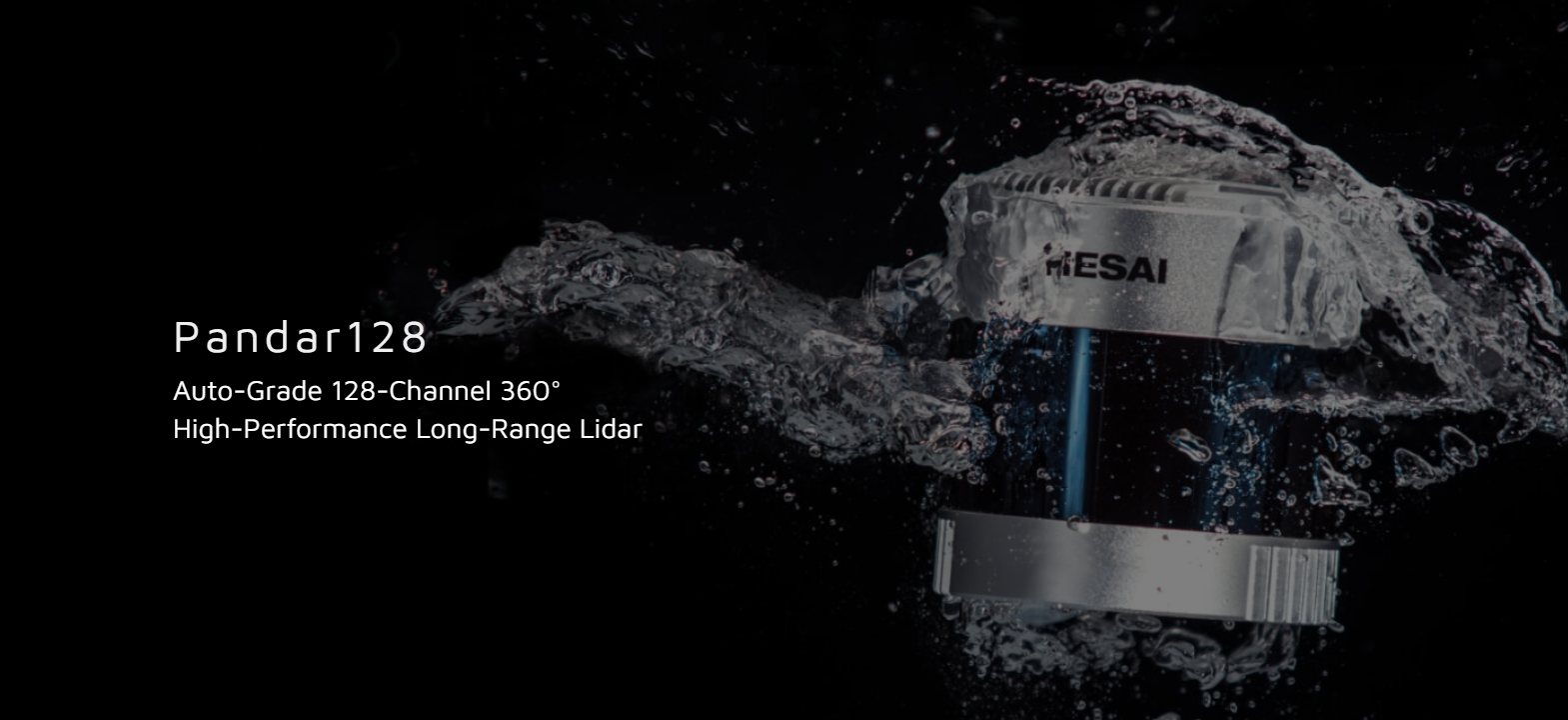
Executive Summary
The commercialization of Level 4 (L4) autonomous driving represents one of the most complex engineering challenges of our time. For vehicles to operate safely without human intervention, they must perceive the world with a level of fidelity that rivals—and in many ways surpasses—human vision. This demands a sensor that not only sees far but also sees with exceptional clarity across the entire 360° surrounding environment.
Hesai Technology’s Pandar128 has emerged as the definitive answer to this challenge. As a flagship 128-channel 360° high-performance long-range LiDAR, the Pandar128 delivers an unparalleled combination of image-like resolution, automotive-grade reliability, and advanced cybersecurity features that have made it the sensor of choice for the world’s leading autonomous driving companies . With a detection range of 200 meters at 10% reflectivity, a point rate of 3.456 million points per second, and a finest angular resolution of 0.1° (H) x 0.125° (V), it provides L4 systems with the perceptual foundation required for safe urban and highway operation .
This comprehensive report provides an in-depth analysis of the Hesai Pandar128. We will examine its revolutionary “image-like” point cloud architecture, dissect its industry-leading specifications and how they translate to quantifiable safety gains, explore its critical role in L4 robotaxi and autonomous trucking applications, and evaluate its unique value proposition for sophisticated clients in Russia, Europe, and North America. For organizations at the forefront of autonomous mobility, the Pandar128 is not merely a sensor—it is the proven, industry-standard foundation upon which the safest autonomous systems are built.
1. Introduction: The Sensor That Defined an Era of Autonomy
The history of autonomous driving is inextricably linked to the evolution of 360° LiDAR technology. In the early days of the DARPA Challenges, autonomous vehicles relied on bulky, experimental sensors that cost hundreds of thousands of dollars and required painstaking manual calibration. As the industry matured, the need for a production-ready, high-performance 360° sensor became increasingly urgent.
When Hesai introduced the Pandar128 in September 2020, it represented a quantum leap forward . At a time when most 128-line sensors were still in development or offered compromised performance, the Pandar128 delivered on every critical metric simultaneously: long range, ultra-high resolution, automotive-grade durability, and advanced cybersecurity . It was, in the words of industry observers, the new “flagship” that set the benchmark for what a 360° LiDAR could achieve.
The Pandar128’s impact on the autonomous driving industry has been profound. It has been adopted by over 90% of the world’s leading L4 autonomous driving companies, including Zoox, Didi, Pony.ai, Baidu Apollo, and WeRide . It powers the perception systems of robotaxis operating on three continents, from the bustling streets of San Francisco to the complex urban environments of Shanghai and Beijing. Its “image-like” point cloud has become the gold standard against which other sensors are measured.
This remarkable market position is no accident. The Pandar128 was designed from the ground up with a singular focus: to provide autonomous systems with the highest possible perceptual fidelity, backed by the reliability required for commercial deployment. Every aspect of its design—from its proprietary interference rejection technology to its comprehensive cybersecurity framework—reflects a deep understanding of what it takes to operate safely at scale .
2. Pandar128: Technical Architecture and Flagship Specifications
2.1 Core Performance Breakthroughs
The Pandar128’s specifications represent the culmination of years of engineering refinement and chip-level innovation.
2.2 The “Image-Like” Point Cloud Advantage
The Pandar128’s most distinctive characteristic is its ability to generate an “image-like” point cloud—a term that has become synonymous with the sensor’s exceptional perceptual fidelity .
What Makes It “Image-Like”?
- Matched Horizontal and Vertical Resolution: Unlike sensors that sacrifice horizontal detail for vertical lines, the Pandar128 achieves a finest horizontal resolution of 0.1° and a finest vertical resolution of 0.125° in its central 64 channels . This balanced resolution ensures that objects are captured with sufficient detail in both dimensions for instant classification.
- Point Frequency as the True Measure: Hesai has consistently emphasized that point frequency—the total number of points emitted per second—is the single most important metric for gauging a LiDAR’s true resolution capability . The Pandar128’s 3.456 million points per second (single return) provides approximately 1.5x the point density of other 128-channel sensors available at the time of its release .
- No Stitching Artifacts: As a true 128-channel mechanical LiDAR, the Pandar128 generates its point cloud through a continuous 360° scan, with all 128 lines firing simultaneously. This eliminates the stitching artifacts and alignment challenges that can plague sensors using multi-module or scanning approaches.
The Perceptual Impact:
- Vehicle Detection at 200m: At 200 meters, a standard passenger car is captured with dozens of points, providing sufficient detail for the perception stack to classify it as a vehicle—and even distinguish between a sedan and an SUV—without requiring multiple frames of temporal tracking .
- Pedestrian Detection: A pedestrian at 100 meters is captured with enough points to identify pose, orientation, and movement direction, enabling predictive path planning.
- Small Obstacle Identification: Debris, tires, and other small hazards are detectable at ranges that provide ample reaction time for highway-speed maneuvers.
2.3 200-Meter Detection at 10% Reflectivity: The Safety Benchmark
The ability to detect a dark-colored vehicle (10% reflectivity) at 200 meters is widely considered the baseline requirement for safe L4 highway operation . The Pandar128 not only meets this standard but exceeds it with a maximum range of 230 meters under ideal conditions .
Real-World Scenario:
A vehicle is traveling at 130 km/h (approximately 36 m/s) on a highway at dusk. A dark-colored car with a non-functioning taillight is stationary in the lane ahead.
- The Pandar128 detects the obstacle at 200 meters, providing approximately 5.5 seconds of reaction time.
This 5.5-second window allows the autonomous system to:
- Detect the obstacle with high confidence.
- Classify it as a stationary vehicle (as opposed to a false positive).
- Plan a safe trajectory (e.g., gentle braking or a lane change).
- Execute the maneuver smoothly and comfortably.
The Pandar128 achieves this performance even under 100 klux strong ambient light, ensuring reliable operation in direct sunlight .
2.4 Graded Vertical Resolution: Optimized for Real-World Perception
The Pandar128’s vertical resolution is not uniform across its 40° field of view. Instead, it employs a “graded” design that concentrates resolution where it matters most .
Resolution Distribution:
- Central 64 Channels (-6° to +2°): Ultra-high resolution of 0.125° for critical forward and rear perception at the horizon .
- Intermediate Channels: Gradually decreasing resolution that maintains good situational awareness.
- Upper/Lower Channels: Coarser resolution for near-field ground detection and overhead monitoring.
This “foveated” design delivers two critical benefits:
- Optimized Perceptual Resources: The sensor concentrates its 3.456 million points per second where they provide the most value—at the distances and elevations where obstacles are most likely to appear.
- Efficient Data Management: By reducing point density in less critical areas, the Pandar128 manages data bandwidth efficiently without compromising safety.
2.5 Advanced Interference Rejection: Every Pulse Has Its Own “Fingerprint”
One of the most sophisticated features of the Pandar128 is its proprietary interference rejection technology . In environments with multiple LiDAR-equipped vehicles—such as robotaxi fleets operating in close proximity—interference between sensors can corrupt point cloud data, creating false positives or obscuring real obstacles.
How It Works:
Hesai’s engineers developed a system in which every laser pulse emitted by the Pandar128 has its own unique “fingerprint” or “key” . The receiver is designed to recognize and accept only pulses bearing its own specific signature. Pulses from other LiDARs—even those operating at the same wavelength—are rejected as noise.
The Benefit:
- Clean Data in Dense Environments: Robotaxi fleets can operate in close proximity without mutual interference.
- Immunity to Ambient Light: The same technology helps reject noise from strong sunlight and other ambient sources.
- Consistent Performance: The sensor maintains its full detection range and resolution even in challenging electromagnetic environments.
2.6 Automotive-Grade Reliability: Designed for Continuous Operation
The Pandar128 was designed from its inception to meet the stringent requirements of automotive deployment, not just prototype use .
Comprehensive Validation Testing:
The sensor has passed over 50 reliability validation tests based on international OEM standards . These include:
- Electrical Testing: Power cycling, over-voltage protection, short-circuit protection.
- Mechanical Testing: Random vibration, mechanical shock, drop testing.
- Climatic Testing: Thermal cycling, thermal shock, high-temperature endurance, low-temperature startup, humidity resistance.
- Sealing Testing: IP6K7 (water immersion) and IP6K9K (high-pressure washdown) certification .
- Material Testing: Salt spray resistance, chemical resistance.
- EMC Testing: Electromagnetic compatibility for operation in electrically noisy environments.
Component-Level Qualification:
All core components meet AEC-Q (Automotive Electronics Council) series standards, ensuring they can withstand the thermal, mechanical, and operational stresses of automotive life .
Design Life:
The Pandar128 boasts a design life exceeding 30,000 hours (typical) —equivalent to over 3 years of continuous 24/7 operation . This ensures consistent performance even after prolonged deployment in demanding commercial applications.
2.7 Functional Safety: ISO 26262 ASIL B Certified
In addition to its hardware reliability, the Pandar128 has obtained ISO 26262 ASIL B functional safety certification, making it the first LiDAR in its class to achieve this milestone .
What This Means for Integrators:
- Comprehensive Safety Analysis: Hesai’s development team conducted thorough safety analysis of every internal module, identifying and mitigating thousands of potential failure modes .
- Active Fault Detection: The sensor features per-channel diagnostic capabilities that can detect failures within 100 ms and communicate fault information to the host vehicle .
- Confidence in Safety-Critical Applications: ASIL B certification enables integration into systems where sensor failure could have safety implications.
2.8 Cybersecurity: ISO 21434 Compliance and Network Protection
The Pandar128 was the first LiDAR to implement comprehensive cybersecurity features, anticipating industry standards before they were formally codified .
Cybersecurity Architecture:
- Data Encryption: All sensor data is encoded to prevent tampering or falsification during transmission .
- Client Authentication: The sensor verifies the identity of systems attempting to access its data stream.
- Immunity to Spoofing: The interference rejection technology also helps prevent malicious actors from injecting false pulses .
As Hesai’s development team noted during the Pandar128’s development: “How to make radar network system hardware, software, and its data protected to ensure continuous and reliable operation of the system… This is an important indicator valued by many mass production customers” .
2.9 Compact Form Factor and Integration Flexibility
Despite its 128-channel architecture, the Pandar128 maintains a remarkably compact form factor (Φ116 mm × H123.7 mm) and weighs just 1.63 kg . This represents only a 7 mm increase in height over Hesai’s 64-channel Pandar64, ensuring that customers could upgrade to 128-channel performance without completely redesigning their vehicle integration .
Integration Features:
- Wide Voltage Range: 9-48 V DC input accommodates diverse vehicle electrical systems .
- Flexible Mounting: The compact design allows for roof mounting, bumper integration, or custom enclosures.
- Web-Based Configuration: Sensor parameters can be configured through a standard web browser, simplifying installation and maintenance .
3. Transformative Application Scenarios
The Pandar128’s unique combination of 360° coverage, long range, ultra-high resolution, and automotive-grade reliability makes it applicable across a remarkably broad spectrum of autonomous applications.
3.1 L4 Robotaxis: The Industry Standard
The Pandar128 has achieved near-universal adoption among the world’s leading L4 robotaxi developers, establishing itself as the de facto industry standard for 360° perception .
Zoox: A Showcase Partnership
Zoox, the Amazon subsidiary developing a purpose-built bidirectional robotaxi, has selected the Pandar128 as a core sensor for its autonomous vehicles .
The Challenge:
- Complex Urban Traffic: Navigating unpredictable urban environments with diverse traffic participants poses significant safety challenges for robotaxis .
- 24/7 All-Weather Operation: Robotaxis must operate reliably around the clock in varying weather conditions, from bright sunlight to rain and fog .
- Long-Range Detection Needs: Limited detection range can prevent vehicles from identifying obstacles early enough for safe decision-making .
The Pandar128 Solution:
- Image-Level Resolution: The 3.45 million points per second provide “image-level” resolution, enabling the robotaxi to capture its surroundings in great detail and precisely identify obstacles, reducing collision risks in complex urban traffic .
- Automotive-Grade Reliability: Having passed over 50 reliability tests—including waterproof, dustproof, and mechanical shock—the Pandar128 ensures consistent robotaxi performance even in challenging weather conditions .
- Ultra Long-Range Detection: With its 200-meter range, the Pandar128 enables robotaxis to detect obstacles at much greater distances, improving early detection and enhancing the vehicle’s decision-making capabilities .
Didi Autonomous Driving
In April 2021, Didi Autonomous Driving announced a strategic partnership with Hesai, becoming the first Chinese autonomous driving company to mass-produce vehicles equipped with Pandar128 sensors .
Key Details:
- The Pandar128 was selected to power Didi’s “Didi” (Didi Gemini) autonomous driving hardware platform.
- Didi became the first domestic company to use Pandar128 at scale for its L4 autonomous driving fleet.
- The partnership highlighted the Pandar128’s “image-level point cloud, active anti-interference, automotive-grade, and high reliability” as key factors in its selection .
Broader Industry Adoption
According to industry data, among the world’s top 10 autonomous driving companies, nine use Hesai’s 360° high-performance LiDAR—with the Pandar128 serving as the flagship sensor for most . This customer base includes:
- Baidu Apollo
- Pony.ai
- WeRide
- AutoX
- Plus
- And numerous other global leaders
3.2 Autonomous Trucking and Heavy-Duty Vehicles
For long-haul trucking applications, the Pandar128’s combination of long range, high resolution, and automotive-grade durability is essential.
Truck-Specific Advantages:
- Extended Braking Distances: Heavy trucks require significantly longer stopping distances than passenger vehicles. The Pandar128’s 200-meter range at 10% reflectivity provides the early warning necessary for safe highway-speed operation.
- Blind Spot Elimination: The 360° coverage ensures that no area around the truck—including the massive blind spots typical of heavy vehicles—goes unobserved.
- Dock and Yard Maneuvering: When backing into loading docks or navigating tight yard spaces, the Pandar128’s near-field detection (starting at just 0.3 meters) ensures safe operation .
3.3 High-Definition Mapping and Surveying
The creation and maintenance of high-definition maps requires sensors capable of capturing the world with extraordinary fidelity .
Why Pandar128 for Mapping:
- Ultra-Dense Point Clouds: The 3.456 million points per second (single return) or 6.912 million points per second (dual return) capture fine details of road markings, curb geometry, signage, and building facades .
- Long-Range Feature Capture: The 200-meter range allows for efficient mapping of highways and large infrastructure projects, capturing features at a distance that reduces the number of passes required.
- Precision and Accuracy: ±2 cm accuracy ensures that mapped features are positioned correctly relative to each other and to global coordinates .
3.4 Smart Cities and Traffic Infrastructure
Fixed installations of Pandar128 sensors are increasingly used for smart city applications and intelligent traffic monitoring .
Applications:
- Intersection Monitoring: Pandar128s mounted at complex intersections provide comprehensive 360° coverage of vehicles, cyclists, and pedestrians, feeding real-time data to traffic management systems.
- Highway Traffic Flow Analysis: Long-range detection enables monitoring of traffic flow over extended highway segments.
- Safety Zone Monitoring: In areas with high pedestrian activity, Pandar128s can detect potential conflicts and trigger warnings.
3.5 Autonomous Shuttles and Low-Speed People Movers
For autonomous shuttles operating in campuses, airports, and urban pedestrian zones, the Pandar128 provides the 360° situational awareness essential for safe operation .
Application Requirements:
- Pedestrian-Rich Environments: Shuttles must reliably detect and track pedestrians from all directions.
- All-Weather Operation: Outdoor shuttles must function in rain, snow, and varying light conditions.
- Regulatory Compliance: Meeting safety standards requires sensors with proven reliability and functional safety certification.
4. Value Proposition and Cost-Effectiveness
For sophisticated clients in European, North American, and Russian markets, the Pandar128 offers a compelling and unique value proposition.
4.1 Unmatched Industry Validation and Track Record
The strongest argument for the Pandar128 is its track record. With adoption by over 90% of the world’s leading autonomous driving companies , it is not a theoretical product awaiting validation—it is a proven, mature platform that has logged millions of kilometers of real-world operation across three continents.
For organizations evaluating sensor technologies, this industry consensus significantly reduces technology risk. The Pandar128 has been battle-tested in the most demanding autonomous applications and has emerged as the sensor of choice for the industry’s leaders.
4.2 “Image-Like” Data Reduces Development Complexity
The Pandar128’s high-resolution, structured point cloud is explicitly designed to be easy for perception algorithms to consume . For a development team, this translates directly to:
- Lower Engineering Costs: Less time spent on low-level data filtering and processing.
- Faster Development Cycles: Perception algorithms can be developed and validated more quickly.
- More Robust Performance: The consistent, high-quality data leads to more reliable object detection and classification.
4.3 True 360° Coverage with Minimal Integration Complexity
Unlike configurations requiring multiple forward-facing sensors to achieve omnidirectional coverage, the Pandar128 delivers comprehensive 360° perception from a single sensor .
The Benefits:
- Simplified Calibration: No need to align multiple sensors or manage overlapping FOVs.
- Reduced System Cost: One Pandar128 can replace multiple lower-performance sensors, reducing overall system BOM.
- Streamlined Integration: Single-sensor mounting, power, and data interfaces simplify vehicle integration.
4.4 Automotive-Grade Reliability for Continuous Operation
The Pandar128 is not a “lab-grade” prototype; it is an automotive-grade sensor designed for 24/7 commercial operation .
- 30,000-Hour Design Life: Three times the industry average, minimizing downtime and replacement costs .
- -40°C to +85°C Operation: Suitable for deployment in all climates, from Russian winters to desert summers .
- IP6K7 & IP6K9K Protection: Withstands dust, water immersion, and high-pressure washdowns .
4.5 Future-Proof Through Continuous Innovation
The Pandar128’s technology platform continues to evolve. Hesai’s ongoing investment in chip-level innovation, functional safety, and cybersecurity ensures that the Pandar128 remains at the forefront of LiDAR performance.
4.6 Global Availability and Support
The Pandar128 is available through Hesai’s global distribution network, ensuring that clients in Russia, Europe, and North America can access the sensor with local support.
Pricing Reference:
The Pandar128 is available through authorized distributors at approximately €28,650 (excl. VAT) , reflecting its flagship positioning and comprehensive capabilities .
Global Presence:
- European Office: Stuttgart, Germany (sales and application engineering)
- North American Presence: Serving customers across the US and Canada
- Asia-Pacific Headquarters: Shanghai, China
5. Conclusion: The Proven Foundation for L4 Autonomy
The Hesai Pandar128 represents more than a sensor; it is the embodiment of a decade of progress in autonomous vehicle technology. As the first 128-channel LiDAR to achieve widespread commercial adoption, it has established the performance, reliability, and safety standards that define the L4 perception category.
For clients in Russia, Europe, and North America, the Pandar128 offers a unique combination of capabilities that cannot be found elsewhere:
- Unmatched Industry Validation: Adopted by over 90% of the world’s leading autonomous driving companies, including Zoox, Didi, Baidu Apollo, Pony.ai, and WeRide .
- Image-Like Resolution: 3.456 million points per second and 0.1° × 0.125° finest resolution provide the perceptual foundation for the most demanding applications .
- Proven Reliability: 30,000-hour design life, IP6K7/IP6K9K protection, and -40°C to +85°C operation ensure continuous, safe operation in all environments .
- Comprehensive Safety: ISO 26262 ASIL B functional safety certification and ISO 21434 cybersecurity compliance provide confidence in safety-critical applications .
- Advanced Interference Rejection: Proprietary “fingerprinting” technology ensures clean data even in dense multi-LiDAR environments .
The Pandar128 is not merely a sensor; it is the industry standard upon which the safest and most advanced autonomous systems are built. For organizations serious about deploying L4 autonomous vehicles at scale, the choice is clear: the Hesai Pandar128 provides the proven performance, reliability, and safety that commercial autonomy demands.









