
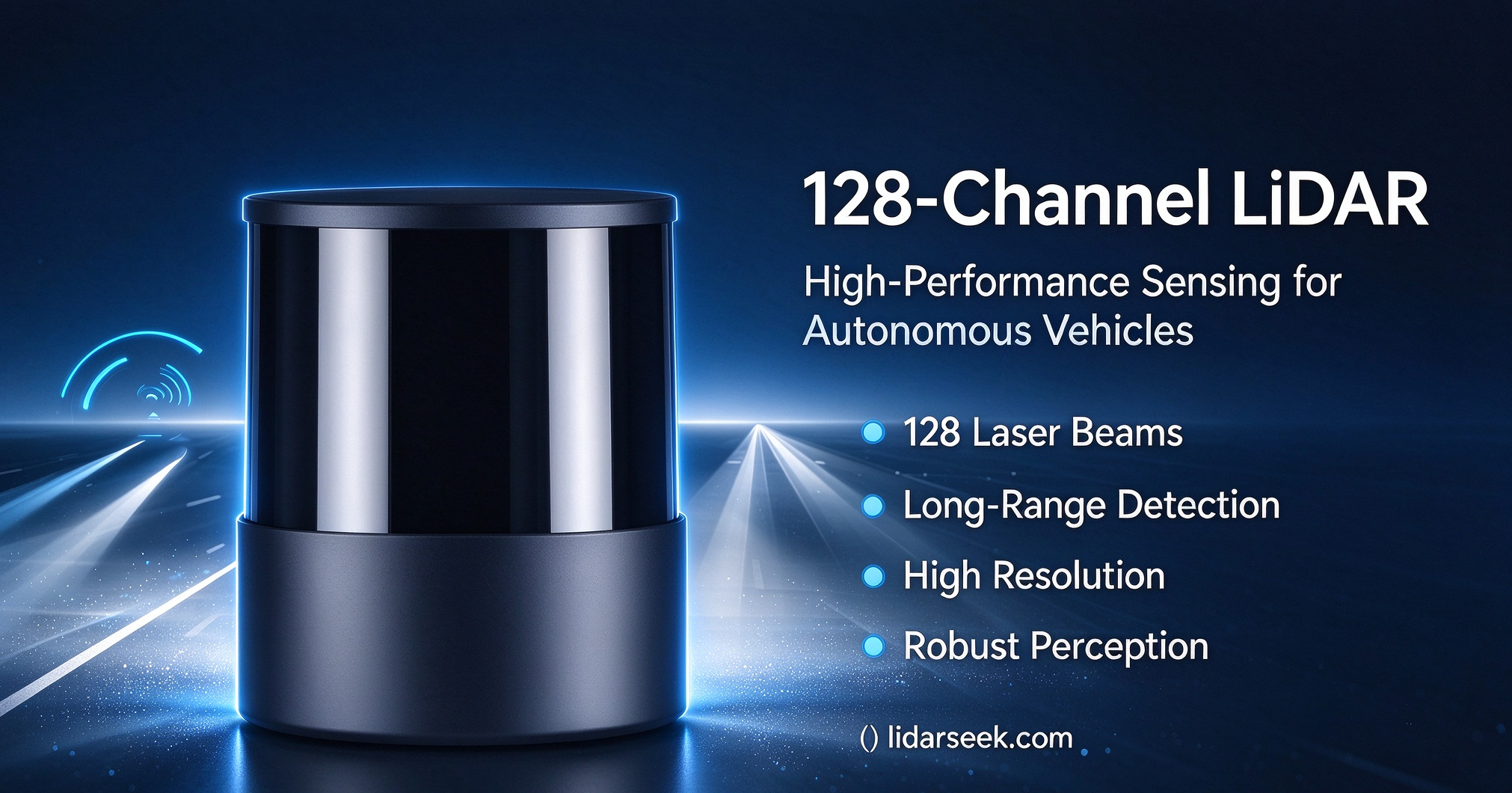
As autonomous technologies continue to evolve, LiDAR has become one of the most important sensing technologies for perception, navigation, mapping, and environmental awareness. Among the various LiDAR configurations available today, 128-channel LiDAR systems have emerged as a preferred choice for applications requiring high-resolution perception and long-range detection.
However, selecting the right 128-channel LiDAR is not as simple as comparing specifications on a datasheet. Engineers, system integrators, and project managers must evaluate factors such as detection range, field of view, point cloud density, environmental robustness, integration requirements, and total cost of ownership.
Whether you are developing autonomous vehicles, robotic systems, intelligent transportation infrastructure, or industrial automation solutions, this guide will help you understand the key considerations when choosing a 128-channel LiDAR.
Why Choose a 128-Channel LiDAR?
LiDAR sensors are commonly categorized by the number of laser channels they use. Compared with 16-channel, 32-channel, or 64-channel systems, a 128-channel LiDAR generates significantly denser point clouds and provides better object recognition capabilities.
Benefits of 128-channel LiDAR include:
- Higher point cloud density
- Improved object detection accuracy
- Better perception of small objects
- Enhanced environmental modeling
- Superior long-range performance
- Improved AI and machine learning perception results
For applications operating in dynamic or safety-critical environments, these advantages can be substantial.
Understanding Your Application Requirements
Before evaluating specific products, define your project’s requirements.
Different applications prioritize different performance characteristics.
Autonomous Driving
Autonomous vehicles typically require:
- Long-range detection
- High point cloud density
- Automotive-grade reliability
- All-weather operation
- Fast refresh rates
Examples include:
- Robotaxis
- Autonomous trucks
- Autonomous shuttles
- ADAS testing platforms
For these applications, range and perception quality often take priority over sensor size.
Robotics and Automation
Robotic systems may prioritize:
- Compact installation
- Close-range perception
- 360° awareness
- Low power consumption
- Cost efficiency
Applications include:
- Mobile robots
- Autonomous delivery robots
- Warehouse automation
- Security robots
- Inspection robots
Smart Transportation
Infrastructure projects typically require:
- Wide-area coverage
- Long-term reliability
- Environmental durability
- Accurate traffic monitoring
Common deployments include:
- Smart intersections
- Traffic analytics
- Vehicle classification systems
- Roadside perception units
Mapping and Surveying
For mapping applications, priorities may include:
- High point density
- Accuracy
- Consistent performance
- Precise object reconstruction
Understanding your use case helps narrow down the available options.
Evaluate Detection Range
One of the most important specifications is detection range.
Range determines how early a system can detect and react to obstacles.
For example:
| Application | Recommended Range |
|---|---|
| Indoor Robotics | 20–50 m |
| Warehouse Automation | 30–80 m |
| Delivery Robots | 50–100 m |
| Autonomous Vehicles | 150–250+ m |
| Highway Autonomy | 200–300+ m |
For autonomous driving projects, long-range detection is critical because vehicles traveling at high speeds require more reaction time.
A sensor such as the Hesai OT128, which offers up to 230 m detection range, is often selected for these demanding applications.
Examine Point Cloud Density
Many buyers focus solely on range and overlook point cloud density.
Point cloud density directly affects:
- Object classification
- Tracking performance
- Mapping accuracy
- AI perception quality
A high-quality 128-channel LiDAR should generate millions of points per second.
Dense point clouds allow systems to identify:
- Pedestrians
- Road signs
- Traffic cones
- Curbs
- Small obstacles
at greater distances and with higher confidence.
Consider Field of View (FOV)
Field of view determines how much of the surrounding environment the sensor can observe.
Horizontal FOV
Most mechanical LiDAR systems provide:
- 360° horizontal coverage
This allows complete environmental awareness.
Vertical FOV
Vertical field of view varies significantly between products.
A wider vertical FOV improves:
- Object detection
- Urban navigation
- Perception on slopes
- Multi-level obstacle recognition
For example:
| Vertical FOV | Typical Use |
|---|---|
| 20° | Highway driving |
| 30° | Mixed environments |
| 40°+ | Urban autonomy and robotics |
Always consider whether your environment requires a broader vertical field of view.
Assess Angular Resolution
Angular resolution determines how finely a LiDAR samples the environment.
Higher resolution allows detection of:
- Smaller objects
- Distant obstacles
- Thin structures
- Roadside hazards
A high-performance 128-channel LiDAR typically offers:
- Horizontal resolution: 0.1°–0.2°
- Vertical resolution: 0.1°–0.2°
Higher resolution generally results in better perception performance.
Evaluate Environmental Performance
Real-world conditions are often far more challenging than laboratory testing.
A LiDAR should maintain reliable performance in:
- Rain
- Fog
- Dust
- Snow
- Direct sunlight
- Extreme temperatures
Look for:
- Advanced signal processing
- Rain and fog filtering
- Multi-return technology
- Environmental interference suppression
These features can significantly improve perception quality in outdoor deployments.
Check Protection Ratings
For industrial and outdoor applications, environmental protection ratings matter.
Common ratings include:
- IP67
- IP6K7
- IP6K9K
These indicate resistance to:
- Water
- Dust
- High-pressure cleaning
For autonomous vehicles and industrial machinery, higher protection ratings are generally preferred.
Consider Integration Requirements
Integration complexity can have a major impact on project costs.
Questions to ask include:
Does the sensor support ROS?
ROS compatibility simplifies robotics integration.
Is an SDK available?
A mature SDK reduces development time.
What interfaces are supported?
Common interfaces include:
- Ethernet
- UDP
- TCP/IP
Are software tools provided?
Good software tools help engineers:
- Visualize point clouds
- Configure sensors
- Diagnose issues
Single Return vs Dual Return
Many advanced 128-channel LiDAR systems support dual-return mode.
Dual returns allow the sensor to capture multiple reflections from the same laser pulse.
Benefits include:
- Better vegetation penetration
- Improved perception in rain
- Enhanced obstacle detection
For forestry, mapping, and autonomous driving, dual-return capability is often valuable.
Reliability and Lifecycle Considerations
A LiDAR sensor may operate continuously for years.
Evaluate:
- Manufacturer reputation
- Product maturity
- Warranty support
- Long-term availability
- Global technical support
For commercial deployments, lifecycle support can be as important as technical performance.
Cost vs Performance
The cheapest sensor is not always the most economical option.
When evaluating cost, consider:
- Purchase price
- Installation costs
- Calibration requirements
- Maintenance expenses
- Software development effort
- Expected lifespan
A higher-performance LiDAR may reduce overall system costs by simplifying integration and improving reliability.
Why Many Developers Choose Hesai OT128
Among 128-channel LiDAR options, the Hesai OT128 remains a popular choice for autonomous systems.
Key advantages include:
- 128 channels
- 360° horizontal FOV
- 40° vertical FOV
- Up to 230 m range
- Up to 6.9 million points per second
- Automotive-grade design
- Dual-return support
- Advanced environmental filtering
These capabilities make it suitable for:
- Autonomous vehicles
- Robotaxi fleets
- Autonomous trucks
- Smart transportation infrastructure
- Advanced robotics
Final Thoughts
Choosing a 128-channel LiDAR involves much more than comparing datasheets. The best sensor depends on your application, operating environment, integration requirements, and long-term project goals.
Before making a decision, carefully evaluate:
✔ Detection range
✔ Point cloud density
✔ Field of view
✔ Angular resolution
✔ Environmental robustness
✔ Software ecosystem
✔ Integration complexity
✔ Long-term support
By considering these factors, you can select a LiDAR solution that delivers reliable performance today while supporting future growth and system upgrades.
FAQ
What is a 128-channel LiDAR?
A 128-channel LiDAR uses 128 laser channels to generate highly detailed 3D point clouds, providing superior perception compared with lower-channel sensors.
Is a 128-channel LiDAR necessary for autonomous driving?
For advanced autonomous driving applications, a 128-channel LiDAR often provides the resolution and range needed for accurate object detection and safe operation.
What range should a 128-channel LiDAR have?
The ideal range depends on the application. Autonomous vehicles typically require 150–250 m or more, while indoor robots may only need 20–50 m.
What is the advantage of dual-return LiDAR?
Dual-return LiDAR captures multiple reflections from a single laser pulse, improving performance in vegetation, rain, fog, and complex environments.
How important is point cloud density?
Point cloud density is critical because it affects object recognition, tracking, mapping accuracy, and overall perception quality.
What protection rating should I look for?
For outdoor and industrial applications, IP67, IP6K7, or IP6K9K ratings are generally recommended.
Can 128-channel LiDAR be used for robotics?
Yes. High-resolution 128-channel LiDAR sensors are widely used in autonomous robots, warehouse automation, mapping systems, and industrial inspection platforms.
What software support should a LiDAR provide?
Look for ROS compatibility, SDK availability, visualization tools, configuration software, and comprehensive technical documentation.
Is Hesai OT128 suitable for smart city projects?
Yes. Its long range, high point density, and 360° coverage make it suitable for traffic monitoring, smart intersections, and infrastructure perception.
How do I choose between different 128-channel LiDARs?
Compare range, field of view, point cloud density, environmental performance, software support, reliability, and total cost of ownership based on your specific application requirements.









