

Introduction
Automated Guided Vehicles (AGVs) have become a critical part of modern warehouses, manufacturing facilities, logistics centers, and smart factories. As industries continue to automate material handling and transportation processes, AGVs are expected to operate safely, efficiently, and autonomously in increasingly complex environments.
At the heart of every high-performance AGV is its perception system. While cameras, ultrasonic sensors, and radar all play important roles, LiDAR remains the preferred sensor for precise navigation, obstacle detection, localization, and mapping.
The challenge for many AGV manufacturers and system integrators is choosing the right LiDAR. With dozens of sensors available on the market, selecting the best solution depends on factors such as operating environment, detection range, navigation requirements, and project budget.
In this guide, we compare the best LiDAR sensors for AGV applications in 2026 and explain how to choose the ideal sensor for warehouse automation, industrial robotics, and outdoor logistics vehicles.
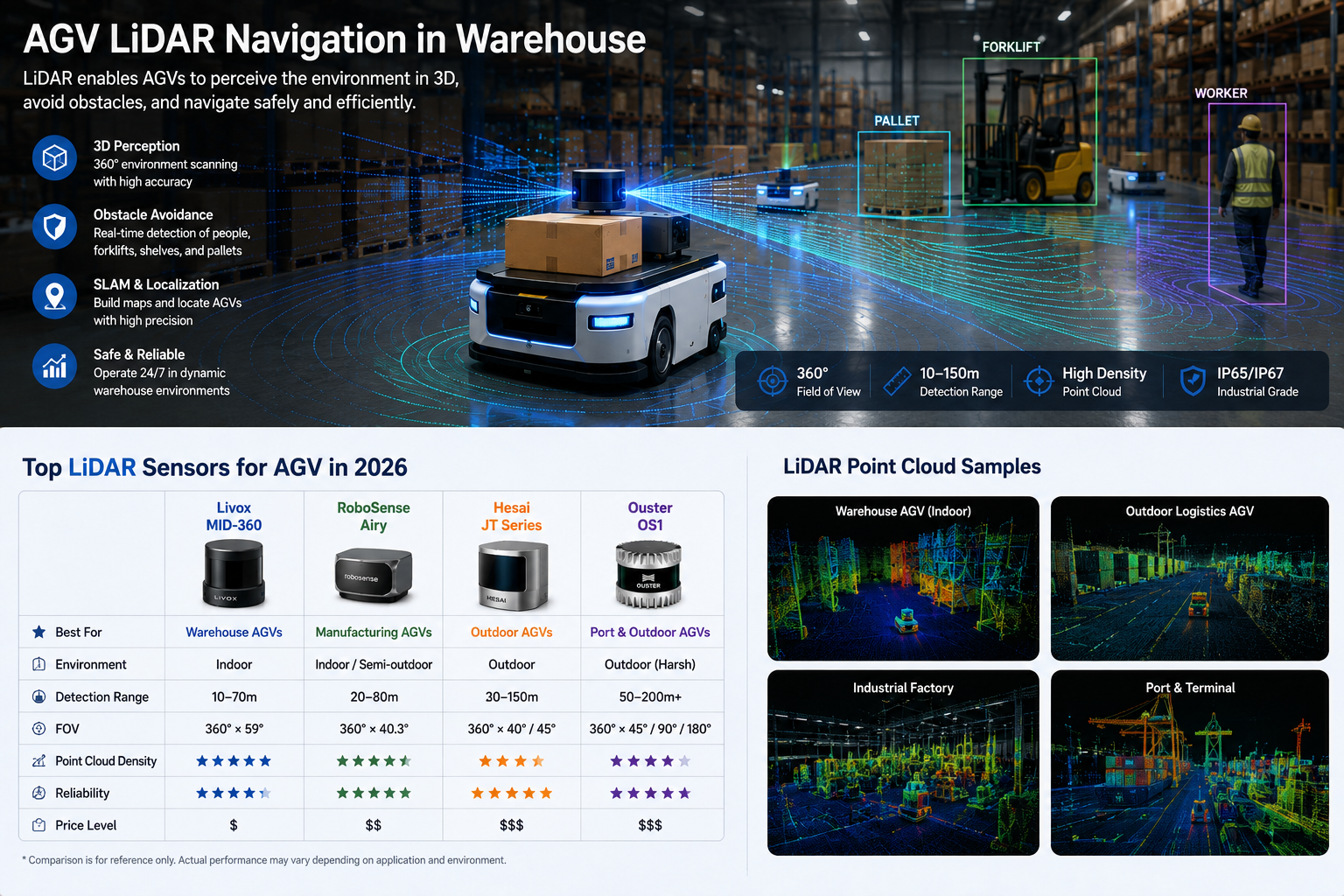
Quick Answer: What Is the Best LiDAR for AGV?
If you’re looking for the best LiDAR for AGV applications in 2026, the answer depends on your operating environment:
| Application | Recommended LiDAR |
|---|---|
| Warehouse AGVs | Livox MID-360 |
| Manufacturing AGVs | RoboSense Airy |
| Outdoor Industrial AGVs | Hesai JT Series |
| Port & Logistics AGVs | Ouster OS1 |
For most indoor warehouse automation projects, the Livox MID-360 currently provides the best combination of performance, reliability, ease of integration, and affordability.
Why LiDAR Is Essential for Modern AGVs
Compared with traditional navigation technologies, LiDAR offers significant advantages:
Accurate Obstacle Detection
LiDAR measures distance directly using laser pulses, enabling AGVs to detect workers, forklifts, pallets, shelving, and unexpected obstacles in real time.
Reliable Performance in Any Lighting
Unlike cameras, LiDAR is not affected by darkness, shadows, or sudden lighting changes.
High-Precision Mapping and Localization
Modern AGVs rely heavily on SLAM (Simultaneous Localization and Mapping). LiDAR provides highly accurate environmental data for real-time positioning.
Enhanced Safety
Industrial facilities demand safe operation around people and equipment. LiDAR helps reduce collision risks and supports compliance with safety standards.
Key Factors When Choosing a LiDAR for AGV
Detection Range
The required range depends on the application:
- Indoor warehouse AGVs: 10–50 meters
- Manufacturing AGVs: 20–80 meters
- Outdoor logistics AGVs: 50–150 meters
Longer detection range allows smoother navigation and earlier obstacle avoidance.
Field of View (FOV)
A wider field of view helps AGVs perceive surrounding objects without requiring multiple sensors.
Point Cloud Density
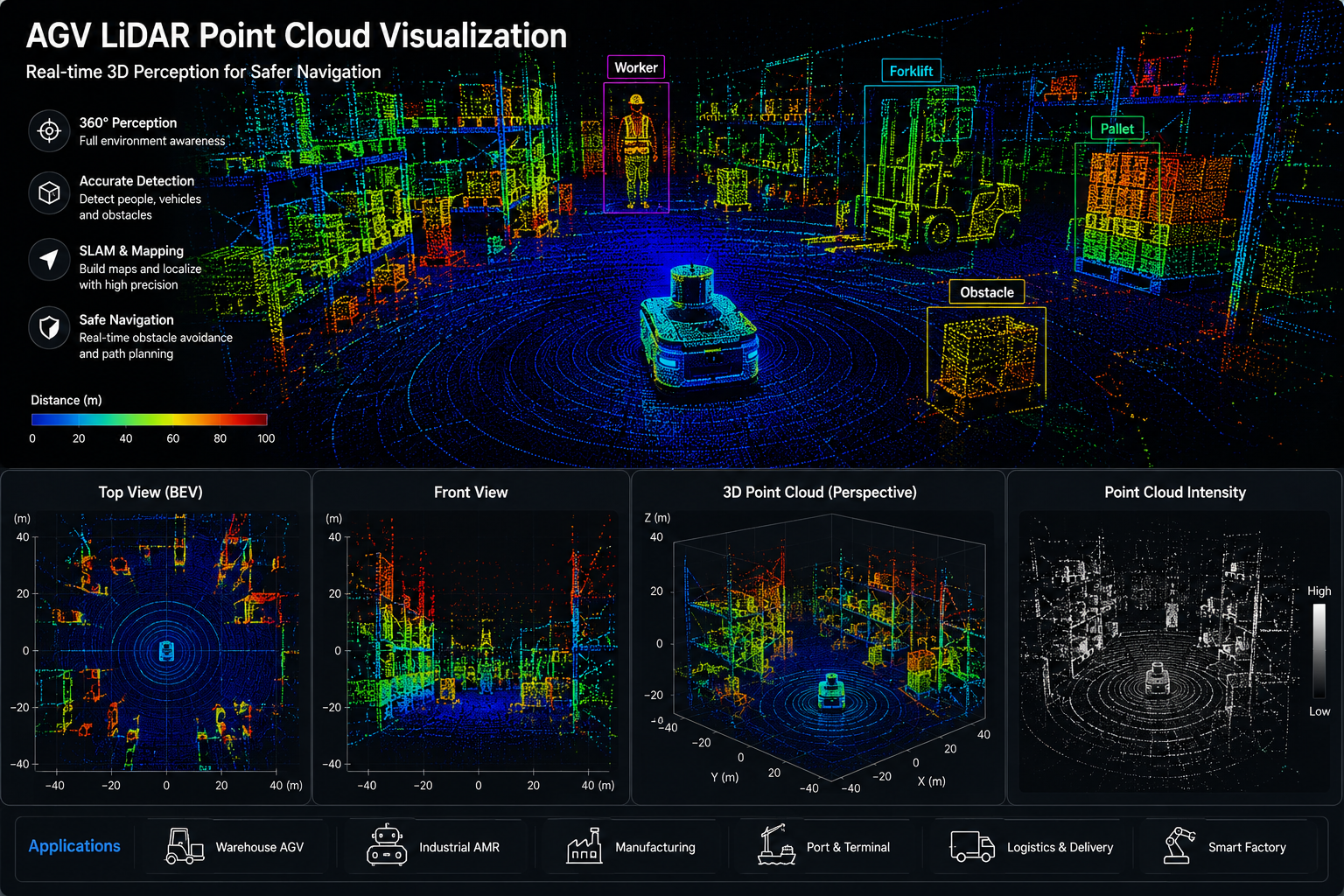
Higher point cloud density improves:
- Object recognition
- Navigation accuracy
- SLAM performance
- Dynamic obstacle tracking
Reliability
Industrial AGVs often operate 24/7. The chosen LiDAR must withstand vibration, dust, temperature variations, and long operating hours.
Best LiDAR Sensors for AGV in 2026
1. Livox MID-360 – Best Overall LiDAR for Warehouse AGVs
The Livox MID-360 has become one of the most widely adopted LiDAR solutions for warehouse automation and mobile robotics.
Key Advantages
- 360° environmental perception
- Compact design
- Excellent SLAM performance
- ROS and ROS2 compatibility
- Cost-effective deployment
Best Applications
- Warehouse AGVs
- Autonomous Mobile Robots (AMRs)
- Inventory robots
- Indoor logistics automation
For most indoor AGV projects, MID-360 delivers the strongest balance between performance and cost.
2. RoboSense Airy – Best for High-Precision Navigation
The RoboSense Airy is specifically designed for robotics and intelligent automation applications.
Key Advantages
- High-resolution perception
- Excellent obstacle recognition
- Advanced localization capability
- Compact industrial design
Best Applications
- Smart factories
- Manufacturing AGVs
- Precision logistics systems
- High-end industrial robotics
Airy excels in environments where navigation accuracy and perception quality are critical.
3. Hesai JT Series – Best for Outdoor Industrial AGVs
Hesai developed the JT Series specifically for robotics, industrial automation, and autonomous systems.
Key Advantages
- Industrial-grade reliability
- Long-range detection
- Weather resistance
- High mapping accuracy
Best Applications
- Outdoor AGVs
- Mining vehicles
- Port automation
- Heavy industrial environments
For challenging outdoor deployments, the JT Series provides excellent robustness.
4. Ouster OS1 – Best for Harsh Outdoor Environments
The Ouster OS1 is widely used in autonomous systems requiring reliable long-range perception.
Key Advantages
- Rugged construction
- Long-range obstacle detection
- Strong environmental resistance
- Proven robotics ecosystem
Best Applications
- Container terminals
- Autonomous yard trucks
- Outdoor logistics vehicles
- Autonomous industrial equipment
AGV LiDAR Comparison Table
| Feature | Livox MID-360 | RoboSense Airy | Hesai JT Series | Ouster OS1 |
|---|---|---|---|---|
| Indoor Navigation | Excellent | Excellent | Good | Fair |
| Outdoor Navigation | Good | Good | Excellent | Excellent |
| SLAM Performance | Excellent | Excellent | Good | Good |
| Cost Efficiency | Excellent | Good | Good | Moderate |
| Industrial Reliability | Good | Excellent | Excellent | Excellent |
| ROS Compatibility | Excellent | Good | Good | Excellent |
Which LiDAR Is Best for Your AGV Application?
Warehouse AGVs
Recommended: Livox MID-360
Ideal for:
- Warehouse automation
- Inventory transportation
- Shelf navigation
- Indoor logistics
Manufacturing AGVs
Recommended: RoboSense Airy
Ideal for:
- Smart factories
- Production line logistics
- Precision positioning
Outdoor Logistics AGVs
Recommended: Hesai JT Series
Ideal for:
- Outdoor transportation
- Industrial facilities
- Construction sites
Port and Container AGVs
Recommended: Ouster OS1
Ideal for:
- Port automation
- Container terminals
- Heavy-duty logistics
How Much Does an AGV LiDAR Cost?
LiDAR pricing varies significantly depending on:
- Detection range
- Resolution
- Field of view
- Environmental protection level
- Integration requirements
Typical market ranges include:
| Category | Typical Price Range |
|---|---|
| Entry-Level AGV LiDAR | $300 – $1,000 |
| Mid-Range Industrial LiDAR | $1,000 – $5,000 |
| High-End AGV LiDAR | $5,000 – $20,000+ |
While price is important, long-term reliability and operational efficiency often provide a much greater return on investment.
Why LiDAR Delivers the Best ROI for AGVs
Compared with camera-only navigation systems, LiDAR-equipped AGVs offer:
- More accurate navigation
- Better obstacle avoidance
- Lower accident rates
- Reduced downtime
- Higher productivity
As warehouse automation scales, these benefits can significantly reduce operating costs while improving efficiency.
Final Verdict
Selecting the best LiDAR for AGV applications depends on your environment and operational requirements.
For most warehouse automation projects, the Livox MID-360 remains the best overall choice due to its excellent balance of performance, reliability, and affordability.
For precision industrial navigation, RoboSense Airy is an outstanding option.
For outdoor industrial automation, Hesai JT Series provides exceptional robustness.
For harsh environments and long-range perception, Ouster OS1 remains one of the industry’s most trusted solutions.
By carefully matching the LiDAR sensor to your AGV application, you can improve navigation accuracy, enhance safety, and maximize long-term operational efficiency.
Frequently Asked Questions
What is the best LiDAR for warehouse AGVs?
Livox MID-360 is one of the most popular solutions due to its 360° coverage, compact size, and strong SLAM performance.
Is LiDAR necessary for AGVs?
While some AGVs use cameras or magnetic guidance, LiDAR provides superior navigation accuracy, obstacle detection, and operational flexibility.
What range does an AGV LiDAR need?
Most indoor AGVs require 10–50 meters, while outdoor AGVs often require 50–150 meters or more.
What is the difference between AGV and AMR LiDAR requirements?
AGVs typically follow predefined routes, while AMRs require more advanced perception and dynamic navigation capabilities.
Which LiDAR is best for outdoor AGVs?
Hesai JT Series and Ouster OS1 are among the strongest options for outdoor autonomous vehicle applications.
Need Help Choosing the Right LiDAR for Your AGV Project?
LiDARSeek supplies genuine LiDAR sensors for warehouse automation, industrial robotics, AGVs, and AMRs.
Our engineering team can help you:
✓ Compare LiDAR models
✓ Select the best sensor for your project
✓ Provide competitive pricing
✓ Support global shipping
✓ Offer technical consultation
Contact us today to discuss your AGV automation project and receive a customized quotation.









