Meta Title:
Hesai AT128 vs RoboSense M1 | Automotive LiDAR Comparison 2026
Meta Description:
Compare Hesai AT128 and RoboSense M1 automotive LiDARs in terms of range, resolution, point cloud quality, integration, and autonomous driving performance. Find the best LiDAR for your ADAS, robotaxi, or autonomous vehicle project.
As autonomous driving technology continues to advance, LiDAR has become one of the most important sensors for vehicle perception. Whether you’re developing an ADAS platform, robotaxi fleet, autonomous truck, or intelligent passenger vehicle, selecting the right LiDAR sensor directly impacts safety, perception accuracy, and system performance.
Among the leading automotive LiDAR manufacturers, Hesai and RoboSense have established themselves as key suppliers for global OEMs and autonomous driving companies. Two products frequently compared by engineers and procurement teams are the Hesai AT128 and RoboSense M1.
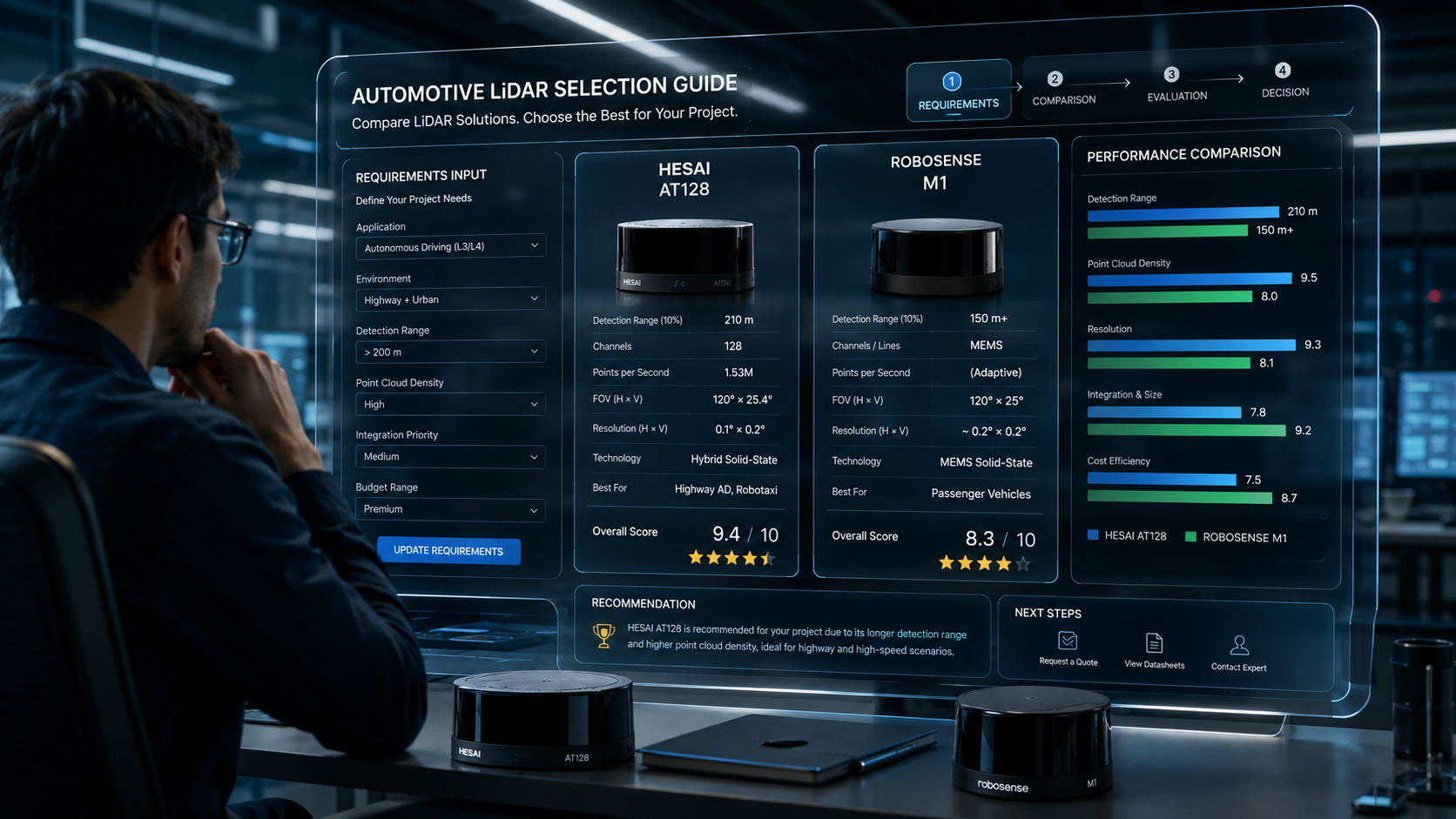
Although both sensors are designed for automotive applications, they represent two different technical philosophies. The AT128 focuses on long-range detection and ultra-dense point cloud generation, while the M1 emphasizes MEMS solid-state technology, compact design, and easier vehicle integration.
This article provides a detailed comparison of the Hesai AT128 and RoboSense M1, covering technical specifications, real-world performance, integration considerations, pricing factors, and ideal deployment scenarios.
Understanding the Design Philosophy Behind Each LiDAR
Before comparing specifications, it’s important to understand what each manufacturer aimed to achieve.
Hesai AT128
The Hesai AT128 was developed for advanced autonomous driving systems requiring maximum perception performance. It is widely recognized for its long detection range, high point cloud density, and automotive-grade reliability.
The sensor is particularly suitable for:
- Robotaxis
- Autonomous trucks
- Highway Pilot systems
- High-speed ADAS applications
- Level 3 and Level 4 autonomous driving platforms
Its primary objective is simple: detect objects earlier and more accurately at longer distances.
RoboSense M1
The RoboSense M1 was one of the world’s first mass-produced automotive MEMS LiDAR sensors.
Rather than maximizing point cloud density everywhere, RoboSense focused on creating a compact LiDAR that could be more easily integrated into production vehicles.
The M1 is designed for:
- Passenger vehicles
- Advanced driver assistance systems
- Urban autonomous driving
- OEM integration programs
- Cost-sensitive automotive projects
Its MEMS architecture allows intelligent scanning and a smaller physical footprint.
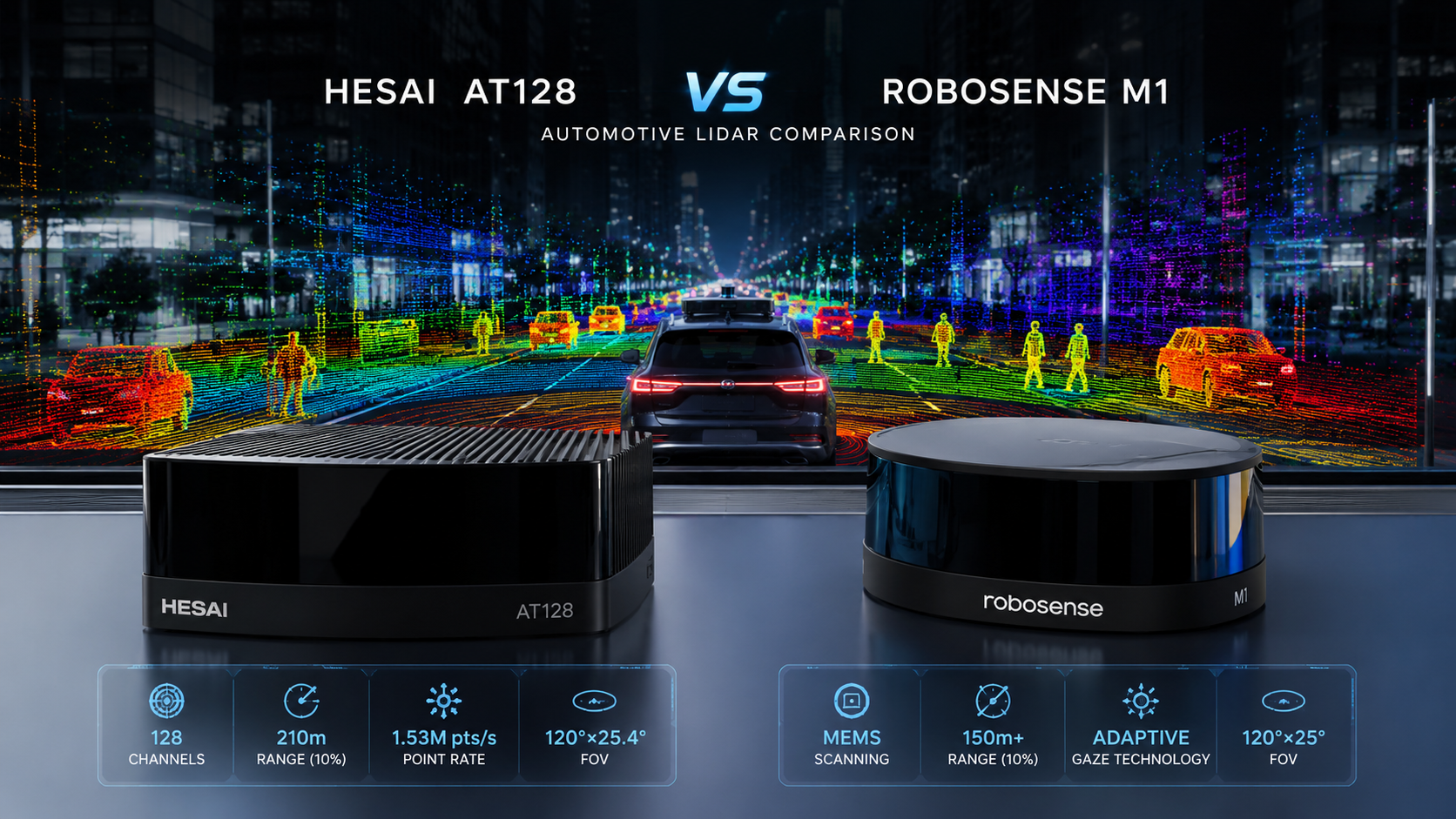
Hesai AT128 vs RoboSense M1 Specifications Comparison
| Feature | Hesai AT128 | RoboSense M1 |
|---|---|---|
| Scanning Technology | Hybrid Solid-State | MEMS Solid-State |
| Detection Range | Up to 210 m @ 10% Reflectivity | Up to 150 m+ |
| Horizontal FOV | 120° | 120° |
| Vertical FOV | 25.4° | Approx. 25° |
| Point Cloud Density | Very High | High |
| Automotive Grade | Yes | Yes |
| Integration Complexity | Moderate | Easier |
| Primary Application | Robotaxi, Highway ADAS | Passenger Vehicles |
From a pure performance perspective, the AT128 provides stronger long-range perception capabilities. The M1, however, offers advantages in packaging and integration.
Detection Range: Why It Matters for Autonomous Driving
Long-range perception is critical because vehicles need sufficient reaction time at highway speeds.
Hesai AT128 Advantage
The AT128 delivers an impressive detection range of up to 210 meters for low-reflectivity targets.
Benefits include:
- Earlier obstacle detection
- More time for path planning
- Better high-speed safety margins
- Improved highway autonomous driving performance
For robotaxis and autonomous trucks operating at higher speeds, this additional detection distance can significantly improve system confidence.
RoboSense M1 Advantage
The M1 provides strong performance for urban and suburban driving scenarios.
Its detection range is more than sufficient for:
- City traffic
- Passenger vehicles
- Urban autonomous driving
- Most Level 2+ and Level 3 ADAS systems
For many OEM projects, the M1‘s range is adequate while offering packaging advantages.
Winner: Hesai AT128
If maximum sensing distance is the priority, the AT128 clearly leads.
Point Cloud Density and Object Recognition
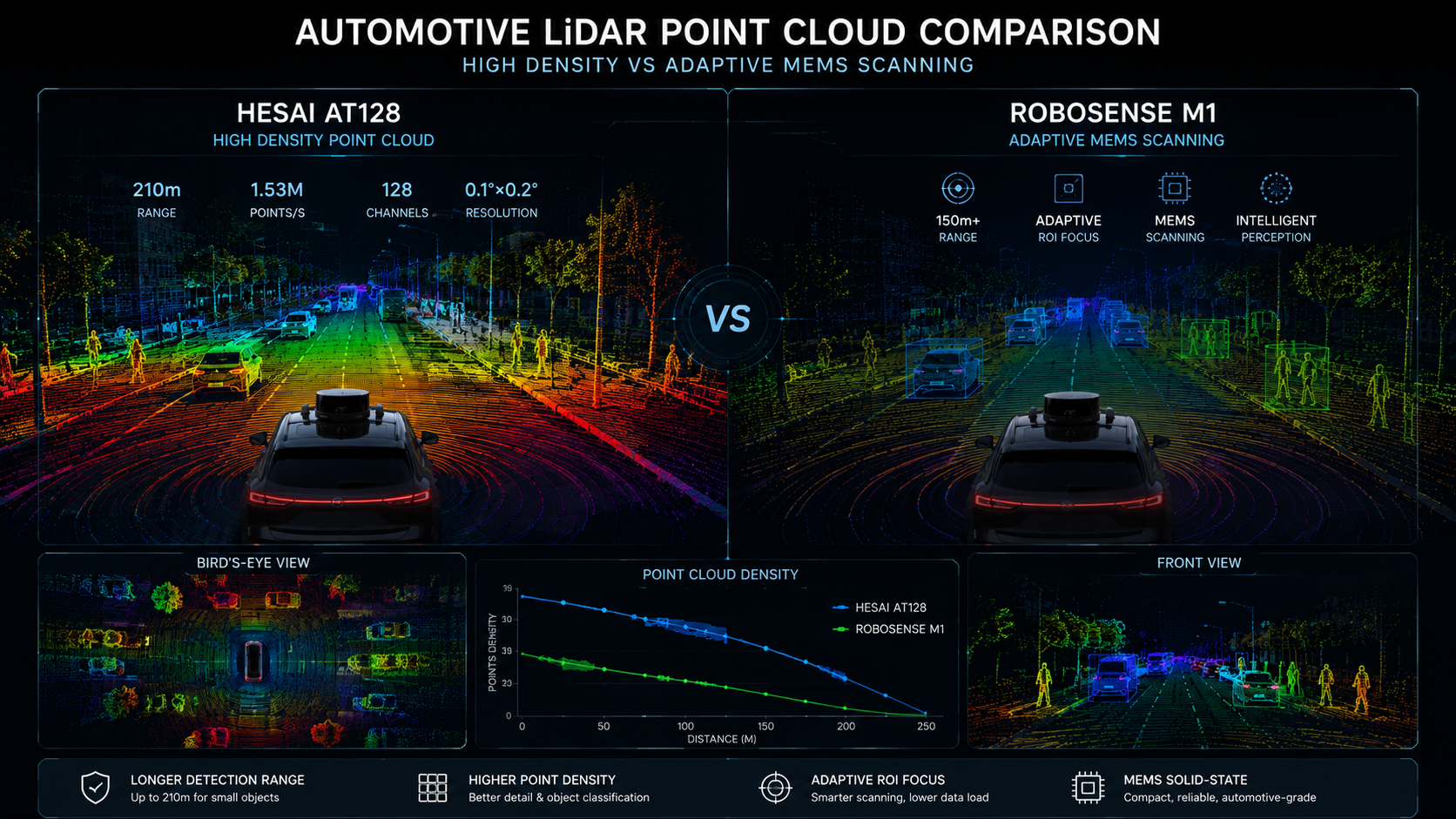
A LiDAR’s effectiveness depends not only on how far it sees but also on how much detail it captures.
Hesai AT128
The AT128 generates extremely dense point clouds, helping autonomous systems identify:
- Pedestrians
- Motorcycles
- Road debris
- Traffic cones
- Small roadside objects
Higher point density improves object classification and tracking accuracy.
RoboSense M1
The M1 utilizes intelligent MEMS scanning technology to focus perception resources on important regions of interest.
Advantages include:
- Efficient perception
- Adaptive scanning
- Reduced computational waste
- Better resource allocation
Winner: Depends on the Application
For raw perception capability, the AT128 has an advantage.
For intelligent scanning efficiency, the M1 performs exceptionally well.
Vehicle Integration and Design Flexibility
This is one of the biggest differences between these two sensors.
Why OEMs Like the RoboSense M1
Vehicle manufacturers increasingly prefer sensors that can be hidden within the body structure.
Benefits include:
- Better vehicle aesthetics
- Easier roofline integration
- Reduced aerodynamic impact
- More flexibility during vehicle design
The compact MEMS architecture gives the M1 a significant advantage in this area.
Hesai AT128 Integration
While the AT128 remains relatively compact compared with previous-generation LiDARs, its primary goal is performance rather than minimum size.
Manufacturers selecting the AT128 are usually prioritizing perception quality over packaging constraints.
Winner: RoboSense M1
For passenger vehicle integration, the M1 is often the preferred solution.
Which LiDAR Is Better for Different Autonomous Driving Projects?
Robotaxi Platforms
Recommended: Hesai AT128
Reasons:
- Longer range
- Denser point clouds
- Better perception redundancy
- Improved safety margins
Autonomous Trucks
Recommended: Hesai AT128
Long-range detection is essential for large vehicles operating at highway speeds.
Passenger Vehicles
Recommended: RoboSense M1
Reasons:
- Compact design
- Easier OEM integration
- Lower packaging requirements
Urban Autonomous Driving
Recommended: RoboSense M1
Its intelligent MEMS architecture is highly effective in dense urban environments.
Price Comparison: Hesai AT128 vs RoboSense M1
One of the most common questions from procurement teams is pricing.
However, automotive LiDAR pricing depends on several factors:
- Order quantity
- Project scale
- Development stage
- Shipping terms
- Technical support requirements
Generally speaking:
- Hesai AT128 typically commands a higher price due to its superior range and point cloud density.
- RoboSense M1 is often selected by projects seeking a balance between performance and integration cost.
For accurate project pricing, it is always recommended to request a quotation directly from an authorized supplier.
Final Verdict
Both the Hesai AT128 and RoboSense M1 are excellent automotive LiDAR sensors, but they target different priorities.
Choose the Hesai AT128 if your project requires:
✔ Maximum detection range
✔ High-speed autonomous driving
✔ Robotaxi deployment
✔ Autonomous trucking
✔ Ultra-dense point clouds
Choose the RoboSense M1 if your project requires:
✔ Compact integration
✔ MEMS solid-state architecture
✔ Passenger vehicle deployment
✔ Urban autonomous driving
✔ Cost optimization
For projects where perception performance is the primary requirement, the Hesai AT128 remains one of the strongest automotive LiDAR solutions available today.
For OEMs focused on vehicle integration and scalable deployment, the RoboSense M1 continues to be an attractive choice.
Frequently Asked Questions
Is Hesai AT128 better than RoboSense M1?
For long-range perception and point cloud density, the AT128 generally offers stronger performance.
Is RoboSense M1 a solid-state LiDAR?
Yes. The M1 uses MEMS-based solid-state scanning technology.
Which LiDAR is better for robotaxis?
The Hesai AT128 is typically preferred due to its longer detection range and denser point cloud output.
Which LiDAR is easier to integrate into passenger vehicles?
The RoboSense M1 is generally easier to integrate because of its compact MEMS architecture.
Can both LiDARs support Level 3 autonomous driving?
Yes. Both sensors are designed for automotive-grade autonomous driving applications.
Need a Quote for Hesai AT128 or RoboSense M1?
LiDARSeek supplies genuine automotive-grade LiDAR sensors worldwide, including Hesai, RoboSense, Livox, Ouster, and other leading brands.
Our team can help you:
- Compare LiDAR models
- Select the right sensor for your project
- Obtain competitive pricing
- Arrange global shipping
- Provide technical support
Contact us today to receive a quotation and delivery schedule for your autonomous driving project.