
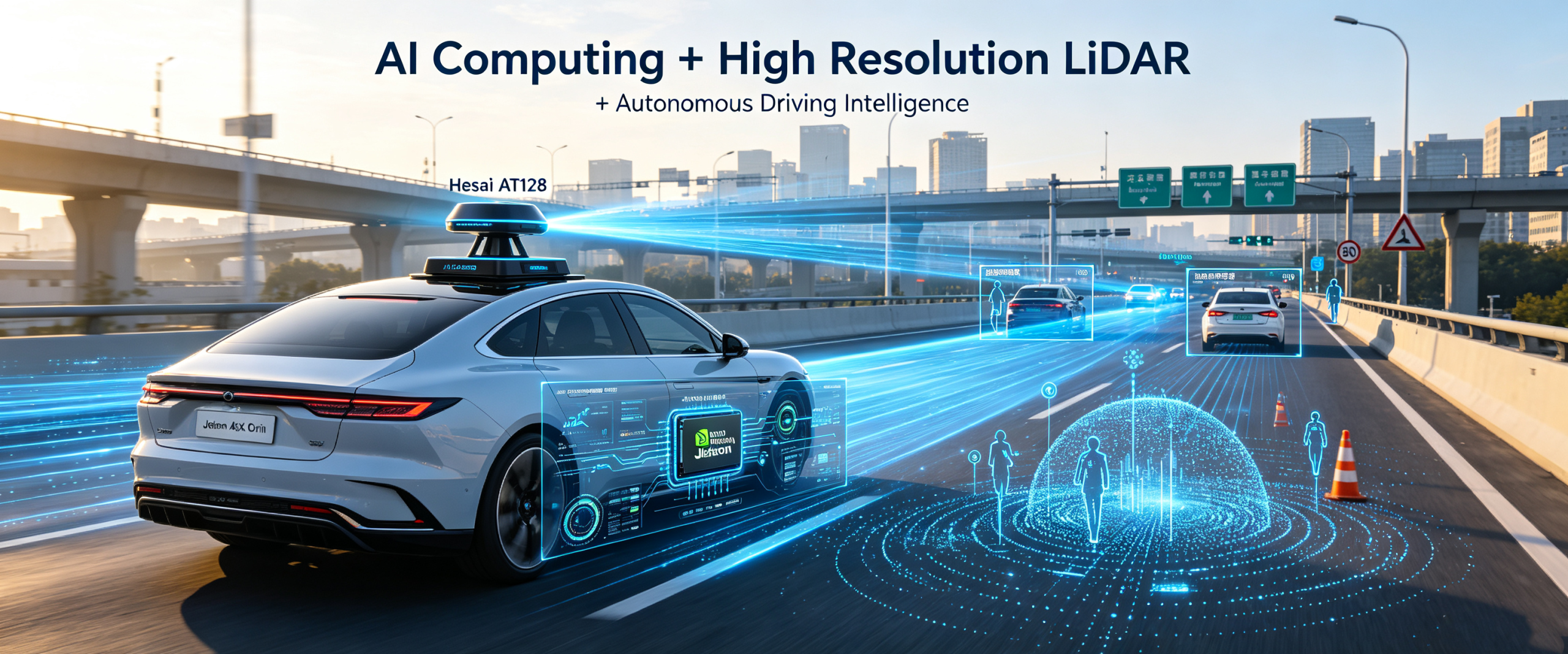
The New Era of AI-Based Autonomous Driving Perception
Autonomous driving technology is rapidly transforming the future of transportation.
From advanced driver assistance systems (ADAS) to robotaxis and autonomous delivery vehicles, modern intelligent vehicles require powerful perception capabilities to understand complex environments in real time.
A successful autonomous driving system depends on three fundamental components:
- High-performance sensors
- Powerful AI computing platforms
- Advanced perception algorithms
Among different sensor technologies, LiDAR has become one of the most important solutions for achieving reliable 3D environmental perception.
At the same time, edge AI computing platforms such as NVIDIA Jetson AGX Orin provide the computational power required to process massive sensor data and run deep learning algorithms directly inside vehicles.
The combination of:
- NVIDIA Jetson AGX Orin AI computing platform
- Hesai AT128 high-performance LiDAR sensor
creates a complete autonomous driving perception solution capable of delivering:
- High-resolution 3D environmental understanding
- Real-time object detection
- AI-based perception processing
- Low-latency decision making
- Scalable autonomous driving development
This solution is especially suitable for:
- Autonomous vehicles
- Robotaxi platforms
- Autonomous delivery vehicles
- ADAS development
- Intelligent transportation systems
- Industrial autonomous vehicles
1. Why Autonomous Driving Requires Advanced LiDAR and AI Computing
Chapter Image Recommendation
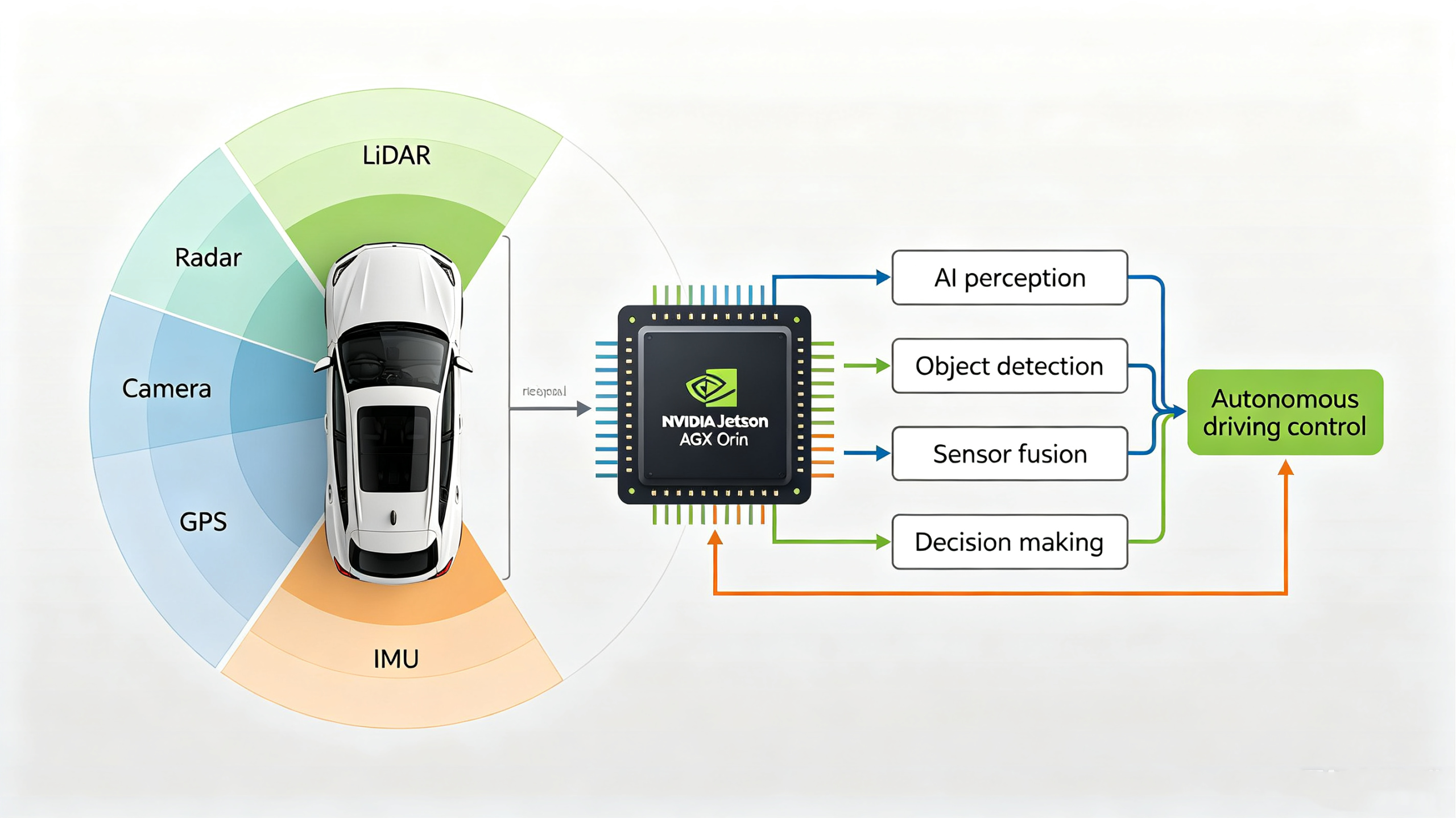
A vehicle perception architecture diagram showing:
Autonomous vehicles must operate safely in unpredictable environments.
Unlike traditional vehicles, autonomous systems need to continuously answer critical questions:
- Where is the vehicle located?
- What objects are nearby?
- How fast are surrounding objects moving?
- Which path is safe?
- How should the vehicle respond?
To achieve this, vehicles need accurate environmental perception.
Traditional camera-only systems face several challenges:
Limited Depth Information
Cameras provide rich visual information but have difficulty accurately measuring distance.
For autonomous driving, knowing that an object exists is not enough.
The vehicle must know:
- Exact distance
- Object position
- Object size
- Movement direction
Performance Limitations Under Difficult Conditions
Camera performance can be affected by:
- Low light
- Strong sunlight
- Shadows
- Weather conditions
LiDAR provides direct distance measurement using laser pulses, making it highly valuable for reliable perception.
Massive Data Processing Requirements
Modern LiDAR sensors generate millions of data points every second.
Processing this information requires powerful AI computing hardware.
This is where NVIDIA Jetson AGX Orin becomes essential.
2. NVIDIA Jetson AGX Orin: The AI Computing Platform for Autonomous Systems
Chapter Image Recommendation
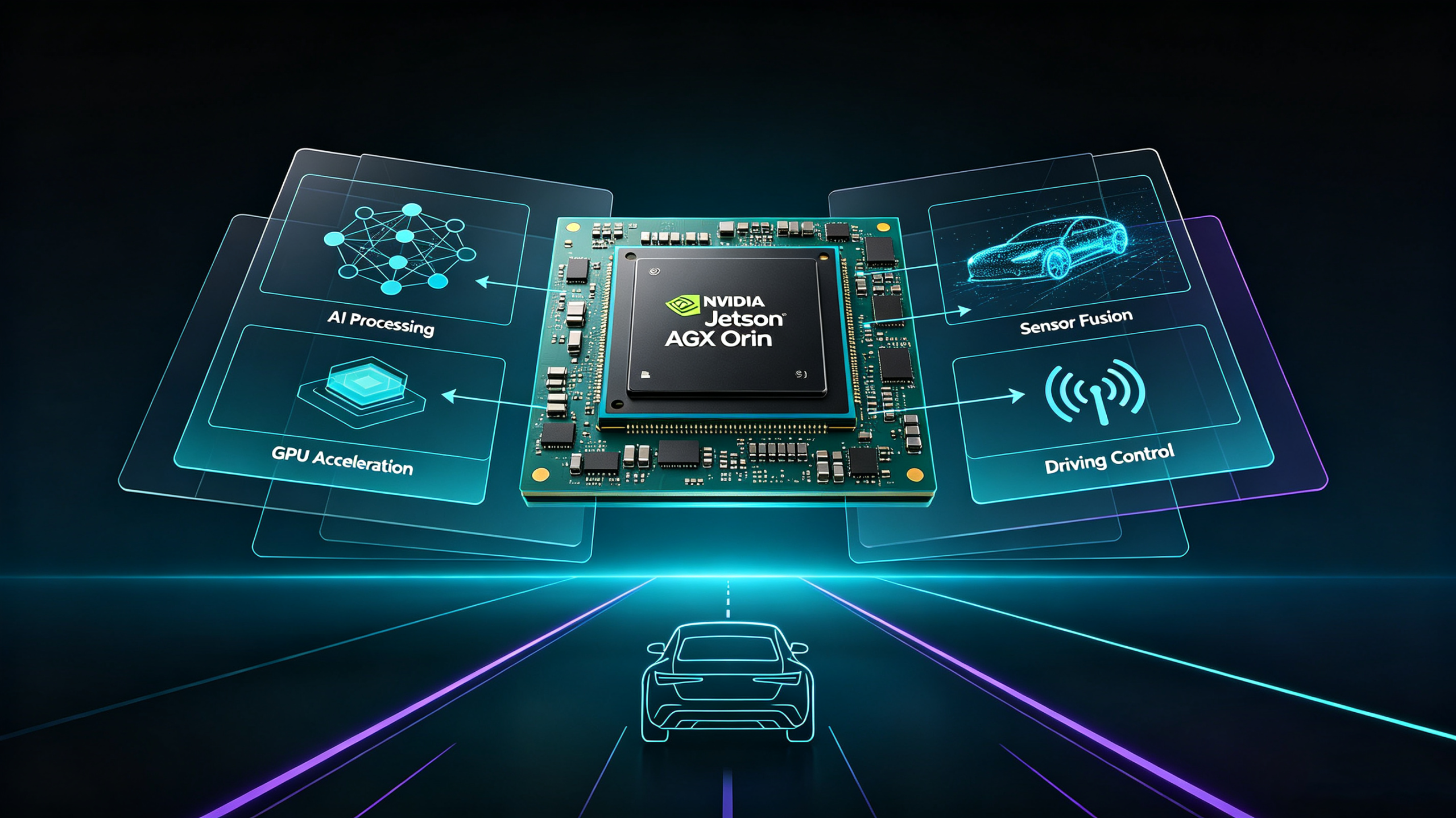
Close-up view of NVIDIA Jetson AGX Orin module with:
- AI processing visualization
- GPU acceleration graphics
- Neural network data flow
- Autonomous vehicle application
Overview of NVIDIA Jetson AGX Orin
NVIDIA Jetson AGX Orin is a powerful edge AI computing platform designed for robotics, autonomous machines, and intelligent vehicles.
It provides high-performance AI processing capabilities while maintaining compact size and low power consumption.
For autonomous driving developers, Jetson AGX Orin offers an ideal balance between:
- Computing performance
- Energy efficiency
- Development flexibility
- AI software ecosystem
Key Advantages of Jetson AGX Orin in Autonomous Driving
2.1 Powerful AI Inference Performance
Autonomous driving requires real-time execution of complex AI models.
Typical perception tasks include:
- Object detection
- Object classification
- Semantic segmentation
- Tracking
- Sensor fusion
Jetson AGX Orin provides accelerated AI computing capabilities that allow developers to run advanced deep learning models directly on the vehicle.
This enables:
- Faster response time
- Lower communication latency
- Real-time decision making
2.2 GPU Accelerated Computing Architecture
Traditional embedded processors may struggle with large-scale AI workloads.
Jetson AGX Orin uses NVIDIA GPU acceleration technology to efficiently process:
- LiDAR point clouds
- Camera images
- Radar signals
- Neural network models
This makes it suitable for autonomous driving applications requiring continuous perception.
2.3 Rich AI Software Ecosystem
One major advantage of NVIDIA platforms is the mature software ecosystem.
Developers can utilize:
- CUDA acceleration
- TensorRT optimization
- Deep learning frameworks
- Robotics development tools
This reduces development complexity and accelerates product deployment.
2.4 Compact Embedded Design
Autonomous vehicles require computing systems that can operate inside limited vehicle space.
Jetson AGX Orin provides:
- High computing capability
- Compact form factor
- Industrial reliability
making it suitable for:
- Autonomous cars
- Shuttle vehicles
- Delivery robots
- Mobile platforms
3. Hesai AT128 LiDAR: High-Resolution 3D Perception for Autonomous Driving
3.1 High-Resolution Point Cloud Generation
Modern autonomous driving systems require accurate perception of complex road environments.
A vehicle must detect and understand:
- Moving vehicles
- Pedestrians
- Cyclists
- Road barriers
- Traffic infrastructure
- Unexpected obstacles
Hesai AT128 LiDAR provides high-density 3D point cloud data, allowing autonomous systems to build a precise representation of the surrounding environment.
Compared with traditional sensing technologies, LiDAR provides direct measurement of spatial information.
Each point in a LiDAR point cloud contains valuable information:
- X coordinate
- Y coordinate
- Z coordinate
- Distance information
- Reflection intensity
These data points allow AI algorithms to understand the real-world environment in three dimensions.
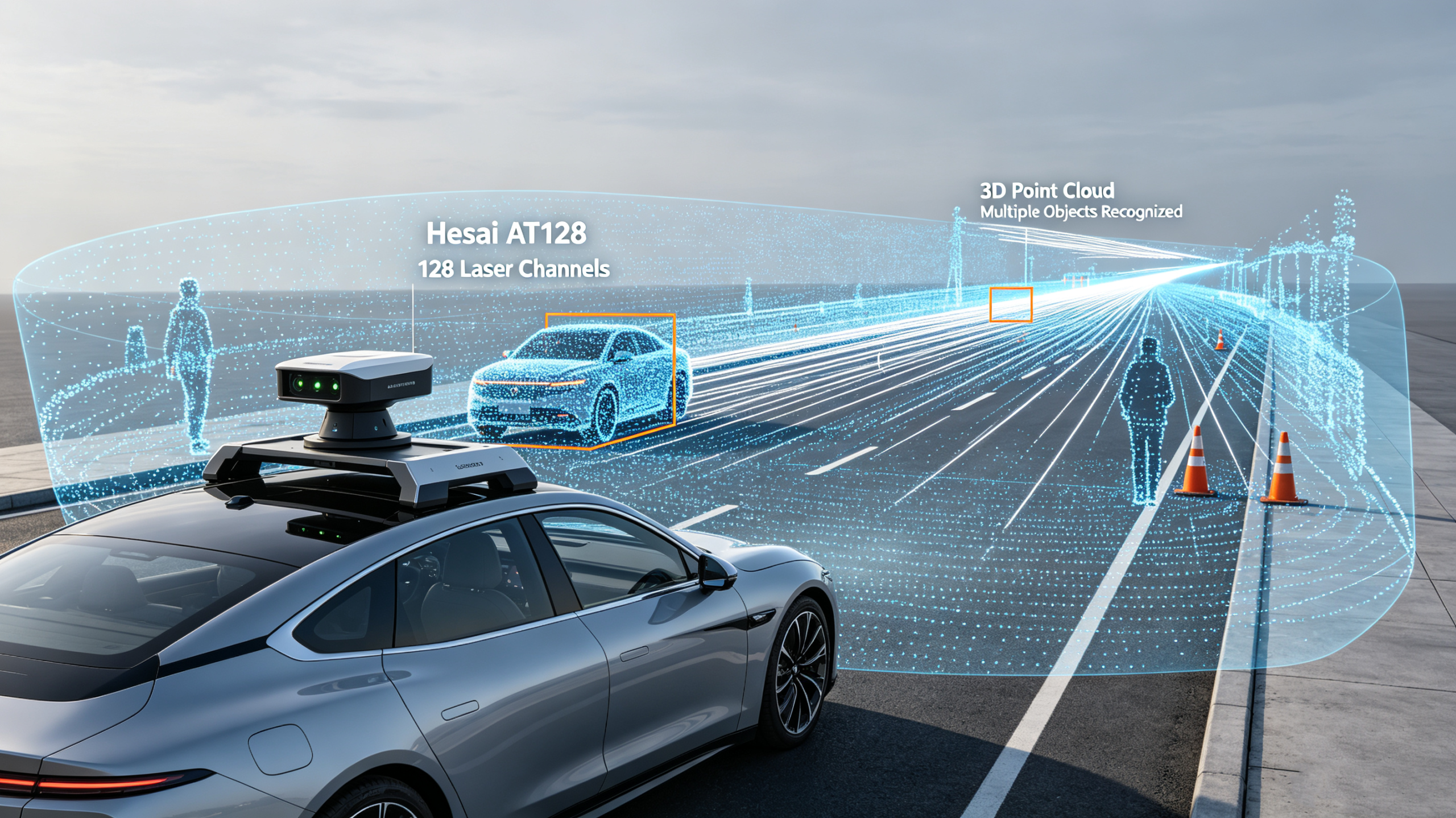
3.2 Wide Field of View for Comprehensive Environmental Awareness
For autonomous vehicles, understanding the entire surrounding environment is critical.
A LiDAR sensor with a wide field of view allows the vehicle to detect objects:
- In front of the vehicle
- On both sides
- Around intersections
- During lane changes
This improves:
- Driving safety
- Obstacle avoidance
- Path planning accuracy
For urban autonomous driving scenarios, vehicles frequently encounter:
- Pedestrians crossing roads
- Bicycles approaching from the side
- Vehicles changing lanes
- Complex intersections
High-quality 3D perception helps autonomous systems react earlier and more accurately.
3.3 Long-Range Detection Capability
High-speed autonomous driving requires early environmental awareness.
For example:
At highway speeds, a vehicle traveling at high velocity needs enough reaction time before reaching an obstacle.
A long-range LiDAR solution enables:
- Earlier obstacle detection
- Better trajectory prediction
- Safer autonomous decisions
This is especially important for:
- Autonomous highway driving
- Robotaxi applications
- Autonomous trucks
3.4 Automotive-Grade Reliability
Commercial autonomous vehicles require sensors that can operate continuously under different conditions.
Important requirements include:
- Stable performance
- Temperature resistance
- Vibration resistance
- Long operating lifetime
Automotive-grade LiDAR solutions are designed for real-world deployment rather than laboratory testing.
This makes them suitable for:
- Fleet vehicles
- Autonomous taxis
- Commercial transportation systems
4. NVIDIA Jetson AGX Orin + Hesai AT128 System Architecture
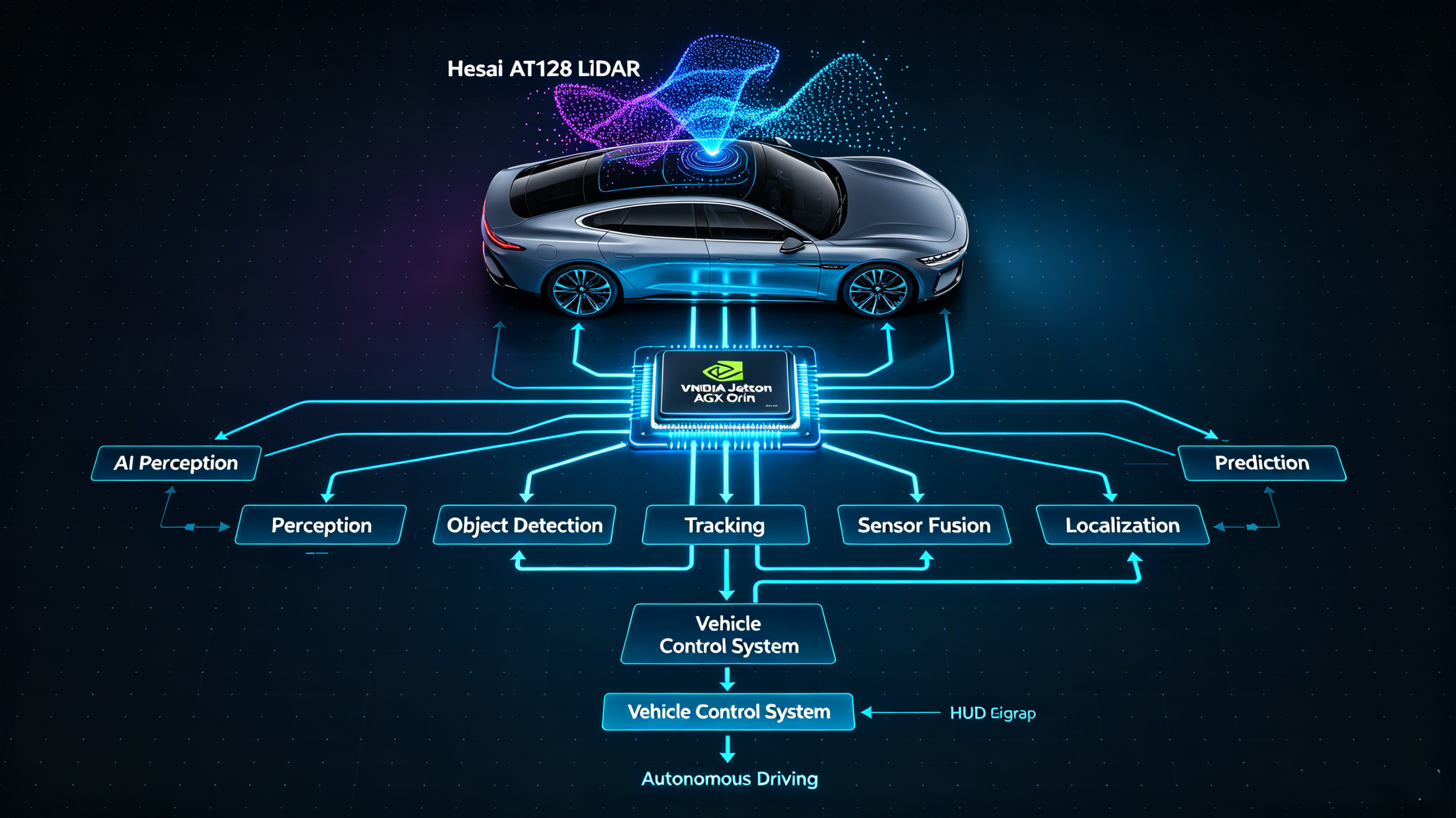
The combination of Hesai AT128 LiDAR and NVIDIA Jetson AGX Orin creates a complete perception computing platform.
The system can be divided into four major layers:
Layer 1: Environmental Sensing Layer
Hesai AT128 LiDAR
The LiDAR sensor collects environmental information by continuously scanning the surroundings.
Input data includes:
- 3D point clouds
- Object distance
- Object position
- Reflection information
The sensor acts as the “eyes” of the autonomous vehicle.
Layer 2: Data Processing Layer
NVIDIA Jetson AGX Orin
The massive amount of LiDAR data requires powerful computing resources.
Jetson AGX Orin receives raw sensor data and performs:
- Data preprocessing
- Point cloud filtering
- Coordinate transformation
- AI inference
The computing platform acts as the “brain” of the autonomous system.
Layer 3: AI Perception Layer
After receiving LiDAR data, AI algorithms analyze the environment.
Main functions include:
Object Detection
The system identifies:
- Cars
- Trucks
- Pedestrians
- Motorcycles
- Obstacles
Object Classification
AI models determine object categories.
For example:
A detected object may be classified as:
- Passenger vehicle
- Emergency vehicle
- Pedestrian
- Traffic barrier
Object Tracking
Autonomous vehicles must understand how objects move.
Tracking algorithms estimate:
- Object speed
- Movement direction
- Future position
This information helps vehicles make safer decisions.
Layer 4: Autonomous Decision and Control
After perception processing, the system generates driving decisions.
Examples:
- Maintain lane
- Slow down
- Change direction
- Stop
- Avoid obstacle
The final commands are sent to vehicle control systems.
5. AI Perception Workflow Using Jetson AGX Orin and AT128 LiDAR
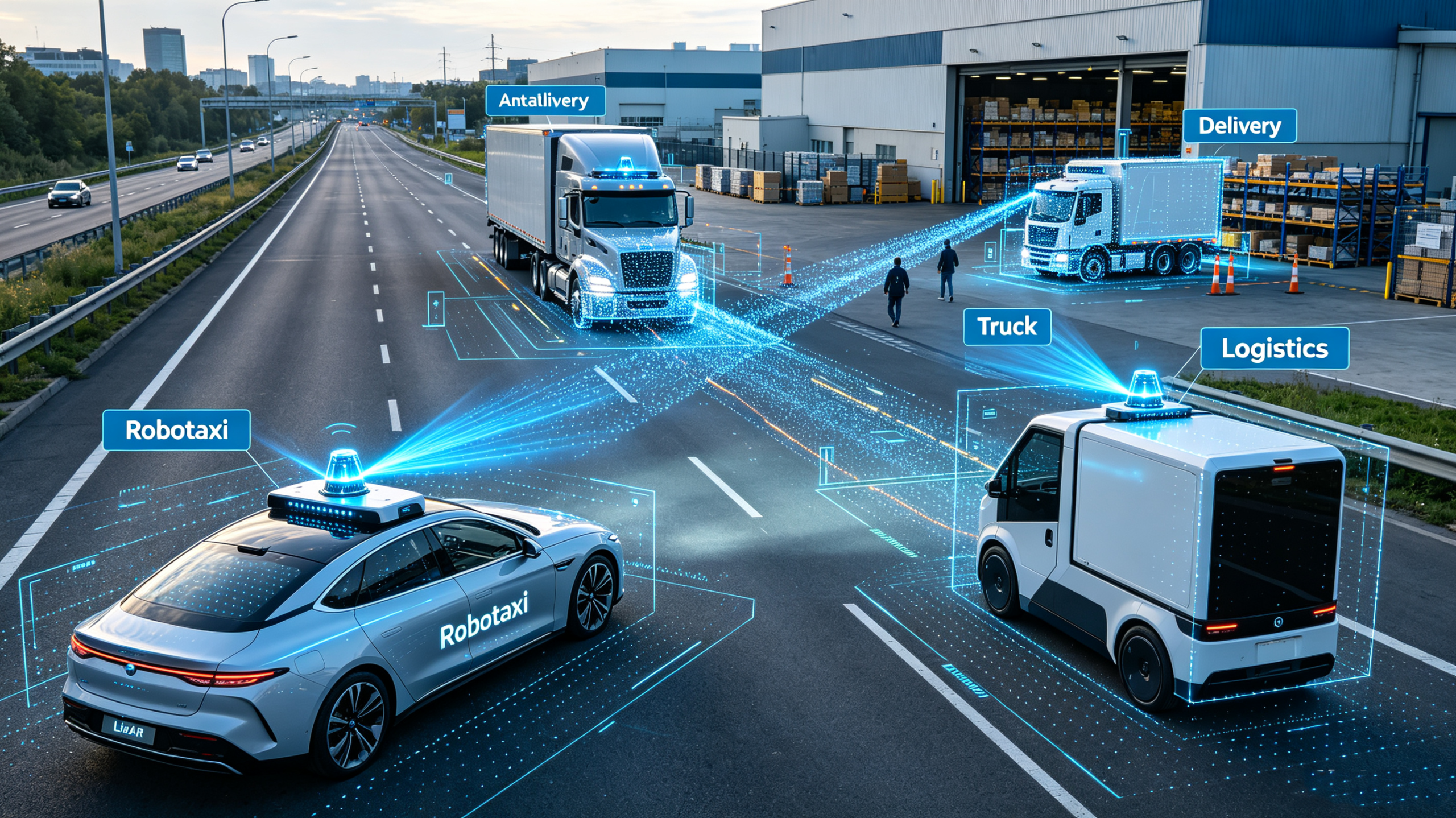
Step 1: LiDAR Data Collection
Hesai AT128 continuously scans the environment.
The sensor generates high-frequency 3D information around the vehicle.
Step 2: Point Cloud Processing
Raw LiDAR data requires preprocessing.
Common operations include:
- Noise filtering
- Ground removal
- Data synchronization
- Coordinate conversion
This prepares the data for AI algorithms.
Step 3: Deep Learning Inference
Jetson AGX Orin runs AI models to analyze LiDAR data.
Typical deep learning tasks include:
- 3D object detection
- Point cloud segmentation
- Object tracking
Advanced AI models can recognize complex environments in real time.
Step 4: Sensor Fusion
Although LiDAR provides excellent 3D information, autonomous vehicles often combine multiple sensors.
Sensor fusion may include:
- LiDAR
- Camera
- Radar
- GPS
- IMU
Combining different sensors improves reliability.
For example:
Camera provides:
- Color information
- Traffic sign recognition
LiDAR provides:
- Accurate distance
- 3D geometry
Radar provides:
- Velocity measurement
Together they create a more complete perception system.
6. Autonomous Driving Applications Based on Jetson AGX Orin + AT128
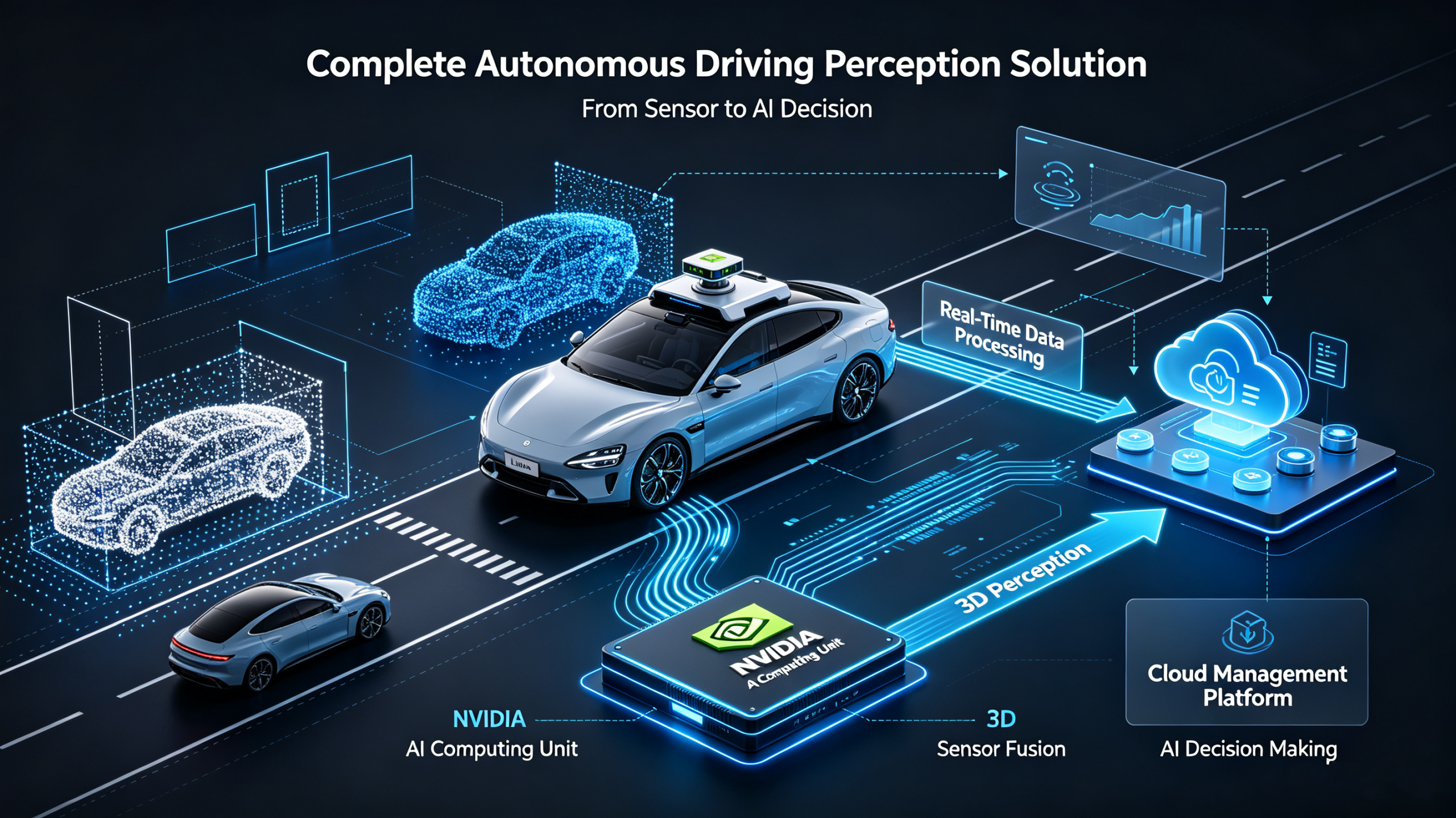
6.1 Robotaxi Systems
Robotaxis require extremely reliable perception because they operate in complex urban environments.
Challenges include:
- Heavy traffic
- Pedestrians
- Intersections
- Changing road conditions
The combination of AT128 LiDAR and Jetson AGX Orin provides:
- Real-time 3D perception
- Fast AI processing
- Reliable obstacle detection
6.2 Autonomous Delivery Vehicles
Autonomous delivery vehicles operate in:
- Residential areas
- Campuses
- Industrial parks
They require:
- Compact design
- Low power consumption
- Accurate navigation
The Jetson + LiDAR platform provides the perception capability needed for unmanned delivery operations.
6.3 Autonomous Trucks
Heavy-duty autonomous vehicles require long-range perception.
Applications include:
- Logistics transportation
- Mining vehicles
- Highway autonomous driving
The solution supports:
- Long-distance detection
- Large-object recognition
- High-speed operation
6.4 Smart Industrial Vehicles
Beyond passenger vehicles, LiDAR and AI computing are also used in:
- Autonomous forklifts
- Port vehicles
- Construction machinery
- Agricultural machines
These applications benefit from:
- Precise positioning
- Environmental understanding
- Autonomous operation
7. Advantages of NVIDIA Jetson AGX Orin + Hesai AT128 LiDAR Autonomous Driving Solution
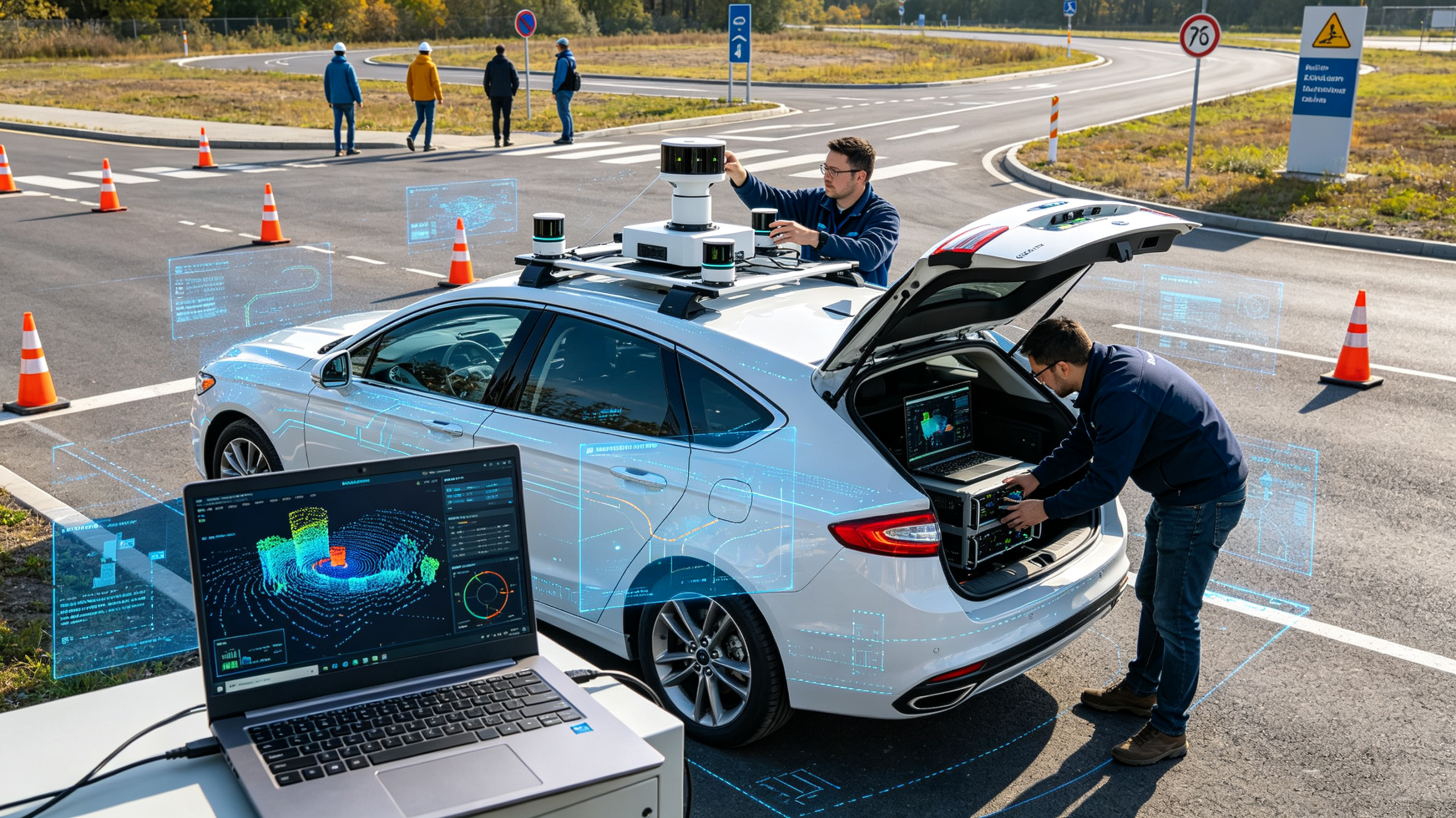
The combination of NVIDIA Jetson AGX Orin and Hesai AT128 creates a powerful autonomous driving development platform by combining high-performance sensing with advanced edge AI computing.
This integrated solution provides several key advantages for autonomous vehicle developers.
7.1 Real-Time AI Perception Processing
One of the biggest challenges in autonomous driving is processing massive amounts of sensor data within milliseconds.
A vehicle cannot wait for cloud processing because driving decisions must happen instantly.
The Jetson AGX Orin platform enables:
- Local AI inference
- Low-latency perception
- Real-time object detection
- Faster autonomous decision-making
By processing data directly inside the vehicle, the system reduces dependency on external networks and improves operational reliability.
7.2 High-Accuracy 3D Environmental Understanding
Hesai AT128 LiDAR provides detailed spatial information that allows autonomous systems to understand the world in three dimensions.
Compared with traditional sensing methods, LiDAR enables vehicles to accurately determine:
- Object distance
- Object position
- Object size
- Road geometry
- Surrounding environment structure
When combined with AI algorithms running on Jetson AGX Orin, the vehicle can transform raw point cloud data into meaningful perception information.
7.3 Flexible Development Platform for Autonomous Driving Companies
Different autonomous driving companies have different requirements.
Some may focus on:
- Robotaxi development
- Delivery vehicles
- Autonomous logistics
- Industrial vehicles
- ADAS systems
The Jetson AGX Orin platform provides flexibility for different software architectures.
Developers can customize:
- AI models
- Perception algorithms
- Sensor fusion strategies
- Vehicle control systems
This makes the solution suitable for both research prototypes and commercial deployment.
7.4 Reduced Development Time
Building an autonomous driving system from scratch requires significant engineering resources.
A complete LiDAR + AI computing platform helps companies accelerate development by providing:
- Proven hardware architecture
- AI computing capability
- Sensor compatibility
- Software development ecosystem
Engineering teams can focus more on:
- Application development
- Algorithm optimization
- Vehicle integration
instead of designing basic hardware infrastructure.
7.5 Scalable From Prototype to Mass Production
For commercial autonomous driving projects, scalability is essential.
A suitable hardware solution should support:
Prototype Stage:
- Algorithm testing
- Data collection
- Vehicle validation
Development Stage:
- System optimization
- Field testing
- Performance improvement
Production Stage:
- Stable supply
- Manufacturing integration
- Long-term support
The combination of industrial-grade LiDAR and embedded AI computing provides a foundation for scalable autonomous systems.
8. Integration Considerations for Developers
ting provide powerful capabilities, successful deployment requires careful system integration.
8.1 Mechanical Installation and Sensor Calibration
LiDAR installation directly affects perception accuracy.
Engineers should consider:
- Sensor mounting position
- Vehicle vibration
- Sensor angle
- Protection from environmental impact
Calibration is necessary to ensure accurate alignment between:
- LiDAR coordinates
- Camera coordinates
- Vehicle coordinate system
8.2 Software and Algorithm Integration
Autonomous driving software requires compatibility between hardware and algorithms.
Important considerations include:
- LiDAR driver support
- Point cloud data format
- SDK availability
- AI framework compatibility
Developers should ensure smooth communication between:
LiDAR sensor →
AI computer →
Perception software →
Vehicle control system
8.3 Data Processing Optimization
High-resolution LiDAR generates significant data volume.
Optimization techniques may include:
- Point cloud filtering
- AI model acceleration
- GPU optimization
- Data compression
NVIDIA Jetson AGX Orin provides GPU acceleration capabilities that help handle demanding AI workloads.
8.4 Thermal and Power Management
Autonomous vehicles often operate for long periods.
Therefore, system designers must evaluate:
- Power consumption
- Heat dissipation
- Operating temperature
- Enclosure design
A well-designed computing system improves reliability.
9. Why Choose an Integrated LiDAR and AI Computing Solution?
Many autonomous driving developers face challenges when selecting separate hardware components.
Using an integrated perception solution provides several benefits.
Faster Technical Evaluation
Instead of testing unrelated components separately, engineers can evaluate:
- Sensor performance
- Computing capability
- AI processing results
as one complete system.
Lower Integration Risk
Hardware compatibility issues can delay autonomous driving projects.
A coordinated solution reduces risks related to:
- Data communication
- Software compatibility
- Performance limitations
Better Technical Support
Working with experienced solution providers allows customers to receive assistance with:
- Sensor selection
- System architecture
- Hardware integration
- Application optimization
10. Frequently Asked Questions
Q1: Why combine LiDAR with NVIDIA Jetson AGX Orin?
LiDAR provides accurate 3D environmental data, while Jetson AGX Orin provides the AI computing power required to process that data.
Together they create a complete perception system for autonomous driving.
Q2: Is LiDAR necessary for autonomous driving?
Different autonomous driving systems use different sensor combinations.
However, LiDAR provides important advantages:
- Accurate distance measurement
- 3D perception
- Reliable object detection
Many advanced autonomous systems use LiDAR as a key perception sensor.
Q3: What applications can use Jetson AGX Orin and AT128 LiDAR?
Typical applications include:
- Robotaxis
- Autonomous delivery vehicles
- ADAS development platforms
- Autonomous trucks
- Smart logistics vehicles
- Industrial autonomous machines
Q4: Can this solution support autonomous driving development projects?
Yes.
The platform can support different development stages:
- University research
- Prototype vehicles
- Engineering validation
- Commercial autonomous vehicles
Q5: How do companies select the right LiDAR and AI computing solution
Selection should consider:
- Vehicle type
- Operating environment
- Detection requirements
- AI algorithm requirements
- Production targets
- Cost objectives
A professional engineering evaluation is recommended before final selection.
11. Autonomous Driving Solution Selection Checklist
Before starting an autonomous driving project, companies should evaluate:
Sensor Requirements
✓ Required detection range
✓ Field of view
✓ Point cloud density
✓ Environmental conditions
✓ Automotive reliability
Computing Requirements
✓ AI model complexity
✓ Processing performance
✓ Power consumption
✓ Software ecosystem
✓ Expansion capability
Deployment Requirements
✓ Prototype testing
✓ Mass production capability
✓ Supplier stability
✓ Technical support
12. Conclusion: Building the Future of Autonomous Driving With AI and LiDAR
Autonomous driving requires a combination of accurate perception, powerful computing, and intelligent algorithms.
Hesai AT128 LiDAR provides high-quality 3D environmental sensing, while NVIDIA Jetson AGX Orin delivers the AI computing capability needed for real-time autonomous decision-making.
Together, they create a powerful autonomous driving perception platform capable of supporting:
- Robotaxi development
- Intelligent transportation
- Autonomous logistics
- ADAS systems
- Next-generation robotic vehicles
For companies developing autonomous vehicles, choosing the right combination of LiDAR sensors and AI computing hardware is one of the most important decisions during system design.
A reliable perception platform can help accelerate development, improve safety, and create more scalable autonomous solutions.
Looking for a LiDAR + AI Computing Solution for Your Autonomous Vehicle Project?
Our engineering team can help you evaluate:
- LiDAR sensor selection
- NVIDIA Jetson AGX Orin integration
- Autonomous driving perception architecture
- Prototype testing solutions
- Customized hardware requirements
Contact our technical team today to discuss your autonomous driving application.
Build smarter vehicles with advanced LiDAR perception and AI computing technology.









