
Why is 3D LiDAR popular?
If you are one of the earliest users of robotic vacuum cleaners, you must have seen their somewhat unintelligent appearance: they hum and clean while constantly hitting walls and getting stuck on stairs, unable to bounce. You can probably understand why the robotics industry is so obsessed with the concept of “eyes”.
Before the emergence of 3D LiDAR, the “eye gaze” of robots had several stages: the most primitive stage was the “blind” stage, which relied on electromagnetic wires buried underground to draw circles and lost direction once out of the circle; Later on, GPS and cameras were introduced, but as soon as one entered a hallway or other space, they immediately “lost themselves”. The cameras were also limited by light, and when the light was dim, they would go blind; Later, 2D LiDAR became popular, which could tell robots that there was something ahead, but they couldn’t distinguish what it was and whether they could run over it. As a result, the robots had no idea and either charged forward or sadly got stuck in a corner.
To put it simply, 2D radar provides a flat black and white photo, while robots require a three-dimensional full-color dynamic map.
This is the biggest background for the emergence of 3D LiDAR – robots cannot only know “whether there is something blocking the way”, they must know “what that thing looks like, how high, how big, and how to go around it”.
Why can’t non 3D LiDAR be used?
Speaking of which, it’s actually not mysterious.
Its working principle is that the device actively emits laser, which reflects back when it hits surrounding objects. The device calculates the round-trip time of the laser, accurately calculates the distance and position of each object, and finally splices together a three-dimensional image of the entire environment, commonly known as a point cloud map in the industry.
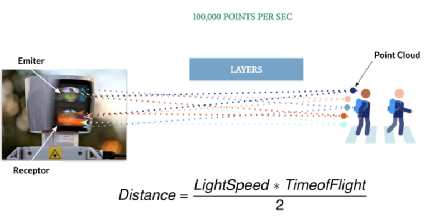
At present, the mainstream all solid state LiDAR in the industry completely eliminates the motor and rotating parts of traditional equipment, and relies on self-developed chips to achieve scanning work, with a simpler structure, longer lifespan, and higher stability.
Its reliability is mainly reflected in the following aspects:
Firstly, it operates stably around the clock and is not affected by the environment. Ordinary cameras rely heavily on light, which can affect their work day and night, cloudy and sunny, and backlit. However, LiDAR actively emits light for detection, and can stably see the environment in dark nights, strong light during the day, or rainy, snowy, and foggy weather, without “blindness”.
Secondly, the data is accurate and error free. The depth distance of the camera relies entirely on algorithm estimation, which is prone to errors. However, LiDAR directly outputs centimeter level precise 3D coordinates, which can accurately identify subtle obstacles such as steps, cables, and small debris, providing absolutely reliable data support for device navigation and obstacle avoidance.
Thirdly, it has a wide detection range and is adaptable to multiple scenarios. Compared to depth cameras that can detect distances of several meters, LiDAR can detect distances of tens of meters, which is sufficient to support robots in outdoor long-distance prediction, obstacle avoidance, and large-scale mapping and navigation.
Fourthly, the cost-effectiveness advantage continues to be highlighted. Leading manufacturers represented by Sagitar Juchuang have achieved full stack self-developed chips, hardware, and mass production. A set of technology bases can be used in both automotive and robot products, diluting research and development and production costs through large-scale mass production. This has reduced the price of laser radar from a high of tens of thousands of yuan in the early years to a popular price of thousands of yuan today, making it suitable for large-scale commercial use.
The “pleasure” and “pain” of landing humanoid robots
Humanoid robots are different from ordinary sweeping and mowing robots. They need to walk, climb up and down stairs, avoid obstacles, and operate autonomously in non-standard complex scenes such as homes, factories, and parks like humans. The requirements for perception systems are extremely high, and 3D LiDAR is the core hardware for achieving autonomous operation.
Firstly, the issue of ‘road blindness’ has been resolved. The activity scenes of humanoid robots are constantly changing, and traditional perception methods are difficult to achieve accurate mapping and positioning. And 3D LiDAR scans the surrounding environment in real time, quickly constructs high-precision 3D maps, and corrects the position in real time during walking to avoid positioning drift and getting lost.
Secondly, it eliminates the security and obstacle avoidance challenges in complex scenarios. Falling and collision of humanoid robots are the biggest pain points for commercial landing. Ground cables, low steps, scattered debris, and pedestrians walking are all safety hazards. Lidar can identify obstacles more than ten meters in advance, and can quickly adjust the walking trajectory regardless of day and night, making up for the shortcomings of pure visual solutions that are prone to missed detection and misjudgment.
Finally, adapt to the lightweight requirements of the body. The body space of humanoid robots is extremely limited, and traditional LiDAR is bulky and bulky. Installing it on humanoid robots will increase the load and affect the endurance. Therefore, it is in great need of a 3D LiDAR product that is compact, lightweight, and can be easily integrated into the robot’s head and torso without affecting the body structure and endurance performance, to adapt to consumer and industrial humanoid robots. And the all solid state LiDAR from Sagitar Juchuang perfectly meets this “both need and need” requirement.
However, as the most essential hardware in the vision system of humanoid robots, 3D LiDAR also has its shortcomings.
One is that it has the problem of “presbyopia”, where the closer the distance, the more severe the perception blind spot. Lidar cannot recognize fine objects within 0.3-0.5 meters, and it is completely incapable of performing close range precision grasping of parts, water cups, and other operations. It must be accompanied by depth cameras and structured light equipment to assist in the work. A single LiDAR cannot cover all scene requirements.
The second is the degradation of extreme weather performance. Although its performance has made a qualitative leap compared to cameras, in extreme weather conditions such as heavy rain, dense fog, and dust, the laser will be scattered, and the detection distance will be significantly shortened. The stability of outdoor extreme environments will decrease, and it needs to be complemented by millimeter wave radar.
Thirdly, the ability to recognize special objects is limited. Black fabrics, dark rubber, matte furniture and other objects have a high absorption rate of laser, and the detection distance will be greatly shortened. To improve the recognition effect, it is necessary to increase the power consumption of the equipment, which creates a certain contradiction.
The fourth issue is that hardware costs are still relatively high. Compared to ordinary depth cameras, the chip and module costs of all solid state LiDAR are higher, which will increase the price of the entire humanoid robot in the short term. To achieve widespread popularity, it is necessary to rely on larger scale mass production to continuously reduce costs.
How will the visual system of humanoid robots evolve in the future?
Chipification makes the radar “smaller and smarter”.
Just like how mobile phone chips are becoming stronger and stronger, LiDAR is also taking the “digitalization” route. The all solid state solution being attempted by Sagitar Juchuang has no mechanical rotating parts, is smaller in size, lower in cost, and may even be embedded in robot bodies like mobile phone cameras in the future.
Integrated fusion of sensors, no longer fighting on their own.
The current humanoid robots are packed with a bunch of sensors inside their heads: LiDAR, cameras IMU, Calculate each one separately, and finally put them together. In the future, there may be a trend towards hardware level integration, where these sensing components can be integrated into a single chip with underlying time synchronization and spatial alignment. This will naturally “align granularity” of the data, making it faster for robots to respond and less prone to precise segmentation.
The perception range extends from ‘how to go’ to ‘how to do it’.
At present, laser radar is mainly used for navigation (lower body work), and in the future, it may be separated into close range high-precision radar specifically used for fine operations (upper body work), specifically for grabbing screws, screwing parts, and assembling. This means that humanoid robots will not only walk, but also be more adept at performing fine tasks.
The fourth is a price drop that makes every robot affordable.
According to industry predictions, the market for 3D LiDAR for robots may soar to over 4 billion RMB by 2030, and as demand increases, costs will naturally decrease. Once the price drops to the level of a few hundred yuan, the assembly rate of humanoid robots will shift from “optional” to “standard”.
From “wall hitting exploration” to “surround view”, 3D LiDAR allows humanoid robots to see the contours of the world clearly. Although it is not yet omnipotent, without it, the safety and autonomy of humanoid robots will be greatly compromised. It can be said that on the road to truly perceiving like a human, 3D LiDAR is not the end, but it is definitely the bridge that cannot be bypassed.
Who will dominate the ups and downs of the future, and who is better than cameras, lasers, and millimeter waves? Most likely, no one can do without each other. By integrating various technologies and gradually filling in the gaps in vision, we can turn humanoid robots into true experts who can “see all directions” and respond sensitively.









