
Introduction
Selecting a LiDAR sensor is only the first step in building an autonomous perception system.
Even an advanced LiDAR can perform poorly if it is installed incorrectly.
Mounting position, sensor orientation, vehicle structure, vibration, cable routing and field-of-view obstruction can all affect the quality of the final perception system.
This becomes especially important when using wide-angle LiDAR.
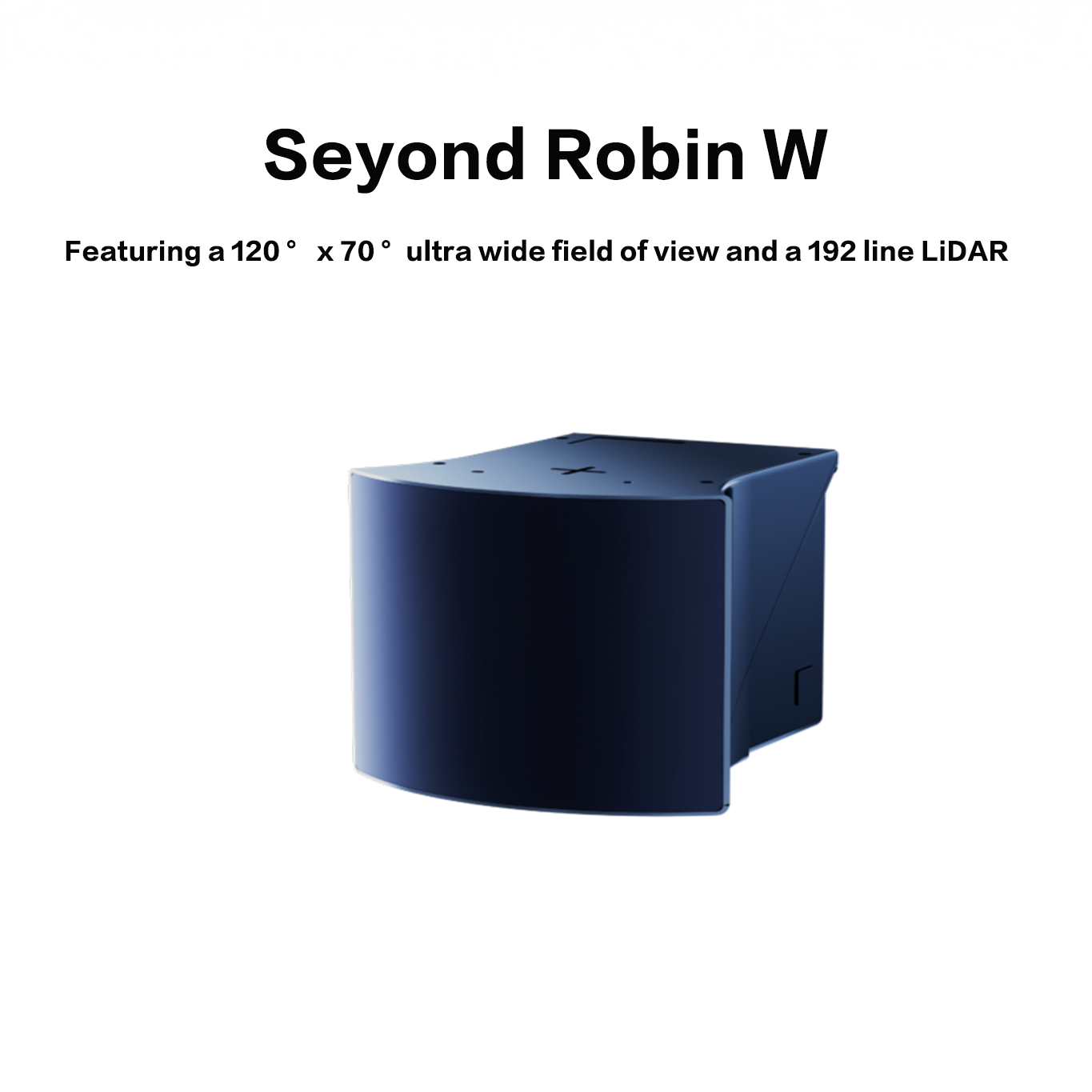
The Seyond Robin W is an interesting example because it provides a 120° × 70° field of view, making mounting geometry a major part of the system design. LidarSeek also describes Robin W as suitable for integration into areas such as side panels and bumpers.
This guide explains how engineering teams can approach LiDAR installation on autonomous vehicles, AGVs and mobile robots, using Robin W as a practical example.
The focus is not simply on where to place the sensor.
The objective is to understand how sensor placement influences the perception architecture.
1. Why LiDAR Placement Matters
A LiDAR does not perceive the entire world.
It only perceives what falls within its optical field of view.
Therefore:
Sensor specification + installation position = actual perception coverage
For example, Robin W provides a 120° × 70° field of view.
If part of that field is blocked by the vehicle body, the usable field of view becomes smaller.
This means an engineering team can unintentionally lose one of the sensor’s most valuable characteristics.
2. Side-Mounted LiDAR
Side-mounted LiDAR can be particularly useful for autonomous vehicles.
The side of a vehicle contains many potential blind areas.
These include:
- Nearby pedestrians
- Bicycles
- Other vehicles
- Barriers
- Walls
- Industrial equipment
A side-facing LiDAR can complement forward-facing sensors.
This is one reason Robin W’s wide horizontal and vertical FOV can be interesting for side perception.
LidarSeek specifically describes the product as suitable for integration into side panels and bumpers.
3. Bumper-Mounted LiDAR
A bumper is another possible installation location.
Advantages can include:
- Low mounting height
- Forward visibility
- Short distance to road surface
- Compact integration
However, bumper mounting introduces challenges.
The sensor may be exposed to:
- Dirt
- Water
- Road debris
- Physical impact
- Vibration
Therefore, a bumper-mounted sensor should be mechanically protected without obstructing the optical field.
4. Sensor Height
Sensor height has a major influence on perception.
A higher LiDAR can see over some obstacles.
A lower LiDAR can detect low-level objects more directly.
There is no universally perfect height.
The correct position depends on:
- Vehicle height
- Object size
- Application
- Speed
- Road environment
- Required detection distance
For a warehouse AMR, a low mounting position may be useful for pallets and obstacles.
For an autonomous vehicle, the optimal position may be very different.
5. Vertical Field of View
Robin W’s 70° vertical FOV is particularly relevant to installation design.
A large vertical FOV means the sensor can capture objects across a larger vertical range.
However, this also means the sensor needs an unobstructed optical path.
The engineering team should create a 3D model of the vehicle and simulate the LiDAR FOV.
This can identify:
- Hood obstruction
- Bumper obstruction
- Body-panel obstruction
- Roof obstruction
- Mounting bracket obstruction
A simple CAD simulation can prevent significant problems later.
6. Horizontal Orientation
The horizontal angle of the sensor must also be considered.
If the goal is side perception, the sensor should be oriented to maximize coverage along the vehicle side.
If the goal is corner perception, the sensor may need a different angle.
A small orientation change can significantly change the coverage area.
Therefore, mounting brackets should ideally provide controlled and repeatable alignment.
7. Avoiding Blind Zones
Blind zones are a major consideration in autonomous perception.
A blind zone can occur because of:
- Sensor geometry
- Vehicle structure
- Sensor minimum range
- Incorrect mounting
- Incorrect orientation
Robin W is listed with a minimum detection distance around 0.1 meter, which is particularly useful for near-field applications.
However, the sensor’s minimum range does not automatically eliminate all vehicle blind spots.
The physical vehicle geometry still matters.
8. Why Minimum Range Is Not the Same as Blind-Zone Elimination
This distinction is important.
Suppose a LiDAR can detect an object from 0.1 meter.
That does not mean the vehicle can detect every object located 0.1 meter away.
If the object is physically hidden behind the bumper, body panel or wheel arch, the LiDAR cannot see it.
Therefore:
Sensor blind zone ≠ vehicle blind zone
Vehicle perception must be evaluated as a complete system.
9. Multiple LiDAR Architecture
Many autonomous platforms use multiple sensors.
A simplified architecture might contain:
- Front LiDAR
- Rear LiDAR
- Left LiDAR
- Right LiDAR
This can provide broad environmental coverage.
However, multiple sensors also increase:
- Cost
- Power consumption
- Data bandwidth
- Calibration requirements
- Mechanical complexity
A wide-angle sensor can potentially reduce the number of sensors required in some architectures.
But this must be proven through actual coverage analysis.
10. Robin W and Multi-Sensor Design
Robin W provides a 120° horizontal field of view.
Four sensors theoretically provide very broad angular coverage.
However, the actual result depends on:
- Sensor orientation
- Overlap
- Vehicle structure
- Mounting height
Engineers should not simply divide 360° by 120° and assume perfect coverage.
The FOV geometry is more complicated because the sensor has both horizontal and vertical characteristics.
A better approach is to create a 3D coverage simulation.
11. Overlap Between Sensors
Sensor overlap is not necessarily wasted.
Overlap can help create redundancy.
If two LiDAR sensors observe the same area, the perception system may have additional information.
This can be useful for:
- Object tracking
- Sensor redundancy
- Occlusion handling
- Calibration
- Fault detection
However, too much overlap increases cost and data processing.
The correct overlap should therefore be determined through system requirements.
12. Time Synchronization
When multiple sensors are installed, time synchronization becomes important.
Imagine two LiDARs observing a moving vehicle.
If their timestamps are not synchronized, the same object may appear in slightly different positions.
This can complicate point-cloud fusion.
Therefore, engineering teams should verify:
- Timestamp source
- Synchronization method
- Network timing
- Hardware triggering if applicable
Time synchronization becomes increasingly important as vehicle speed increases.
13. Coordinate Systems
Every LiDAR needs a defined coordinate system.
For example:
- X-axis
- Y-axis
- Z-axis
The transformation between the sensor coordinate frame and vehicle coordinate frame must be calibrated.
A typical pipeline is:
LiDAR frame → Vehicle frame → World frame
If the sensor is rotated incorrectly, the point cloud can appear distorted relative to the vehicle.
This can affect:
- Localization
- Mapping
- Obstacle detection
- Path planning
14. Mechanical Vibration
Autonomous vehicles are not static laboratory platforms.
They experience:
- Road vibration
- Acceleration
- Braking
- Turning
- Impact
- Mechanical oscillation
A LiDAR mount must therefore be rigid enough to maintain alignment.
If the sensor moves relative to the vehicle body, the perception system may interpret the movement as environmental motion.
This is especially problematic for mapping and localization.
15. Thermal Considerations
Even low-power sensors generate heat.
Robin W’s product information describes approximately 8W power consumption.
Eight watts may sound small.
But in a sealed enclosure with limited airflow, heat can accumulate.
Therefore, the installation design should consider:
- Heat dissipation
- Enclosure ventilation
- Ambient temperature
- Sun exposure
- Nearby heat sources
This becomes particularly important for vehicle-mounted sensors.
16. Cable Routing
Cable routing is often overlooked.
The cable should not:
- Block the FOV
- Experience excessive bending
- Interfere with moving parts
- Create vibration
- Become exposed to water
- Experience unnecessary mechanical stress
For production vehicles, cable routing should be designed together with the mechanical mount.
17. Waterproofing and Environmental Protection
Autonomous vehicles may operate outdoors.
The LiDAR therefore needs to be evaluated according to:
- IP rating
- Operating temperature
- Storage temperature
- Dust resistance
- Water resistance
Engineers should verify the exact environmental specification of the selected Robin W configuration before deployment.
Never assume that a product suitable for indoor robotics automatically qualifies for outdoor automotive use.
18. Cleaning and Maintenance
Sensor performance can degrade when the optical surface becomes contaminated.
Potential contaminants include:
- Dust
- Mud
- Rain
- Snow
- Oil
- Road salt
A production system should therefore have a maintenance strategy.
Possible solutions include:
- Protective windows
- Cleaning systems
- Hydrophobic coatings
- Air jets
- Wipers
The solution depends on the vehicle environment.
19. LiDAR and Camera Fusion
A LiDAR installation should be designed together with camera placement.
For example:
A camera may be mounted near the windshield.
A LiDAR may be mounted in the bumper.
Their fields of view may overlap.
This can enable sensor fusion.
The system can then associate:
Camera object → LiDAR position → Radar velocity
Such fusion can improve environmental understanding.
20. Robin W for AGV and Industrial Vehicles
The same installation principles apply to industrial robots.
For an AGV:
- Sensor height should match obstacle requirements
- Side coverage should be considered
- Near-field detection is important
- Mounting must survive vibration
For an autonomous forklift:
- Vertical FOV becomes particularly important
- Fork and pallet geometry must be considered
- Human detection is critical
- Overhead structures may need to be considered
Robin W’s wide vertical FOV can make it worth evaluating for such environments.
21. Prototype Testing Procedure
A practical LiDAR installation test can follow this process.
Step 1: Install the sensor
Use a temporary but rigid bracket.
Step 2: Record raw point clouds
Collect data while the vehicle is stationary.
Step 3: Test basic coverage
Drive around obstacles.
Step 4: Test dynamic objects
Introduce:
- People
- Vehicles
- Robots
Step 5: Test different speeds
Evaluate perception at increasing speeds.
Step 6: Analyze blind zones
Create a coverage map.
Step 7: Optimize the mounting position
Change height and angle.
Step 8: Repeat
Continue until the desired coverage is achieved.
22. How to Calculate the Practical Coverage Area
Theoretical FOV is only one part of the calculation.
Engineers should consider:
FOV + Range + Mounting Height + Orientation + Vehicle Geometry
For example, if the LiDAR is mounted low and tilted downward, the ground coverage may increase.
If it is tilted upward, long-range object detection may improve.
Therefore, mounting angle should be selected based on application requirements.
23. Why Simulation Is Worth Doing
LiDAR installation can be simulated before physical testing.
A digital vehicle model can include:
- LiDAR location
- FOV
- Range
- Vehicle geometry
- Obstacles
The resulting coverage can be visualized.
This can reduce development time.
It can also help determine whether one sensor is sufficient or whether additional sensors are required.
24. Current Robin W Price and Procurement
LidarSeek currently lists Robin W at approximately $1,725, subject to price changes, inventory and quantity.
The site also indicates sample orders of approximately 3–10 days and standard orders of approximately 7–15 days, although actual lead time should be confirmed at the time of purchase.
For international buyers, LidarSeek lists shipping options including DHL, FedEx and UPS, together with DAP, FOB Shenzhen, EXW and FCA terms.
25. Final Installation Checklist
Before production installation, confirm:
Mechanical
- Mounting bracket
- Sensor height
- Sensor angle
- Vibration
- Protection
Optical
- FOV
- Obstruction
- Ground interference
- Blind zones
Electrical
- Voltage
- Power
- Cable routing
Software
- Driver
- SDK
- ROS
- Timestamp
- Network
Environmental
- Temperature
- Water
- Dust
- Contamination
System
- Sensor fusion
- Calibration
- Object detection
- Localization
- Navigation
Conclusion
A LiDAR sensor should never be evaluated independently from its installation.
For autonomous vehicles, AGVs and mobile robots, the mounting location can determine how much of the sensor’s theoretical performance is actually available to the perception system.
Seyond Robin W is particularly interesting because its 120° × 70° FOV and approximately 0.1-meter minimum detection range make near-field and wide-angle perception important parts of its application profile.
The best installation strategy is therefore not simply “mount the sensor where there is space.”
Instead:
Define the perception requirement → simulate the FOV → select mounting position → test coverage → calibrate → validate in the real environment.
For engineering teams evaluating Robin W, this process can help determine whether one sensor is sufficient or whether a multi-LiDAR architecture is required.
Frequently Asked Questions
1. Where should Robin W be mounted?
Potential locations include side panels and bumpers, depending on the vehicle design.
2. Is Robin W suitable for side perception?
Its 120° horizontal FOV makes it worth evaluating for side and corner perception applications.
3. Can one Robin W provide 360° coverage?
No. A 120° horizontal FOV does not provide complete 360° coverage by itself.
4. Does mounting height affect LiDAR performance?
Yes. Height changes the geometry of the sensing area and can affect near-field and long-range perception.
5. Can the LiDAR be tilted?
Yes, but the angle should be selected based on the desired perception area and validated through testing.
6. What causes LiDAR blind zones?
Blind zones can result from sensor geometry, minimum detection distance and physical obstruction by the vehicle.
7. Does Robin W have a short minimum detection distance?
LidarSeek lists approximately 0.1 meter as the minimum detection distance.
8. Can Robin W be used on an AGV?
Yes, it can be evaluated for AGV perception and autonomous navigation applications.
9. How many LiDARs does an autonomous vehicle need?
There is no universal number. It depends on FOV, vehicle geometry, redundancy requirements and application.
10. Should LiDAR overlap between sensors?
Some overlap can provide redundancy and improve fusion, but excessive overlap increases cost and data volume.
11. Why is time synchronization important?
It ensures that data from multiple sensors can be correctly associated in time, particularly when observing moving objects.
12. Should I test LiDAR installation before mass production?
Yes. Physical testing is strongly recommended before committing to a production design.









