
Introduction
Automotive perception systems are moving toward a new generation of compact, high-resolution and energy-efficient LiDAR sensors.
As vehicle manufacturers and robotics companies develop increasingly intelligent platforms, the sensing hardware must meet several requirements simultaneously.
It must provide sufficient range.
It must capture detailed spatial information.
It must operate with low power.
It must fit within increasingly constrained mechanical spaces.
And it must be capable of integration into a production-oriented perception architecture.
The Seyond Robin E1X is designed around this type of requirement.
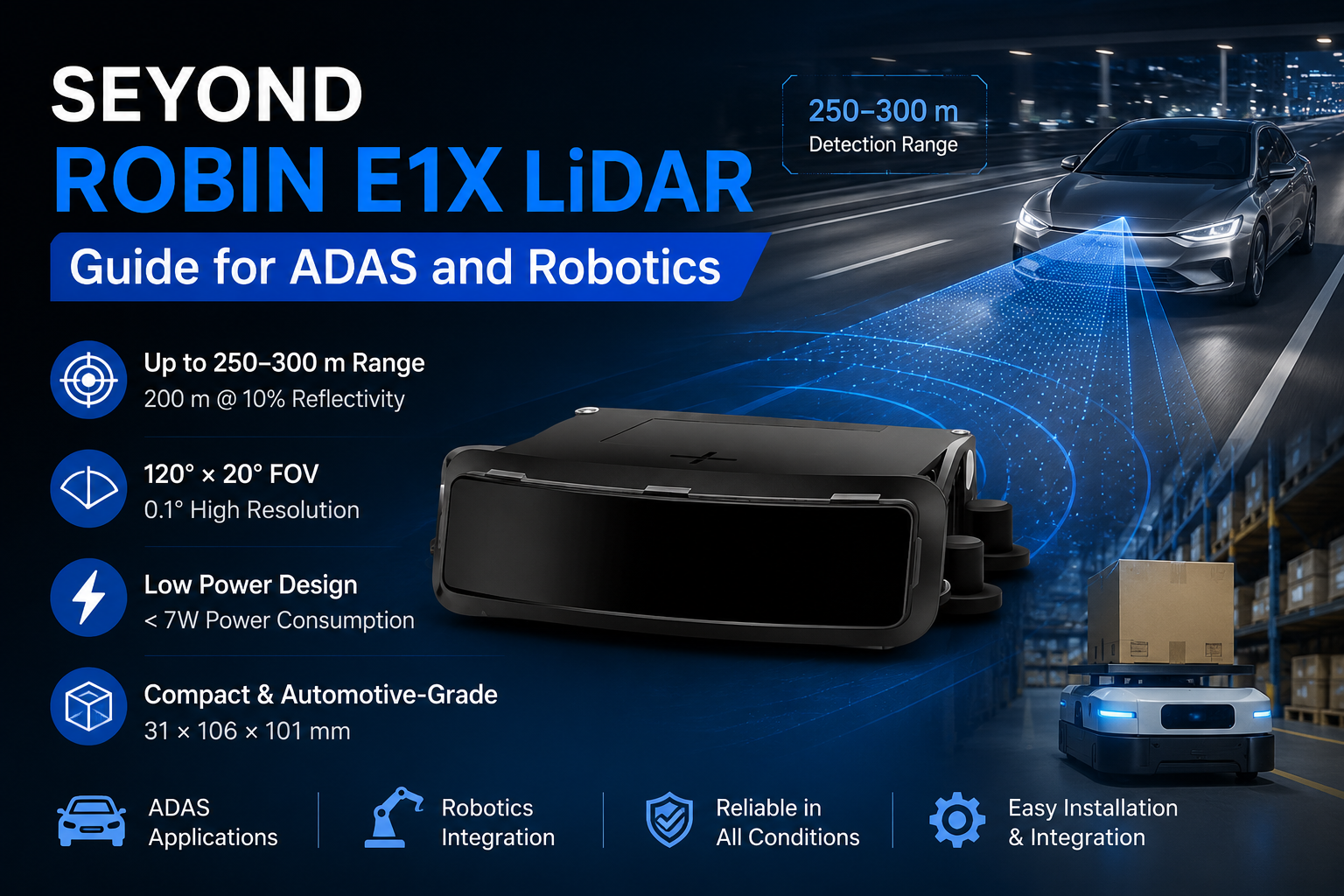
LidarSeek currently presents Robin E1X as a compact LiDAR with a 120° × 20° field of view, high-resolution sensing and low power consumption. The product page describes an automotive-derived scanning architecture and emphasizes integration into locations such as the roof, lighting area, bumper or behind the windshield.
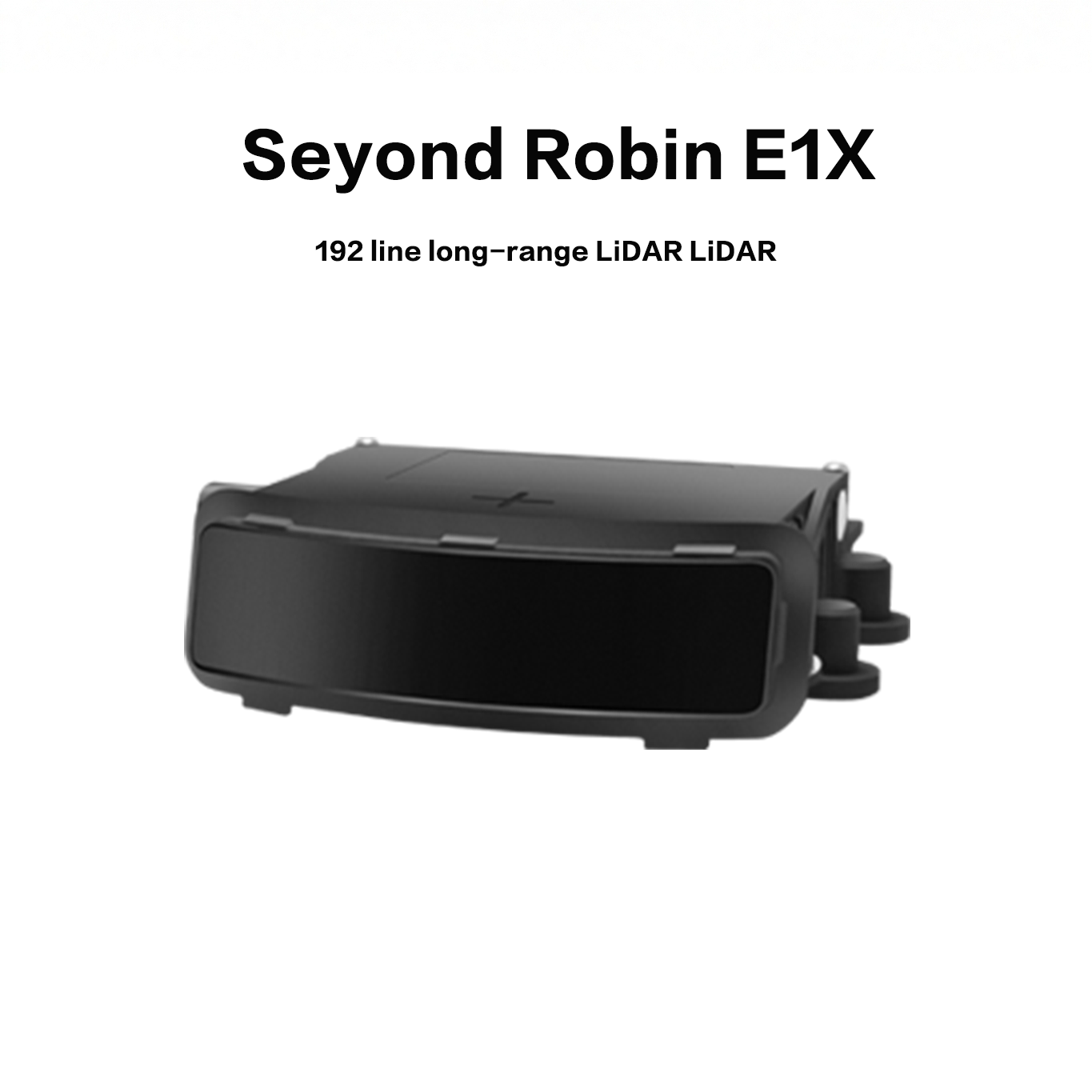
The current product information also lists approximately 250 meters maximum detection distance and 200 meters at 10% reflectivity, while another headline section describes up to 300 meters. Because the page contains multiple specification descriptions, engineering teams should confirm the exact configuration and latest datasheet before final procurement.
This article focuses not on comparing Robin E1X with other Seyond models, but on understanding where a compact forward-facing LiDAR can fit into ADAS, autonomous vehicle and robotics architectures.
1. Why Compact LiDAR Is Becoming More Important
Vehicle design is becoming increasingly constrained.
Modern vehicles must accommodate:
- Cameras
- Radar
- LiDAR
- Lighting
- Cooling systems
- Communication equipment
- Wiring
- Body structures
- Styling requirements
The LiDAR sensor cannot simply occupy an unlimited amount of space.
This is one reason compact LiDAR architecture has become important.
A smaller sensor can potentially be integrated into locations that would be difficult for a larger mechanical sensor.
For example:
- Behind the windshield
- Inside the bumper
- Near the headlamp
- In the vehicle roof
- Within a customized body module
Robin E1X is particularly interesting from this integration perspective.
LidarSeek describes the sensor as compact and modular, with dimensions listed around 31 × 106 × 101 mm.
2. Robin E1X and Forward Perception
A forward-facing LiDAR has a very different job from a wide-angle surround sensor.
Its primary purpose is usually to provide detailed information in the direction of travel.
This can be important for:
- Forward obstacle detection
- Vehicle detection
- Road geometry
- Object tracking
- Free-space analysis
- ADAS perception
- Autonomous driving
A forward-facing sensor needs enough range to give the vehicle’s perception system sufficient time to react.
This becomes increasingly important as vehicle speed increases.
At higher speeds, a vehicle travels a significant distance in a short period.
Therefore:
More useful detection range = more time for perception and planning.
3. Understanding the Robin E1X Range
LidarSeek currently lists Robin E1X with a detection capability in the 200-meter class at 10% reflectivity and a maximum range described as up to approximately 250–300 meters depending on the specification section.
For engineering purposes, the 10% reflectivity figure is especially important.
Why?
Because LiDAR performance should not be evaluated only using a maximum laboratory distance.
Real-world objects have different reflectivity.
A dark object and a highly reflective object may produce very different detection results.
Therefore, when comparing LiDAR sensors, engineering teams should examine:
- Maximum range
- Range at defined reflectivity
- Object size
- Angular resolution
- Environmental conditions
- Detection probability
This gives a more meaningful understanding of real-world performance.
4. Why Angular Resolution Matters
Range tells you how far a LiDAR can detect.
Angular resolution tells you how precisely it can separate objects in angular space.
This matters when multiple objects are close together.
For example, imagine a vehicle traveling behind two cars.
If the LiDAR cannot sufficiently distinguish the objects, the perception system may receive less useful information.
Higher angular resolution can provide more detailed point-cloud structures.
LidarSeek describes Robin E1X with resolution capabilities down to approximately 0.1°, depending on the relevant specification and scanning region.
This can be valuable for applications requiring detailed object perception.
5. 120° Horizontal Field of View
Robin E1X is listed with a 120° horizontal FOV and 20° vertical FOV.
A 120° horizontal field of view is relatively broad for a forward-facing sensing architecture.
It allows the sensor to capture information not only directly ahead but also across a significant portion of the vehicle’s forward surroundings.
This can support perception of:
- Adjacent vehicles
- Pedestrians
- Roadside objects
- Lane-adjacent obstacles
- Vehicles entering the field of view
However, engineers should still evaluate whether additional side or rear sensors are required.
A single forward-facing LiDAR should not automatically be assumed to provide complete 360° perception.
6. Low Power Consumption for Vehicle Integration
Power efficiency is becoming increasingly important in modern vehicles.
Every additional sensor consumes electrical energy.
LiDAR power consumption can also influence:
- Thermal management
- Wiring
- ECU architecture
- Cooling requirements
- Packaging
- Vehicle energy consumption
LidarSeek’s Robin E1X information emphasizes a low-power architecture and lists approximately 6W in the detailed product parameters, while the broader description refers to less than 7W.
This makes the sensor interesting for applications where low power is an important system-level requirement.
Low power is particularly attractive when multiple sensors are installed on one vehicle.
7. Behind-the-Windshield Integration
One of the more interesting possibilities described for Robin E1X is integration behind the windshield.
This type of architecture can provide advantages from a vehicle design perspective.
A protected sensor location may reduce exposure to:
- Road debris
- Physical impacts
- Environmental contamination
However, windshield integration introduces its own engineering challenges.
The windshield material, optical path, mounting angle and surrounding structures must all be evaluated.
Developers should verify:
- Optical transmission
- Distortion
- Reflections
- Heating
- Condensation
- Mechanical alignment
Therefore, “behind windshield” should be considered a potential integration option rather than a universal installation recommendation.
8. Bumper Integration
Another possible integration location is the bumper.
A bumper-mounted LiDAR can provide a relatively low sensing position.
This may be useful for detecting:
- Low obstacles
- Road objects
- Nearby vehicles
- Pedestrians
- Objects close to the vehicle
But the mounting position can influence:
- FOV
- Ground interference
- Contamination
- Mechanical protection
- Cable routing
A well-designed bumper integration should therefore consider the entire sensor field of view.
9. Robin E1X for ADAS
ADAS systems are becoming increasingly sophisticated.
Examples include:
- Adaptive cruise control
- Automatic emergency braking
- Highway assistance
- Lane support
- Collision avoidance
- Intelligent driving assistance
LiDAR can provide a complementary sensing layer to cameras and radar.
Cameras are strong at semantic recognition.
Radar is strong at velocity and robust ranging.
LiDAR provides detailed 3D geometry.
A sensor-fusion architecture can combine these strengths.
For example:
Camera + Radar + LiDAR + IMU + Vehicle Data
can create a richer perception system than any single sensor.
10. Robin E1X for Autonomous Driving Development
Autonomous driving requires the vehicle to continuously estimate:
- What is around it?
- Where are objects located?
- How are they moving?
- What space is available?
- What will happen next?
LiDAR can contribute to this perception pipeline by providing geometric data.
A simplified architecture might be:
LiDAR
↓
Point Cloud Processing
↓
Object Detection
↓
Object Tracking
↓
Sensor Fusion
↓
Prediction
↓
Planning
↓
Vehicle Control
The actual architecture varies by manufacturer and software platform.
11. Robin E1X for Mobile Robotics
Although Robin E1X has an automotive-oriented design philosophy, compact forward-facing LiDAR can also be interesting for mobile robotics.
Potential applications include:
- Autonomous delivery robots
- Outdoor AMRs
- Industrial vehicles
- Autonomous carts
- Mobile inspection platforms
- Campus delivery robots
- Intelligent transportation robots
The reason is simple.
Robots operating at higher speeds or outdoors may benefit from greater forward detection distance.
A warehouse robot moving at walking speed has different sensing requirements from an autonomous industrial vehicle moving significantly faster.
This is why LiDAR selection should always begin with system requirements rather than product specifications alone.
12. What Does 0.1° Resolution Mean for Perception?
Angular resolution can be difficult to understand without an example.
Imagine two objects positioned relatively close together in the distance.
The LiDAR must distinguish the angular difference between those objects.
A smaller angular resolution means the sensor can sample the environment more finely.
This can contribute to more detailed point clouds.
However, resolution should always be evaluated together with:
- Range
- Point rate
- FOV
- Frame rate
- Signal quality
- Return mode
A sensor with extremely high resolution but insufficient range may not be appropriate for a high-speed application.
Similarly, a very long-range sensor with insufficient detail may not provide the desired object-level perception.
13. Frame Rate and Dynamic Environments
Robin E1X is listed with 10 or 20 FPS in the product overview.
Frame rate affects how frequently the environment is sampled.
Higher update rates can be useful for moving environments.
For example:
- Vehicles
- Pedestrians
- Bicycles
- Robots
- Industrial equipment
However, higher frame rates may also affect:
- Point distribution
- Processing load
- Data bandwidth
Therefore, engineers should choose the appropriate configuration based on the application’s speed and computing architecture.
14. Point Rate and Computing Requirements
The product page lists up to approximately 1.152 million points per second in its headline specification, while another section describes a higher point-rate figure.
This discrepancy reinforces an important purchasing principle:
Always confirm the exact specification for the configuration you are buying.
Point rate directly affects downstream computing requirements.
More points mean:
- More data
- More bandwidth
- More processing
- Potentially more detailed perception
A Jetson-based robotics system, industrial PC or automotive compute platform must therefore be sized appropriately.
15. Automotive-Grade Architecture
LidarSeek describes Robin E1X as borrowing its scanning architecture from Seyond’s automotive-oriented technology and emphasizes automotive-grade mass-production experience.
For engineering teams, this can be relevant because automotive deployment imposes requirements beyond basic sensor performance.
Automotive systems must consider:
- Vibration
- Temperature
- Long operating cycles
- Mechanical reliability
- Manufacturing consistency
- Integration constraints
However, developers should distinguish between:
“automotive-inspired architecture”
and
“fully qualified for a specific automotive production program.”
The final qualification depends on the exact product version, testing requirements and vehicle program.
16. Robin E1X and System Cost
LiDAR procurement is not only about the unit price.
The total system cost can include:
- Sensor
- Cable
- Mount
- Computing
- Software
- Calibration
- Integration
- Testing
- Shipping
- Maintenance
A low-power compact sensor may potentially reduce some system-level engineering requirements.
For example, lower power can simplify thermal design.
Smaller dimensions can simplify packaging.
A high-resolution sensor can potentially reduce the need for additional sensing hardware in certain architectures.
But these benefits must be evaluated through actual engineering testing.
17. Current Robin E1X Price
LidarSeek currently displays Robin E1X at approximately $1,725, reduced from a displayed list price of $1,910.
Pricing can change according to:
- Inventory
- Promotions
- Quantity
- Project requirements
- Shipping terms
For production projects, buyers should request a quotation.
LidarSeek currently offers international shipping options including DHL, FedEx and UPS, with shipping terms such as DAP, FOB Shenzhen, EXW and FCA China listed on the product page.
18. What Engineers Should Test
Before integrating Robin E1X into a production system, testing should cover several areas.
Range Testing
Test different targets at different reflectivity levels.
Resolution Testing
Evaluate the ability to distinguish adjacent objects.
Environmental Testing
Test:
- Bright sunlight
- Darkness
- Rain
- Dust
- Temperature variation
Mechanical Testing
Check:
- Vibration
- Mounting stability
- Alignment
Software Testing
Verify:
- Data output
- SDK
- Driver
- ROS compatibility
- Network communication
- Timestamping
19. Who Should Consider Robin E1X?
Robin E1X may be worth evaluating for:
- ADAS developers
- Autonomous vehicle startups
- Automotive OEMs
- Tier suppliers
- Autonomous robotics companies
- Outdoor AMR manufacturers
- Industrial vehicle developers
- Research organizations
It is especially interesting where a project requires a combination of:
Long-range forward perception + compact packaging + low power + high angular resolution.
Conclusion
Seyond Robin E1X represents a different approach to LiDAR integration from large traditional sensor architectures.
Its compact form factor, broad horizontal field of view, high-resolution sensing and low-power design make it worth evaluating for forward perception applications.
LidarSeek currently lists Robin E1X with approximately 120° × 20° FOV, 0.1°-class resolution and a 200-meter-class detection capability at 10% reflectivity, with detailed specifications varying across the page.
For ADAS and autonomous robotics developers, the most important question is not whether Robin E1X has impressive specifications.
The real question is:
Can its sensing characteristics fit the vehicle’s perception architecture, mounting design, computing platform and operating environment?
The best way to answer that question is through sample testing.
Frequently Asked Questions
1. What is Seyond Robin E1X?
Robin E1X is a compact LiDAR designed for forward perception and applications involving automotive and intelligent mobility systems.
2. What is the Robin E1X range?
LidarSeek currently describes Robin E1X as a 200-meter-class LiDAR at 10% reflectivity, with maximum-range descriptions varying between approximately 250 and 300 meters on the page. Confirm the latest datasheet for a specific configuration.
3. What is Robin E1X’s FOV?
The product page lists a 120° horizontal × 20° vertical field of view.
4. Is Robin E1X suitable for ADAS?
It is designed around forward perception requirements and can be evaluated for ADAS development depending on the required system architecture and qualification requirements.
5. Can Robin E1X be used in robotics?
Yes. Its compact size and forward-facing perception characteristics can make it interesting for autonomous mobile robots and industrial vehicles.
6. What is the Robin E1X power consumption?
LidarSeek’s detailed product information lists approximately 6W, while the broader description specifies less than 7W. Confirm the exact configuration before purchasing.
7. Can Robin E1X be installed behind a windshield?
LidarSeek describes behind-windshield integration as one possible installation concept. Actual vehicle integration requires optical and mechanical validation.
8. What is the current Robin E1X price?
LidarSeek currently lists approximately $1,725, although commercial pricing may change.
9. Does Robin E1X support high-resolution perception?
Yes. The product information describes resolution down to approximately 0.1° under applicable conditions.
10. Should I buy a sample first?
For engineering projects, sample evaluation is recommended before committing to a large production quantity.
11. Can I request bulk pricing?
Yes. For OEM, robotics and automotive projects, buyers should provide the required quantity and application when requesting a quotation.
12. What information should I provide when requesting a quote?
Include application, quantity, target range, installation position, country, development stage and required delivery date.









