
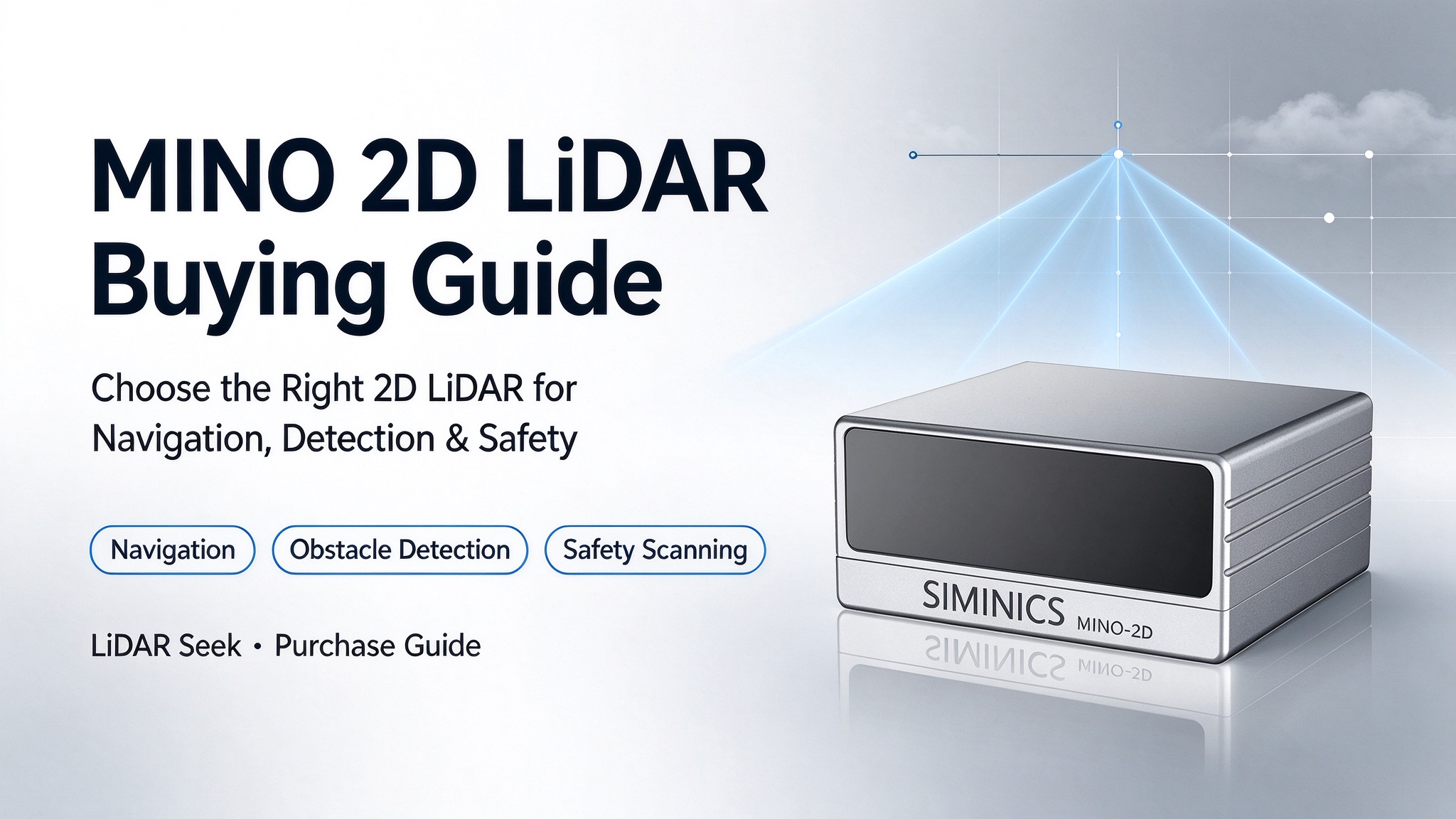
MINO 2D LiDAR Buying Guide: Specs, Applications, Applications and Price
When engineers design autonomous robots, mobile platforms, industrial automation equipment, or compact navigation systems, LiDAR selection is often more complicated than simply choosing the sensor with the longest detection range.
For many projects, the real challenge is finding a LiDAR sensor that provides the right combination of size, detection range, scanning performance, accuracy, power consumption, interface, environmental protection, and overall cost.
This is where a miniature 2D LiDAR such as the MINO-Miniature 2D LiDAR can be particularly useful.
The MINO 2D LiDAR is designed as a compact Time-of-Flight (ToF) scanning sensor for applications where installation space is limited but reliable distance measurement and environmental perception are still required. According to the product specifications published by LidarSeek, the sensor provides a detection range of 0.1–30 meters at 90% reflectivity, a 120° scanning range, 15 Hz scanning frame rate, and a minimum angular resolution of 0.16°.
The sensor measures only 50 × 56 × 25 mm and weighs less than 180 grams excluding cables, making its mechanical footprint significantly smaller than many conventional LiDAR products.
For robotics developers and industrial equipment manufacturers, these characteristics can make MINO worth considering when the project requires a compact 2D LiDAR rather than a large 3D perception system.
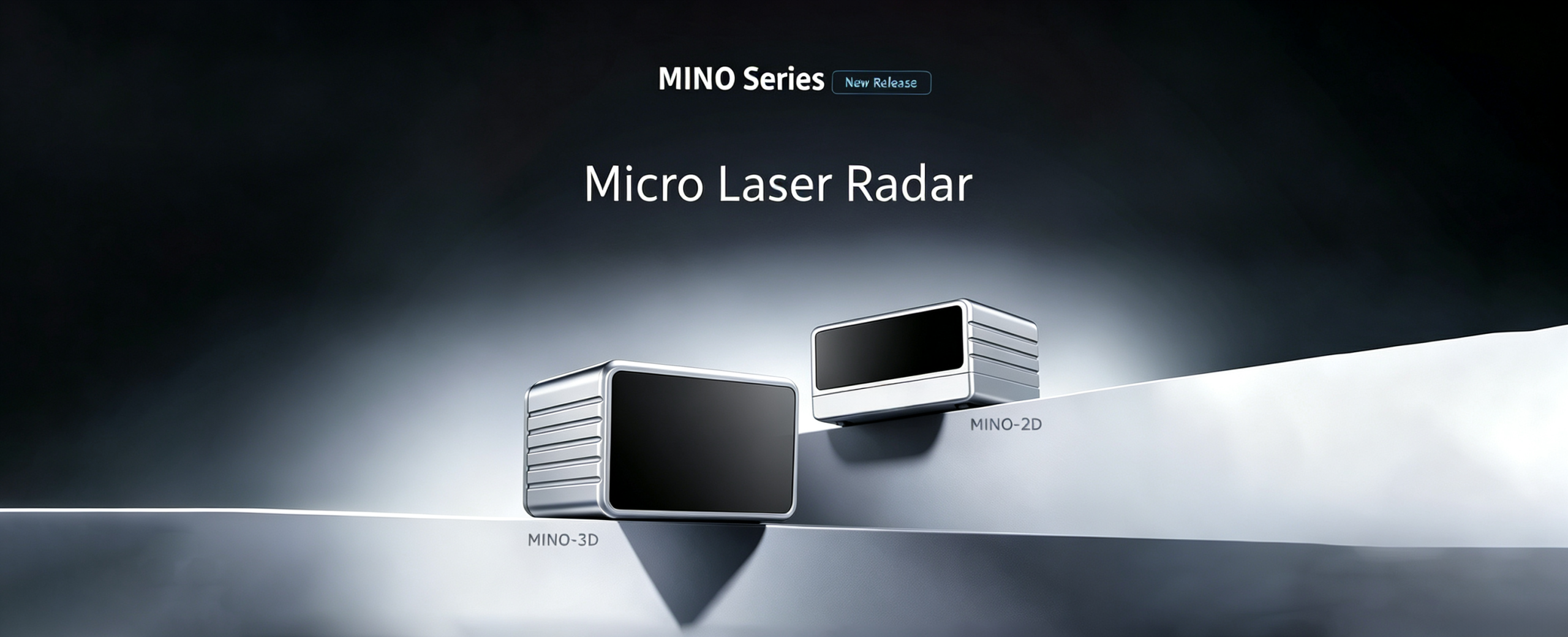
What Is MINO 2D LiDAR?
MINO 2D LiDAR is a compact laser ranging sensor based on the Time-of-Flight principle.
Unlike a conventional camera that primarily provides visual information, LiDAR measures distance by transmitting laser pulses and analyzing the time required for reflected light to return to the receiver.
The MINO 2D LiDAR combines optical, mechanical, electronic, and software components. A rotating mechanism allows the sensor to measure distance at different angles, generating a two-dimensional representation of surrounding objects.
This type of sensing is particularly useful for applications where the system needs information such as:
- Distance to nearby obstacles
- Object boundaries
- Wall positions
- Open and occupied areas
- Navigation corridors
- Environmental contours
- Robot positioning references
Instead of processing a complete 3D environment, a 2D LiDAR focuses on a horizontal scanning plane. This can reduce system complexity when full 3D perception is unnecessary.
For many mobile robots, AGVs, AMRs, security systems, and navigation platforms, this can be an important advantage.
MINO 2D LiDAR Key Specifications
Before purchasing any LiDAR sensor, engineers should evaluate specifications according to the actual application.
The following table summarizes the published MINO 2D LiDAR specifications.
| Parameter | MINO 2D LiDAR |
|---|---|
| Product Name | MINO-Miniature 2D LiDAR |
| Model | MINO 2D LIDAR |
| Detection Range | 0.1–30 m @ 90% reflectivity |
| Repeatability Accuracy | ±20 mm |
| Scanning Range | 120° |
| Scanning Frame Rate | 15 Hz |
| Minimum Angular Resolution | 0.16° |
| Laser Wavelength | 905 nm |
| Laser Class | Class 1 |
| Power Supply | DC 9–24 V |
| Operating Current | 0.17 A @ 12 V |
| Power Consumption | 2 W |
| Data Interface | Ethernet 100BASE-TX |
| Startup Time | <20 seconds |
| Ambient Light | >80,000 lux |
| Operating Temperature | -10°C to 55°C |
| Storage Temperature | -30°C to 75°C |
| Protection Rating | IP65 |
| Dimensions | 50 × 56 × 25 mm |
| Weight | <180 g excluding cables |
These specifications are published on the LidarSeek product page and should be checked against the latest manufacturer documentation before final system qualification.
Why Size Matters in LiDAR Selection
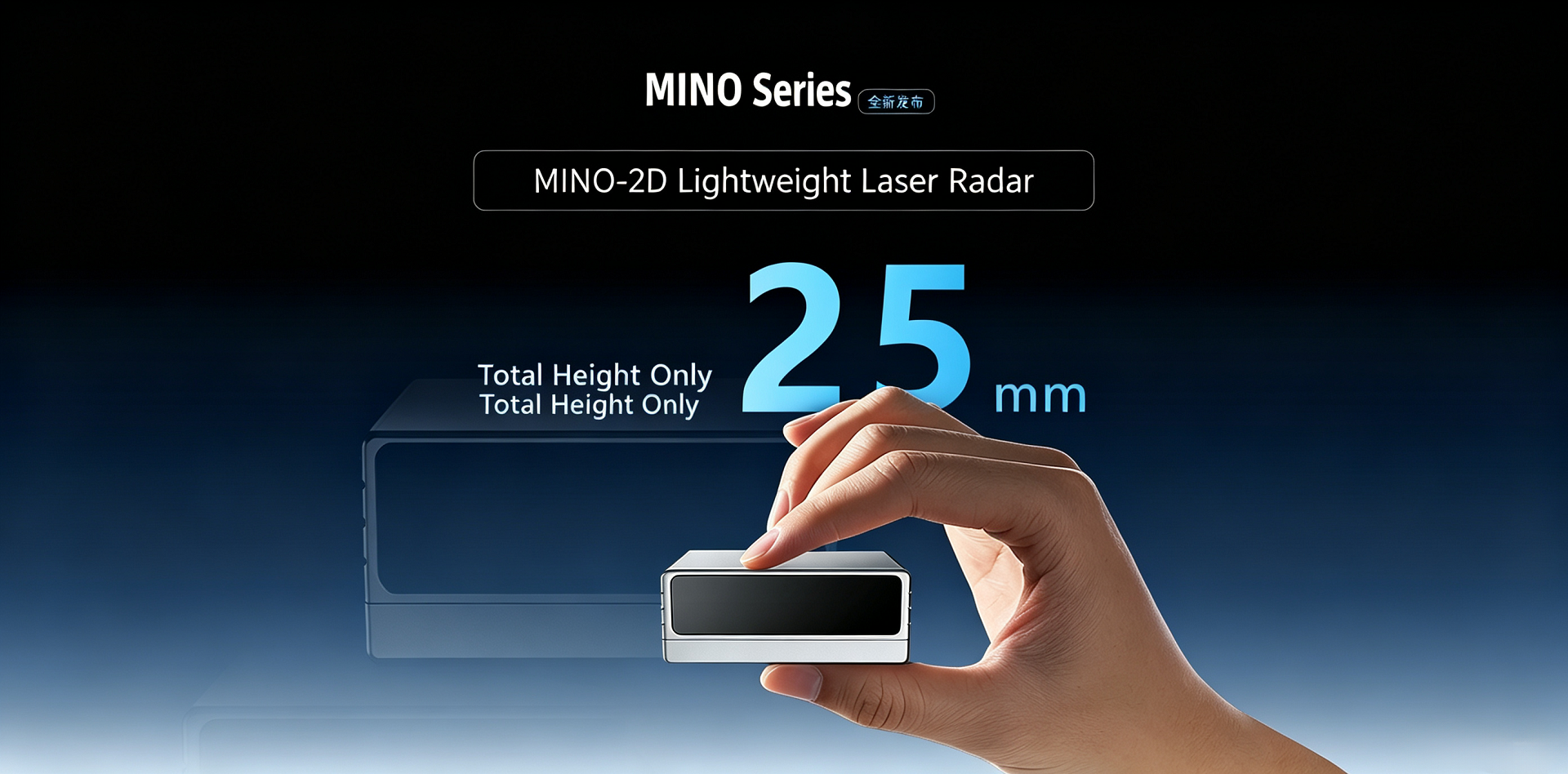
One of the most noticeable characteristics of MINO is its compact mechanical design.
The sensor has a height of only 25 mm and overall dimensions of 50 × 56 × 25 mm.
For a large autonomous vehicle, a few millimeters of sensor size may not matter.
For a small robot, however, the situation is completely different.
Compact robots often have:
- Limited internal volume
- Small battery capacity
- Restricted mounting positions
- Lightweight structural requirements
- Small protective enclosures
- Limited cable routing space
Installing a large LiDAR can force engineers to redesign the robot enclosure.
A miniature sensor can provide more flexibility.
This is especially important for:
- Indoor mobile robots
- Small AMRs
- Educational robots
- Service robots
- Compact AGVs
- Inspection robots
- Security robots
- Navigation platforms
- Embedded automation equipment
A smaller sensor can also make it easier to position LiDAR closer to the robot’s intended sensing plane.
30-Meter Detection Range for Compact Systems
MINO provides a published detection range of 0.1–30 meters at 90% reflectivity.
Thirty meters is more than enough for many indoor and short-range industrial applications.
For example, an indoor mobile robot operating in a warehouse may not need a 100-meter automotive LiDAR.
Similarly, a small AGV navigating through production areas may be more concerned with:
- Reliable obstacle detection
- Stable wall detection
- Fast scanning
- Compact installation
- Low power consumption
- Integration simplicity
than with extremely long-range highway perception.
This is one reason engineers should avoid selecting LiDAR based only on maximum range.
The correct question is:
How much range does the application actually require?
If the answer is within the sensor’s practical operating range, paying for unnecessary range may increase system cost without improving the final application.
120° Scanning Range
MINO provides a 120° scanning range.
The product documentation specifies that its scan data covers the angular region from 120° to 240°, with the 180° position corresponding to the area directly in front of the sensor.
A 120° field of view can be useful when the sensor is installed toward the front of a robot.
For example, consider an autonomous mobile robot moving forward through a warehouse.
The system may primarily need to monitor:
- The path directly ahead
- Left-side obstacles
- Right-side obstacles
- People crossing the navigation path
- Pallets
- Boxes
- Walls
- Equipment
A forward-facing 120° LiDAR can provide a useful perception zone without requiring 360° scanning.
For applications requiring full surrounding coverage, multiple sensors can potentially be installed at different orientations, depending on system requirements.
15 Hz Scanning for Mobile Robots
MINO provides a scanning frame rate of up to 15 Hz according to the published specifications.
Frame rate matters because mobile robots are constantly moving.
A robot traveling through a warehouse does not perceive the environment from a stationary position. Its position changes continuously.
A higher scanning frequency allows the perception system to receive updated spatial information more frequently.
For robot navigation, this can help support:
- Obstacle detection
- Local mapping
- Navigation updates
- Position estimation
- Dynamic obstacle response
- Environmental monitoring
However, frame rate should always be evaluated together with robot speed, sensor placement, processing architecture, and navigation algorithm.
0.16° Minimum Angular Resolution
Another important MINO specification is its minimum angular resolution of 0.16°.
Angular resolution determines how finely the sensor samples the environment.
A finer angular resolution can help distinguish smaller spatial changes within the scanning field.
For robotics applications, this can be useful when detecting:
- Narrow obstacles
- Wall edges
- Door openings
- Structural features
- Equipment boundaries
- Object contours
The practical result depends on object reflectivity, distance, installation geometry, environmental conditions, and the software processing the LiDAR data.
Therefore, angular resolution should not be considered independently from the rest of the sensing system.
±20 mm Repeatability Accuracy
MINO specifies repeatability accuracy of ±20 mm.
For many mobile robot navigation applications, centimeter-level repeatability can be sufficient.
Examples include:
- Indoor robot navigation
- Obstacle avoidance
- Wall following
- Warehouse navigation
- Robot localization
- Mapping
- Security monitoring
Applications requiring higher absolute measurement accuracy should perform application-specific validation before mass deployment.
Low Power Consumption
MINO’s published power consumption is only 2 W.
Low power consumption is especially valuable for battery-powered systems.
Every watt consumed by a mobile robot contributes to total energy demand.
Reducing sensor power can help engineers allocate more energy to:
- Drive motors
- Computing hardware
- Wireless communication
- Cameras
- Edge AI processors
- Other onboard sensors
For compact robots with limited battery capacity, sensor power consumption can become a meaningful design parameter.
Ethernet Interface for System Integration
MINO uses a 100BASE-TX Ethernet data transmission interface.
Ethernet is widely used in robotics and industrial systems because it supports structured communication between sensing devices and computing platforms.
Depending on the software architecture, engineers can integrate the LiDAR with:
- Industrial computers
- Embedded computers
- Edge AI systems
- Robot controllers
- Navigation computers
- ROS-based platforms
LidarSeek also states that the product is compatible with ROS systems and mainstream development integration platforms for secondary development.
Developers should verify the latest SDK, ROS package, protocol documentation, and operating-system compatibility before implementation.
IP65 Protection for Industrial Environments
MINO has an IP65 protection rating.
This is useful for industrial environments where equipment may encounter dust and water spray.
Potential applications include:
- Factory floors
- Warehouses
- Logistics facilities
- Production lines
- Outdoor-adjacent areas
- Inspection environments
However, IP65 should not be interpreted as unlimited environmental protection.
Engineers should still consider:
- Direct water exposure
- Condensation
- Temperature
- Dust concentration
- Chemical exposure
- Mechanical vibration
- Shock
- Installation enclosure
The final environmental qualification should be based on the complete system rather than the sensor specification alone.
MINO 2D LiDAR for Robot Navigation
One of the strongest application areas for a compact 2D LiDAR is mobile robot navigation.
A robot needs to answer several basic questions continuously:
Where am I?
What is around me?
Is there an obstacle?
Can I move forward?
Where is the wall?
Where is the free space?
LiDAR provides distance information that can help navigation software answer these questions.
MINO’s combination of compact size, 30-meter detection range, 120° scan range, 15 Hz frame rate, Ethernet interface, and low power consumption makes it suitable for evaluating in compact robot platforms.
MINO for AGVs and AMRs
Automated Guided Vehicles and Autonomous Mobile Robots frequently use LiDAR for perception and navigation.
AGVs often operate according to predefined routes, while AMRs generally need more flexible environmental perception.
A compact 2D LiDAR can support functions such as:
- Front obstacle detection
- Navigation assistance
- Map generation
- Wall detection
- Localization
- Safety-zone monitoring
- Environment scanning
The exact implementation depends on the robot architecture.
MINO for Mapping
MINO can also be considered for 2D mapping and environmental modeling.
A robot equipped with LiDAR can move through an environment while collecting distance measurements.
Software can then combine:
- LiDAR measurements
- Robot odometry
- IMU data
- Navigation algorithms
to construct a representation of the environment.
This can be useful for:
- Indoor mapping
- Warehouse mapping
- Robot navigation
- Facility inspection
- Research projects
- Academic robotics
MINO vs. Large 3D LiDAR
A common mistake when selecting LiDAR is assuming that more dimensions always mean better performance.
A 3D LiDAR provides substantially richer spatial information, but it can also increase:
- Hardware cost
- Power consumption
- Processing requirements
- Mechanical complexity
- Data volume
- System integration effort
If the application only needs a horizontal scanning plane, 2D LiDAR may be a more appropriate architecture.
MINO is therefore particularly interesting for projects where compact 2D environmental perception is sufficient.
What Does MINO 2D LiDAR Cost?
At the time this article was prepared, the LidarSeek product page listed MINO-Miniature 2D LiDAR at $320, reduced from a displayed price of $360. Prices can change depending on quantity, configuration, shipping terms, and commercial agreement.
For engineering teams, sample price is only one part of the total procurement calculation.
A complete purchasing evaluation should consider:
- Unit price
- Quantity
- Shipping
- Lead time
- Accessories
- Integration costs
- Software support
- Warranty
- Future volume pricing
LidarSeek currently offers sample orders, standard orders, and custom project support, with international shipping options including DHL, FedEx, and UPS.
How to Choose the Right MINO Configuration
Before ordering, buyers should provide several basic project parameters.
1. Required detection range
How far must the robot detect obstacles?
2. Required field of view
Does the application require forward 120° coverage or a wider sensing architecture?
3. Robot speed
A faster robot may require different sensing and processing characteristics.
4. Installation space
Measure the available mounting area before selecting the sensor.
5. Computing platform
Confirm Ethernet compatibility and software requirements.
6. Operating environment
Consider temperature, dust, water, lighting, vibration, and other conditions.
7. Quantity
Sample requirements can differ substantially from production requirements.
Why Buy MINO 2D LiDAR from LidarSeek?
LidarSeek positions itself as a global supplier of LiDAR and intelligent perception products, with direct manufacturer partnerships and competitive pricing. The website states that it serves customers in more than 42 countries and regions and offers product selection, technical consultation, application support, and global logistics assistance.
For international buyers, this can simplify procurement.
Instead of searching across multiple suppliers, customers can request:
- Product pricing
- Availability
- Lead time
- Shipping information
- Technical assistance
- Bulk purchasing information
through one supplier.
Final Thoughts
MINO-Miniature 2D LiDAR is designed for projects where compact dimensions and practical 2D sensing are more important than extremely long-range 3D perception.
Its published specifications include:
- 0.1–30 m detection range at 90% reflectivity
- 120° scanning range
- 15 Hz frame rate
- 0.16° minimum angular resolution
- ±20 mm repeatability accuracy
- 2 W power consumption
- 100BASE-TX Ethernet
- IP65 protection
- 50 × 56 × 25 mm dimensions
- Less than 180 g weight
These characteristics make MINO a candidate for compact robots, AGVs, AMRs, navigation platforms, mapping systems, security equipment, and industrial sensing applications.
If you are evaluating MINO for a new project, the most efficient next step is to provide your application, required quantity, mounting environment, and target delivery location. LidarSeek can then help confirm pricing, availability, shipping, and technical suitability.
Looking for a compact 2D LiDAR at a competitive price? Contact LidarSeek for the latest MINO 2D LiDAR quotation and project support.









