MINO 2D LiDAR for Robotics: A Compact Sensor for Navigation and Obstacle Detection
Modern robots need reliable perception.
Whether a robot operates inside a warehouse, factory, hospital, shopping center, laboratory, or outdoor facility, it must understand its surroundings before it can navigate safely and efficiently.
Cameras can provide rich visual information, but lighting, image processing, and environmental conditions can make vision-based perception challenging.
LiDAR provides a different type of information: direct distance measurements.
For many mobile robots, a 2D LiDAR is sufficient to detect obstacles, identify walls, support mapping, and assist with localization without the complexity and cost of a full 3D LiDAR.
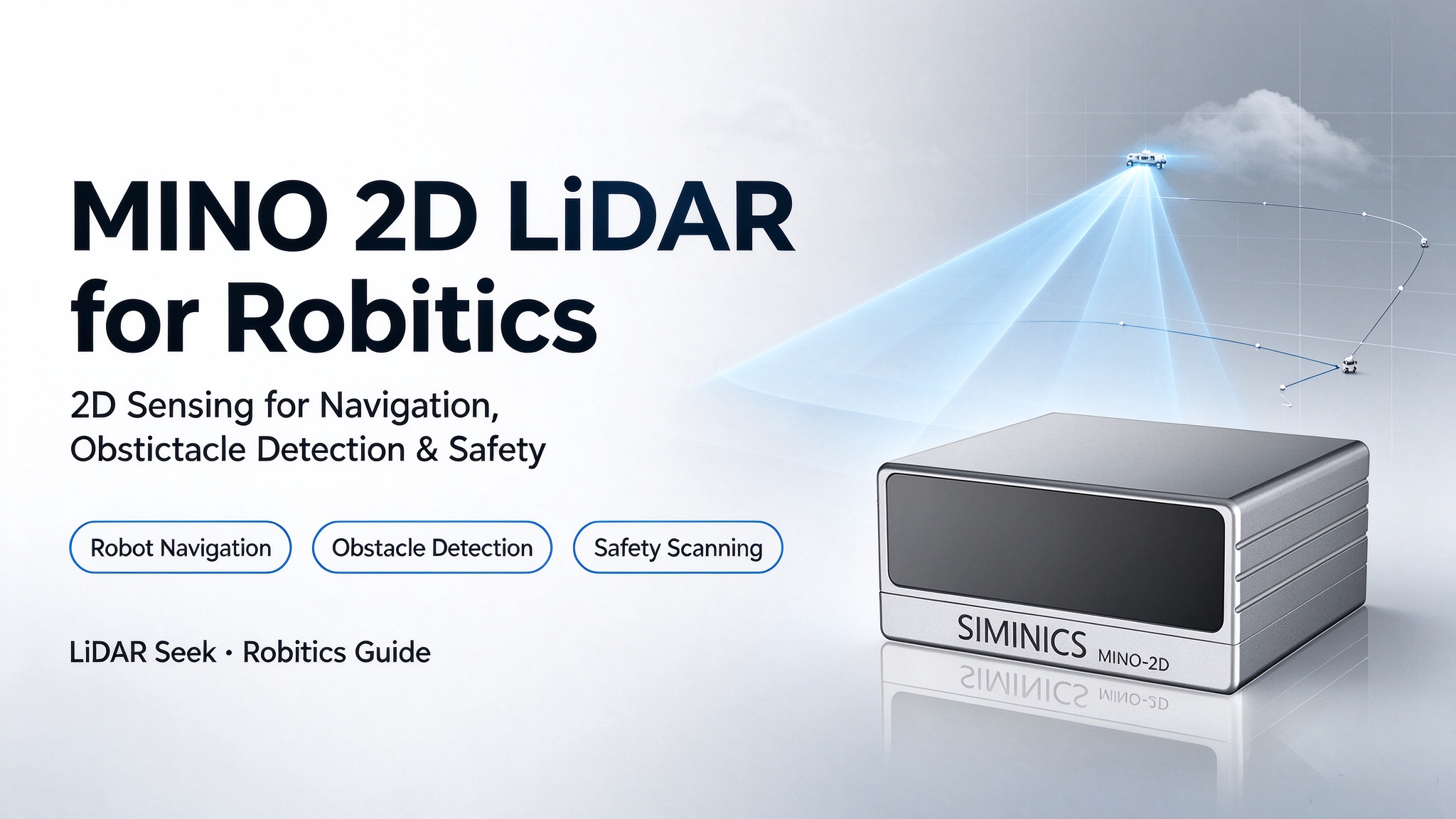
The MINO-Miniature 2D LiDAR is designed around this concept.
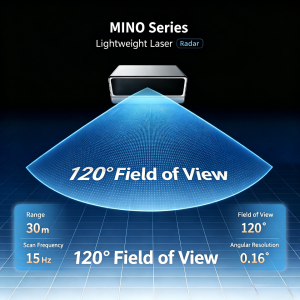
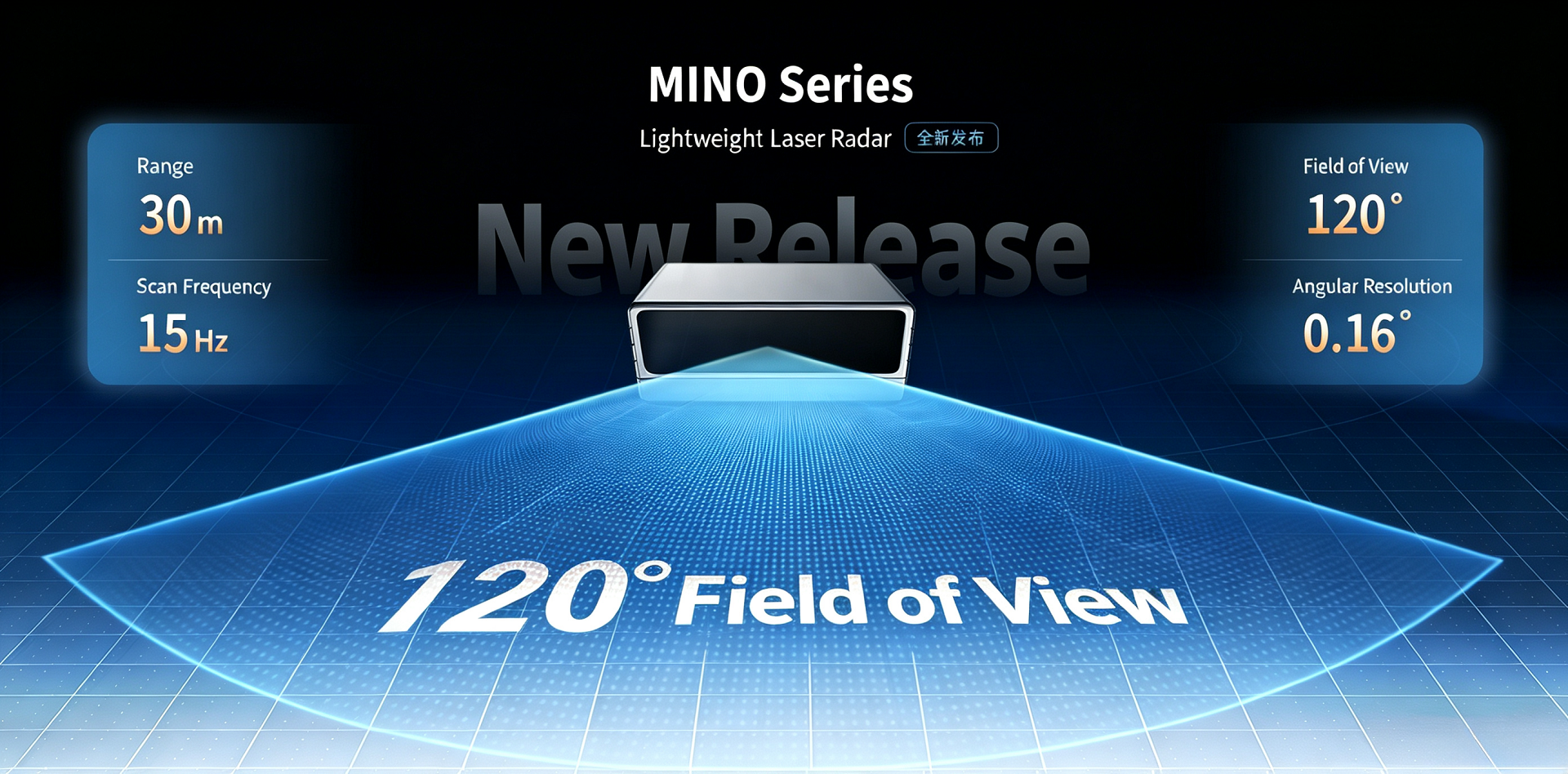
It combines a compact physical design with a 30-meter published detection range, 120° scanning range, 15 Hz scanning frequency, 0.16° minimum angular resolution, Ethernet connectivity, and 2 W power consumption.
For robotics companies developing compact autonomous platforms, these characteristics can be particularly relevant.
Why Robots Need MINO 2D LiDAR
A mobile robot cannot rely only on its internal navigation instructions.
Even if a robot has a predefined map, the real environment can change.
For example:
- A pallet may be moved.
- A worker may enter the path.
- A box may be placed in a corridor.
- A door may be open or closed.
- Equipment may be relocated.
- Another robot may block the route.
The robot therefore needs continuous environmental information.
LiDAR can provide a stream of distance measurements that allows the navigation system to detect the surrounding geometry.
Instead of asking the camera:
“What does this image look like?”
the navigation system can ask LiDAR:
“How far away is the object at this angle?”
This difference makes LiDAR particularly useful for navigation.
What Makes a 2D LiDAR Different?
A 2D LiDAR generally measures distances across a single scanning plane.
This is different from a 3D LiDAR, which measures a larger volume of space.
For a mobile robot moving on a relatively flat floor, a horizontal scanning plane can provide valuable information.
A 2D LiDAR can detect:
- Walls
- Pallets
- Boxes
- Furniture
- Equipment
- People
- Other robots
- Obstacles
The system can then transform these measurements into information used by the robot’s navigation software.
If the application does not require full 3D perception, a 2D sensor can help keep the sensing architecture compact and economical.
MINO 2D LiDAR Specifications for Robotics
The following specifications are particularly relevant for robot developers.
| Specification | MINO |
|---|---|
| Detection Range | 0.1–30 m @ 90% reflectivity |
| Scanning Range | 120° |
| Frame Rate | 15 Hz |
| Minimum Angular Resolution | 0.16° |
| Repeatability Accuracy | ±20 mm |
| Power Consumption | 2 W |
| Operating Voltage | 9–24 V DC |
| Interface | Ethernet 100BASE-TX |
| Dimensions | 50 × 56 × 25 mm |
| Weight | <180 g |
| Protection | IP65 |
| Operating Temperature | -10°C to 55°C |
| Laser | 905 nm Class 1 |
Published product specifications are provided by LidarSeek and should be confirmed against current technical documentation before production deployment.
Compact Design for Compact Robots
One of the biggest challenges in robot engineering is space.
A robot may need to contain:
- Battery
- Motor controllers
- Motors
- Embedded computer
- Camera
- LiDAR
- IMU
- Communication equipment
- Safety components
- Mechanical structures
Every component competes for physical space.
MINO measures only 50 × 56 × 25 mm and weighs less than 180 g excluding cables.
Its 25 mm height is particularly useful when engineers need to install sensing equipment inside a compact enclosure.
For example, the LiDAR can potentially be integrated into:
- Robot front panels
- Compact navigation modules
- Low-profile AMRs
- Small AGVs
- Mobile inspection systems
- Service robots
Mechanical integration should always be validated with the final enclosure and mounting design.
30 m Range for Robot Navigation
The MINO product page specifies a 0.1–30 m detection range at 90% reflectivity.
For indoor robotics, 30 meters can provide a substantial perception distance.
Consider a warehouse robot.
At the end of a long aisle, the robot may need to know whether the path ahead is clear.
The LiDAR can provide distance measurements across its scanning field.
This information can be used by navigation software to:
- Detect obstacles
- Estimate free space
- Identify walls
- Support path planning
- Update local maps
- Assist localization
Actual usable range depends on target reflectivity, environment, installation, and system conditions.
120° Coverage for Forward Navigation
MINO provides a 120° scanning range.
For many mobile robots, forward perception is particularly important.
A front-mounted LiDAR can monitor the robot’s travel direction while also covering areas to the left and right.
This can help detect objects entering the robot’s path.
A 120° sensor can also be combined with other sensors when the robot requires broader environmental coverage.
For example, a system might combine:
- Front LiDAR
- Rear LiDAR
- Cameras
- IMU
- Wheel odometry
to create a multi-sensor navigation architecture.
15 Hz for Moving Robots
Robot perception must keep up with robot motion.
MINO provides a published scanning frequency of 15 Hz.
At 15 scans per second, the navigation system receives repeated updates of the surrounding environment.
This can support applications such as:
- Obstacle avoidance
- Local navigation
- Mapping
- Wall following
- Robot localization
- Dynamic environment monitoring
The actual navigation performance depends on the complete software stack.
Sensor frequency alone does not determine robot performance.
The system must also consider:
- Robot speed
- Processing latency
- Communication latency
- Algorithm performance
- Sensor mounting
- Control-loop frequency
Angular Resolution and Obstacle Detection
MINO specifies a minimum angular resolution of 0.16°.
For robot perception, angular resolution determines how closely the LiDAR samples the environment across its scanning field.
Suppose a robot approaches a narrow obstacle.
The navigation algorithm needs enough spatial information to recognize that the obstacle exists and determine its position.
Higher spatial sampling can provide more detailed geometric information.
This is one reason angular resolution should be included in every LiDAR purchasing comparison.
Low Power Is Important for Battery Robots
Power consumption is a major consideration for mobile robotics.
MINO specifies a typical power consumption of 2 W.
For a battery-powered robot, lower sensor power can help preserve energy for movement and computing.
Consider a robot with multiple sensing devices.
The complete perception system might include:
- LiDAR
- Cameras
- IMU
- GNSS
- Radar
- Embedded computer
Reducing unnecessary energy consumption from individual sensors can contribute to overall system efficiency.
This is particularly relevant for small mobile robots where battery capacity is limited.
Ethernet Integration
MINO uses a 100BASE-TX Ethernet interface.
Ethernet is widely used in industrial and robotic computing systems.
A typical architecture may look like:
MINO LiDAR → Ethernet → Robot Computer → Navigation Software → Motor Controller
The robot computer receives LiDAR data and combines it with other information.
Depending on the project, the computing platform could include an industrial PC, embedded computer, or edge AI platform.
LidarSeek states that the sensor is compatible with ROS systems and mainstream development integration platforms for secondary development.
Before purchasing for production, developers should verify the exact ROS distribution, SDK version, operating system, communication protocol, and supported computing architecture.
MINO for SLAM
One of the most important applications for robot LiDAR is SLAM.
SLAM means:
Simultaneous Localization and Mapping.
The basic objective is for a robot to build a map while estimating its own position within that map.
LiDAR is widely used in this type of architecture because it directly provides spatial distance information.
A simplified system could combine:
LiDAR + Odometry + IMU + SLAM Algorithm
The LiDAR observes the environment.
Odometry estimates movement.
The IMU provides motion information.
The SLAM algorithm combines the available information to estimate robot position and construct a map.
MINO’s 2D scanning architecture makes it suitable for evaluating in 2D navigation and mapping applications.
MINO for Indoor Mobile Robots
Indoor mobile robots are one of the most obvious applications for compact 2D LiDAR.
Examples include:
- Warehouse robots
- Delivery robots
- Cleaning robots
- Hospital robots
- Restaurant service robots
- Factory transport robots
- Security robots
- Inspection robots
These robots often operate in environments where:
- GPS is unavailable
- Space is restricted
- Obstacles change
- People move around
- Walls and structures provide useful navigation references
LiDAR can provide direct geometric information that helps the robot understand these environments.
MINO for AMRs
Autonomous Mobile Robots require flexible perception.
Unlike traditional fixed-path equipment, AMRs can dynamically select routes based on environmental conditions.
A compact LiDAR can provide data for:
- Local obstacle detection
- Navigation
- Mapping
- Localization
- Corridor detection
- Free-space estimation
MINO’s 120° scanning field is especially relevant to forward-facing AMR architectures.
For full 360° perception, system designers can evaluate multiple sensors or combine LiDAR with additional sensing technologies.
MINO for AGVs
AGVs commonly transport materials around factories and warehouses.
Applications include:
- Pallet transport
- Component delivery
- Warehouse logistics
- Production-line transportation
- Material handling
An AGV can use LiDAR to detect obstacles in front of the vehicle and assist navigation.
The compact MINO design can be attractive where the vehicle’s sensor installation area is restricted.
MINO for Security and Monitoring Robots
LiDAR is not limited to logistics robots.
Security and inspection robots can also use 2D LiDAR to understand the geometry of an environment.
Potential use cases include:
- Indoor security patrols
- Facility inspection
- Restricted-area monitoring
- Building navigation
- Automated patrol robots
A LiDAR can help determine whether an object is present in a predefined region.
Combined with cameras and AI algorithms, the overall system can provide both geometric and visual information.
2D LiDAR vs Camera for Robot Navigation
Cameras and LiDAR should not necessarily be viewed as competing technologies.
They can complement one another.
A camera provides visual information.
LiDAR provides distance information.
A robot can combine them.
For example:
Camera: identifies a person.
LiDAR: measures the person’s distance and spatial position.
The combination can provide richer perception than either sensor alone.
For this reason, many robot platforms use sensor fusion.
2D LiDAR vs 3D LiDAR
When should a robot use 2D LiDAR instead of 3D LiDAR?
A 2D sensor may be appropriate when the robot primarily needs:
- Horizontal obstacle detection
- 2D mapping
- Wall detection
- Navigation
- Localization
- Low power
- Compact dimensions
A 3D LiDAR may be more appropriate when the robot needs:
- Full 3D environment reconstruction
- Height information
- Complex terrain perception
- Three-dimensional object detection
- Advanced spatial understanding
The choice should be based on actual application requirements.
There is no reason to use a more complicated sensor architecture if the robot only needs 2D information.
Environmental Considerations
MINO has an IP65 protection rating and a published operating temperature range of -10°C to 55°C.
The product documentation also specifies operation in ambient light above 80,000 lux.
These characteristics can be relevant when evaluating robots that operate in bright industrial or semi-outdoor environments.
However, system engineers should still conduct environmental validation under actual operating conditions.
How Much Does MINO Cost?
The LidarSeek product page currently lists MINO at a displayed sale price of $320, compared with a displayed regular price of $360.
For robot manufacturers purchasing multiple units, the final price can depend on:
- Quantity
- Shipping destination
- Order terms
- Project requirements
- Accessories
- Delivery schedule
LidarSeek promotes direct manufacturer supply and competitive pricing, making it possible for buyers to request project-specific pricing rather than relying only on a single-unit retail price.
What Should Robotics Engineers Ask Before Ordering?
Before ordering MINO, prepare the following information:
Robot type
AGV, AMR, delivery robot, inspection robot, service robot, etc.
Robot dimensions
Provide approximate length, width, and height.
Maximum speed
This helps evaluate perception requirements.
Detection distance
Specify the minimum and maximum required range.
Environment
Indoor, outdoor, warehouse, factory, mixed environment, etc.
Quantity
Prototype quantity and expected production quantity can be different.
Computing platform
Provide the target PC or embedded platform.
Software
ROS, custom software, Linux, Windows, or another environment.
Delivery country
This allows the supplier to calculate shipping options.
Final Conclusion
For robotics developers, LiDAR does not need to be large or complicated to be useful.
The MINO-Miniature 2D LiDAR is designed around a compact form factor and practical sensing capabilities.
Its published specifications include:
- 30 m detection range at 90% reflectivity
- 120° scanning range
- 15 Hz scanning frequency
- 0.16° minimum angular resolution
- ±20 mm repeatability
- 2 W power consumption
- Ethernet 100BASE-TX
- IP65 protection
- 50 × 56 × 25 mm dimensions
- Less than 180 g weight
These specifications make it worth evaluating for compact mobile robots, AGVs, AMRs, mapping platforms, inspection robots, and industrial navigation systems.
If your robot requires a compact 2D LiDAR, request the latest MINO pricing, availability, lead time, and technical documentation from LidarSeek.
Build a smaller robot without giving up reliable distance sensing. Contact LidarSeek today to get a MINO 2D LiDAR quotation.