
Introduction
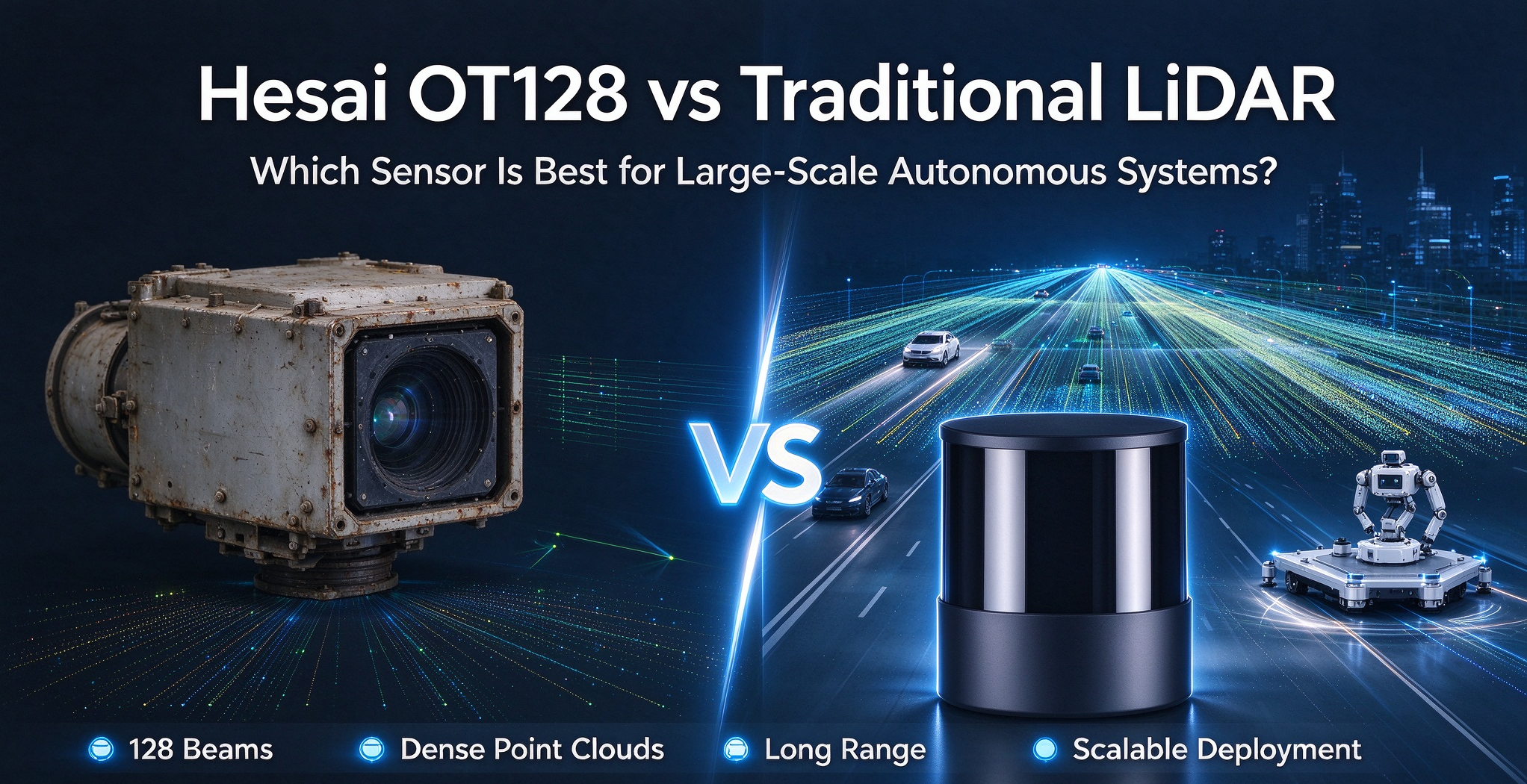
The LiDAR industry has evolved rapidly over the past decade. Early-generation sensors were expensive, bulky, and difficult to integrate into large-scale autonomous systems. Today, products such as the Hesai OT128 provide significantly higher performance while simplifying deployment.
For organizations developing autonomous vehicles, robotics platforms, and intelligent transportation systems, selecting the right LiDAR architecture can have a major impact on system performance, development time, and overall project cost.
Traditional Multi-LiDAR Architectures
Historically, many autonomous vehicles relied on multiple LiDAR sensors to achieve full coverage.
Challenges included:
- Complex calibration
- Sensor synchronization
- Increased installation cost
- Higher maintenance requirements
- More complicated software development
How OT128 Simplifies System Design
The OT128 delivers complete 360° perception from a single sensor.
Advantages include:
Reduced Sensor Count
Fewer sensors mean:
- Lower hardware cost
- Reduced integration effort
- Simplified maintenance
Faster Software Development
Because there is no need to stitch multiple LiDAR point clouds together, algorithm development becomes significantly easier.
Resolution Comparison
Many legacy LiDAR systems struggle to identify small objects at long distances.
The OT128 provides:
- 128 channels
- 0.1° horizontal resolution
- 0.125° vertical resolution
This enables accurate detection of:
- Pedestrians
- Road signs
- Traffic cones
- Vehicles
even at extended ranges.
Point Cloud Density Comparison
Traditional systems often generate fewer than one million points per second.
The OT128 delivers:
- 3.45 million points/s (single return)
- 6.91 million points/s (dual return)
This provides significantly richer environmental data for AI perception systems.
Reliability in Harsh Environments
The OT128 is designed for automotive deployment and has undergone testing for:
- UV exposure
- Vibration
- Salt spray
- Mechanical shock
- Water ingress
- Thermal cycling
These capabilities help ensure long-term reliability in real-world deployments.
Why Robotaxi Developers Choose OT128
Robotaxi operators need:
- High perception accuracy
- Long-range awareness
- Reliable object classification
- Continuous operation
The OT128’s combination of range, resolution, and point density makes it particularly attractive for large-scale robotaxi programs.
OT128 for Smart Infrastructure
Beyond vehicles, OT128 is increasingly used in:
- Smart intersections
- Traffic analytics
- Infrastructure monitoring
- Security systems
- Industrial automation
Its 360° field of view enables complete monitoring of large areas with a single sensor.
FAQ
Why choose OT128 over multiple smaller LiDARs?
A single OT128 provides full 360° perception, reducing calibration complexity and simplifying system architecture.
What industries use the Hesai OT128?
Industries include autonomous driving, robotaxi fleets, logistics, robotics, smart cities, and industrial automation.
Is the OT128 automotive-grade?
Yes. The sensor follows automotive development processes and supports safety-focused deployments.
Does the OT128 support dual-return mode?
Yes. Dual-return mode provides up to 6.91 million points per second.
Is OT128 suitable for smart city applications?
Yes. Its 360° coverage and long-range detection make it effective for traffic monitoring and infrastructure perception.









