
Modern autonomous robots need more than long-range detection. They need to understand what is happening around them, including objects that are very close to the platform, low obstacles near the ground, changes in terrain, pallets, curbs, ramps, people, equipment, and other objects that may not be easy to detect with a narrow vertical field of view.
This is where the LSLiDAR C32W becomes particularly interesting.
The C32W is a 32-channel mechanical 3D LiDAR designed around a wide vertical scanning field. LidarSeek lists the sensor with 360° horizontal coverage and a vertical field of view extending from approximately -54.7° to +15°. Its product page also lists a detection range of 40 meters at 10% reflectivity and 80 meters at 70% reflectivity, ±3 cm range accuracy, 600,000 points per second in single-echo mode, and up to 1.2 million points per second in dual-echo mode.
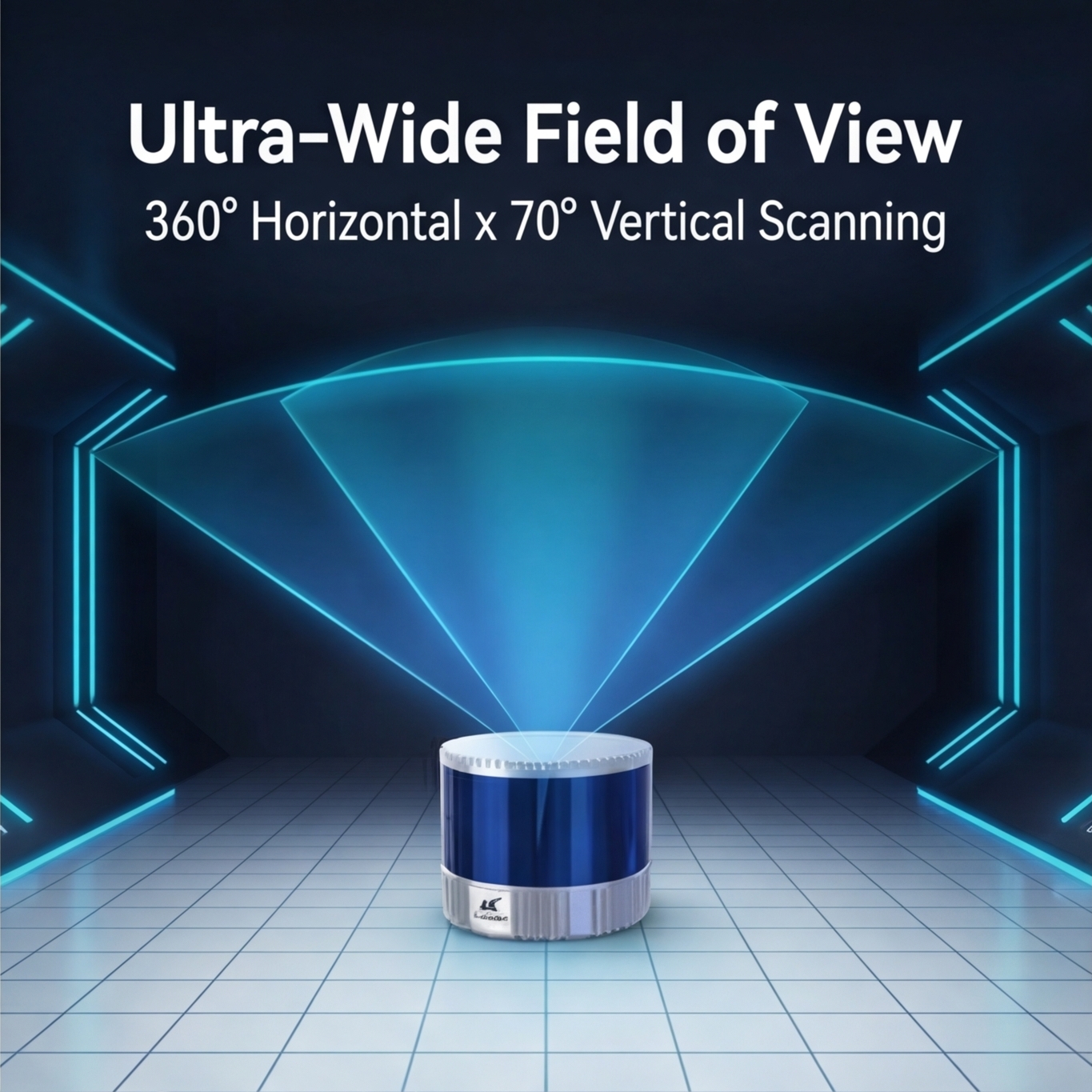
The manufacturer describes the C32W as a wide-view mechanical LiDAR designed to identify short and low obstacles at close range. Its published product information similarly emphasizes the 360° × 70° class field of view and applications including mapping, UAVs, industrial systems, infrastructure, robotics, and security.
For robot developers, this combination is important because LiDAR selection is not simply a matter of choosing the sensor with the longest advertised range. The geometry of the field of view can have a major impact on what the robot can actually perceive.
1. What Is the LSLiDAR C32W?
The LSLiDAR C32W is a multi-line mechanical 3D LiDAR that uses the Time-of-Flight, or ToF, measurement principle.
The sensor emits laser pulses and measures the time required for the reflected light to return to the receiver. By combining distance measurements with angular information, the system produces a three-dimensional representation of the surrounding environment.
Unlike a conventional 2D scanning LiDAR that produces a single horizontal scan plane, the C32W uses 32 laser channels to create a three-dimensional point cloud.
This allows a robot to detect objects at different heights and positions.
According to LidarSeek’s current product specifications, the C32W includes:
| Specification | C32W |
|---|---|
| LiDAR Type | Mechanical 3D LiDAR |
| Channels | 32 |
| Measurement Principle | ToF |
| Wavelength | 905 nm |
| Laser Safety | Eye-safe |
| Horizontal FOV | 360° |
| Vertical FOV | -54.7° to +15° |
| Detection Range | 40 m @ 10%; 80 m @ 70% reflectivity |
| Range Accuracy | ±3 cm |
| Range Precision | ±1 cm (1σ) |
| Point Rate | 600,000 pts/s single echo |
| Point Rate | 1,200,000 pts/s dual echo |
| Scan Rate | 5 / 10 / 20 Hz |
| Horizontal Resolution | 0.09° @ 5 Hz; 0.18° @ 10 Hz; 0.36° @ 20 Hz |
| Vertical Resolution | Minimum 1.5° |
| Interface | 100 Base-TX Ethernet / PPS |
| Time Source | GPS / gPTP |
| Input Voltage | 12–32 VDC |
| Typical Power | 10 W |
| Protection | IP67 |
| Operating Temperature | -20°C to +60°C |
| Weight | Approximately 1.04 kg |
These specifications are based on the current LidarSeek C32W product listing.
2. The Main Difference: Its Very Wide Vertical Field of View
The most important characteristic of the C32W is not simply the number of channels.
It is the vertical scanning range.
The sensor provides a vertical field of view of approximately -54.7° to +15°, while maintaining 360° horizontal coverage.
That creates a particularly downward-focused perception pattern.
For mobile robots, this can be valuable because many potential collision hazards exist below or near the horizontal level of the LiDAR.
Examples include:
- Low boxes
- Pallets
- Curbs
- Small barriers
- Loading ramps
- Raised platforms
- Objects lying on the floor
- Equipment legs
- Low walls
- Ground-level obstacles
- Uneven terrain
A conventional LiDAR with a narrower vertical field of view may require additional sensors or a carefully selected mounting angle to observe some of these objects.
The C32W approaches the problem through its sensor geometry.
3. Why Low-Obstacle Detection Matters for Autonomous Robots
Autonomous mobile robots often operate in environments that were originally designed for humans.
Warehouses contain pallets, shelves, forklifts, carts, and packaging materials.
Factories contain machines, cables, barriers, platforms, and safety equipment.
Outdoor robots may encounter curbs, stones, ramps, vegetation, construction materials, and uneven surfaces.
A robot that only detects large objects at approximately sensor height can still have a significant perception gap close to the ground.
This is one reason 3D LiDAR is increasingly used for mobile robot perception.
The C32W’s downward-oriented vertical coverage can help provide more information about the area surrounding the robot’s lower envelope.
For example, an AMR traveling through a warehouse may need to detect a pallet positioned partially outside its expected route.
The pallet may not present a large vertical surface at the LiDAR’s horizontal level.
A wide vertical scanning pattern can provide additional geometric information that can be incorporated into obstacle detection and navigation algorithms.
4. 360° Horizontal Coverage for Mobile Robots
Another important characteristic is the 360° horizontal field of view.
The robot does not need to rely on a single forward-facing LiDAR scan.
Instead, a rotating mechanical LiDAR can continuously observe the surrounding environment.
This is useful for:
- SLAM
- Autonomous navigation
- Obstacle avoidance
- Mapping
- Localization
- Perception
- Security monitoring
- Industrial automation
For a robot operating in an unknown environment, surrounding information can be useful not only for forward navigation but also for localization and map generation.
When the robot turns, reverses, or changes direction, the LiDAR can continue scanning around the platform.
This can simplify some sensor configurations compared with architectures that rely on multiple narrow-angle sensors.
5. 32 Channels and 3D Point Cloud Generation
The C32W uses 32 physical laser channels.
More channels generally provide more vertical sampling opportunities than a single-line 2D LiDAR.
This is important when the environment contains objects at different heights.
A 3D point cloud can contain information about:
- Ground surfaces
- Vertical walls
- Vehicles
- People
- Shelving
- Machinery
- Obstacles
- Structures
- Terrain
LidarSeek specifies up to 600,000 points per second in single-echo mode and up to 1.2 million points per second in dual-echo mode.
The actual usefulness of the point rate depends on scan frequency, scene geometry, return characteristics, software processing, and application requirements. Point rate should therefore be considered together with FOV, angular resolution, range, and system architecture rather than treated as a standalone performance metric.
6. C32W for AMR and AGV Navigation
Autonomous Mobile Robots and Automated Guided Vehicles are among the practical applications where the C32W’s characteristics can make sense.
An AMR needs to answer several questions continuously:
- Where am I?
- What is around me?
- Is there an obstacle ahead?
- Is the path clear?
- Has the environment changed?
- Can I safely move through this area?
A 3D LiDAR can provide geometric information for these tasks.
The C32W can also be integrated into software systems using Ethernet communication. LidarSeek lists compatibility with ROS systems and mainstream development platforms for secondary development.
For developers building ROS-based robots, this can reduce the barrier to experimentation.
A typical architecture might look like:
C32W LiDAR → Ethernet → ROS/ROS2 computer → Point Cloud Processing → SLAM → Navigation → Motion Controller
The LiDAR is only one part of the complete system, but it provides the spatial data needed by the perception pipeline.
7. C32W for Outdoor Robotics
Outdoor robots present different challenges from indoor AMRs.
Outdoor environments can include:
- Variable lighting
- Large open areas
- Uneven ground
- Vehicles
- Pedestrians
- Infrastructure
- Vegetation
- Low obstacles
- Long detection distances
LiDAR has an important advantage over conventional cameras in that distance is measured directly.
The C32W uses a 905 nm laser wavelength and ToF measurement architecture.
The product is also specified with IP67 protection, making it suitable for systems where dust and water exposure need to be considered.
However, system designers should still evaluate environmental conditions, installation position, optical contamination, weather performance, and the specific operating environment before selecting a sensor for production deployment.
8. C32W for Mapping and 3D SLAM
3D LiDAR is widely used for mapping because it can capture geometric information from the environment.
A mobile platform equipped with the C32W can potentially generate point clouds containing:
- Buildings
- Walls
- Poles
- Vehicles
- Trees
- Infrastructure
- Terrain
- Industrial equipment
The 360° scanning architecture is useful for SLAM because the environment can be observed around the sensor rather than only in one direction.
For mapping robots, the combination of wide FOV and 32 channels can be particularly useful in environments where vertical structure matters.
Examples include:
- Indoor industrial mapping
- Warehouse mapping
- Construction sites
- Infrastructure inspection
- Outdoor robotic surveying
- Port environments
- Large industrial facilities
9. Ethernet Connectivity for System Integration
The C32W uses Ethernet communication, with LidarSeek listing 100 Base-TX and PPS interfaces. GPS/gPTP are also listed as time-source options.
Ethernet is commonly used in robotic perception systems because it provides a practical way to transfer point-cloud data to an onboard computer.
A typical system could include:
- LiDAR
- NVIDIA Jetson
- Industrial PC
- x86 robot computer
- Ethernet switch
- IMU
- GNSS
- Camera system
The LiDAR data can then be combined with camera, IMU, GNSS, and wheel odometry information.
This type of sensor fusion can improve the overall perception architecture.
10. Mechanical LiDAR vs. Solid-State LiDAR
The C32W is a mechanical LiDAR.
That means the scanning mechanism physically rotates to generate the surrounding point cloud.
Mechanical LiDAR has a significant advantage when the application requires broad horizontal coverage.
The 360° scanning architecture is particularly natural for:
- Mobile robots
- Mapping systems
- Security systems
- Industrial vehicles
- Autonomous platforms
Solid-state LiDAR can offer different mechanical and integration characteristics, but many solid-state sensors are optimized around a particular viewing direction.
Therefore, the question is not whether mechanical or solid-state LiDAR is universally better.
The correct question is:
What scanning geometry does the application require?
For applications requiring full surrounding coverage and substantial downward visibility, the C32W’s architecture deserves consideration.
11. Installation Considerations
Correct installation is important for any LiDAR.
For the C32W, engineers should pay particular attention to:
Sensor height
The mounting height changes how the downward field of view intersects with the ground.
Sensor orientation
Because the vertical FOV is strongly downward-oriented, installation angle can significantly influence the observed environment.
Vibration
Robotic platforms can generate vibration from motors, wheels, tracks, and mechanical structures.
The manufacturer specifies vibration testing from 5 Hz to 2000 Hz at 3G rms.
Power supply
LidarSeek specifies an operating voltage of 12–32 VDC and typical power consumption of approximately 10 W.
Ethernet network
Developers should plan the Ethernet architecture, IP configuration, bandwidth requirements, and synchronization strategy before integration.
12. Who Should Consider the C32W?
The C32W may be worth evaluating if your project requires:
- 360° perception
- Wide vertical coverage
- Low-obstacle detection
- 3D point clouds
- 32 laser channels
- Outdoor robotic perception
- AMR or AGV navigation
- Mapping and SLAM
- Industrial automation
- Infrastructure monitoring
It is especially interesting when low-angle perception is a major requirement.
13. C32W vs. a Conventional 2D LiDAR
A 2D LiDAR generates measurements primarily within one scanning plane.
This can be excellent for:
- Simple obstacle detection
- Basic navigation
- Indoor robots
- Wall following
- Cost-sensitive applications
However, a 2D scan may not provide enough information for applications requiring three-dimensional perception.
A 32-channel 3D LiDAR provides substantially richer spatial information.
The trade-off is that the 3D sensor generally requires more processing and integration effort.
Therefore, the C32W should be selected when the project actually benefits from 3D perception.
14. LSLiDAR C32W for Developers
For developers, one of the most important considerations is not just the hardware.
It is whether the sensor can fit into the existing software architecture.
The C32W supports Ethernet-based communication and LidarSeek states that it is compatible with ROS systems and mainstream development platforms.
A developer can therefore build a perception stack around:
LiDAR → Driver → Point Cloud → Filtering → Ground Segmentation → Clustering → SLAM/Localization → Navigation
Additional algorithms can be added depending on the application.
For example, an AMR project may use the LiDAR for SLAM and obstacle avoidance while cameras handle object classification.
15. Should You Buy the LSLiDAR C32W?
The answer depends on the actual project requirements.
The C32W is most relevant when a project needs broad surrounding coverage combined with unusually wide vertical perception.
Its key characteristics include:
- 32 channels
- 360° horizontal FOV
- approximately 70° vertical FOV
- 40 m detection at 10% reflectivity
- 80 m detection at 70% reflectivity
- ±3 cm range accuracy
- 600,000 pts/s single echo
- 1.2 million pts/s dual echo
- 5/10/20 Hz scan rates
- Ethernet communication
- IP67 protection
These specifications make it a candidate for robotics, industrial automation, mapping, security, and other 3D perception applications.
LidarSeek currently lists the C32W with a sale price of $1,960 and provides a quotation process for customers who need pricing, lead time, shipping information, or project quantities.
For commercial projects, it is better to request a current quotation because pricing, shipping, quantity discounts, configuration, and availability can change.
FAQ
1. What is the LSLiDAR C32W?
The LSLiDAR C32W is a 32-channel mechanical 3D LiDAR using ToF measurement technology. It provides 360° horizontal scanning and a very wide vertical field of view designed to improve perception of low and nearby obstacles.
2. What is the vertical FOV of the C32W?
LidarSeek currently lists the vertical FOV as approximately -54.7° to +15°, while the manufacturer describes it as approximately 70° vertical coverage.
3. How many channels does the C32W have?
The C32W has 32 laser channels.
4. What is the detection range?
The current LidarSeek listing specifies 40 meters at 10% reflectivity and 80 meters at 70% reflectivity.
5. What is the C32W point rate?
The current product page specifies 600,000 points per second in single-echo mode and 1.2 million points per second in dual-echo mode.
6. Is the C32W suitable for robots?
Yes. The sensor is positioned for applications including robotics, autonomous systems, logistics, industrial automation, and mapping.
7. Can C32W be used with ROS?
LidarSeek states that the product is compatible with ROS systems and mainstream development platforms for secondary development.
8. Is C32W suitable for outdoor use?
The product specifications include IP67 protection and an operating temperature range of -20°C to +60°C. Actual suitability depends on the environmental and installation conditions of the specific project.
9. How does C32W detect low obstacles?
Its unusually wide downward vertical field of view allows the LiDAR to scan a large portion of the space below the sensor, helping expose low obstacles that may be difficult to capture with narrower vertical coverage.
10. Where can I buy the LSLiDAR C32W?
The LSLiDAR C32W is available through LidarSeek. Customers can request pricing, lead time, shipping information, and project quotations directly from the product page.
Conclusion
The LSLiDAR C32W is a 32-channel mechanical 3D LiDAR designed around a specific perception challenge: providing broad surrounding coverage while maintaining a very wide downward vertical field of view.
For AMRs, AGVs, outdoor robots, mapping platforms, industrial systems, and other autonomous machines, this geometry can be useful when low obstacles and nearby ground-level objects are important.
Rather than selecting a LiDAR based only on range or channel count, system developers should evaluate FOV, point density, mounting position, scan rate, interface, synchronization, environmental protection, software compatibility, and total system cost.
For projects where 360° perception and wide downward coverage are important, the C32W is a LiDAR model worth evaluating.
If you are comparing C32W with other 16-channel, 32-channel, or higher-resolution LiDAR sensors, request a project-specific quotation and technical comparison before purchasing.









