
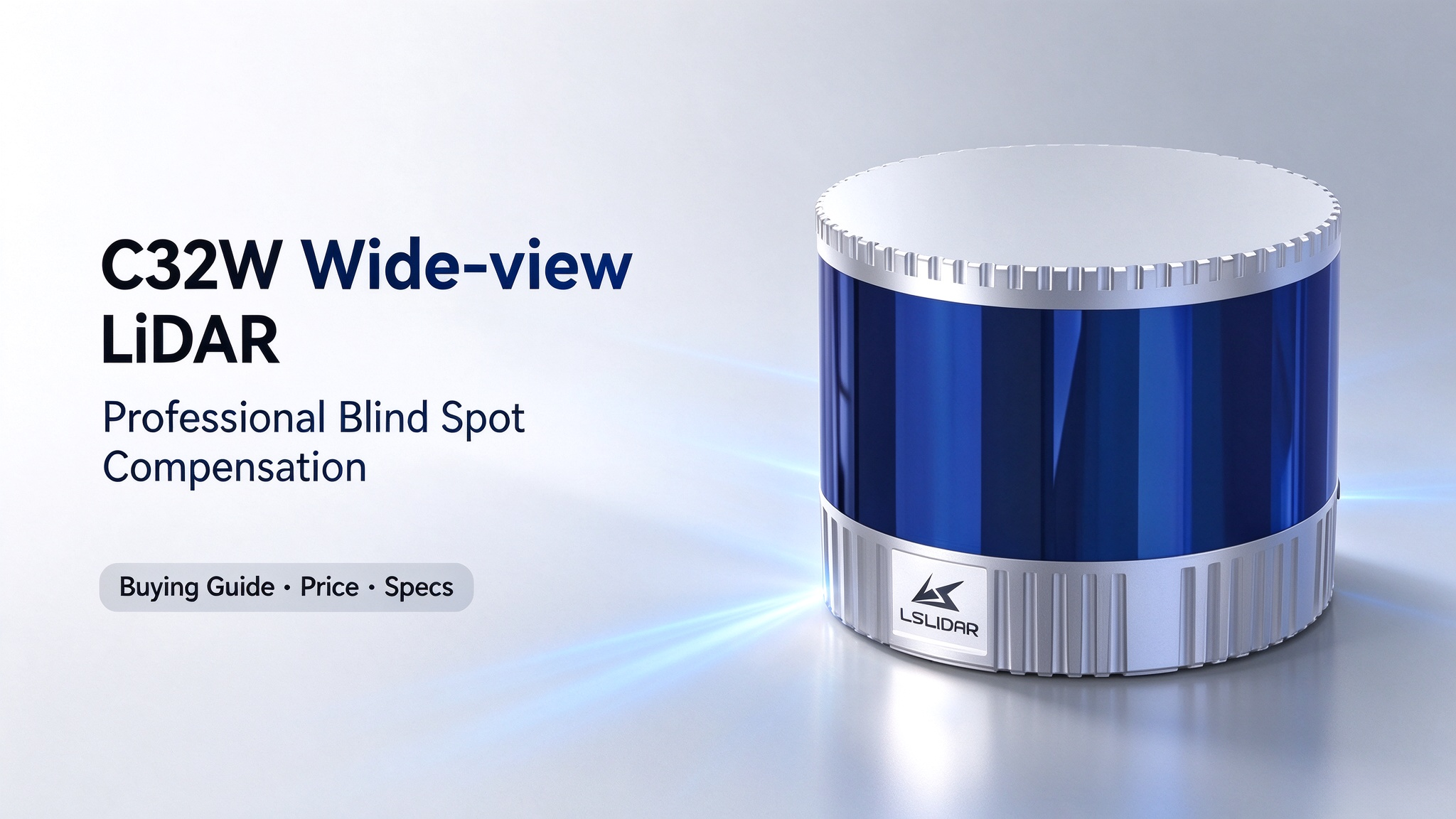
Choosing a 3D LiDAR for a robot or autonomous system requires more than comparing the headline detection distance.
A LiDAR may have an impressive maximum range but still be unsuitable for a particular robot if its vertical field of view, point density, scanning pattern, interface, environmental protection, or software compatibility does not match the project.
The LSLiDAR C32W is an interesting example because its main selling point is not simply long-range measurement.
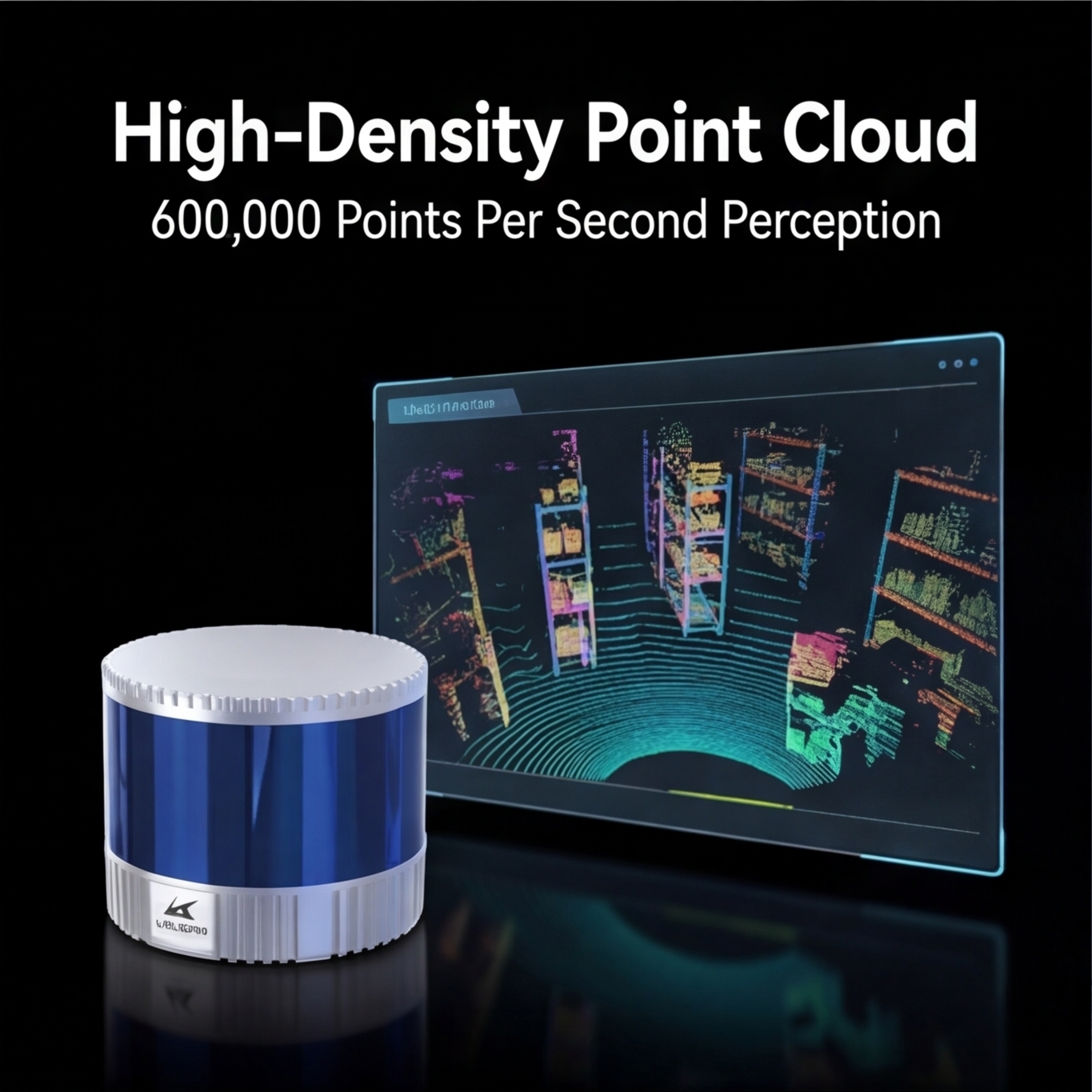
The C32W combines 32 laser channels with 360° horizontal coverage and a very wide vertical field of view extending from approximately -54.7° to +15°. LidarSeek currently lists the sensor with 40 m detection at 10% reflectivity, 80 m at 70% reflectivity, ±3 cm range accuracy, and up to 1.2 million points per second in dual-echo mode.
The manufacturer also positions the C32W as a wide-FOV mechanical LiDAR for applications such as mapping, UAVs, industrial systems, infrastructure, robotics, and security.
This guide explains what buyers should consider before ordering the C32W and how to determine whether its specifications match a real-world application.
1. C32W at a Glance
The C32W is a 32-channel mechanical 3D LiDAR based on Time-of-Flight measurement.
Its main specifications listed by LidarSeek include:
| Parameter | C32W Specification |
|---|---|
| Model | LSLiDAR C32W |
| Sensor Type | 3D Mechanical LiDAR |
| Measurement Principle | ToF |
| Laser Wavelength | 905 nm |
| Laser Safety | Eye-safe |
| Channels | 32 |
| Horizontal FOV | 360° |
| Vertical FOV | -54.7° to +15° |
| Detection Range | 40 m @10%; 80 m @70% reflectivity |
| Range Accuracy | ±3 cm |
| Range Precision | ±1 cm (1σ) |
| Point Rate | 600,000 pts/s single echo |
| Point Rate | 1,200,000 pts/s dual echo |
| Scan Rate | 5 / 10 / 20 Hz |
| Horizontal Resolution | 0.09° / 0.18° / 0.36° depending on scan rate |
| Vertical Resolution | Minimum 1.5° |
| Communication | 100 Base-TX Ethernet / PPS |
| Time Synchronization | GPS / gPTP |
| Operating Voltage | 12–32 VDC |
| Typical Power | 10 W |
| Operating Temperature | -20°C to +60°C |
| Storage Temperature | -40°C to +85°C |
| Protection | IP67 |
| Weight | Approximately 1.04 kg |
These specifications are taken from the current C32W product information on LidarSeek.
2. Understanding the C32W’s Wide Field of View
The first specification buyers should examine is FOV.
FOV means Field of View.
For the C32W, horizontal coverage is 360°, meaning the rotating sensor can scan the surrounding environment.
The vertical FOV is approximately 69.7° according to the LidarSeek product data, extending from -54.7° to +15°.
This is significantly different from a LiDAR designed around a relatively narrow vertical window.
The C32W’s vertical coverage is strongly biased toward the area below the sensor.
That design is useful for applications where the robot needs to understand what is happening close to the ground.
For example:
Robot → low obstacle → LiDAR
The downward field can increase the chance that the obstacle appears within the sensor’s scanning envelope.
This is especially relevant for:
- AMRs
- AGVs
- Service robots
- Outdoor delivery robots
- Industrial vehicles
- Mapping platforms
- Security robots
3. How Much Does the C32W Cost?
Pricing is one of the most important considerations when purchasing LiDAR.
LidarSeek currently lists the C32W at a sale price of $1,960, compared with a displayed original price of $2,248.
However, online product pricing should not automatically be treated as the final project cost.
The actual purchasing cost may depend on:
- Quantity
- Shipping destination
- Shipping method
- Configuration
- Sample versus production order
- Project requirements
- Import duties
- Taxes
- Accessories
- Integration services
LidarSeek provides quotation support for customers who need current pricing, availability, lead time, and shipping information. Its current product page indicates sample orders of approximately 3–10 days and standard orders of approximately 7–15 days, while custom projects require contacting sales.
For companies purchasing multiple sensors, requesting a project quotation is usually more useful than relying only on the displayed single-unit website price.
4. Is C32W a Good Choice for an AMR?
An Autonomous Mobile Robot typically requires reliable environmental perception.
The LiDAR needs to help the robot:
- Build maps
- Localize itself
- Detect obstacles
- Identify free space
- Navigate around people
- Avoid collisions
- Understand changes in the environment
The C32W’s 360° scanning capability is useful for surrounding perception.
Its wide vertical coverage can also provide more information about low objects.
For example, a warehouse AMR might encounter:
- Pallets
- Cart wheels
- Low barriers
- Boxes
- Loading ramps
- Forklift components
- Ground-level objects
These objects can have complex shapes that are not always well represented by a single horizontal scanning plane.
A 3D LiDAR can provide more geometric information for perception algorithms.
5. C32W for AGV Systems
Automated Guided Vehicles are often deployed in industrial environments.
Depending on the system design, AGVs may operate around:
- Production equipment
- Storage racks
- Pallets
- Conveyors
- Workers
- Forklifts
- Safety barriers
A LiDAR system can contribute to obstacle detection and localization.
The C32W’s wide vertical FOV is potentially useful where obstacles can appear at different elevations.
However, LiDAR should not automatically be considered a complete safety system.
Safety-rated functions may require dedicated safety scanners, redundant sensing, safety controllers, or other certified architectures depending on the application and applicable regulations.
The C32W should therefore be evaluated as part of the complete system architecture.
6. C32W for 3D Mapping
Mapping is another natural application.
A mobile platform can move through an environment while the C32W continuously generates spatial measurements.
The resulting point cloud can be used by mapping and SLAM software.
Potential applications include:
- Warehouse mapping
- Factory mapping
- Construction surveying
- Infrastructure inspection
- Industrial facility digitization
- Robot navigation maps
- Outdoor environment reconstruction
The 360° scanning geometry can provide a large amount of surrounding information during robot movement.
This can be useful when the platform changes direction frequently.
7. Point Rate: 600,000 vs. 1.2 Million Points per Second
A common mistake when buying LiDAR is to look at point rate alone.
The C32W is listed with:
600,000 points/second — single echo
and
1,200,000 points/second — dual echo.
A higher point rate can provide more measurements, but buyers should also examine:
- Number of channels
- Horizontal resolution
- Vertical resolution
- Scan frequency
- Detection range
- Return mode
- FOV
- Processing requirements
For a robot, more data is not automatically better.
The onboard computer must process the data.
Therefore, C32W integration should include a hardware and software performance test.
8. Choosing the Correct Scan Rate
The C32W supports 5 Hz, 10 Hz, and 20 Hz scanning.
The horizontal angular resolution changes with scan rate:
- 5 Hz: 0.09°
- 10 Hz: 0.18°
- 20 Hz: 0.36°
This creates a practical trade-off.
At a lower scan frequency, the sensor can provide finer horizontal angular resolution according to the published specifications.
At a higher scan frequency, the environment is updated more frequently.
For a slowly moving mapping platform, 5 Hz may be attractive.
For a faster mobile robot, 10 Hz or 20 Hz may be worth evaluating.
The correct setting depends on:
- Robot speed
- Detection distance
- Required reaction time
- Mapping algorithm
- Processing capability
- Desired point density
There is no universally correct scan frequency.
9. C32W and ROS Integration
For robotics developers, software compatibility can be just as important as hardware specifications.
LidarSeek states that the C32W supports ROS systems and mainstream development platforms for secondary development.
A typical robotics software architecture could be:
C32W
↓
Ethernet
↓
LiDAR Driver
↓
ROS / ROS2 PointCloud2
↓
Filtering
↓
Ground Segmentation
↓
Obstacle Detection
↓
SLAM / Localization
↓
Navigation
This architecture can be combined with:
- IMU
- GNSS
- Wheel odometry
- RGB cameras
- Depth cameras
- Radar
The exact software implementation depends on the robot platform and development framework.
10. Ethernet Integration
The C32W uses Ethernet communication.
LidarSeek specifies 100 Base-TX Ethernet and PPS.
Before ordering, system engineers should verify:
- Ethernet connector requirements
- IP configuration
- Network bandwidth
- Point-cloud packet structure
- Driver availability
- Time synchronization
- Computer compatibility
- Cable requirements
- Power requirements
For a prototype, this can be relatively straightforward.
For a production robot, the network architecture should be tested under real operating conditions.
11. Time Synchronization
Multi-sensor systems frequently require accurate timing.
The C32W lists GPS/gPTP as time sources.
This can matter when combining:
- LiDAR
- Camera
- IMU
- GNSS
- Radar
- Wheel odometry
If the LiDAR point cloud and camera frames have significant timing differences, moving objects may appear spatially misaligned.
Therefore, synchronization should be considered early in the system design rather than added at the end.
12. Power and Electrical Integration
The C32W operates from a 12–32 VDC supply and lists approximately 10 W typical power consumption.
For mobile robots, power consumption matters because every sensor adds to the energy budget.
Engineers should calculate:
Total sensor power + computer power + motor power + communication power + safety system power
The LiDAR itself may represent only a portion of the total electrical consumption.
The power supply should also be designed with suitable voltage regulation and protection.
13. IP67 Protection
The C32W is specified as IP67.
This makes the sensor more suitable for applications where exposure to dust and water needs to be considered.
Potential applications include:
- Outdoor robots
- Industrial automation
- Ports
- Infrastructure monitoring
- Outdoor mapping
- Agricultural robotics
Nevertheless, IP rating does not mean that every environmental condition is automatically acceptable.
Engineers should evaluate:
- Temperature
- Condensation
- Salt exposure
- Mud
- Dust
- Mechanical vibration
- Installation location
- Optical window contamination
14. C32W Mechanical LiDAR Installation
Mechanical LiDAR installation should be designed around the intended perception area.
Because the C32W’s vertical FOV extends strongly downward, mounting height can have a significant influence on the ground coverage.
For example:
A LiDAR mounted higher above the ground will intersect the downward scanning rays at different distances compared with a low-mounted sensor.
Therefore, engineers should simulate or test:
- Mounting height
- Tilt angle
- Robot dimensions
- Minimum obstacle height
- Desired detection distance
- Ground clearance
A simple physical test with representative obstacles can reveal whether the scanning geometry fits the robot.
15. C32W vs. 2D LiDAR
For buyers deciding between 2D and 3D LiDAR, the fundamental question is application complexity.
A 2D LiDAR may be sufficient when the robot only needs a horizontal obstacle map.
A 3D LiDAR becomes more attractive when the robot needs:
- Height information
- 3D SLAM
- Terrain information
- Low-obstacle detection
- Complex object geometry
- Multi-level environmental perception
The C32W belongs to the second category.
If your application does not require 3D information, a 2D sensor may be more economical.
If your application depends on 3D perception, the C32W provides a substantially different type of data.
16. C32W vs. Narrow-FOV 3D LiDAR
Another comparison is between the C32W and conventional 3D LiDAR models with narrower vertical coverage.
The C32W’s defining characteristic is its wide downward field.
This can be valuable for low-obstacle detection.
A conventional LiDAR with a more balanced vertical FOV may provide different coverage above the sensor’s horizontal plane.
Therefore, buyers should create a simple FOV diagram for the actual application.
Ask:
What area must the LiDAR see?
Then compare the sensor’s FOV against that area.
This is often more useful than comparing marketing descriptions.
17. What Should You Ask Before Ordering?
Before purchasing C32W sensors for a commercial project, prepare the following information:
Application
What is the sensor being used for?
Examples:
- AMR
- AGV
- Robot dog
- Mapping
- UAV
- Industrial automation
- Security
- Infrastructure
Quantity
How many units are required?
Environment
Indoor, outdoor, warehouse, factory, road, port, construction site, etc.
Detection requirement
What is the required minimum and maximum detection distance?
Robot speed
How fast will the platform move?
Computer
What onboard computer will process the LiDAR?
Software
ROS, ROS2, custom C++, Python, MATLAB, or another platform?
Synchronization
Does the application require PPS, gPTP, GNSS, or another timing architecture?
Delivery
Where should the sensors be shipped?
This information allows the supplier to provide a more useful quotation and integration recommendation.
18. Buying C32W from LidarSeek
LidarSeek currently lists the C32W as a purchasable product and provides a request-for-quotation workflow. The product page indicates that customers can provide requirements, confirm the model and quantity, receive a quotation, confirm payment, and arrange international shipment.
The listed shipping options include DHL, FedEx, UPS, and other methods, while the page also lists DAP, FOB Shenzhen, EXW Factory, and FCA China shipping terms.
This can be relevant to international buyers who need to calculate the complete landed cost rather than simply the sensor price.
19. Why Request a Project Quote Instead of Buying One Unit?
The website price is useful as a reference.
However, engineering projects frequently require different commercial conditions.
For example:
A university may need two units for research.
A startup may need five units for prototypes.
An integrator may need 20 units for pilot deployment.
A robot manufacturer may need hundreds of units for production.
The appropriate quotation structure can be different for each situation.
Therefore, companies should provide the supplier with:
- Quantity
- Application
- Destination
- Required delivery date
- Required accessories
- Integration requirements
This allows the supplier to respond with more relevant commercial information.
20. C32W Buyer Checklist
Before placing an order, check:
Hardware
- 32 channels
- 360° horizontal FOV
- Wide downward vertical FOV
- Required detection range
- Required accuracy
- Required point rate
Mechanical
- Sensor dimensions
- Weight
- Mounting position
- Vibration environment
- Protection requirements
Electrical
- 12–32 VDC supply
- Approximately 10 W typical power
- Connector compatibility
- Cable length
Software
- Ethernet connectivity
- ROS/ROS2 compatibility
- Point-cloud driver
- Data format
- Time synchronization
Commercial
- Quantity
- Unit price
- Shipping
- Taxes/duties
- Lead time
- Warranty
- Technical support
FAQ
What is the LSLiDAR C32W used for?
The C32W is designed for 3D perception applications including robotics, mapping, industrial automation, infrastructure, UAV-related systems, and security.
What is the C32W LiDAR price?
LidarSeek currently displays a sale price of $1,960 for the C32W. Actual project pricing can depend on quantity, shipping, configuration, and commercial terms.
Is the C32W a 32-line LiDAR?
Yes. The C32W uses 32 laser channels.
Does C32W provide 360-degree scanning?
Yes. Its horizontal field of view is 360°.
What makes the C32W different from many conventional 3D LiDARs?
Its particularly wide downward vertical field of view is one of its defining characteristics. This is intended to improve perception of low obstacles and nearby ground-level objects.
What is the maximum detection range?
The current LidarSeek specifications list 40 meters at 10% reflectivity and 80 meters at 70% reflectivity.
What is the accuracy of the C32W?
LidarSeek lists ±3 cm range accuracy and ±1 cm range precision at 1σ.
Can I use C32W for ROS robotics?
LidarSeek states that the C32W is compatible with ROS systems and mainstream development platforms for secondary development.
Does the C32W support outdoor applications?
The C32W is specified with IP67 protection and an operating temperature range of -20°C to +60°C. Its suitability should still be evaluated against the specific environment and installation conditions.
How much power does C32W consume?
The current product specification lists typical operating power at approximately 10 W.
What interface does the C32W use?
The product page specifies 100 Base-TX Ethernet and PPS, with GPS/gPTP listed as time-source options.
Is C32W suitable for autonomous mobile robots?
It can be considered for AMR applications where 3D environmental perception, 360° coverage, and low-obstacle detection are important. The final selection should be based on the robot’s speed, mounting geometry, perception requirements, and software architecture.
Can I order C32W internationally?
LidarSeek lists international shipping options including DHL, FedEx, UPS, and other methods, with DAP, FOB Shenzhen, EXW Factory, and FCA China terms shown on the current product page.
Conclusion: Is the C32W Worth Evaluating?
The LSLiDAR C32W is best understood as a wide-FOV 32-channel mechanical 3D LiDAR, rather than simply another 32-line sensor.
Its most distinctive feature is the combination of:
32 channels + 360° horizontal scanning + approximately 70° vertical FOV + strong downward coverage.
That combination makes the sensor particularly relevant to projects where low obstacles, nearby ground-level objects, and surrounding 3D perception are important.
The current LidarSeek specification lists 40 m detection at 10% reflectivity, 80 m at 70% reflectivity, ±3 cm range accuracy, up to 1.2 million points per second in dual-echo mode, 5/10/20 Hz scanning, Ethernet communication, and IP67 protection.
For buyers evaluating the C32W, the best approach is to compare its actual FOV and scanning geometry against the robot or machine rather than choosing purely on maximum range.
If the project requires 360° perception and significant downward visibility, the C32W can be an interesting candidate for evaluation.
For current pricing, quantity discounts, lead time, shipping, and technical requirements, buyers should request a project-specific quotation from LidarSeek.









