
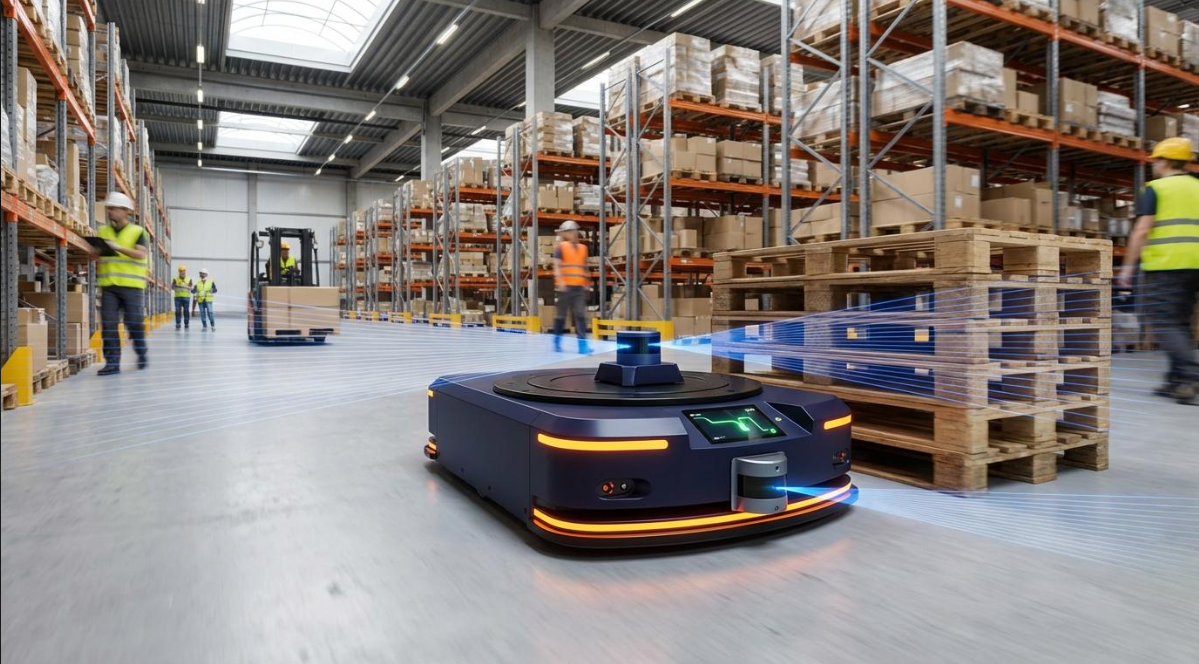
Introduction: The Growing Demand for Industrial LiDAR Sensors
Industrial automation is transforming manufacturing, warehousing, logistics, and material handling.
Factories and distribution centers are increasingly using automated guided vehicles (AGVs), autonomous mobile robots (AMRs), robotic inspection platforms, and intelligent material-handling systems to improve operational efficiency.
However, an autonomous industrial vehicle needs more than a motor and a control system. It must understand its surrounding environment, identify obstacles, measure distances, and make navigation decisions.
This is why industrial LiDAR sensors have become important components in modern automation systems.
A LiDAR sensor uses laser light to measure the distance between itself and surrounding objects. By collecting distance measurements at different angles, it can generate a representation of the surrounding environment.
For AGVs and AMRs, this information can support obstacle detection, localization, navigation, mapping, and environmental monitoring.
If you are looking for an industrial 2D LiDAR sensor with Ethernet communication, a wide scanning angle, and a compact design, the PAVO2-LS-50H is worth considering.
This single-line TOF LiDAR provides a specified maximum detection range of 50 meters at 90% reflectivity, a 280-degree scanning range, a 45 kHz sampling rate, and an IP67 protection rating.
In this guide, we will explore how industrial LiDAR works, its applications in smart factories, and the key specifications to consider when selecting a sensor for your project.
Product details:
https://lidarseek.com/product/pavo2-ls-50h
1. What Is an Industrial LiDAR Sensor?
An industrial LiDAR sensor is a distance-measurement device that uses laser technology to detect surrounding objects and structures.
In a typical TOF LiDAR system, the sensor emits laser pulses and receives the light reflected by nearby surfaces.
By measuring the time between emission and reception, the system calculates the distance to the target.
When the sensor scans across multiple angular positions, it produces a series of distance measurements.
These measurements can be used to create a two-dimensional laser scan or point cloud.
In industrial automation, this information can support:
- AGV and AMR navigation.
- Obstacle detection.
- Industrial robot positioning.
- Warehouse environmental monitoring.
- Automated material handling.
- Mapping and localization.
- Equipment monitoring.
- Security and perimeter monitoring.
Unlike a conventional proximity sensor that may only detect an object within a limited area, a scanning LiDAR can collect distance information across a much wider angular range.
This makes it useful for mobile equipment that needs to continuously monitor its surroundings.
2. Why AGV and AMR Systems Need LiDAR
AGVs and AMRs are designed to transport materials and products through industrial facilities.
Although their navigation methods may differ, both types of vehicles need reliable environmental information.
2.1 Obstacle Detection
An AGV or AMR may encounter people, pallets, forklifts, boxes, equipment, and other vehicles.
A LiDAR sensor can measure the distance to obstacles that intersect its scanning plane.
The robot controller can then use this information to decide whether to continue moving, slow down, or change its route.
For example, a warehouse AMR moving through an aisle can continuously scan the area ahead. When an obstacle enters the monitored region, the navigation software can update the movement plan.
The actual stopping distance and safety response must be designed according to vehicle speed, braking performance, sensor response time, and applicable safety requirements.
2.2 Mapping and Localization
Many AMRs use simultaneous localization and mapping (SLAM) to estimate their position while building a map of their environment.
A 2D LiDAR provides distance measurements that can be compared with the surrounding walls, structures, and other environmental features.
This data can support the robot’s localization and mapping algorithms.
The PAVO2-LS-50H can be evaluated for these applications where the sensor’s scanning plane and data interface are compatible with the navigation architecture.
2.3 Navigation in Dynamic Environments
Industrial facilities are not always static.
Pallets are moved, production equipment changes position, and forklifts may enter or leave an aisle.
An AMR needs to update its environmental information while operating.
A LiDAR with an appropriate scanning frequency can provide repeated distance measurements to support dynamic obstacle detection and route planning.
The PAVO2-LS-50H supports scanning frame rates of 25 Hz and 50 Hz, allowing developers to evaluate different configurations.
3. PAVO2-LS-50H: Industrial 2D LiDAR Specifications
When selecting an industrial LiDAR sensor, specifications should be evaluated according to the actual operating environment.
The PAVO2-LS-50H provides the following technical characteristics.
| Parameter | Specification |
|---|---|
| Product Model | PAVO2-LS-50H |
| Sensor Type | Single-line TOF LiDAR |
| Detection Range | 0.1–50m @ 90% reflectivity |
| Detection Range | 0.1–20m @ 10% reflectivity |
| Scanning Range | 280° |
| Minimum Angular Resolution | 0.08° |
| Sampling Rate | 45 kHz |
| Scanning Frame Rate | 25/50 Hz |
| Repeatability Accuracy | ±20 mm |
| Laser Wavelength | 905 nm |
| Laser Safety | Class 1 |
| Communication Interface | Ethernet 100BASE-TX |
| Power Supply | DC 12–24V |
| Typical Operating Current | 0.17A at 12V |
| Power Consumption | 2W |
| Protection Rating | IP67 |
| Operating Temperature | -10°C to 55°C |
| Dimensions | 60 × 60 × 80 mm |
| Weight | 250g excluding cables |
3.1 50-Meter Detection Range
One of the key characteristics of the PAVO2-LS-50H is its specified 50-meter detection range at 90% reflectivity.
For targets with 10% reflectivity, the specified range is 20 meters.
This makes it important to understand the surfaces commonly encountered in a factory or warehouse.
Different materials, colors, angles, and surface conditions can influence reflected laser energy.
For example, highly reflective surfaces may produce different measurement results from dark or low-reflectivity objects.
When designing an AGV or AMR, developers should test the sensor using representative targets from the actual operating environment.
3.2 280-Degree Scanning Coverage
The sensor provides a 280-degree scanning range.
This can be useful for front-mounted installation on mobile robots, allowing the platform to monitor a wide horizontal area.
However, a 280-degree scanning angle is not the same as complete 360-degree coverage.
If the application requires detection around the entire vehicle, developers should evaluate additional sensors or an alternative mounting configuration.
3.3 0.08-Degree Minimum Angular Resolution
The PAVO2-LS-50H supports a minimum angular resolution of 0.08 degrees.
This allows closely spaced angular measurement positions within its scanning field.
For warehouse robots, this can help represent walls, equipment, pallets, and other structures that intersect the scanning plane.
The smallest detectable object still depends on its dimensions, distance, reflectivity, and orientation.
3.4 IP67 Protection for Industrial Environments
Industrial equipment may operate in environments containing dust, moisture, and other challenging conditions.
The PAVO2-LS-50H has an IP67 protection rating.
This rating is relevant when evaluating sensors for industrial applications where ingress protection is important.
Nevertheless, correct installation and cable connections are essential. Environmental suitability should always be confirmed against the actual application requirements.
3.5 Compact Size and Low Power Consumption
The sensor measures 60 × 60 × 80 mm and weighs approximately 250g excluding cables.
Its specified power consumption is 2W.
These characteristics can help simplify mechanical and electrical integration into mobile robot platforms.
For battery-powered AMRs, power consumption is an important factor because it contributes to the overall energy budget of the vehicle.
4. Industrial Applications of PAVO2-LS-50H
4.1 Warehouse AGV and AMR Systems
Warehouse automation is one of the most common application areas for mobile robotics.
AGVs and AMRs transport products, raw materials, containers, and finished goods between different locations.
A 2D LiDAR can provide distance information to support navigation and obstacle detection.
Potential applications include:
- Pallet transportation.
- Automated warehouse logistics.
- Material delivery.
- Inventory movement.
- Production-line supply.
- Distribution center automation.
For developers building warehouse robots, the PAVO2-LS-50H can be evaluated as a horizontal scanning sensor.
4.2 Smart Manufacturing
Smart factories use interconnected machines, industrial robots, automated transportation systems, and digital control platforms.
Mobile robots may move between production areas to deliver materials or transport components.
A LiDAR sensor can provide environmental distance information to help these platforms navigate through manufacturing facilities.
The Ethernet interface can also simplify connection to compatible industrial computing systems.
4.3 Industrial Inspection Robots
Inspection robots are used to monitor equipment, infrastructure, and industrial environments.
They may operate in production areas, utility facilities, tunnels, and other controlled environments.
LiDAR measurements can help identify nearby structures, support mapping, and provide environmental information to the inspection platform.
The PAVO2-LS-50H can be considered when the application requires single-plane distance measurements.
4.4 Automated Material Handling
Automated material-handling platforms transport products between storage locations, assembly lines, and shipping areas.
These platforms require environmental information to support movement and obstacle awareness.
A scanning LiDAR can help the control system monitor the space around the vehicle.
For complex material-handling applications, additional sensors may be required to detect objects at different heights or outside the scanning plane.
4.5 Outdoor Industrial Mobile Robots
Some mobile robots operate outside factories, including industrial yards, logistics facilities, and large infrastructure sites.
In these applications, sensor selection must consider dust, water, temperature, sunlight, and target reflectivity.
The PAVO2-LS-50H’s IP67 rating and specified operating temperature range of -10°C to 55°C make it worth evaluating for appropriate outdoor installations.
Field testing is recommended before large-scale deployment.
5. Ethernet Integration and Robotics Software Development
Hardware and software compatibility are essential when integrating a LiDAR sensor into an industrial robot.
The PAVO2-LS-50H supports Ethernet 100BASE-TX communication.
A typical integration architecture can include:
- PAVO2-LS-50H industrial LiDAR.
- Ethernet network connection.
- Industrial PC or embedded controller.
- Manufacturer-provided SDK.
- Data processing and point cloud visualization.
- ROS or custom robotics software.
- SLAM and localization algorithms.
- Navigation and motion control.
The manufacturer provides SimiView software and a PAVO2 SDK package for sensor configuration, data visualization, and secondary development.
For engineering teams, it is recommended to confirm the available SDK version, network settings, data packet format, supported operating systems, and ROS driver information before integration.
A successful integration process should also include testing under realistic operating conditions.
For example, developers should verify measurement stability, network latency, frame consistency, and detection performance using actual industrial obstacles.
6. 2D LiDAR vs. Safety Laser Scanner: What Is the Difference?
This is an important consideration for AGV and AMR manufacturers.
A navigation LiDAR and a certified safety laser scanner are not necessarily interchangeable.
A navigation LiDAR generally provides distance information for environmental perception, mapping, and navigation algorithms.
A safety laser scanner is specifically designed and certified for defined personnel-protection functions.
The PAVO2-LS-50H has a Class 1 laser safety classification. This describes its laser emission safety classification, not its functional safety certification.
If an AGV or AMR requires personnel protection, emergency stopping, or safety-rated obstacle detection, the system designer must select equipment that meets the relevant safety standards.
A navigation LiDAR may be used as part of the overall perception architecture, but it should not be assumed to replace a certified safety device.
7. How to Choose an Industrial LiDAR Sensor for Your Project
Before purchasing an industrial LiDAR, evaluate the following factors.
1. Detection distance
Determine the maximum distance needed for your application and consider the reflectivity of actual targets.
2. Scanning coverage
Check whether the sensor’s scanning angle matches the vehicle’s mounting position and required coverage.
3. Sampling rate and frame rate
Select a configuration suitable for the platform’s movement speed and response requirements.
4. Environmental protection
Evaluate IP rating, operating temperature, dust, moisture, vibration, and installation conditions.
5. Communication interface
Confirm that the controller supports the required Ethernet connection and data protocol.
6. Software compatibility
Check SDK documentation, ROS support, operating system requirements, and available development resources.
7. Power consumption
Consider the sensor’s electrical requirements as part of the mobile robot’s overall power budget.
8. Safety requirements
Determine whether the application requires certified safety scanners or other safety-rated components.
8. Why Buy Industrial LiDAR Sensors from LidarSeek?
For manufacturers and engineering teams, finding a suitable LiDAR sensor at a competitive price can directly influence project development costs.
LidarSeek provides LiDAR products and intelligent perception hardware for industrial automation, robotics, autonomous driving, and mapping applications.
Customers can contact LidarSeek to discuss:
- Individual sample orders.
- Bulk purchasing requirements.
- Competitive project quotations.
- Product availability and lead time.
- Technical specifications and documentation.
- International delivery options.
- Alternative LiDAR models for different applications.
Whether you are developing an AGV, AMR, warehouse robot, industrial inspection platform, or automated material-handling system, choosing the right LiDAR is an important part of building a reliable perception solution.
The PAVO2-LS-50H offers a combination of 50-meter specified maximum detection range, 280-degree scanning, Ethernet communication, compact dimensions, and IP67 protection.
If these specifications match your project requirements, contact LidarSeek for a competitive quotation.
Request PAVO2-LS-50H pricing:
Frequently Asked Questions (FAQ)
Q1: What is an industrial LiDAR sensor used for?
Industrial LiDAR sensors are used for distance measurement, obstacle detection, mapping, robot navigation, industrial automation, and environmental monitoring.
Q2: Can the PAVO2-LS-50H be used in AGVs?
Yes. It can be evaluated for AGV applications involving horizontal environmental scanning, obstacle detection, and navigation. The final system design must address application-specific safety requirements.
Q3: Is it suitable for AMR navigation?
The sensor can be considered for AMR environmental scanning and navigation systems, provided its 280-degree scanning coverage, frame rate, measurement performance, and interface meet the application requirements.
Q4: What is its detection range?
The specified range is 0.1–50 meters at 90% reflectivity and 0.1–20 meters at 10% reflectivity.
Q5: Does it support outdoor industrial applications?
Its IP67 protection rating and operating temperature range of -10°C to 55°C make it a candidate for suitable outdoor applications. Environmental testing is recommended.
Q6: Does it support Ethernet communication?
Yes. The PAVO2-LS-50H supports Ethernet 100BASE-TX.
Q7: What is its power consumption?
The specified power consumption is 2W, with a typical operating current of 0.17A at 12V.
Q8: Is it a safety laser scanner?
No. Class 1 laser classification does not establish functional safety certification. For personnel protection, use an appropriately certified safety device.
Q9: Can it work with ROS?
The product page states ROS compatibility. Developers should confirm the exact ROS distribution, driver, SDK, and data interface before implementation.
Q10: Can I purchase multiple units for an industrial project?
Yes. Contact LidarSeek with your required model, quantity, project application, and destination country to request a quotation and shipping information.
Q11: What is the difference between a 2D and 3D industrial LiDAR?
A 2D LiDAR measures distances in a single scanning plane, while a 3D LiDAR generates spatial measurements across multiple vertical and horizontal angles. The correct choice depends on the perception requirements.
Q12: How do I get a competitive price for PAVO2-LS-50H?
Visit the LidarSeek product page and submit your purchasing requirements. For larger quantities or ongoing projects, request a project-based quotation.









