
Introduction: Why Long-Range LiDAR Is Becoming Essential for Industrial Applications
As autonomous systems, industrial automation, and intelligent infrastructure continue to develop, the demand for accurate and reliable environmental perception is increasing. In many industrial applications, conventional short-range LiDAR sensors cannot provide sufficient detection distance or spatial coverage.
For example, power transmission line inspection requires identifying thin cables and vegetation from considerable distances. Railway monitoring systems need to detect potential obstacles along long track sections. Mining facilities and industrial warehouses require accurate 3D measurements of large material stockpiles. Autonomous outdoor robots also need reliable environmental information to navigate safely through complex environments.
These applications require more than basic distance measurement. They need long-range detection, high-quality 3D point clouds, reliable performance in changing environmental conditions, and flexible sensing configurations.
This is where the Livox Avia 2 becomes an interesting solution.
Developed by Livox, Avia 2 is an industrial long-range 3D LiDAR sensor using a 1535nm laser. It offers a maximum cutoff detection range of up to 1000 meters in Focus Mode, dual field-of-view configurations, a narrow laser beam divergence, and integrated rain and fog noise removal functions.
Compared with traditional LiDAR systems designed primarily for short- or medium-range applications, Avia 2 is engineered to capture detailed spatial information across much larger distances.
For companies developing intelligent inspection systems, autonomous robots, smart transportation infrastructure, and industrial monitoring solutions, Livox Avia 2 provides an advanced sensing option worth considering.
In this article, we will explore its technical advantages, operating principles, industrial applications, and important considerations when selecting a long-range 3D LiDAR sensor.
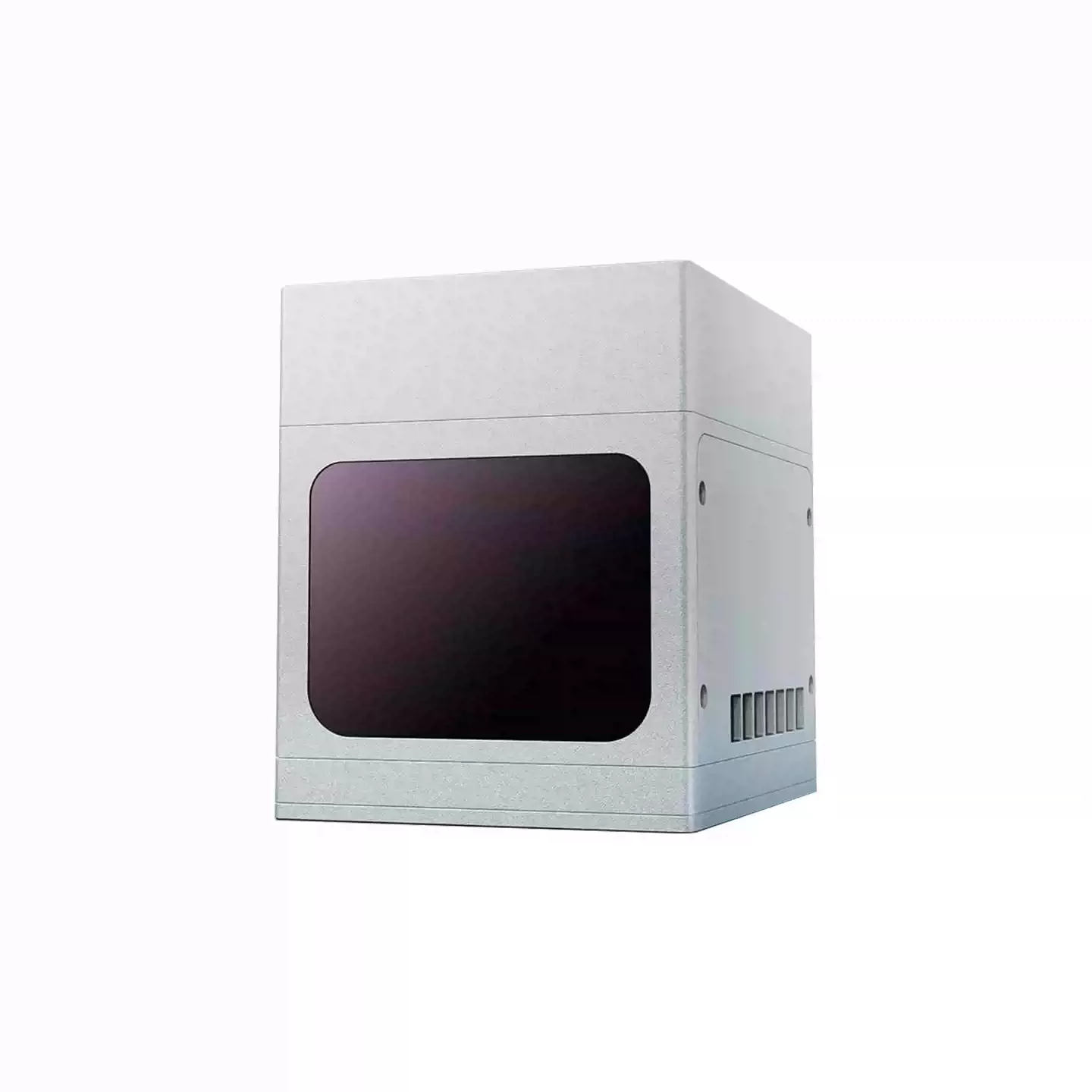
1. What Is Livox Avia 2?
Livox Avia 2 is an industrial-grade 3D LiDAR sensor designed for ultra-long-range environmental perception and high-precision distance measurement.
It uses a 1535nm laser to detect surrounding objects and generate 3D point cloud data. Each point represents a measured spatial position, allowing computers to reconstruct surrounding environments and identify objects.
Unlike conventional cameras, which depend on visible light and image processing, LiDAR measures distances using laser signals. This provides direct geometric information that can be used for 3D mapping, obstacle detection, object localization, and industrial inspection.
The main characteristics of Livox Avia 2 include:
- 1535nm laser wavelength
- Maximum cutoff detection range of up to 1000m in Focus Mode
- 400m detection range at 5% reflectivity in Normal Mode
- At least 800m detection range at 10% reflectivity in Focus Mode
- Dual field-of-view configurations
- 350,000 points per second in Normal Mode
- 100,000 points per second in Focus Mode
- 0.25mrad × 0.25mrad beam divergence
- Integrated rain and fog noise removal strategies
- Non-repetitive scanning technology
- IP66 protection rating
These features make Avia 2 particularly suitable for applications that require long-distance sensing and detailed 3D environmental information.
2. 1000m Long-Range Detection: A Major Advantage of Livox Avia 2
Detection distance is one of the most important considerations when selecting an industrial LiDAR sensor.
In traditional industrial applications, multiple short-range sensors may be needed to monitor a large area. This can increase equipment costs, installation complexity, communication requirements, and maintenance workloads.
A long-range LiDAR sensor can potentially reduce the number of sensing units required by covering a larger detection area.
Livox Avia 2 provides two operating modes with different range and point rate characteristics.
Normal Mode: Wide-Area Environmental Perception
Normal Mode provides an 80° × 80° field of view and a point rate of 350,000 points per second.
Its specified detection range is:
- 400m at 5% target reflectivity
- Approximately equivalent to 600m at 10% reflectivity
This mode is designed for applications requiring wider environmental coverage and relatively dense point cloud acquisition.
It is particularly useful for industrial monitoring, railway environments, large-area perception, and outdoor robotic applications.
Focus Mode: Extended Detection Distance
Focus Mode provides a narrower 15° × 15° field of view, concentrating the sensing area for long-distance target detection.
Its specified performance includes:
- At least 800m at 10% reflectivity
- Maximum cutoff detection range of 1000m
This mode is particularly valuable when detecting distant objects, narrow structures, and potential obstacles.
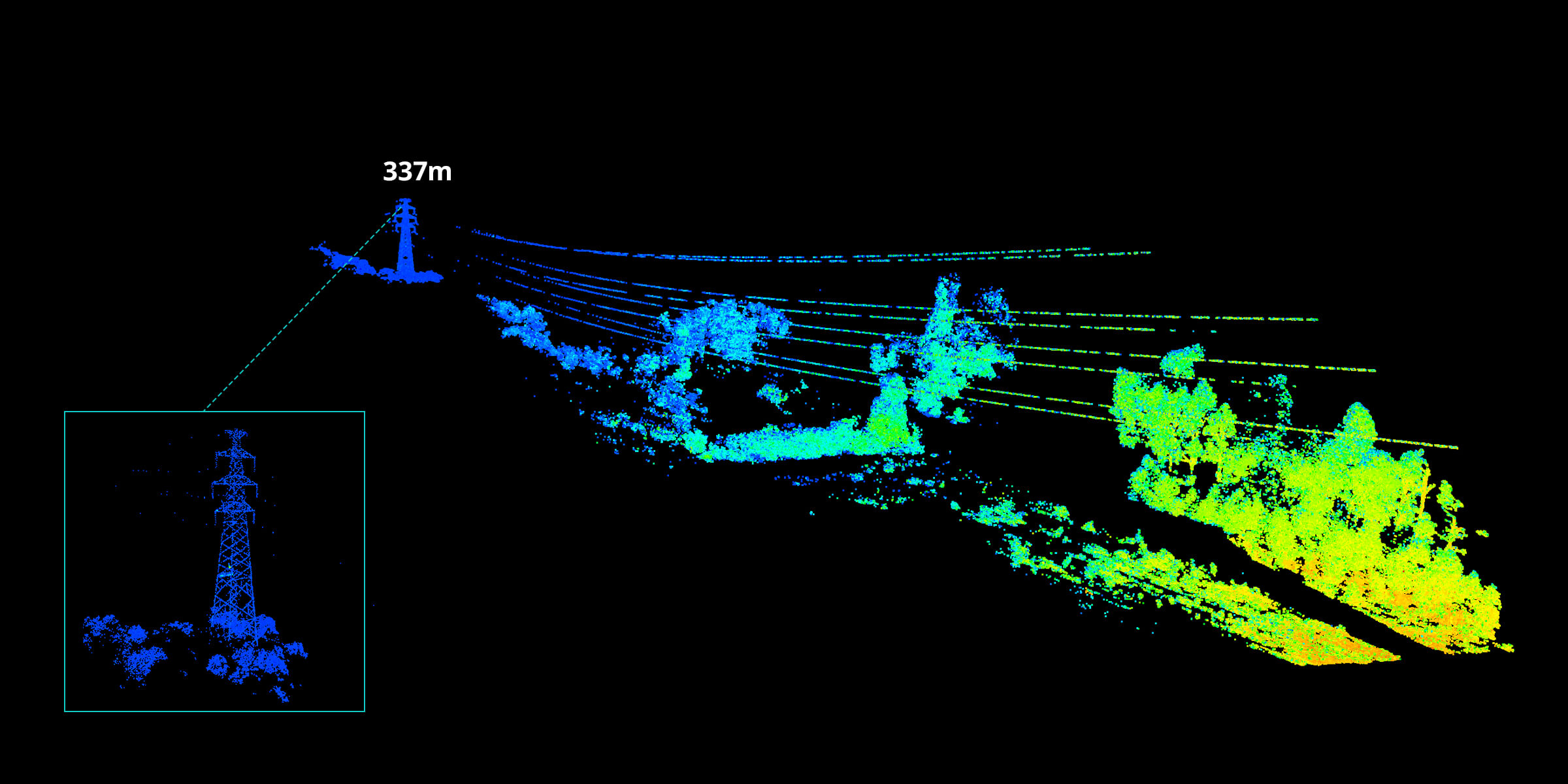
For example, in power line inspection, Focus Mode can help identify cables, branches, and other small objects at considerable distances.
It is important to distinguish the maximum cutoff range from guaranteed detection performance. The 1000m figure is measured under specified controlled conditions using a 20% reflectivity target. Actual results depend on target reflectivity, size, atmospheric conditions, and point cloud integration time.
3. 1535nm Laser Technology and Narrow Beam Divergence
Another important advantage of Livox Avia 2 is its 1535nm laser technology.
The laser wavelength and beam characteristics directly influence long-range sensing performance.
Avia 2 uses a narrow beam divergence of 0.25mrad × 0.25mrad. This helps concentrate laser energy into a relatively small spot, making it easier to detect narrow or small targets at long distances.
According to the manufacturer, the theoretical laser spot diameter at 100 meters is approximately 2.5cm.
This is particularly important in applications involving:
- Overhead power cables
- Tree branches
- Crane arms
- Industrial structures
- Railway obstacles
- Other narrow objects
For comparison, a wider laser beam may cover a larger area at the same distance, potentially reducing the amount of laser energy received from a small target.
The concentrated beam of Avia 2 helps improve the ability to capture detailed information from distant objects.
The 1535nm laser belongs to the broader 1550nm eye-safe wavelength spectrum. The manufacturer specifies Class 1 laser safety according to IEC 60825-1:2014.
This combination of long-range detection and eye-safety classification makes Avia 2 an attractive option for industrial sensing projects.
4. Dual FOV Design: Flexible Detection for Different Applications
Different industrial applications require different sensing coverage.
A railway monitoring system may need to observe a relatively wide area around the tracks, while a power line inspection system may need to focus on a specific distant cable.
Livox Avia 2 addresses these requirements with two selectable field-of-view modes.
| Feature | Normal Mode | Focus Mode |
|---|---|---|
| Field of View | 80° × 80° | 15° × 15° |
| Detection Range | 400m @ 5% reflectivity | ≥800m @ 10% reflectivity |
| Maximum Cutoff Range | 400m | 1000m |
| Point Rate | 350,000 pts/s | 100,000 pts/s |
| Main Advantage | Wider environmental coverage | Longer-distance detection |
When Should You Use Normal Mode?
Normal Mode is suitable for applications where surrounding environmental coverage is more important than maximum detection distance.
Examples include:
- Outdoor robotic perception
- Railway environment monitoring
- Large-area industrial inspection
- General obstacle detection
- 3D environmental reconstruction
When Should You Use Focus Mode?
Focus Mode is designed for applications requiring longer-distance detection within a narrower sensing area.
Examples include:
- Power transmission line inspection
- Long-distance obstacle detection
- Distant infrastructure monitoring
- Large-area perimeter observation
- Target monitoring in industrial environments
The ability to select between these two modes provides additional flexibility when designing an industrial sensing system.
5. Rain and Fog Noise Removal for Outdoor LiDAR Applications
Environmental conditions can significantly influence LiDAR performance.
Rain, fog, dust, and airborne particles may generate unwanted laser returns, producing noise in point cloud data. These abnormal points can increase the workload of perception algorithms and reduce the reliability of object detection.
Livox Avia 2 incorporates rain and fog noise removal strategies designed to identify interference signals and filter abnormal point cloud data.
The manufacturer describes two functions:
- Rain noise removal
- Fog noise removal
These functions use high-precision sampling and signal characteristics to help distinguish environmental interference from useful target information.
Potential benefits include:
- Reduced abnormal points caused by raindrops.
- Improved usability of point cloud data.
- Reduced processing requirements for downstream perception systems.
- More consistent outdoor monitoring performance.
- Better suitability for industrial environments with changing weather.
The rain noise removal function is designed for light to moderate rain. Its actual effectiveness varies according to weather and site conditions.
For applications involving heavy rain, dense fog, snow, or other severe weather, system designers should perform environmental testing rather than assuming that LiDAR can operate without performance degradation.
6. Non-Repetitive Scanning for Detailed 3D Point Clouds
The scanning method is another important factor when evaluating a 3D LiDAR sensor.
Livox Avia 2 uses a wedge-prism-based non-repetitive scanning architecture.
Unlike conventional repetitive scanning patterns, the scanning trajectory changes over time. As the integration period increases, previously unscanned areas are progressively covered.
This design provides several potential advantages:
- Progressive spatial coverage
- Improved environmental reconstruction
- Detailed point cloud acquisition
- Better coverage of small objects
- Useful 3D data for perception algorithm development
For example, when monitoring power lines, a LiDAR system needs to capture relatively thin objects against complex backgrounds. A detailed point cloud can help identify the spatial relationship between cables, trees, poles, and surrounding structures.
In industrial stockpile measurement, point cloud coverage is important for reconstructing irregular material surfaces and calculating volume.
The non-repetitive scanning approach allows Avia 2 to balance long-range detection with progressively increasing spatial coverage.
System designers should also consider the integration time and movement speed of the sensing platform when evaluating point cloud density.
7. Industrial Applications of Livox Avia 2
The combination of long detection range, dual FOV, narrow beam divergence, and environmental noise removal makes Livox Avia 2 suitable for several industrial applications.
7.1 Power Line Inspection and Electrical Infrastructure Monitoring
Power transmission lines cover extensive geographical areas and often pass through forests, mountains, and urban environments.
Traditional inspection methods may require manual field operations or multiple sensing devices to monitor long transmission corridors.
Livox Avia 2 provides a long-range sensing solution for power line monitoring and 3D infrastructure inspection.
Its concentrated laser beam helps detect narrow targets such as overhead wires and tree branches.
Potential applications include:
- Overhead cable detection
- Vegetation encroachment monitoring
- Power transmission corridor inspection
- Crane and construction equipment detection
- Electrical infrastructure 3D mapping
For automated inspection systems, the generated point clouds can be processed to identify changes in the surrounding environment and assess potential safety risks.
7.2 Railway Obstacle Detection and Wayside Monitoring
Railway safety systems need to identify obstacles and environmental changes along railway tracks.
Potential hazards include rocks, fallen branches, construction equipment, and other objects near the railway corridor.
The 80° × 80° Normal Mode field of view helps capture a relatively wide surrounding area.
Meanwhile, Focus Mode can be considered for long-distance observation of selected regions.
Potential applications include:
- Trackside obstacle detection
- Railway perimeter monitoring
- Tunnel entrance inspection
- Slope and rockfall monitoring
- Overhead railway infrastructure inspection
Integrating LiDAR data with railway monitoring software can support automated object detection and early warning systems.
Actual deployment should account for railway operating conditions, sensor mounting, vibration, weather, and the required detection response time.
7.3 Autonomous Robotics and Outdoor Mobile Robots
Autonomous mobile robots depend on reliable environmental perception to understand their surroundings and navigate safely.
Indoor robots generally operate in relatively controlled environments, while outdoor autonomous robots may encounter larger detection distances, changing lighting conditions, uneven terrain, and complex obstacles.
Livox Avia 2 offers long-range 3D sensing capabilities that can support outdoor robotic perception systems.
Potential applications include:
- Outdoor autonomous mobile robots
- Industrial inspection robots
- Autonomous navigation research
- Large-area obstacle detection
- Infrastructure inspection robots
- Long-distance environmental mapping
The point cloud data can be integrated into perception software for object recognition, localization, mapping, and obstacle analysis.
However, Avia 2 should be selected according to the robot’s actual sensing requirements. Its narrow Focus Mode field of view may not be sufficient as the only perception sensor for applications requiring continuous wide-angle, close-range coverage.
For some robotic platforms, combining Avia 2 with additional cameras or shorter-range LiDAR sensors may provide a more complete perception solution.
7.4 Bulk Material Measurement and Mining Automation
Large mining sites, ports, coal yards, and grain storage facilities often need to measure bulk material volumes.
Manual measurement can be time-consuming and may not provide sufficiently detailed information for automated inventory management.
Livox Avia 2 can collect 3D point cloud data from large stockpiles and industrial storage areas.
These point clouds can be processed to reconstruct material surfaces and calculate volume changes.
Potential applications include:
- Coal stockpile measurement
- Mining material volume estimation
- Grain storage monitoring
- Industrial inventory management
- Port material handling automation
- Large-area 3D scanning
Its long-range detection capability may help reduce the number of sensing positions required in suitable installations.
For dusty industrial environments, the sensor’s environmental performance should be validated under actual operating conditions.
7.5 Smart Waterways and Port Monitoring
Ports and waterways require monitoring systems that can observe large areas and identify potential navigation or infrastructure hazards.
A long-range LiDAR sensor can provide 3D spatial information for monitoring vessels, surrounding structures, and selected areas of waterways.
Livox Avia 2 can be considered for:
- Port perimeter monitoring
- Vessel detection
- Waterway observation
- Maritime infrastructure inspection
- Large-area environmental monitoring
Its rain and fog noise removal strategies are also relevant to outdoor applications where weather conditions may affect sensor data.
For marine environments, installation design should additionally consider corrosion protection, mounting stability, and environmental exposure.
8. Livox Avia 2 Technical Specifications
When comparing long-range LiDAR sensors, it is important to evaluate not only maximum range but also point rate, measurement precision, field of view, environmental protection, and integration interfaces.
The following table summarizes the main specifications published by Livox.
| Technical Parameter | Livox Avia 2 |
|---|---|
| Product Type | Industrial 3D LiDAR |
| Laser Wavelength | 1535nm |
| Laser Safety | Class 1 |
| Normal Mode Range | 400m @ 5% reflectivity |
| Normal Mode Equivalent | Approx. 600m @ 10% reflectivity |
| Focus Mode Range | ≥800m @ 10% reflectivity |
| Maximum Cutoff Range | 1000m (Focus Mode) |
| Normal Mode FOV | 80° × 80° |
| Focus Mode FOV | 15° × 15° |
| Normal Mode Point Rate | 350,000 points/s |
| Focus Mode Point Rate | 100,000 points/s |
| Beam Divergence | 0.25mrad × 0.25mrad |
| Angular Precision | ≤0.02° @ 1σ |
| Range Precision | ≤4cm @ 1σ (5–400m) |
| Range Precision | ≤6cm @ 1σ (400–700m) |
| Blind Zone | 5m @ 80% reflectivity |
| Return Modes | Strongest, First, Dual |
| Scanning Method | Non-Repetitive |
| IMU | Built-in |
| Data Format | X / Y / Z / Intensity / Tag |
| Operating Temperature | -20°C to +65°C |
| Protection Rating | IP66 |
| Power Supply | 9–27V DC |
| Data Interface | 100Mbps Ethernet |
| Synchronization | GPS, PTP, NTP |
| Dimensions | 146 × 113 × 139mm (with fan) |
| Weight | ≤1.8kg (with fan) |
Important: Detection range and precision depend on target reflectivity, test conditions, temperature, and actual operating environments. The maximum 1000m cutoff range should not be interpreted as a guaranteed detection distance for every object.
9. How to Choose the Right Long-Range LiDAR Sensor
Choosing a suitable industrial LiDAR sensor requires a comprehensive evaluation of the application rather than simply selecting the model with the longest advertised detection distance.
Here are several important considerations.
Detection Distance and Target Reflectivity
Different objects reflect laser energy differently.
A white reflective surface may be easier to detect than a dark object at the same distance.
Before selecting a sensor, identify the minimum target reflectivity, target dimensions, and required detection distance.
Field of View
A wide FOV is useful for surrounding environmental monitoring, while a narrow FOV can concentrate sensing on distant targets.
If your application requires both wide-area monitoring and long-distance detection, consider whether the sensor supports selectable FOV modes.
Point Cloud Density
Point rate affects the amount of spatial data generated per second.
Higher point rates may benefit applications requiring detailed environmental reconstruction, but actual point distribution also depends on scanning patterns, target distance, integration time, and object movement.
Environmental Protection
Outdoor industrial sensors must withstand changing temperatures, moisture, dust, and other environmental conditions.
Avia 2 provides an IP66 protection rating and an operating temperature range of -20°C to +65°C.
However, installation design and environmental validation remain essential.
Integration and Data Processing
Before purchasing a LiDAR sensor, check:
- Ethernet communication requirements
- Point cloud data format
- Software and SDK compatibility
- ROS or ROS 2 integration requirements
- Time synchronization
- Power supply requirements
- Mounting and mechanical dimensions
These factors can significantly influence the overall development cost and integration schedule.
10. Why Source Livox Avia 2 from LidarSeek?
Selecting a suitable LiDAR sensor is only one part of an industrial project. Procurement cost, product sourcing, technical information, and international shipping also affect the purchasing decision.
LidarSeek focuses on LiDAR sensors and intelligent perception solutions for global customers.
We help businesses and engineering teams identify suitable products for robotics, industrial automation, autonomous systems, surveying, and infrastructure monitoring.
When sourcing Livox Avia 2 through LidarSeek, customers can benefit from:
Competitive Pricing
We focus on providing competitive LiDAR product pricing and helping customers reduce unnecessary sourcing costs.
Product Selection Assistance
Our team can help evaluate detection range, field of view, point cloud requirements, and application compatibility.
Global Supply Support
We support international customers with product sourcing and shipping coordination.
Project-Based Quotations
Whether you need one sensor for testing or multiple units for an industrial deployment, you can contact us for a project-specific quotation.
Technical Information
We can assist with product specifications, datasheet requests, and basic integration-related product inquiries.
11. Get the Best Price for Livox Avia 2
Are you looking for a 1000m long-range 3D LiDAR sensor for industrial inspection, autonomous robotics, power line monitoring, or infrastructure applications?
Livox Avia 2 combines 1535nm laser technology, long-distance detection, selectable field-of-view modes, and advanced point cloud processing features in one industrial sensing solution.
LidarSeek helps global customers source Livox LiDAR products at competitive prices.
Contact us to request:
- Latest Livox Avia 2 pricing
- Product availability
- Technical datasheets
- Product configuration information
- International shipping estimates
- Bulk order quotations
Looking for a competitive Livox Avia 2 price?
Contact LidarSeek today and tell us about your application and required quantity.
Our team will help you find the right LiDAR solution for your project.
Request a Quote Now – Get Competitive Livox Avia 2 Pricing.
Frequently Asked Questions About Livox Avia 2
Q1. What is the maximum detection range of Livox Avia 2?
Livox Avia 2 has a maximum cutoff range of up to 1000 meters in Focus Mode under specified test conditions. It can detect targets with 10% reflectivity at distances of at least 800 meters.
Q2. What is the difference between Normal Mode and Focus Mode?
Normal Mode provides an 80° × 80° FOV and 350,000 points per second, making it suitable for wider environmental coverage.
Focus Mode provides a 15° × 15° FOV and 100,000 points per second, concentrating sensing on a smaller area for longer-distance detection.
Q3. Is Livox Avia 2 suitable for power line inspection?
Yes. Its long detection range and narrow laser beam help capture thin objects such as overhead wires, cables, and branches. It is suitable for consideration in automated power line inspection and infrastructure monitoring systems.
Q4. Can Livox Avia 2 be used on autonomous mobile robots?
Yes. It can provide long-range 3D point cloud data for outdoor autonomous robot perception, mapping, and obstacle detection. The final configuration should consider the robot’s speed, field-of-view requirements, and complementary sensors.
Q5. Does Livox Avia 2 support operation in rain and fog?
It integrates rain and fog noise removal strategies to help reduce abnormal point cloud noise. The rain filtering function is designed for light to moderate rain. Performance in severe weather conditions requires application-specific testing.
Q6. What is the laser wavelength of Livox Avia 2?
Avia 2 uses a 1535nm laser and has a Class 1 eye-safety classification according to IEC 60825-1:2014.
Q7. What is the protection rating of Livox Avia 2?
The official specification lists an IP66 protection rating. Its specified operating temperature range is -20°C to +65°C.
Q8. What communication interface does Livox Avia 2 use?
The sensor provides a 100Mbps Ethernet data interface and supports GPS (PPS + GPRMC), PTP (IEEE 1588), and NTP time synchronization.
Q9. How many points per second can Livox Avia 2 output?
It supports 350,000 points per second in Normal Mode and 100,000 points per second in Focus Mode.
Q10. Where can I buy Livox Avia 2?
You can contact LidarSeek for Livox Avia 2 product information, availability, competitive quotations, and international shipping support.
Contact LidarSeek today to get the latest price for your project.









