
Executive Summary
The commercialization of Level 4 (L4) autonomous driving and the rapid advancement of industrial automation have long been constrained by a fundamental challenge: the lack of a high-performance 360° LiDAR that is both reliable enough for continuous operation and cost-effective enough for scalable deployment. Traditional mechanical LiDARs, while capable of providing omnidirectional coverage, have been notoriously expensive, complex to manufacture, and difficult to qualify for automotive-grade durability. This has created a bottleneck for industries ranging from robotaxis and autonomous trucks to port logistics and smart factories.
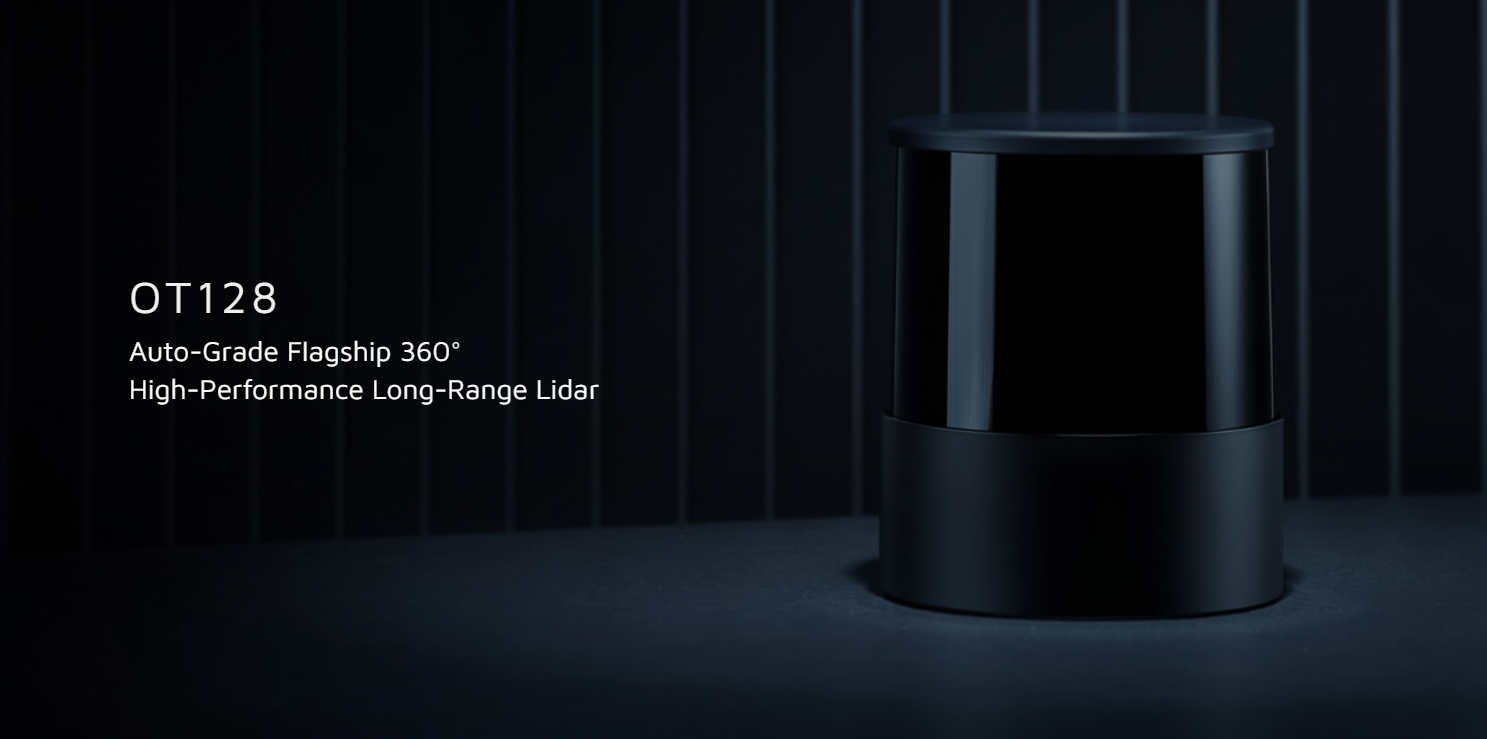
Hesai Technology’s OT128 is the definitive solution to this challenge. As the new flagship in Hesai’s 360° long-range LiDAR lineup, the OT128 represents a paradigm shift in the design and production of mechanical LiDARs . By leveraging the same chip-based architecture that powered Hesai’s record-breaking AT128—the world’s most widely adopted ADAS LiDAR—the OT128 achieves an unprecedented combination of high performance, automotive-grade reliability, and scalable manufacturability .
With a detection range of 200 meters at 10% reflectivity, a point rate of 3.456 million points per second, and a finest angular resolution of 0.1° (H) x 0.125° (V), the OT128 delivers perception clarity that far exceeds industry requirements . Its 66% reduction in components and 95% reduction in core production time compared to previous-generation mechanical LiDARs make it the first 360° sensor truly designed for mass deployment .
This comprehensive report provides an in-depth analysis of the Hesai OT128. We will examine its revolutionary chip-based architecture, dissect its industry-leading specifications, explore its transformative applications across L4 autonomous driving, ADAS ground truth development, port automation, and industrial robotics, and evaluate its unique value proposition for sophisticated clients in Russia, Europe, and North America. For organizations seeking to bridge the gap between prototype autonomy and commercial-scale deployment, the OT128 is not just an incremental improvement—it is the catalyst for a new era of scalable, reliable, and affordable 360° perception.
1. Introduction: The Scalability Challenge in 360° Perception
The history of autonomous driving is inextricably linked to the evolution of 360° LiDAR. Early pioneers like the DARPA Grand Challenge relied on bulky, spinning sensors that cost tens of thousands of dollars and required painstaking manual assembly. While these sensors proved the concept of autonomous navigation, they were never intended for mass production. Their architectures were fundamentally unscalable: discrete components stacked layer by layer, each requiring individual calibration, resulting in production times measured in hours and price tags that limited them to research prototypes and well-funded robotaxi pilots .
For years, the industry accepted this trade-off. L4 developers needed 360° coverage, and if that meant paying a premium and accepting long lead times, they did so. Meanwhile, the ADAS market charted a different course, focusing on forward-facing solid-state sensors that could be mass-produced affordably. Hesai’s AT128 became the emblem of this success, accumulating millions of units in design wins and demonstrating the power of chipization—integrating complex optical and electronic functions into custom silicon to dramatically simplify design, improve reliability, and reduce cost .
The OT128 represents the culmination of this journey. It asks a simple but profound question: why shouldn’t a 360° LiDAR benefit from the same technological advances that revolutionized ADAS sensing? By adapting the mature, battle-tested architecture of the AT128 to a rotating form factor, Hesai has created a sensor that retains all the perceptual advantages of a 360° scanner while inheriting the manufacturability, reliability, and cost structure of a modern solid-state device .
Unveiled at the IAA Transportation 2024 in Hannover, the OT128 has already garnered significant market traction, with over 90 customers across Europe, China, and North America adopting it for applications ranging from autonomous trucks to harbor automation . Its design philosophy—simplify, integrate, and scale—is poised to unlock new levels of commercial viability for the entire autonomous ecosystem.
2. OT128: Technical Architecture and Flagship Specifications
2.1 The Chip-Based Revolution in Mechanical LiDAR
The OT128’s most significant innovation lies not in its specifications, but in its internal architecture. Traditional mechanical LiDARs use a “discrete component” approach, with separate laser diodes and avalanche photodiodes for each channel, stacked vertically and painstakingly aligned. This process is labor-intensive, error-prone, and fundamentally resistant to automation.
Hesai’s OT128 shatters this paradigm by adopting the same chip-based transceiver module design that powered the AT128 to commercial success .
Key Architectural Innovations:
- VCSEL + SiPM Integration: For the first time in a 360° mechanical LiDAR, the OT128 utilizes Vertical-Cavity Surface-Emitting Laser (VCSEL) arrays and Silicon Photomultiplier (SiPM) receivers integrated onto single boards . This replaces dozens of discrete components with highly integrated modules.
- 95% Core Component Reuse: The OT128 shares over 95% of its core transceiver modules with the AT128, leveraging a design that has already been validated through millions of hours of real-world operation in mass-production vehicles .
- 66% Fewer Components: By eliminating discrete parts in favor of integrated chips, the OT128 reduces its total component count by two-thirds compared to previous-generation 360° LiDARs .
- Automated Production: The simplified design enables core production steps to be performed on fully automated assembly lines, reducing manufacturing time per unit by over 95% compared to traditional mechanical LiDARs .
The Strategic Implications:
This architecture delivers three transformative benefits:
- Cost Efficiency: Fewer parts and automated assembly directly translate to lower production costs, making the OT128 accessible for high-volume commercial deployments.
- Uncompromised Performance: Despite the simplified design, the OT128 maintains—and in many ways exceeds—the performance of its predecessors.
- Proven Reliability: By building on a platform already qualified for automotive mass production, the OT128 inherits a level of maturity and robustness that de-risks adoption for safety-critical applications.
2.2 Detailed Technical Specifications
The following specifications are compiled from Hesai’s official product documentation and verified by multiple authoritative sources .
2.3 The Perception Advantage: 0.1° × 0.125° Angular Resolution
The OT128’s finest angular resolution of 0.1° horizontally and 0.125° vertically in its central 66 channels represents a significant advancement in 360° perception capability .
What This Means for Perception:
- Vehicle Detection at 200m: At 200 meters, a standard passenger car occupies enough pixels in the point cloud for instant classification—distinguishing a sedan from an SUV or a car from a motorcycle—without requiring multiple frames of temporal tracking .
- Pedestrian Detection: A pedestrian at 100 meters is captured with sufficient detail to identify pose and movement direction, enabling predictive path planning.
- Small Obstacle Identification: Debris, tires, and other small hazards are detectable at ranges that provide ample reaction time for highway-speed maneuvers.
The resolution is achieved through a graded vertical distribution optimized for real-world driving:
- Central Channels (24-89): 0.125° ultra-high resolution for critical forward and rear perception.
- Intermediate Channels (8-24, 89-121): 0.36° resolution for general environment awareness.
- Upper/Lower Channels (1-8, 121-128): Coarser resolution (0.67° to 1.72°) for near-field ground detection and overhead monitoring .
This “foveated” design concentrates perceptual resources where they matter most—at the horizon—while maintaining comprehensive coverage of the entire vertical scene.
2.4 200-Meter Range at 10% Reflectivity: The Safety Benchmark
The ability to detect a dark-colored vehicle (10% reflectivity) at 200 meters is widely considered the baseline for safe L4 highway operation. The OT128 not only meets this standard but exceeds it with a maximum range of 230 meters under ideal conditions .
For a vehicle traveling at 130 km/h (36 m/s), this provides approximately 5.5 seconds of reaction time—sufficient for:
- Detection: The system identifies an obstacle.
- Classification: The perception stack determines whether it is a stationary vehicle, debris, or a false positive.
- Planning: The motion planner computes a safe trajectory (e.g., gentle braking or lane change).
- Execution: The vehicle executes the maneuver smoothly and comfortably.
This performance is maintained even under 100 klux strong ambient light, ensuring reliable operation in direct sunlight .
2.5 IPE: Intelligent Point Cloud Engine for All-Weather Operation
One of the OT128’s most distinctive features is Hesai’s proprietary Intelligent Point Cloud Engine (IPE) .
How IPE Works:
The IPE is a real-time point cloud processing system that operates at the “pixel level” within the sensor’s firmware. It is trained to recognize the unique signatures of environmental artifacts such as:
- Rain and Fog: Water droplets in the air create spurious returns that can obscure real obstacles.
- Vehicle Exhaust: Dense exhaust plumes can be mistakenly interpreted as solid objects.
- Road Spray: Water kicked up by tires creates transient noise.
- Dust: In industrial environments, dust particles generate false points.
The Benefit:
The IPE intelligently identifies these phenomena and filters them in real-time, marking or removing them from the output point stream . This delivers two critical advantages:
- Cleaner Data: Downstream perception algorithms receive a point cloud that more accurately represents the solid world, reducing false positives and improving detection confidence.
- True All-Weather Capability: By mitigating the impact of precipitation and particulates, the IPE enables reliable 360° perception in conditions that would defeat conventional LiDARs.
For clients in regions with challenging weather—such as Northern Europe’s frequent rain or Russia’s snow and fog—this capability is essential for year-round operational reliability.
2.6 Automotive-Grade Durability and Safety Certification
The OT128 was designed from its inception to meet the stringent requirements of automotive deployment, not just prototype use .
Comprehensive Reliability Testing:
The OT128 has passed over 50 automotive-grade reliability tests at Hesai’s CNAS-certified Bayes Testing Center, covering:
- Thermal shock and thermal cycling
- Mechanical shock and random vibration
- High-temperature and high-humidity endurance
- Salt spray and chemical resistance
- EMC (electromagnetic compatibility)
Design Life:
The sensor boasts a design life exceeding 30,000 hours—three times the industry average—ensuring consistent performance even after prolonged operation in demanding conditions .
Functional Safety (ISO 26262):
The OT128 is developed in accordance with ISO 26262 and meets ASIL B functional safety requirements, making it suitable for integration into safety-critical systems .
Cybersecurity (ISO 21434):
The sensor complies with ISO 21434 cybersecurity standards, featuring data signature, encryption, and client authentication to prevent tampering and ensure data integrity .
2.7 Unstitched 360° FOV: Calibration-Free and Algorithm-Friendly
Traditional multi-LiDAR configurations require complex calibration procedures to align point clouds from multiple sensors, and even single 360° sensors often require internal stitching of data from multiple modules.
The OT128’s fully integrated design delivers true unstitched 360° coverage from a single sensor .
The Benefits:
- Simplified Development: Perception engineers work with a single, continuous point cloud without worrying about alignment artifacts or calibration drift.
- Reduced Maintenance: No need for periodic re-calibration in the field.
- Faster Integration: System integrators can focus on application logic rather than low-level sensor fusion.
3. Transformative Application Scenarios
The OT128’s unique combination of 360° coverage, long range, high resolution, and scalable cost makes it applicable across a remarkably broad spectrum of industries.
3.1 L4 Autonomous Trucks and Robotaxis
For L4 autonomous vehicles operating without human fallback, 360° situational awareness is non-negotiable. The OT128 is ideally suited as the primary perception sensor for these applications.
Autonomous Trucking:
- Highway Maneuvers: The 200m range provides the stopping distance required for heavy vehicles at highway speeds.
- Blind-Spot Elimination: 360° coverage ensures that no quadrant is left unobserved during lane changes and merges.
- All-Weather Reliability: The IPE ensures clean data in rain, fog, and snow, which is essential for long-haul operations.
Robotaxi Fleets:
- Urban Intersections: 40° vertical FOV captures both cross-traffic vehicles and overhead traffic lights.
- Pedestrian Tracking: High resolution enables reliable detection and trajectory prediction of pedestrians in complex urban environments.
- Scalable Deployment: With its cost-optimized design, the OT128 makes multi-sensor 360° configurations commercially viable.
Market Validation:
Leading L4 developers including DeepRoute.ai , WeRide , and Westwell have selected the OT128 for their partner projects, validating its performance and reliability .
3.2 ADAS Ground Truth Development and Validation
As ADAS systems become more sophisticated, automakers and Tier 1 suppliers require high-fidelity “ground truth” data to train and validate their perception algorithms. The OT128 serves as an exceptional reference sensor for this purpose .
Applications:
- Data Collection Fleets: Equipped with multiple OT128s, data collection vehicles capture rich 360° scenes for training neural networks.
- Validation and Testing: The OT128’s high accuracy and repeatability provide a trusted baseline against which to measure the performance of production sensors.
- Corner Case Capture: The 128-line resolution and IPE noise filtering ensure that even rare and challenging scenarios are captured with sufficient fidelity for meaningful analysis.
3.3 Port Logistics and Container Terminal Automation
Ports and intermodal terminals represent some of the most demanding environments for autonomous systems: heavy machinery, salt spray, constant vibration, and a mix of human and automated operations.
Applications:
- Automated Container Handlers: Rubber-tired gantry cranes and straddle carriers use OT128s to precisely position containers and avoid collisions.
- Autonomous Terminal Trucks: Embotech, a Zurich-based autonomous driving provider, integrates the OT128 into its harbor terminal trucks to meet customers’ strict requirements for reliability and performance .
- Safety Monitoring: 360° coverage ensures that automated equipment operates safely alongside human workers and conventional vehicles.
Customer Validation:
Embotech’s Head of Commercial Vehicle Automation, Giorgio Corbellini, notes: “Reliability and performance were critical during the proof-of-concept phase, while ROI becomes a key focus in the deployment phase. Hesai’s lidar products enable us to meet our customers’ requirements in both stages” .
3.4 Autonomous Shuttles and Last-Mile Delivery
Low-speed autonomous shuttles and delivery vehicles operate in pedestrian-rich environments where comprehensive situational awareness is essential.
Applications:
- Campus Shuttles: The OT128’s 360° coverage provides awareness of pedestrians, cyclists, and other vehicles in all directions.
- Delivery Robots: The compact form factor allows integration into space-constrained robot designs.
Customer Validation:
EasyMile, a Toulouse-based leader in autonomous shuttle technology, integrates the OT128 into its vehicles. General Manager Benoit Perrin states: “Hesai has a track record of designing industry-leading performance lidars. The OT128 has ultra-high resolution, long-range perception, with a level of support that doesn’t compromise functionality” .
3.5 Industrial Robotics and Smart Factories
In manufacturing and logistics, fixed and mobile robots require reliable 3D perception to navigate dynamic environments and interact safely with human workers.
Applications:
- Automated Guided Vehicles (AGVs): OT128s provide 360° obstacle detection for AGVs navigating factory floors.
- Mobile Manipulators: High-resolution point clouds enable precise positioning for pick-and-place operations.
- Safety Zones: The sensor’s ASIL B certification makes it suitable for safety-rated applications.
3.6 Heavy Machinery and Construction
Large construction and mining vehicles operate in challenging environments with limited visibility. The OT128’s robust design and all-weather performance make it ideal for these applications .
Applications:
- Autonomous Excavators and Haul Trucks: 360° awareness enables safe operation in dynamic mining environments.
- Site Monitoring: Fixed OT128s can monitor construction sites for safety compliance and progress tracking.
4. Market Position and Commercial Validation
4.1 Unmatched Market Traction
Since its unveiling at IAA Transportation 2024, the OT128 has achieved remarkable commercial success .
- 90+ Global Customers: The sensor has been adopted by over 90 customers across Europe, China, and North America .
- Diverse Applications: Customers span L4 autonomous driving, ADAS development, port automation, industrial robotics, and smart factories .
- Mass Production: The OT128 has already entered mass production at Hesai’s manufacturing facilities, ensuring supply chain readiness for volume deployments .
4.2 Strategic European Partnerships
Hesai has established a strong presence in Europe, with a sales and application engineering office in Stuttgart, Germany, serving customers across the continent .
Key European Customers:
- Embotech (Switzerland): Deploying OT128s on harbor terminal trucks.
- EasyMile (France): Integrating OT128s into autonomous shuttles.
4.3 Industry Leadership and Recognition
Hesai’s position as the global leader in LiDAR technology provides strong validation for the OT128.
- #1 in Robotic Car LiDAR Market: According to Yole Intelligence’s “Lidar for Automotive 2024” report, Hesai holds a 74% market share in the robotic car LiDAR segment .
- Top-Tier Customer Base: Among the world’s top 10 autonomous driving companies, nine use Hesai’s 360° high-performance LiDAR .
4.4 Built on a Legacy of Success
The OT128 inherits the proven technology of the AT128, which as of Q2 2024 had achieved cumulative deliveries exceeding 380,000 units . This extensive field experience provides confidence in the OT128’s reliability and performance.
5. Value Proposition and Cost-Effectiveness
For sophisticated clients in European, North American, and Russian markets, the OT128 offers a compelling and unique value proposition.
5.1 Unprecedented Scalability
The OT128’s chip-based architecture and automated manufacturing represent a fundamental breakthrough in the economics of 360° LiDAR.
- 66% Fewer Components: Reduced parts count directly translates to lower bill-of-materials cost .
- 95% Faster Production: Automated assembly slashes manufacturing time, enabling high-volume output .
- Proven Scalability: Hesai’s “Maxwell” Intelligent Manufacturing Center, with its annual capacity exceeding one million units, provides the production backbone for volume deployments .
For organizations planning to deploy fleets of autonomous vehicles or large numbers of industrial robots, this scalability is essential to achieving commercially viable unit economics.
5.2 True 360° Performance with Minimal Integration Complexity
The OT128 delivers comprehensive 360° coverage from a single sensor, eliminating the complexity of multi-LiDAR configurations.
- Unstitched FOV: No calibration or stitching required .
- Simplified Fusion: Single-sensor coverage reduces the computational load and algorithm complexity associated with fusing multiple point clouds.
- Reduced System Cost: One OT128 can replace multiple lower-performance sensors, reducing overall system cost.
5.3 Automotive-Grade Reliability for Continuous Operation
The OT128 is not a “lab-grade” prototype; it is an automotive-grade sensor designed for 24/7 commercial operation.
- 30,000-Hour Design Life: Three times the industry average, minimizing downtime and replacement costs .
- -40°C to +75°C Operation: Suitable for deployment in all climates, from Russian winters to desert summers .
- IP6K7 & IP6K9K Protection: Withstands dust, water immersion, and high-pressure washdowns .
5.4 Algorithm-Friendly Data Accelerates Development
The OT128’s high-resolution, unstitched, noise-filtered point cloud is explicitly designed to be easy for perception algorithms to consume.
- Structured Data: The graded vertical resolution and uniform horizontal sampling simplify feature extraction.
- Clean Output: The IPE removes environmental noise before it reaches the developer’s software stack.
- Faster Time-to-Market: Development teams spend less time on low-level filtering and more time on core perception logic.
5.5 Future-Proof Platform
The OT128 is built on a technology platform that will continue to evolve. As Hesai advances its chip designs and manufacturing processes, the OT128 family will benefit from ongoing performance improvements and cost reductions.
5.6 Global Support and Availability
Hesai maintains a global footprint to support international clients:
- European Office: Stuttgart, Germany (sales and application engineering)
- North American Presence: Serving customers across the US and Canada
- Asia-Pacific Headquarters: Shanghai, China
- Global Customer Base: Over 40 countries served
6. Conclusion: The Scalable Foundation for Autonomous Commercialization
The Hesai OT128 represents a watershed moment in the evolution of 360° LiDAR technology. By applying the chip-based design principles that revolutionized ADAS sensing to the challenges of omnidirectional perception, Hesai has created a sensor that delivers uncompromised performance, proven reliability, and—most importantly—true scalability.
For clients in Russia, Europe, and North America, the OT128 offers a unique combination of capabilities:
- Unmatched Performance: 200m range @10% reflectivity, 3.456M pts/s, and 0.1° × 0.125° resolution provide the perceptual foundation for the most demanding applications .
- Proven Reliability: Automotive-grade durability, ASIL B functional safety, ISO 21434 cybersecurity, and a 30,000-hour design life ensure continuous, safe operation .
- True Scalability: A 66% reduction in components and 95% faster production enable cost-effective high-volume deployment .
- All-Weather Capability: The IPE delivers clean data in rain, fog, and dust, essential for year-round operation .
- Market Validation: Adoption by industry leaders like WeRide, DeepRoute.ai, Embotech, and EasyMile confirms its real-world effectiveness .
The OT128 is not merely a new sensor; it is a catalyst for commercialization. It bridges the gap between the proven performance of mechanical 360° LiDAR and the scalability required for widespread deployment. For autonomous trucking, robotaxis, port automation, industrial robotics, and beyond, the OT128 provides the scalable, reliable, and affordable 360° perception that the industry has long awaited.









