
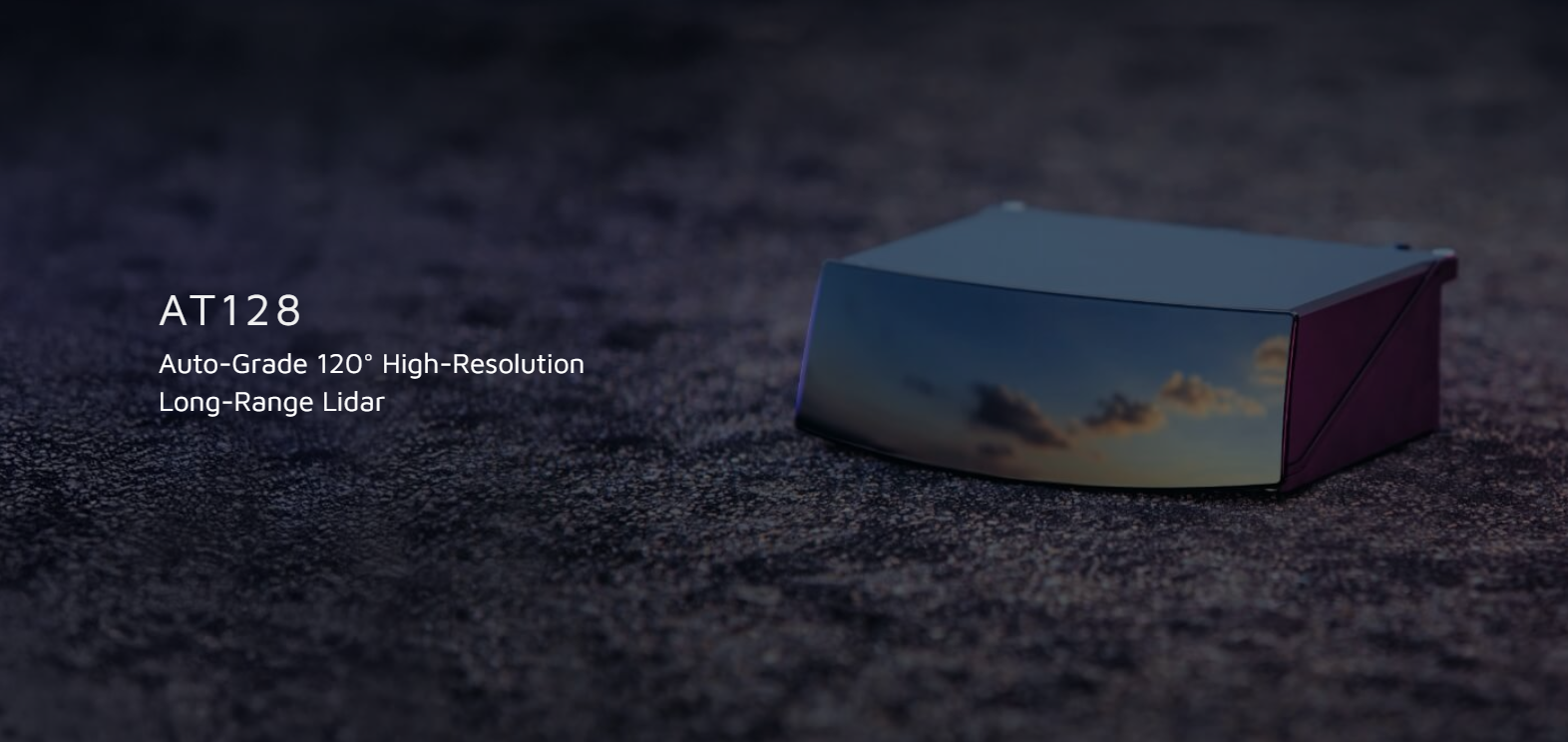
Executive Summary
The journey of LiDAR from a niche research tool to an essential component of mass-produced vehicles has been marked by a few true milestones. Few sensors have had as profound an impact on the industry as the Hesai AT128. When it was released in 2021, it was the first—and for a long time, the only—automotive-grade LiDAR on the market that could simultaneously deliver long-range detection (200m at 10% reflectivity) and an ultra-high point frequency (1.53 million points per second) . It didn’t just set a new benchmark; it redefined the standard for what an ADAS front-facing main LiDAR could achieve.
The AT128 is a 120° ultra-high resolution long-range hybrid solid-state LiDAR built on Hesai’s proprietary chip technology. It achieves “true 128-line” structured scanning through 128-channel electronic scanning, creating an image-like point cloud that is uniformly distributed without stitching . This structured data is inherently algorithm-friendly, significantly simplifying the development of perception software.
But the AT128’s legacy is not defined by its specifications alone. It is defined by its unparalleled commercial success and its role in bridging the gap between ADAS and L4 autonomy. The AT128 has secured design wins totaling millions of units and has been deployed in popular production vehicles from leading OEMs like Li Auto and Xiaomi . Perhaps most impressively, it has become the “primary LiDAR of choice” for the world’s most advanced L4 Robotaxi developers. Today, four AT128 sensors form the core perception suite for the latest generation Robotaxis from Didi, Pony.ai, and Baidu Apollo—a testament to its performance, reliability, and scalability .
This comprehensive report provides an in-depth analysis of the Hesai AT128. We will dissect its revolutionary chip-based architecture, explore its key specifications and how they translate into real-world safety, examine its transformative role in both the ADAS and Robotaxi markets, and evaluate its value proposition for sophisticated automotive and technology clients in Russia, Europe, and North America. The AT128 is not just a sensor; it is a proven, mass-production platform that has already powered the first wave of intelligent vehicles.
1. Introduction: The Sensor That Changed the ADAS Landscape
Before the AT128, the LiDAR market was characterized by a difficult trade-off. High-performance 128-line sensors existed, but they were primarily mechanical devices designed for robotaxi prototypes—expensive, bulky, and not built for the rigors of automotive mass production. On the other hand, sensors being developed for ADAS often compromised on resolution or range to achieve a smaller form factor and lower cost.
Hesai’s philosophy with the AT128 was to reject this compromise. Leveraging years of experience from its industry-leading Pandar series (the sensor of choice for over 90% of top global autonomous driving companies ), Hesai set out to build a sensor that delivered “best-in-class” performance in every critical metric while being designed from the ground up for automotive-grade reliability and high-volume manufacturing.
The result was a sensor that, upon its release, was described as “the only one on the market that satisfies long-range (200m@10%) and ultra-high measurement frequency (1.53 million per second, single return) at the same time” . It achieved this through a deep commitment to chipization—moving from discrete components to highly integrated, custom-designed chips.
This approach proved to be the winning formula. The AT128 quickly accumulated over 1.5 million units in design wins from top global OEMs and began mass production and delivery in 2022 . Its success laid the foundation for Hesai’s “Maxwell” Intelligent Manufacturing Center, a 60,000+ square meter facility with an annual production capacity of over one million units, capable of delivering a LiDAR every 12 seconds .
2. AT128: The Technology Behind the “True 128-Line” Revolution
2.1 Chip-Based Architecture and “True 128-Line” Scanning
The most critical technological differentiator of the AT128 is its method of achieving 128-line resolution. At a time when many competitors were using 2D mechanical scanning methods to create “equivalent” resolutions by stitching together multiple scans, Hesai took a different path.
The AT128 utilizes a chipized 128-channel solid-state electronic scanning architecture . Each of the 128 lines has its own dedicated laser driver and receiver channel, integrated into custom high-power multi-junction VCSEL (Vertical-Cavity Surface-Emitting Laser) arrays .
Why this matters:
- No Stitching Artifacts: Because all 128 lines are fired and received electronically in a single flash, the resulting point cloud is perfectly structured and uniformly distributed across the entire 120° horizontal and 25.4° vertical field of view . There are no “gaps” or misalignments that require complex post-processing to correct.
- Algorithm-Friendly Data: This structured data is often described as “image-like” . For perception engineers, this is a massive advantage. Instead of writing custom filters to handle irregular point patterns, they can apply more standard computer vision techniques, accelerating development and improving the reliability of the perception stack.
- Enhanced Reliability: By eliminating complex 2D mechanical scanning mechanisms, the AT128’s core scanning is more robust and has a longer operational life, which is critical for automotive applications.
2.2 Detailed Technical Specifications
The following specifications are compiled from Hesai’s official user manual and product announcements .
2.3 The Power of Point Frequency: 1.53 Million Points Per Second
Hesai has consistently emphasized that point frequency is the single most important metric for gauging a LiDAR’s true resolution and imaging capability . It is the 3D equivalent of a camera’s total pixel count.
The AT128’s point frequency of 1.53 million points per second (single echo) provides the raw data necessary for:
- Detecting Small Objects at Distance: The dense point cloud means that even a small object like a tire or a piece of debris at 150 meters will be hit by multiple laser points, making it detectable and classifiable .
- Single-Frame Classification: With this density, an object’s shape (e.g., distinguishing a car from a motorcycle) can often be determined from a single frame, reducing perception latency and giving the vehicle’s control systems more time to react.
2.4 200-Meter Range @10% Reflectivity: The Safety Threshold for L3
The ability to detect a dark, low-reflectivity object at 200 meters is widely considered the baseline requirement for safe L3 highway autonomy . The AT128 meets and exceeds this standard.
For a vehicle traveling at 130 km/h, a 200-meter detection range provides approximately 5.5 seconds of reaction time. This allows the system to:
- Detect the obstacle.
- Classify it (e.g., a stationary car vs. a large pothole).
- Plan a safe trajectory (e.g., gentle braking or a lane change).
- Execute the maneuver smoothly and comfortably.
Furthermore, the AT128 boasts an effective ground detection range of up to 70 meters, ensuring that the system can see the road surface and small obstacles directly in front of the vehicle .
2.5 Automotive-Grade Reliability and Functional Safety
Designed for mass production, the AT128’s journey to “automotive-grade” status was rigorous and comprehensive.
- Component-Level Qualification: All key components meet the stringent AEC-Q100/200 series standards for automotive electronics .
- System-Level Validation: The sensor underwent over 50 Design Validation (DV) tests according to international OEM standards, covering electrical, mechanical, environmental (temperature, humidity), sealing, material, and EMC (electromagnetic compatibility) aspects .
- Functional Safety: The AT128 was developed with a comprehensive functional safety concept. It includes detailed FMEA/FTA (Failure Mode and Effects Analysis / Fault Tree Analysis) covering thousands of potential failure modes, with a diagnostic coverage rate exceeding 90% and fault response times of less than 100ms . It meets the requirements for systems up to ASIL-B(D) .
- Cybersecurity: In line with the ISO 21434 standard, the AT128 features a comprehensive cybersecurity framework, including data signature, encryption, and client authentication to prevent tampering and hacking .
2.6 Maxwell Center: The Engine of Mass Production
The AT128’s commercial success is inseparable from Hesai’s “Maxwell” Intelligent Manufacturing Center. This state-of-the-art facility, spanning over 60,000 square meters with an annual capacity exceeding one million units, ensures that the AT128 can be delivered at the scale demanded by the world’s largest automakers .
3. Transformative Application Scenarios
The AT128’s versatility and proven performance have made it the sensor of choice for a wide range of applications, from mass-production passenger cars to the most advanced Robotaxis.
3.1 L2+ and L3 ADAS for Mass-Production Passenger Vehicles
The AT128 was purpose-built for this market. Its specifications align perfectly with the requirements of highway assist and urban pilot systems.
- Market Validation: The AT128 has powered the full-scenario intelligent driving systems of popular models from leading OEMs, including Li Auto and Xiaomi EV .
- Highway Pilot: The 200m range and 120° FOV provide the confidence for safe lane changes, adaptive cruise control, and emergency braking at high speeds.
- Traffic Jam Assist: In low-speed, stop-and-go traffic, the dense point cloud reliably distinguishes between stationary vehicles and other obstacles, ensuring a smooth and safe ride.
3.2 L4 Robotaxi Fleets: The Industry Standard
Perhaps the most remarkable achievement of the AT128 is its widespread adoption in the L4 Robotaxi industry. It has become the “primary lidar solution” for multiple global leaders, demonstrating performance that transcends the ADAS market.
Didi Autonomous Driving:
In April 2025, Didi and GAC Aion unveiled their first L4 production-ready Robotaxi. The vehicle’s perception system is centered around four Hesai AT128 sensors, providing a 360° blind-spot-free view of its surroundings . This configuration, part of a 33-sensor heterogeneous fusion architecture, ensures the vehicle can navigate complex urban environments safely.
Pony.ai:
At the 2025 Shanghai Auto Show, Pony.ai unveiled its seventh-generation L4 autonomous driving platform. For this platform, four AT128 sensors were selected as the primary LiDAR for all three of its new mass-production Robotaxi models . This system, now undergoing road testing, is a 100% automotive-grade solution with a 70% reduction in BOM costs, proving that the AT128 is key to scalable and commercially viable autonomy.
Baidu Apollo:
Baidu Apollo’s sixth-generation Robotaxi, the Yichi 06, also relies on four AT128 units as its primary LiDAR . This marked a significant breakthrough as the first large-scale deployment of an ADAS-use semi-solid-state LiDAR in Robotaxis, bridging the gap between the two markets.
The fact that Didi, Pony.ai, and Baidu—three of the world’s leading autonomous driving companies—all arrived at the same conclusion (four AT128s for 360° coverage) is the ultimate validation of the sensor’s capabilities .
3.3 Other Applications: Robotics and Beyond
The AT128’s robust design and high-performance data also make it suitable for a range of other applications, including heavy-duty robotics, port automation, and smart infrastructure, where reliable, long-range 3D perception is required .
4. Value Proposition and Cost-Effectiveness
For sophisticated international clients, the AT128’s value is undeniable and multifaceted.
4.1 Unmatched Commercial Validation and Track Record
The strongest argument for the AT128 is its track record. With millions of units in design wins, mass production since 2022, and deployment in tens of thousands of vehicles globally, it is not a theoretical product. It is a proven, mature platform. The fact that it was chosen by three of the top L4 companies as the core of their next-generation Robotaxis speaks volumes about its reliability and performance .
4.2 “True 128-Line” Data Reduces Development Complexity
The structured, “image-like” point cloud from the AT128’s true 128-line scanning is inherently more algorithm-friendly than data from sensors that use stitching or scanning tricks . For a development team, this translates directly to:
- Lower Engineering Costs: Less time spent on low-level data filtering and processing.
- Faster Development Cycles: Perception algorithms can be developed and validated more quickly.
- More Robust Performance: The consistent data quality leads to more reliable object detection and classification.
4.3 Proven Scalability and Supply Chain Security
With the “Maxwell” Intelligent Manufacturing Center, Hesai has demonstrated its ability to scale production to meet the massive demands of the automotive industry . For any client planning for high-volume production, Hesai’s manufacturing capacity provides a secure and reliable supply chain.
4.4 Bridging ADAS and L4 Autonomy
The AT128 is unique in that it has proven itself in both the cost-sensitive, high-volume ADAS market and the performance-driven, safety-critical L4 Robotaxi market . This dual validation provides a level of confidence that few other sensors can match. It proves that the sensor is both affordable enough for mass production and performant enough for the most demanding autonomous applications.
4.5 Built on a Foundation of Safety and Security
The AT128’s development, with its rigorous DV testing, functional safety analysis (ASIL-B(D)), and cybersecurity features (ISO 21434), provides peace of mind for integrators . It is a sensor designed for the real world, where failure is not an option.
5. Conclusion: The Proven Foundation of the Autonomous Revolution
The Hesai AT128 is more than a component; it is a landmark achievement in the history of autonomous vehicle technology. It was the first sensor to prove that a single device could simultaneously deliver the long range, high resolution, and automotive-grade reliability required for mass-production ADAS. Its subsequent adoption as the core sensor for the world’s leading L4 Robotaxi programs has cemented its legacy as a truly foundational technology.
For clients in Russia, Europe, and North America, the AT128 offers a unique value proposition that combines:
- Best-in-Class Performance: 200m @10% range and 1.53 million points per second.
- Unmatched Track Record: Millions of units in design wins, mass production since 2022.
- Proven Reliability: Automotive-grade certification, rigorous testing, and a secure supply chain.
- Market Leadership: Trusted by Li Auto, Xiaomi, and the world’s top L4 companies (Didi, Pony.ai, Baidu).
The AT128 is not a future promise; it is a present reality. It has already powered the first wave of intelligent vehicles and will continue to be a cornerstone of autonomous mobility for years to come. For any organization serious about deploying safe, scalable, and reliable autonomous systems, the Hesai AT128 is the proven choice.









