
Introduction: The Growing Challenges of Industrial Inspection
Across industries such as energy, manufacturing, logistics, mining, and critical infrastructure, inspection and monitoring remain among the most labor-intensive and costly operational tasks.
Traditional inspection methods often involve:
- Manual patrols by technicians
- Exposure to hazardous environments
- High labor costs
- Inconsistent inspection quality
- Limited real-time visibility
- Delayed fault detection
As facilities become larger and more complex, companies are seeking autonomous technologies capable of improving safety, reducing operational costs, and delivering continuous monitoring.
This demand has accelerated the adoption of Industrial Robotic Dogs.
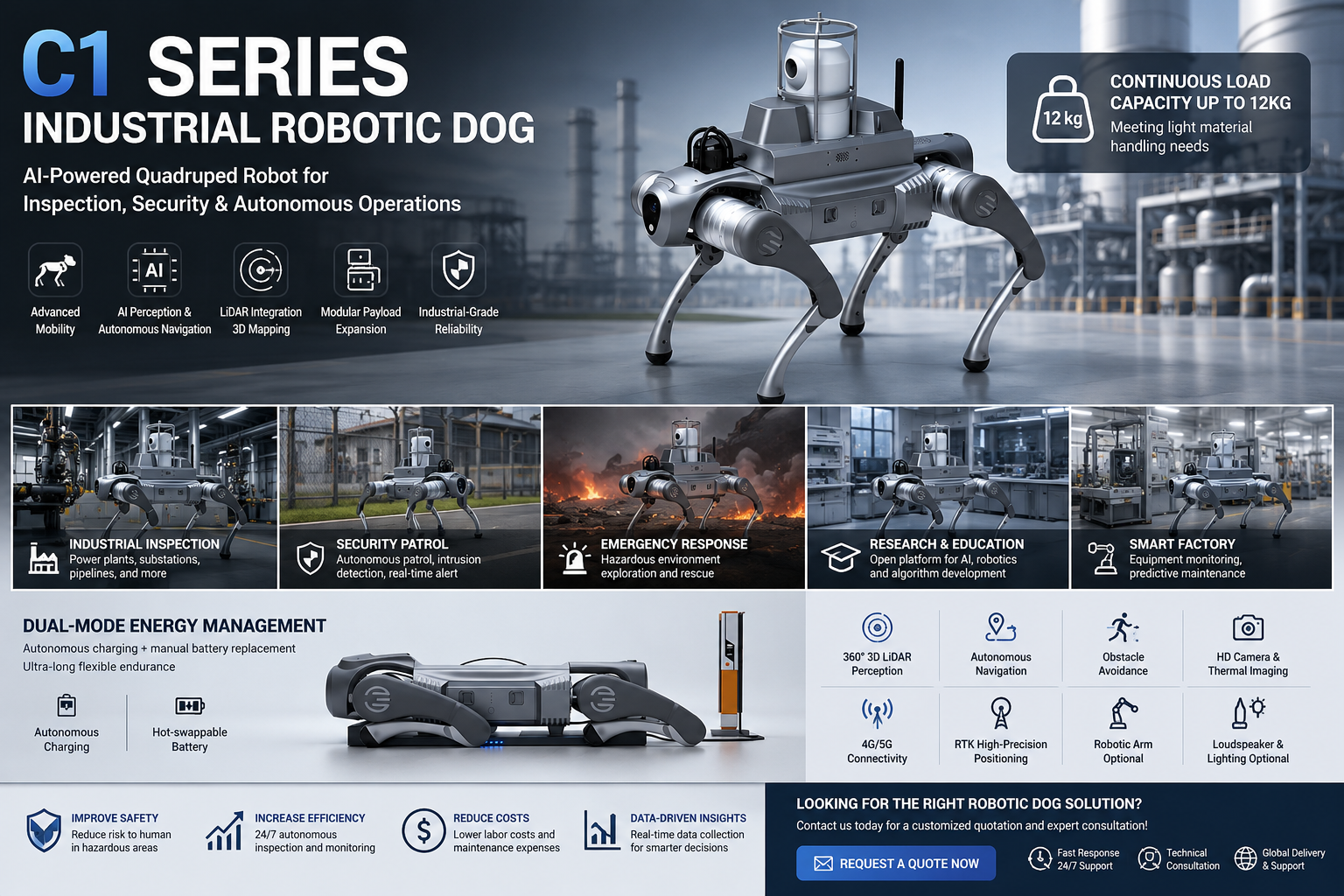
The C1 Series Industrial Robotic Dog combines advanced quadruped mobility, AI-powered perception, LiDAR navigation, and autonomous operation into a powerful robotic platform designed for modern industrial environments.
The Problem: Why Traditional Inspection Methods Are No Longer Enough
Many industrial facilities still rely on manual inspections performed by operators carrying cameras, thermal devices, or inspection tools.
While effective in the past, these methods present several challenges.
Safety Risks
Personnel often need to access:
- High-voltage substations
- Power generation facilities
- Chemical plants
- Oil and gas installations
- Mining sites
- Construction zones
These environments can expose workers to significant risks.
Rising Labor Costs
Routine inspections require dedicated teams and recurring labor expenses.
For facilities operating 24/7, inspection costs can become substantial.
Limited Inspection Frequency
Most manual inspections are conducted only once or twice daily.
Critical equipment issues may develop between inspection cycles.
Data Collection Limitations
Human inspections often rely on visual observations that may vary between operators.
This makes long-term trend analysis difficult.
The Solution: C1 Series Industrial Robotic Dog
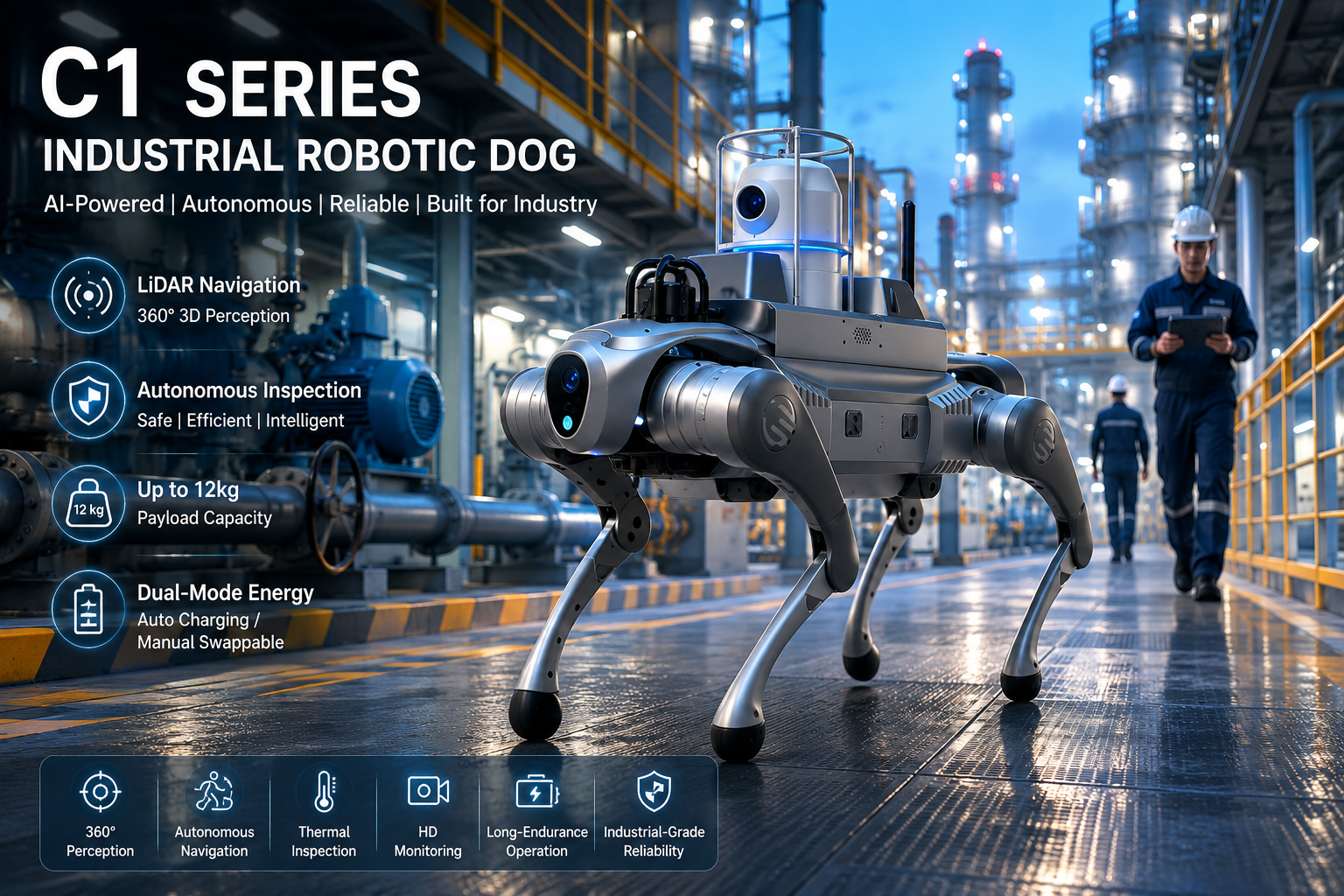
The C1 Series was developed to solve these challenges through autonomous mobility and intelligent sensing technologies.
Unlike traditional wheeled robots, the C1 Series uses a quadruped design that enables it to move naturally through complex industrial environments.
Key capabilities include:
- Autonomous patrol missions
- AI-powered obstacle avoidance
- LiDAR-based navigation
- Real-time video transmission
- Thermal inspection support
- Remote operation
- Automatic charging capability
- Continuous payload capacity up to 12kg
The result is a highly flexible inspection platform capable of operating where conventional robots struggle.
Built for Real Industrial Environments
The C1 Series is engineered specifically for industrial deployment.
Continuous Load Capacity up to 12kg
Many robotic platforms have limited payload capacity.
The C1 Series supports continuous payloads up to 12kg, enabling integration of:
- LiDAR sensors
- Thermal imaging cameras
- Gas detectors
- Industrial cameras
- Communication equipment
- Robotic manipulators
This flexibility allows organizations to customize the robot according to specific operational requirements.
Dual-Mode Energy Management
The robot supports:
Autonomous Charging
The robot automatically returns to its charging station when battery levels are low.
Manual Battery Replacement
For continuous operations, batteries can be swapped quickly to minimize downtime.
This dual-mode design enables ultra-long endurance and round-the-clock deployment.
Industry Applications
Power Plant Inspection
Power plants require routine inspection of:
- Turbines
- Transformers
- Boilers
- Electrical systems
- Cooling infrastructure
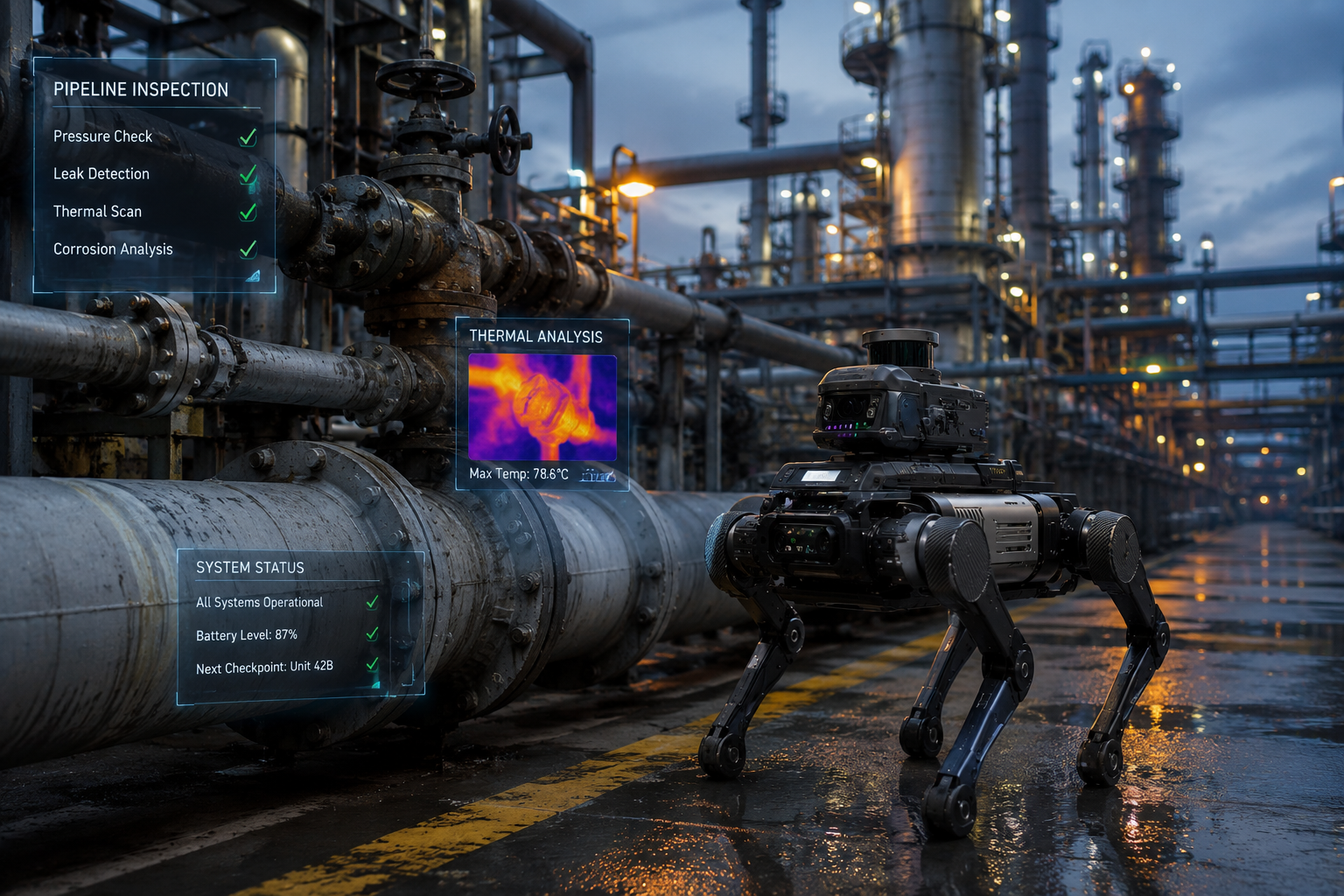
The C1 Series can autonomously patrol designated routes while collecting visual, thermal, and operational data.
Benefits include:
- Reduced inspection time
- Improved worker safety
- Earlier fault detection
Electrical Substation Monitoring
Substations often span large areas and contain hazardous equipment.
The robot can monitor:
- Equipment temperature
- Physical damage
- Security breaches
- Environmental conditions
This enables predictive maintenance and improves grid reliability.
Oil & Gas Facilities
Oil and gas environments present unique challenges.
The C1 Series can inspect:
- Pipelines
- Refineries
- Storage facilities
- Offshore platforms
By reducing human exposure to hazardous areas, organizations improve safety while maintaining inspection quality.
Security Patrol and Surveillance
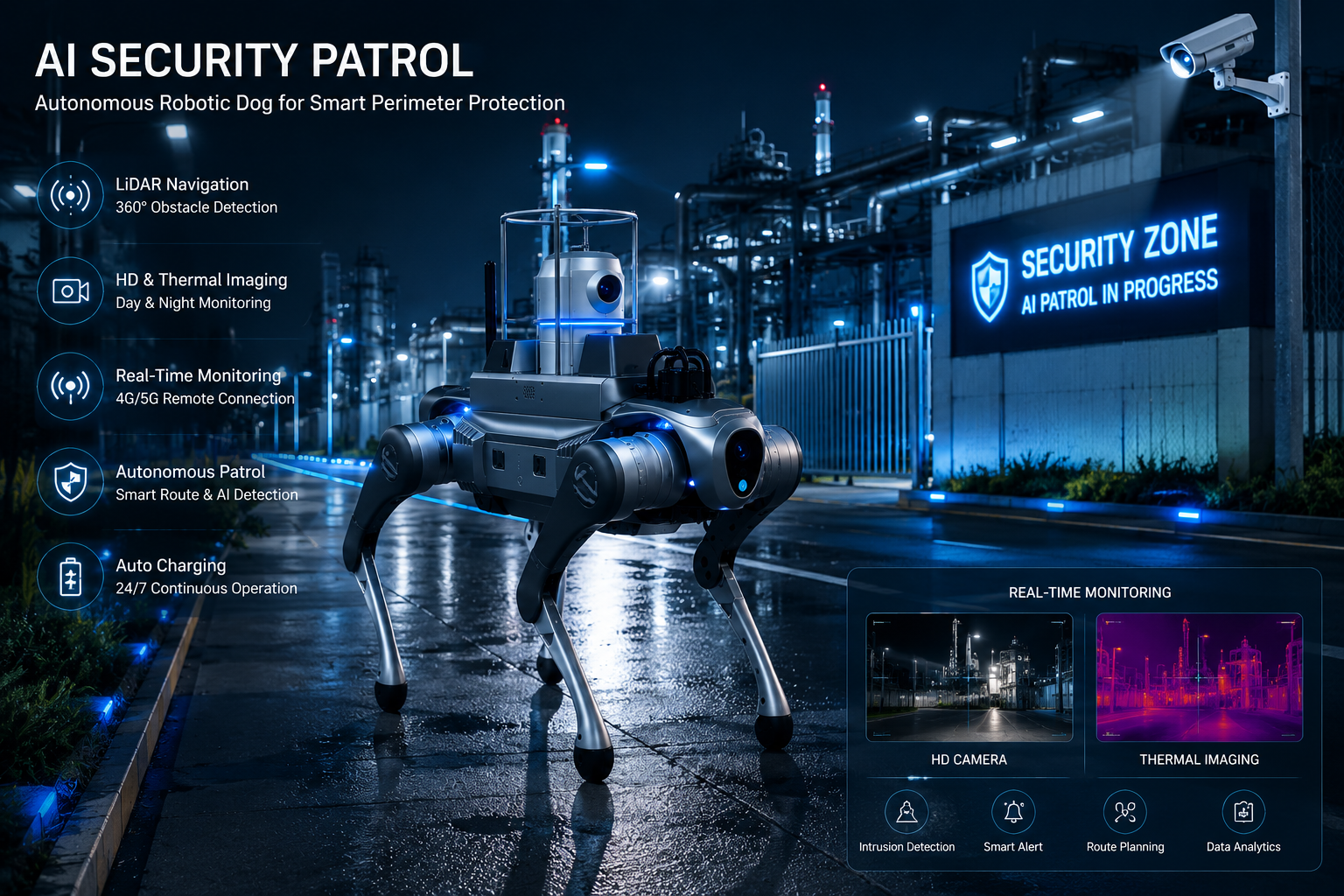
Security is one of the fastest-growing applications for robotic dogs.
The C1 Series can perform:
- Autonomous perimeter patrols
- Intrusion detection
- Remote surveillance
- Real-time alert generation
Applications include:
- Warehouses
- Data centers
- Industrial parks
- Logistics facilities
- Utility infrastructure
Smart Manufacturing
Manufacturers increasingly require continuous visibility into equipment health and production efficiency.
The C1 Series supports:
- Production line monitoring
- Equipment inspection
- Thermal anomaly detection
- Facility patrol automation
This helps reduce downtime and improve operational efficiency.
Key Technical Advantages
Advanced Quadruped Mobility
Unlike wheeled robots, the C1 Series can:
- Climb stairs
- Cross obstacles
- Navigate rough terrain
- Maintain stability on uneven surfaces
This significantly expands operational coverage.
LiDAR-Based Autonomous Navigation
High-precision LiDAR systems provide:
- Real-time 3D mapping
- Environmental perception
- Obstacle detection
- Accurate positioning
The robot can navigate safely in dynamic environments with minimal human intervention.
AI-Powered Perception
Integrated AI algorithms enable:
- Object recognition
- Environmental analysis
- Autonomous decision-making
- Mission optimization
Modular Payload Integration
Organizations can equip the robot with:
- LiDAR
- Thermal cameras
- RTK systems
- Robotic arms
- Gas sensors
- 4G/5G communication modules
This modular architecture ensures long-term scalability.
ROI: How Robotic Dogs Deliver Measurable Business Value
Industrial robotic dogs are not simply technology demonstrations.
They generate measurable operational improvements.
Reduced Labor Costs
Routine patrols can be automated, reducing manpower requirements.
Increased Inspection Frequency
Autonomous robots can conduct inspections multiple times per day.
Improved Equipment Reliability
Frequent inspections enable earlier fault detection.
Reduced Downtime
Predictive maintenance minimizes unexpected equipment failures.
Enhanced Safety
Personnel exposure to hazardous environments is significantly reduced.
For many facilities, robotic dog deployments can achieve a positive return on investment within the first few years.
Case Study: Improving Inspection Efficiency at an Industrial Facility
A large industrial facility previously relied on three technicians to perform daily inspections.
Before Deployment
- Inspection time: 4 hours
- Personnel required: 3 technicians
- Inspection frequency: Twice daily
After Deploying the C1 Series
- Inspection time reduced by over 70%
- Continuous autonomous patrols
- Real-time anomaly reporting
- Reduced manpower requirements
Results
- Faster inspections
- Improved data consistency
- Reduced operational costs
- Enhanced workplace safety
Frequently Asked Questions
What is an industrial robotic dog?
An industrial robotic dog is a four-legged autonomous robot designed for inspection, monitoring, security patrol, mapping, and data collection in complex environments.
Why is a quadruped robot better than a wheeled robot?
Quadruped robots can climb stairs, navigate rough terrain, and overcome obstacles that would prevent wheeled robots from operating effectively.
Can the C1 Series operate autonomously?
Yes. The robot supports autonomous navigation using LiDAR, AI perception, route planning, and obstacle avoidance technologies.
Does the robot support LiDAR integration?
Yes. The C1 Series supports integration with advanced LiDAR sensors for mapping, localization, and autonomous navigation.
What industries can benefit from robotic dogs?
Industries including energy, utilities, manufacturing, logistics, mining, oil and gas, research, and security can benefit from robotic dog deployment.
Request a Quote Today
Every facility has unique inspection and monitoring requirements.
Whether you are evaluating robotic automation for industrial inspection, security patrol, predictive maintenance, or research applications, our engineering team can help identify the optimal solution.
Contact us today for:
✓ Product specifications
✓ Demonstration videos
✓ Technical consultation
✓ Integration support
✓ OEM & ODM projects
✓ Distributor opportunities
✓ Bulk purchase quotations
Transform your inspection and security operations with the C1 Series Industrial Robotic Dog — a next-generation autonomous platform designed for the future of industrial automation.









