
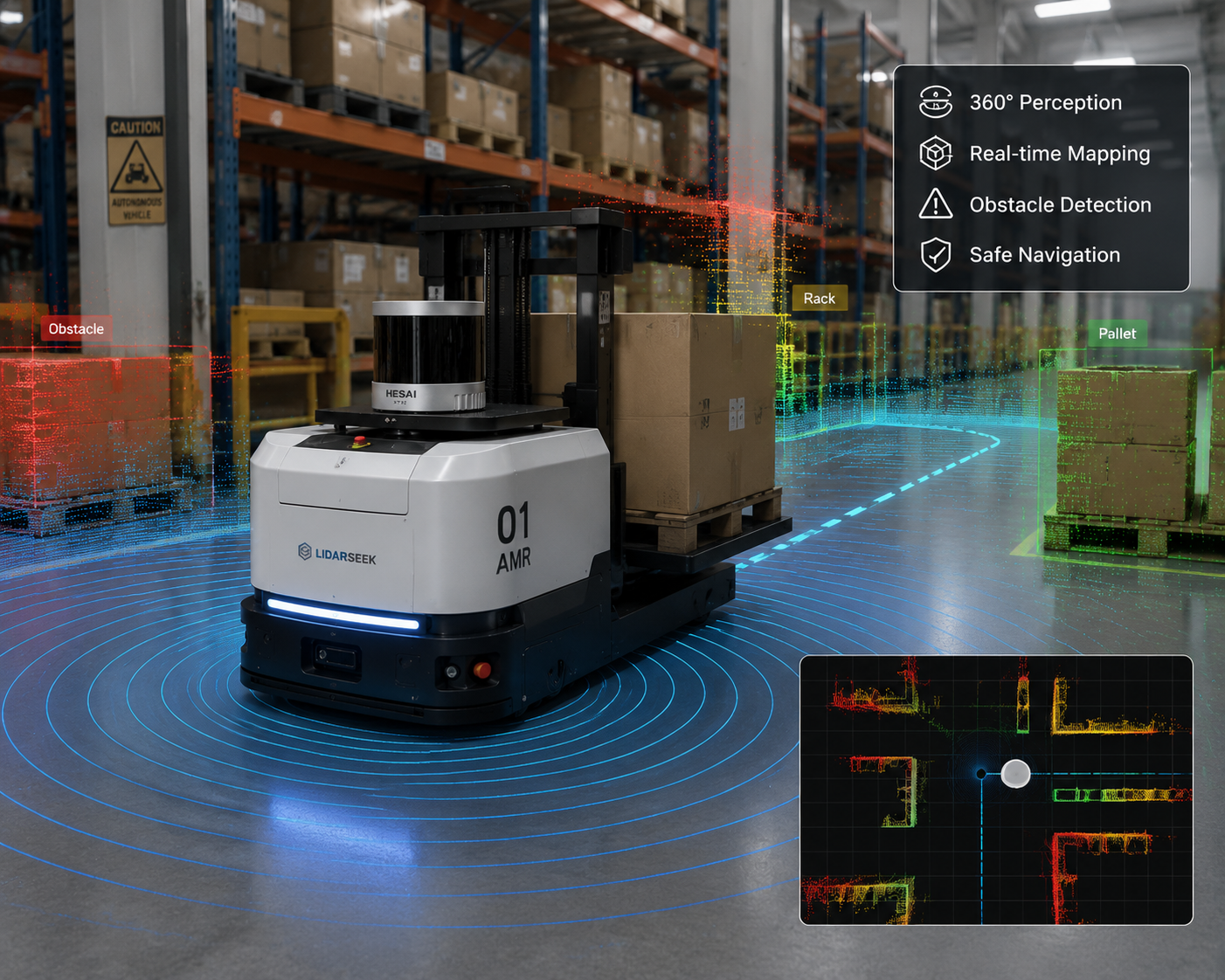
Complete Guide for Robotics, Mapping, Industrial Automation and Autonomous Systems
Introduction: Why Hesai XT32 Remains a Popular 3D LiDAR Sensor in 2026
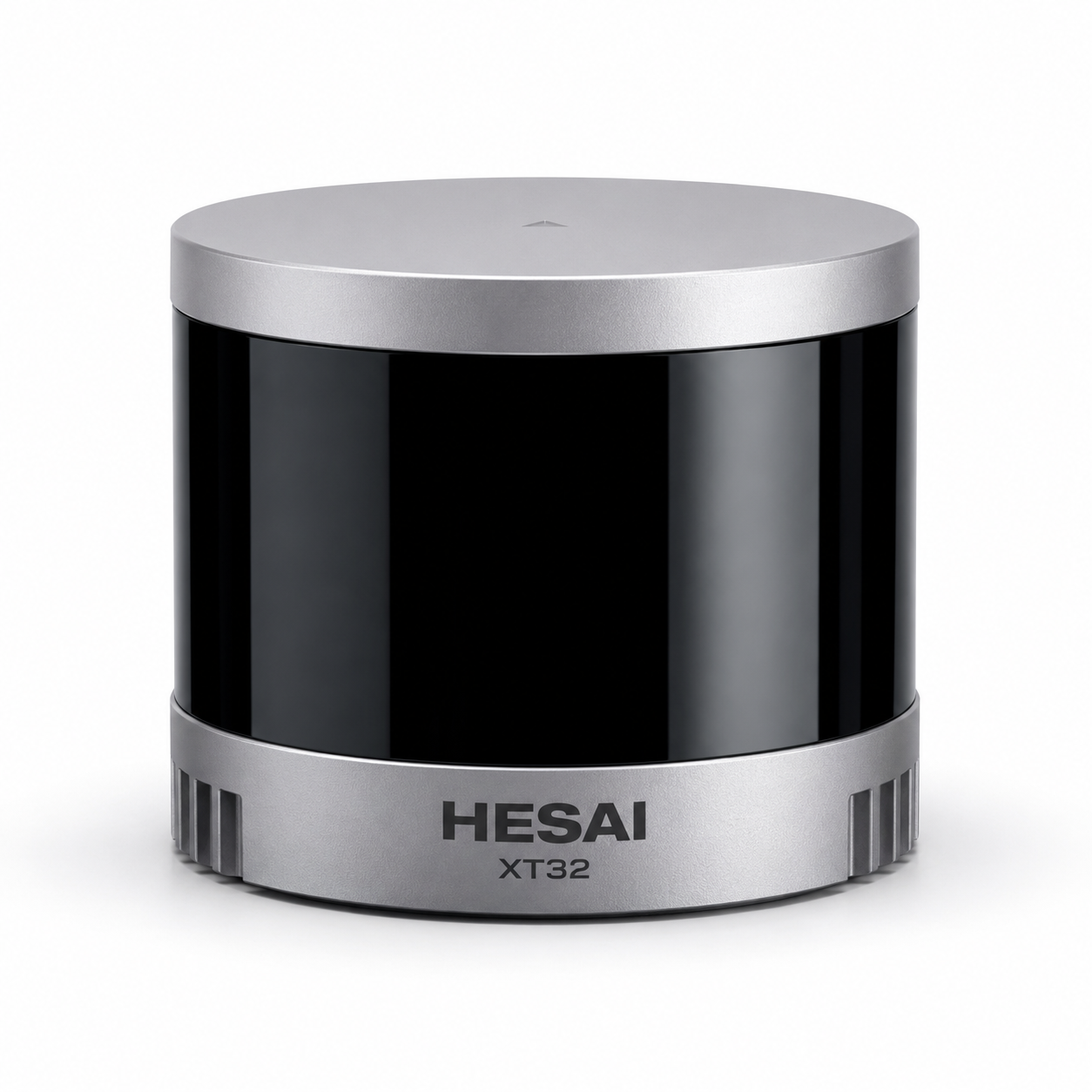
As autonomous technologies continue to expand, high-performance 3D perception has become a critical requirement for robotics, industrial automation, mapping, and autonomous vehicle development.
LiDAR sensors provide accurate distance measurement and detailed 3D environmental information, allowing machines to understand surrounding objects, detect obstacles, and navigate safely in complex environments.
- 32-channel laser scanning
- 360-degree environmental perception
- high-density point cloud generation
- long-range detection capability
- reliable performance for outdoor and industrial environments
1. What is Hesai XT32 LiDAR
It belongs to Hesai’s XT series LiDAR product family and is widely used in:
- Autonomous Mobile Robots (AMR)
- Automated Guided Vehicles (AGV)
- Mobile mapping systems
- Industrial automation
- Robotics research
- Autonomous driving development
Unlike traditional 2D LiDAR sensors that only measure distance on a single horizontal plane, 3D LiDAR sensors such as Hesai XT32 capture spatial information in three dimensions.
This allows robots and autonomous systems to identify:
- surrounding objects
- obstacles
- environmental structures
- moving targets
- navigation paths
By generating dense point cloud data, XT32 helps machines achieve more accurate localization, mapping, and obstacle avoidance.
2. Hesai XT32 Technical Specifications
The performance of a LiDAR sensor directly affects the perception ability of an autonomous system.
The main specifications of Hesai XT32 include:
| Specification | Hesai XT32 |
|---|---|
| LiDAR Type | 3D Mechanical LiDAR |
| Laser Channels | 32 Channels |
| Horizontal Field of View | 360° |
| Vertical Field of View | Approximately 31° |
| Detection Range | Up to 120 m |
| Point Rate | Up to 640,000 points/s |
| Measurement Accuracy | Approximately ±1 cm |
| Data Output | Point Cloud Data |
| Application | Robotics, Mapping, Automation, Autonomous Systems |
The 32-channel architecture provides significantly higher vertical resolution compared with lower-channel LiDAR sensors.
This makes Hesai XT32 suitable for applications that require:
- precise object recognition
- stable navigation
- detailed environmental modeling
- high-quality 3D perception
3. Key Features of Hesai XT32 LiDAR
3.1 High-Density 3D Point Cloud Generation
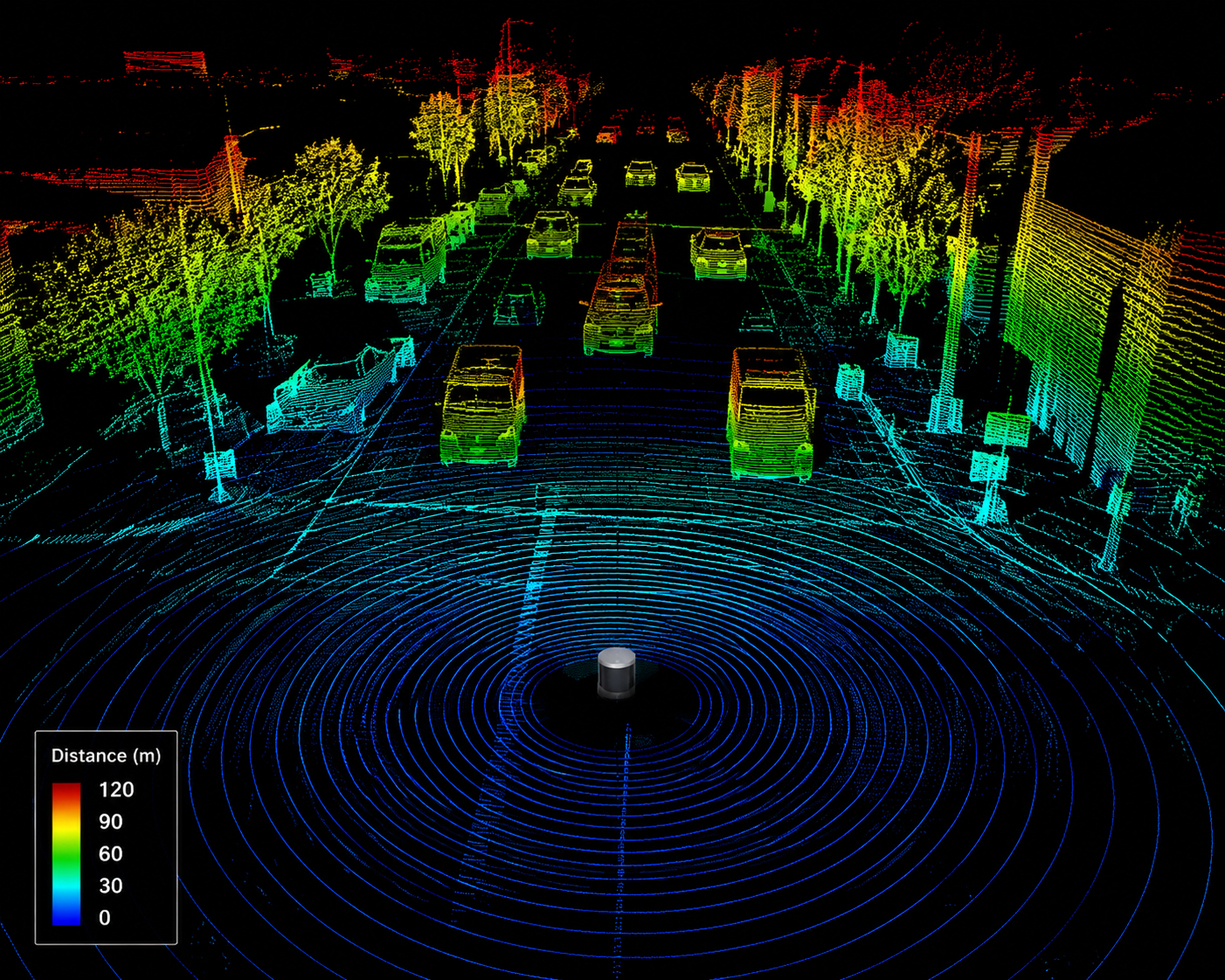
One of the biggest advantages of Hesai XT32 is its ability to generate dense point cloud data.
For autonomous robots and mapping systems, point cloud density directly influences perception accuracy.
Higher-density point clouds help systems:
- recognize objects more clearly
- improve SLAM accuracy
- detect obstacles earlier
- create detailed maps
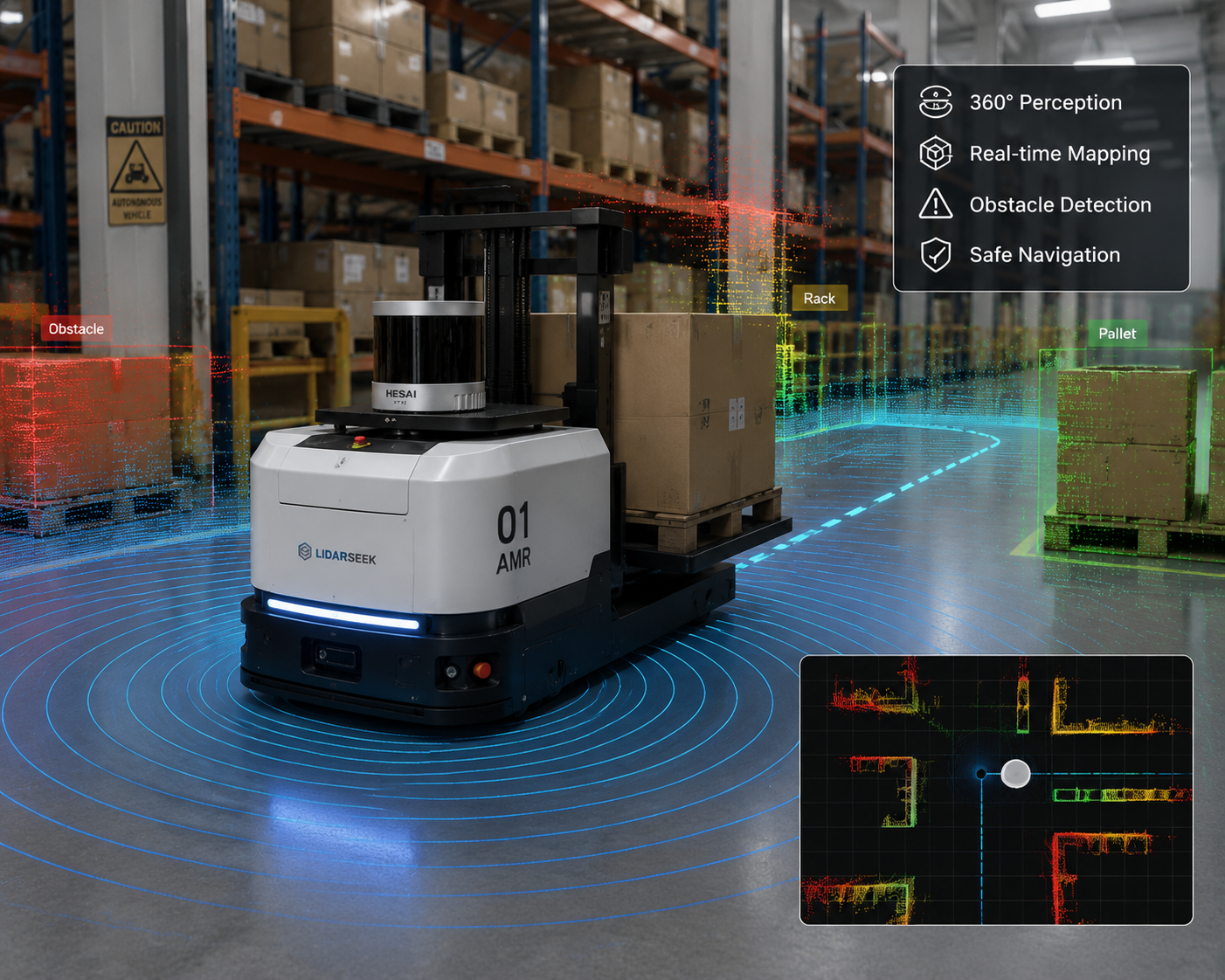
For example, warehouse robots operating in dynamic environments need accurate perception to avoid collisions with:
- workers
- shelves
- pallets
- moving equipment
Hesai XT32 provides the detailed environmental information required for reliable robot navigation.
3.2 360-Degree Environmental Awareness
Hesai XT32 provides a full 360-degree horizontal scanning capability.
This allows autonomous systems to continuously monitor their surroundings without requiring multiple LiDAR sensors.
Typical applications include:
- robot navigation
- autonomous inspection
- industrial vehicles
- outdoor mobile robots
A complete view of the environment helps reduce blind spots and improves operational safety.
3.3 Long-Range Detection Capability
For outdoor robotics and autonomous platforms, detection range is an important factor.
Hesai XT32 supports long-range perception, enabling systems to detect objects at greater distances and make decisions earlier.
This is especially valuable for:
- autonomous vehicles
- outdoor robots
- mapping platforms
- large industrial sites
3.4 Reliable Performance for Industrial Applications
Industrial environments require sensors that can operate continuously under demanding conditions.
Hesai XT32 is designed for professional applications where reliability, accuracy, and stable data output are important.
It can support:
- factory automation
- logistics systems
- autonomous transportation
- research platforms
4. Hesai XT32 LiDAR Applications
Hesai XT32 is used across multiple industries where accurate 3D perception is required.
4.1 Autonomous Mobile Robots (AMR)
The demand for Autonomous Mobile Robots has increased rapidly due to smart warehouses and intelligent logistics.
AMR systems require LiDAR sensors for:
- navigation
- localization
- obstacle detection
- path planning
Hesai XT32 provides the 3D perception capability required for advanced mobile robots operating in complex environments.
Typical AMR applications include:
- warehouse robots
- logistics robots
- factory transportation robots
- autonomous delivery robots
For companies developing AMR solutions, choosing the right robot LiDAR sensor is critical for achieving stable navigation performance.
4.2 Mobile Mapping and 3D Surveying Applications
Another important application area for Hesai XT32 is mobile mapping.
Modern mapping systems require accurate 3D environmental data to create detailed digital models of real-world spaces.
Hesai XT32 can support mapping applications such as:
- indoor mapping
- outdoor surveying
- infrastructure inspection
- 3D modeling
- autonomous mapping platforms
Compared with traditional measurement methods, LiDAR-based mapping provides faster data collection and high-resolution spatial information.
For companies developing mobile mapping solutions, selecting a reliable 3D LiDAR sensor is essential to achieve accurate point cloud generation and efficient data processing.
4.3 Industrial Automation and Smart Manufacturing
Industry 4.0 has accelerated the adoption of intelligent robots and autonomous systems in manufacturing environments.
Factories increasingly use LiDAR sensors for:
- robot navigation
- safety monitoring
- autonomous transportation
- machine vision enhancement
Hesai XT32 can be integrated into industrial robotic platforms to provide real-time environmental perception.
Typical applications include:
- autonomous forklifts
- factory logistics robots
- inspection robots
- industrial vehicles
By combining LiDAR perception with AI algorithms, industrial systems can improve efficiency, reduce operational risks, and optimize workflows.
4.4 Autonomous Driving Development and Research
Although automotive LiDAR solutions continue to evolve toward automotive-grade solid-state designs, rotating LiDAR sensors remain widely used in autonomous driving research and development.
Hesai XT32 is suitable for:
- autonomous vehicle prototypes
- university research projects
- ADAS development platforms
- autonomous driving testing
Researchers and engineers often select XT32 because it provides high-quality point cloud data for:
- object detection
- localization
- environment reconstruction
- autonomous navigation algorithms
5. Hesai XT32 vs XT16: Which LiDAR Should You Choose?
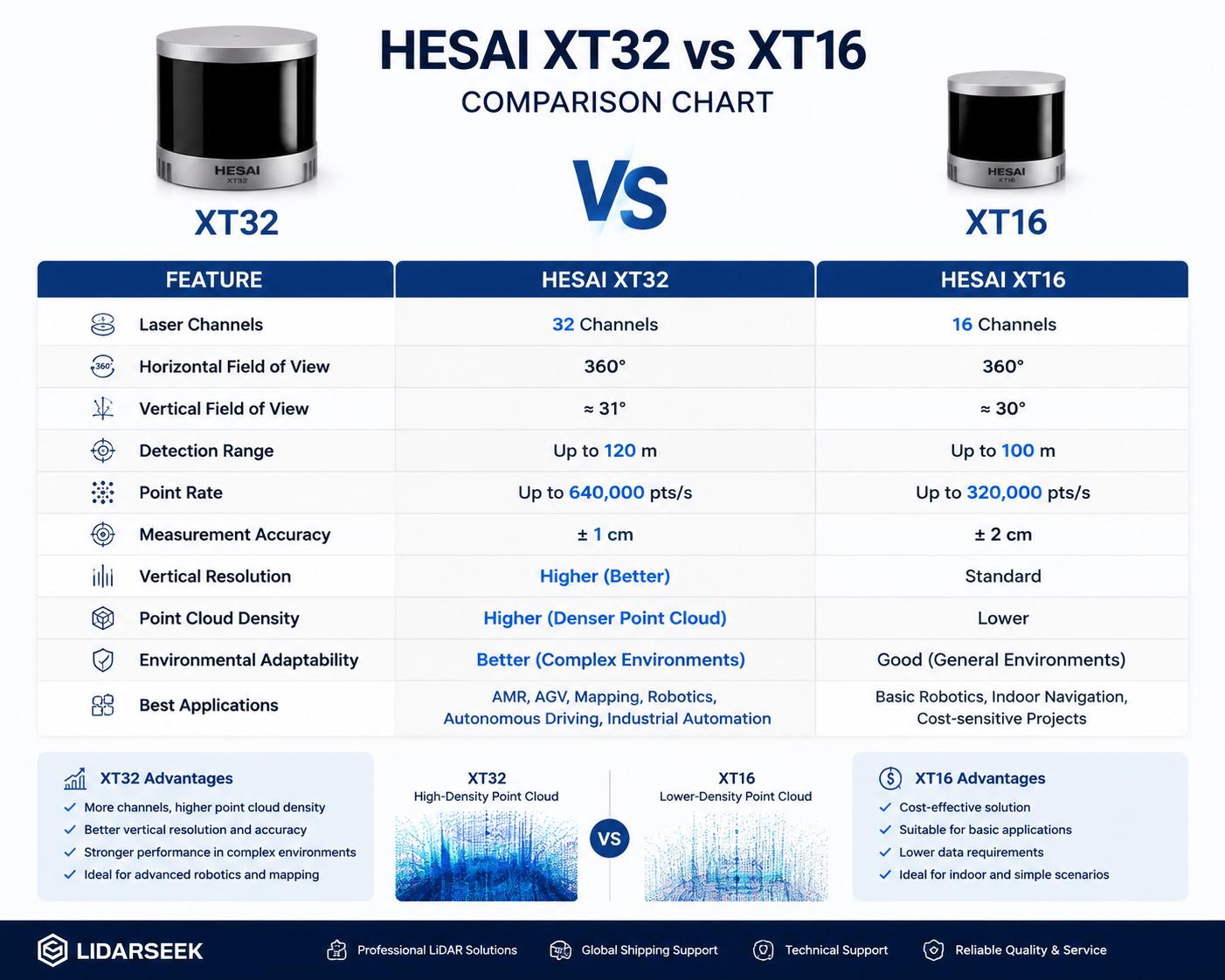
When selecting a LiDAR sensor, engineers often compare Hesai XT32 with Hesai XT16.
Both sensors belong to the Hesai XT product family, but they target different application requirements.
Hesai XT32 vs XT16 Comparison
| Feature | Hesai XT32 | Hesai XT16 |
|---|---|---|
| Laser Channels | 32 | 16 |
| Point Cloud Density | Higher | Lower |
| Vertical Resolution | Better | Standard |
| Detection Capability | Advanced perception | Basic perception |
| Cost Level | Higher | Lower |
| Best Applications | AMR, mapping, robotics, autonomous systems | Basic robotics and cost-sensitive projects |
When Should You Choose Hesai XT32?
Hesai XT32 is recommended when your project requires:
- higher point cloud density
- improved object recognition
- better environmental understanding
- more accurate mapping
- advanced robot navigation
Examples:
- industrial AMR fleets
- autonomous vehicles
- mobile mapping systems
- research platforms
When Is Hesai XT16 a Better Choice?
Hesai XT16 may be suitable for applications where:
- budget is limited
- basic obstacle detection is enough
- lower data requirements are acceptable
Examples:
- simple autonomous robots
- indoor navigation systems
- entry-level robotics projects
The right choice depends on your application requirements, environment, and performance expectations.
6. How Much Does Hesai XT32 LiDAR Cost?
One of the most common questions from buyers is:
“How much does Hesai XT32 LiDAR cost?”
The final price of Hesai XT32 depends on several factors.
There is no universal price because LiDAR projects often involve different requirements, quantities, shipping methods, and technical support needs.
Factors Affecting Hesai XT32 Price
6.1 Order Quantity
The quantity required for your project can influence commercial pricing.
Typical buyers include:
- research laboratories
- robotics companies
- system integrators
- industrial automation companies
Bulk orders may have different pricing structures compared with single-unit evaluation purchases.
6.2 Product Availability and Lead Time
Availability is another important consideration.
Engineering teams often need LiDAR sensors quickly for:
- prototype development
- testing
- demonstrations
- customer projects
Working with an experienced LiDAR supplier can help reduce procurement delays.
6.3 Shipping Method and Destination
International LiDAR purchases may involve:
- express shipping
- customs requirements
- import documentation
Shipping costs may vary depending on:
- destination country
- delivery method
- shipment size
6.4 Technical Support Requirements
Some projects require additional support, including:
- product selection assistance
- integration guidance
- application consultation
A reliable supplier can help customers select the right LiDAR configuration and avoid unnecessary development problems.
7. Who Needs Hesai XT32 LiDAR?
Hesai XT32 is commonly selected by organizations that need professional-grade 3D perception technology.
7.1 Robotics Companies
Robotics developers use XT32 for:
- autonomous navigation
- obstacle avoidance
- SLAM systems
- environmental perception
Common projects include:
- AMR robots
- AGV systems
- service robots
- inspection robots
7.2 Universities and Research Institutions
Many autonomous technology research projects require reliable LiDAR sensors for experimentation.
Applications include:
- autonomous driving research
- robotics research
- computer vision development
- sensor fusion experiments
7.3 Mapping Companies
Companies working on digital mapping and 3D reconstruction require accurate point cloud data.
XT32 can support:
- mobile mapping
- surveying
- spatial modeling
7.4 System Integrators
System integration companies often need stable LiDAR supply channels for customer projects.
A professional supplier can provide:
- product sourcing
- technical communication
- international logistics support
8. How to Buy Hesai XT32 LiDAR?
Purchasing a LiDAR sensor requires more than simply selecting a model.
A successful procurement process usually includes several steps.
Step 1: Define Your Application Requirements
Before purchasing, confirm:
- application scenario
- required detection range
- operating environment
- data requirements
- installation method
Examples:
A warehouse robot may prioritize navigation stability.
A mapping system may prioritize point cloud density.
Step 2: Select the Right LiDAR Configuration
Based on your requirements, compare:
- channel number
- range
- accuracy
- scanning performance
- compatibility
Hesai XT32 is a strong option for projects requiring high-quality 3D perception.
Step 3: Request a Professional Quotation
A professional quotation should include:
- product model
- quantity
- availability
- delivery time
- shipping terms
Working with a trusted Hesai XT32 supplier helps ensure transparent communication throughout the purchasing process.
Step 4: Arrange Shipment and Integration
After confirmation, suppliers can support:
- international shipping
- documentation
- technical communication
For global customers, choosing an experienced LiDAR distributor can simplify the entire purchasing process.
9. Why Choose Lidarseek as Your Hesai XT32 Supplier?
Selecting the right LiDAR supplier is an important step for companies developing autonomous systems, robotics platforms, and industrial automation solutions.
Lidarseek provides professional LiDAR sourcing and supply support for global customers who need reliable 3D sensing solutions.
Our advantages include:
9.1 Professional LiDAR Product Support
Lidarseek focuses on advanced LiDAR solutions for:
- robotics
- autonomous driving
- industrial automation
- mapping
- AI perception systems
We help customers identify suitable LiDAR sensors based on their technical requirements and application scenarios.
9.2 Global Shipping Support
For international customers, purchasing LiDAR sensors requires experience with:
- export documentation
- international logistics
- delivery coordination
Lidarseek supports customers worldwide with efficient LiDAR procurement and shipping solutions.
9.3 Support for Engineering Development Projects
Many customers purchase LiDAR sensors for:
- prototype development
- research projects
- product testing
- commercial deployment
Our team can assist customers with product information, availability confirmation, and technical communication during the evaluation process.
9.4 Multiple LiDAR Solutions Available
Different projects require different LiDAR performance levels.
Besides Hesai XT32, Lidarseek also provides access to various LiDAR solutions for:
- autonomous robots
- AMR systems
- ADAS development
- industrial applications
- mapping platforms
This allows customers to select the most suitable sensor according to their project requirements.
10. Frequently Asked Questions About Hesai XT32 LiDAR
Q1: What is Hesai XT32 LiDAR?
Hesai XT32 is a 32-channel 3D LiDAR sensor designed for robotics, mapping, industrial automation, and autonomous system applications.
It provides 360-degree scanning capability and generates high-density point cloud data for accurate environmental perception.
Q2: How much does Hesai XT32 LiDAR cost?
The price of Hesai XT32 depends on factors including:
- order quantity
- availability
- shipping destination
- project requirements
For current Hesai XT32 availability and quotation, contact Lidarseek for professional support.
Q3: Where can I buy Hesai XT32 LiDAR?
Hesai XT32 can be purchased through professional LiDAR suppliers and distributors.
Lidarseek provides global customers with LiDAR sourcing, quotation support, and international shipping assistance.
Q4: Is Hesai XT32 suitable for robotics applications?
Yes.
Hesai XT32 is widely used for robotics applications that require accurate 3D perception, including:
- AMR robots
- AGV systems
- autonomous navigation platforms
- industrial robots
Q5: What is the range of Hesai XT32?
Hesai XT32 supports long-range detection capability, making it suitable for both indoor and outdoor applications requiring extended perception distances.
Q6: What is the difference between Hesai XT32 and XT16?
The main difference is the number of laser channels.
XT32 provides:
- higher point cloud density
- better vertical resolution
- improved perception performance
XT16 is more suitable for applications with lower perception requirements or cost-sensitive designs.
Q7: Can Hesai XT32 be used for SLAM?
Yes.
Hesai XT32 provides high-quality point cloud data that can support SLAM applications, including:
- mapping
- localization
- autonomous navigation
Q8: Is Hesai XT32 compatible with robotics development platforms?
Hesai XT32 can be integrated into many robotics platforms through standard communication interfaces and point cloud processing frameworks.
Engineers commonly combine LiDAR sensors with:
- ROS/ROS2 systems
- NVIDIA Jetson platforms
- AI perception software
Q9: How long does Hesai XT32 delivery take?
Delivery time depends on:
- product availability
- destination country
- shipping method
Contact Lidarseek to confirm current stock status and estimated delivery time.
Q10: Can Lidarseek provide Hesai XT32 OEM support?
Yes.
Lidarseek can support customers with:
- LiDAR sourcing
- project communication
- technical information
- international delivery coordination
Conclusion: Choose the Right Hesai XT32 LiDAR Solution for Your Project
As robotics, automation, and autonomous technologies continue to develop, reliable 3D perception has become a fundamental requirement.
Hesai XT32 provides a powerful combination of:
- 32-channel scanning
- high-density point cloud output
- long-range perception
- reliable performance
It is a suitable solution for companies developing:
- autonomous mobile robots
- industrial automation systems
- mapping platforms
- autonomous technology projects
When selecting a Hesai XT32 supplier, choosing a partner with product knowledge, international shipping experience, and engineering support can make the purchasing process easier and more efficient.
Need Hesai XT32 LiDAR for Your Project?
Contact Lidarseek today for:
- Hesai XT32 availability
- quotation support
- LiDAR selection assistance
- OEM and engineering support
Request Hesai XT32 LiDAR Quote
Contact Lidarseek for Hesai XT32 availability and OEM support.









