
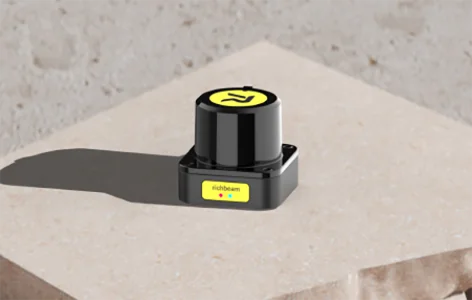
LiDAR technology has become one of the most important sensing solutions for robotics, autonomous vehicles, industrial automation, smart infrastructure, drone mapping, and AI-powered machines. As industries continue to move toward automation, the demand for high-performance LiDAR sensors is growing rapidly.
However, choosing the right LiDAR sensor is not as simple as selecting the model with the longest detection range or the highest number of channels. Different applications require different sensing capabilities, communication interfaces, environmental protection ratings, and software ecosystems.
Whether you are building an autonomous mobile robot (AMR), an automated guided vehicle (AGV), a robot dog, a drone mapping system, or an autonomous driving platform, this comprehensive LiDAR buying guide will help you understand how to select the right sensor while avoiding costly mistakes.

What Is a LiDAR Sensor?
LiDAR (Light Detection and Ranging) is a remote sensing technology that measures distances by emitting laser pulses and calculating the time it takes for the reflected light to return to the sensor.
A LiDAR sensor generates precise three-dimensional information about surrounding environments, allowing machines to:
- Detect obstacles
- Build maps
- Navigate autonomously
- Perform object recognition
- Support SLAM algorithms
- Enable collision avoidance
Today, LiDAR sensors are widely used in:
- Mobile robots
- Autonomous vehicles
- Industrial automation
- Smart factories
- Security robots
- Drone mapping
- Surveying and mapping
- Agricultural automation
- Intelligent transportation systems
Why More Companies Are Buying LiDAR Sensors
Traditional sensors such as cameras and ultrasonic sensors have limitations.
Cameras can be affected by lighting conditions, shadows, and weather.
Ultrasonic sensors provide only limited distance information.
LiDAR sensors provide:
- Accurate distance measurement
- High-resolution point clouds
- Wide field of view
- Reliable outdoor operation
- Real-time obstacle detection
- Precise localization
For modern intelligent machines, LiDAR is becoming a critical component of the perception system.
Understanding Different Types of LiDAR Sensors
Before purchasing a LiDAR sensor, it is important to understand the major categories available on the market.
2D LiDAR Sensors
A 2D LiDAR scans a single plane horizontally.
Advantages:
- Cost-effective
- Easy integration
- Low power consumption
- Suitable for indoor navigation
Applications:
- AGV
- AMR
- Cleaning robots
- Security robots
- Warehouse navigation
When to Buy a 2D LiDAR:
If your robot operates mainly on flat surfaces and only requires obstacle detection and navigation, a 2D LiDAR is often the most economical solution.
3D LiDAR Sensors
A 3D LiDAR captures full three-dimensional environmental information.
Advantages:
- Detects height and depth
- Supports advanced SLAM
- Better obstacle recognition
- Suitable for dynamic environments
Applications:
- Autonomous driving
- Robot dogs
- Drone mapping
- Smart cities
- Industrial inspection
When to Buy a 3D LiDAR:
If your project requires perception beyond a single plane, a 3D LiDAR is usually necessary.
Mechanical LiDAR
Mechanical LiDAR sensors use rotating components to achieve a 360-degree field of view.
Advantages:
- Long detection range
- Mature technology
- High accuracy
Best For:
- Mapping
- Autonomous vehicles
- Outdoor robotics
Solid-State LiDAR
Solid-state LiDAR eliminates mechanical moving parts.
Advantages:
- Higher durability
- Smaller size
- Lower maintenance
- Better shock resistance
Best For:
- ADAS
- Automotive applications
- Embedded robotic systems
Key Factors to Consider Before Buying a LiDAR Sensor
Detection Range
The first question every buyer should ask is:
How far does my sensor need to see?
Typical requirements:
- Indoor robots: 10–30 meters
- Warehouse AGVs: 30–80 meters
- Outdoor robots: 50–150 meters
- Autonomous vehicles: 150–300+ meters
Choosing excessive range can significantly increase costs.
Accuracy
Accuracy determines how precisely objects are measured.
Typical requirements:
- Navigation robots: ±30 mm
- Industrial automation: ±10 mm
- Surveying systems: ±5 mm
Higher accuracy usually means higher cost.
Field of View (FOV)
The field of view affects environmental perception.
Examples:
- 270° for indoor robots
- 360° for mapping
- Wide vertical FOV for autonomous driving
A wider FOV often improves perception performance.
Number of Channels
Channel count significantly impacts point cloud density.
Examples:
- 16-channel LiDAR
- 32-channel LiDAR
- 64-channel LiDAR
- 128-channel LiDAR
More channels generally provide:
- Better resolution
- Better object detection
- Better long-distance perception
However, they also increase costs.
Communication Interfaces
Check supported interfaces before purchasing.
Common options:
- Ethernet
- TCP/IP
- UDP
- CAN
- USB
- UART
For industrial and robotics applications, Ethernet-based LiDAR sensors are generally preferred.
ROS Compatibility
For robotics developers, ROS support is critical.
Look for sensors that provide:
- ROS Driver
- ROS2 Driver
- SDK Documentation
- Sample Code
This can save hundreds of engineering hours during integration.
Environmental Protection Rating
Outdoor deployments require environmental protection.
Recommended ratings:
- IP65
- IP67
- IP68
Applications:
- Outdoor robots
- Construction vehicles
- Agricultural equipment
- Smart transportation systems
Choosing LiDAR Based on Your Industry
Mobile Robots and AMRs
Recommended:
- 2D LiDAR
- Compact 3D LiDAR
- Camera Sensor Integration
Key priorities:
- SLAM performance
- Low power consumption
- ROS support
Warehouse Automation
Recommended:
- 2D LiDAR for navigation
- 3D LiDAR for pallet detection
Key priorities:
- Reliability
- Obstacle avoidance
- Fast response
Autonomous Driving
Recommended:
- Automotive LiDAR Sensor
- Long-range 3D LiDAR
Key priorities:
- High resolution
- Long-range detection
- Functional safety
Industrial Automation
Recommended:
- Industrial-grade LiDAR
- Camera + LiDAR Fusion
Key priorities:
- Precision
- Durability
- Continuous operation
Drone Mapping
Recommended:
- Lightweight LiDAR
- High-density point cloud sensor
Key priorities:
- Weight
- Accuracy
- Mapping performance
Common Mistakes Buyers Make
Buying Based Only on Price
The cheapest sensor may create expensive integration challenges later.
Ignoring Software Support
A good SDK is often more valuable than a small hardware specification improvement.
Choosing Excessive Performance
Many projects do not need a 128-channel LiDAR.
Selecting an oversized solution wastes budget.
Forgetting Future Scalability
Always consider future software upgrades and platform expansion.
Why Work with a Multi-Brand LiDAR Supplier?
Many buyers initially approach a single manufacturer.
However, working with a multi-brand supplier offers several advantages:
- More product options
- Faster comparison
- Better price flexibility
- Unbiased recommendations
- Access to multiple technologies
This approach allows engineers and procurement teams to find the most suitable solution rather than being limited to one product ecosystem.
Recommended Product Categories for Buyers
When evaluating LiDAR solutions, consider combining:
3D LiDAR Sensors
For advanced perception and mapping.
2D LiDAR Sensors
For cost-effective navigation.
Camera Sensors
For vision-based object recognition.
Development Kits
For AI and robotics development.
Robotics Solutions
For complete integration support.
Autonomous Driving Solutions
For vehicle perception systems.
Industrial Automation Solutions
For smart factory deployments.
Frequently Asked Questions
What is the best LiDAR sensor for robots?
The best sensor depends on your application requirements, operating environment, range, and budget.
Should I choose a 2D LiDAR or a 3D LiDAR?
2D LiDAR is ideal for navigation, while 3D LiDAR is better for advanced perception and object recognition.
Is LiDAR better than cameras?
LiDAR and cameras serve different purposes. Most advanced systems combine both technologies.
What range do I need?
Indoor robots typically require 10–30 meters, while autonomous vehicles may require 200 meters or more.
Do I need ROS support?
If you are developing robotics applications, ROS support is highly recommended.
What protection rating should I choose?
For outdoor use, IP67 or higher is generally recommended.
How long does LiDAR integration take?
Projects with mature SDK support can often be integrated within days rather than weeks.
Are solid-state LiDAR sensors better?
For automotive and embedded systems, solid-state LiDAR offers significant advantages in durability and size.
What is the lifespan of a LiDAR sensor?
Industrial-grade LiDAR sensors can operate reliably for many years when properly maintained.
Can LiDAR be used in rain and fog?
Performance may be affected under extreme conditions, but modern LiDAR sensors are designed to operate in challenging environments.
Choosing the right LiDAR sensor requires balancing performance, cost, integration complexity, and future scalability. The ideal solution depends on your application, operating environment, software ecosystem, and long-term project goals.
Whether you are developing autonomous robots, intelligent vehicles, industrial automation systems, or drone mapping platforms, investing time in the selection process can significantly improve project success while reducing integration costs.
As LiDAR technology continues to evolve, organizations that select the right sensing platform today will gain a competitive advantage in the rapidly growing world of intelligent machines.
Ready to buy a LiDAR sensor? Explore professional 2D LiDAR, 3D LiDAR, Camera Sensors, and Development Kits to find the ideal solution for your next project.









