

Introduction: The Lowest LiDAR Quote Is Not Always the Best Procurement Decision
When sourcing LiDAR sensors for automotive, robotics, autonomous driving, or industrial automation projects, procurement teams often receive quotations from multiple suppliers.
At first glance, comparing these quotations seems straightforward: review the unit price, compare delivery times, and select the most competitive offer.
However, professional procurement decisions involve much more than comparing numbers on a quotation sheet.
Two suppliers may quote the same LiDAR model but offer different product configurations, accessories, delivery commitments, warranty conditions, technical support, and international shipping terms.
A lower initial quotation may also result in additional costs later, including expedited shipping, missing accessories, customs-related expenses, engineering delays, or unexpected product substitutions.
For OEMs, Tier 1 automotive suppliers, robotics manufacturers, and global sourcing teams, the objective should be to identify the supplier that offers the best overall commercial and operational value.
This guide explains how professional procurement teams can evaluate LiDAR supplier quotations, establish objective supplier evaluation criteria, and make better purchasing decisions for both individual projects and large-volume procurement.

1. Standardize Supplier Quotations Before Comparing Prices
One of the most common procurement mistakes is comparing quotations that are not based on identical purchasing requirements.
For example, Supplier A may quote a LiDAR sensor with a standard cable, while Supplier B includes an additional interface component.
Similarly, one quotation may include international freight, while another only covers the product price.
These differences make direct price comparisons unreliable.
Before evaluating suppliers, procurement teams should establish a standardized RFQ specification.
A professional LiDAR RFQ should include:
Product Information
- Manufacturer and exact model number
- Hardware revision, if applicable
- Required accessories and cable configurations
- Required firmware or configuration
- Technical documentation requirements
Commercial Information
- Estimated order quantity
- Expected annual purchasing volume, if available
- Target unit price or budget range
- Required delivery destination
- Preferred Incoterms
- Payment terms
Project Information
- Application and end-use environment
- Prototype, validation, pilot production, or mass production stage
- Initial order schedule
- Potential future purchasing requirements
When every supplier receives the same RFQ, procurement teams can compare offers on a consistent basis.
This also reduces unnecessary quotation revisions and communication delays.
2. Compare Total Cost of Ownership Instead of Unit Price
Unit price is an important purchasing factor, but it should not be the only factor.
Enterprise procurement teams should evaluate the Total Cost of Ownership (TCO), which considers the broader costs associated with purchasing, delivering, integrating, and maintaining the equipment.
For LiDAR procurement, the cost structure may include:
| Cost Category | Procurement Considerations |
|---|---|
| Product cost | Unit price and volume discounts |
| Accessories | Cables, connectors and interface boxes |
| Freight | Air, express or other shipping methods |
| Import costs | Duties, taxes and customs clearance |
| Integration | Engineering and compatibility requirements |
| Delivery | Expedited shipment and schedule changes |
| Warranty | Coverage and replacement arrangements |
| Project risk | Potential costs associated with delays or product changes |
For international purchases, Incoterms are particularly important.
For example:
EXW: The buyer generally takes responsibility for arranging transportation and export-related logistics from the agreed delivery point.
FCA: The seller delivers the goods to the carrier or another nominated party at the agreed location, with responsibilities defined by the selected FCA point.
DAP: The seller arranges transportation to the named destination, while the buyer generally handles import clearance and applicable import duties and taxes.
DDP: The seller assumes a broader range of responsibilities, including import clearance and applicable duties and taxes, subject to the agreed terms and local requirements.
Procurement teams should compare quotations using the same delivery basis wherever possible.
A lower EXW quotation should not be directly compared with a DAP quotation without accounting for the additional logistics and import costs.
The objective is to understand the actual landed procurement cost, not simply the lowest product price.
3. Evaluate Product and Technical Compliance Separately from Commercial Pricing

For automotive and industrial projects, a competitive price does not compensate for a product that fails to meet engineering requirements.
Procurement teams should work with engineering departments to establish a technical compliance checklist before commercial evaluation.
Important LiDAR parameters include:
Detection Performance
- Detection range under specified target reflectivity and operating conditions
- Horizontal and vertical field of view
- Point cloud density
- Measurement accuracy
- Frame rate or scan frequency
Hardware Compatibility
- Power supply requirements
- Communication interfaces
- Mechanical dimensions
- Mounting requirements
- Environmental protection rating
Software Compatibility
- SDK availability
- ROS and ROS 2 support
- Operating system compatibility
- Point cloud output format
- Integration documentation
A particularly important consideration is that headline specifications do not always describe real-world performance.
For example, maximum detection range may depend on target reflectivity, environmental conditions, and the manufacturer’s measurement methodology.
Engineering teams should therefore verify that the quoted product configuration meets the project’s actual acceptance criteria.
Procurement should not approve a technically non-compliant alternative simply because it is cheaper.
A useful approach is to establish two separate evaluation stages:
- Technical qualification: Determine whether the proposed product meets mandatory engineering requirements.
- Commercial evaluation: Compare prices and purchasing conditions among technically acceptable offers.
This prevents commercial pricing from overriding essential technical requirements.
4. Verify Product Availability and Delivery Commitments
Delivery reliability is especially important when LiDAR sensors are required for vehicle development, robotics production, or customer deployment.
A supplier may provide an attractive quotation but still be unable to deliver the required quantity within the project’s schedule.
Procurement teams should distinguish between different types of availability:
- Physically available inventory
- Confirmed manufacturer allocation
- Products awaiting production
- Estimated replenishment
- Unconfirmed future availability
For larger orders, the buyer should request a clear delivery plan.
For example, a procurement requirement of 300 sensors may be fulfilled through several scheduled shipments rather than one immediate delivery.
The supplier should clarify:
- Quantity available for immediate shipment
- Expected availability of the remaining quantity
- Estimated shipment dates
- Whether partial deliveries are accepted
- Whether the quoted lead time is confirmed or estimated
It is also important to distinguish between product lead time and international transportation time.
These are separate stages and should be reflected clearly in the quotation.
Procurement recommendation: Ask suppliers to provide an estimated delivery schedule alongside the commercial quotation, particularly when the project has fixed validation or production milestones.
5. Assess Supplier Reliability and Supply Channel Transparency
A professional procurement department should understand who is supplying the products and how the supply arrangement works.
This is especially relevant when purchasing internationally through distributors, resellers, trading companies, or other supply partners.
A supplier evaluation should consider:
Business and Commercial Information
- Registered business identity
- Quotation and invoicing entity
- Contracting entity
- Payment beneficiary
- Export and shipping arrangements
Product Supply Information
- Manufacturer and product origin
- Product model and configuration
- Product condition and packaging
- Traceability documentation, where applicable
- Warranty responsibility
Supply Channel Information
- Whether the supplier is a manufacturer, authorized distributor, or independent channel partner
- Whether the supplier can verify product sourcing
- Whether the supply arrangement can support the required quantity
Importantly, suppliers should describe their actual commercial status accurately.
An independent sourcing partner should not claim to be an authorized distributor without the relevant authorization.
For enterprise purchasing, transparency and verifiable documentation are more useful than unsupported claims about supplier status.
Where formal authorization is a mandatory tender requirement, procurement teams should request the specific documentation required by their internal policy.
6. Evaluate Warranty, After-Sales Support, and Engineering Responsiveness
LiDAR sensors are part of a larger perception system.
If a sensor encounters an integration issue, engineering teams may need assistance with configuration, software, communication protocols, or troubleshooting.
Procurement teams should therefore evaluate the supplier’s support capabilities before placing an order.
Questions worth asking include:
- What warranty period applies to the quoted product?
- Who handles warranty claims?
- What documentation is available?
- Can the supplier assist with SDK and driver-related questions?
- Is ROS or ROS 2 integration support available?
- Can technical questions be escalated to relevant engineering resources?
- What is the expected response process for after-sales issues?
For global projects, time-zone coverage and communication efficiency can also affect project schedules.
A supplier that can coordinate product information, technical questions, and logistics through one communication channel may help reduce purchasing and integration complexity.
However, procurement teams should distinguish between standard product warranty, technical consultation, and customized engineering services.
These should be clearly defined rather than assumed to be included in every quotation.
7. Use a Supplier Evaluation Scorecard
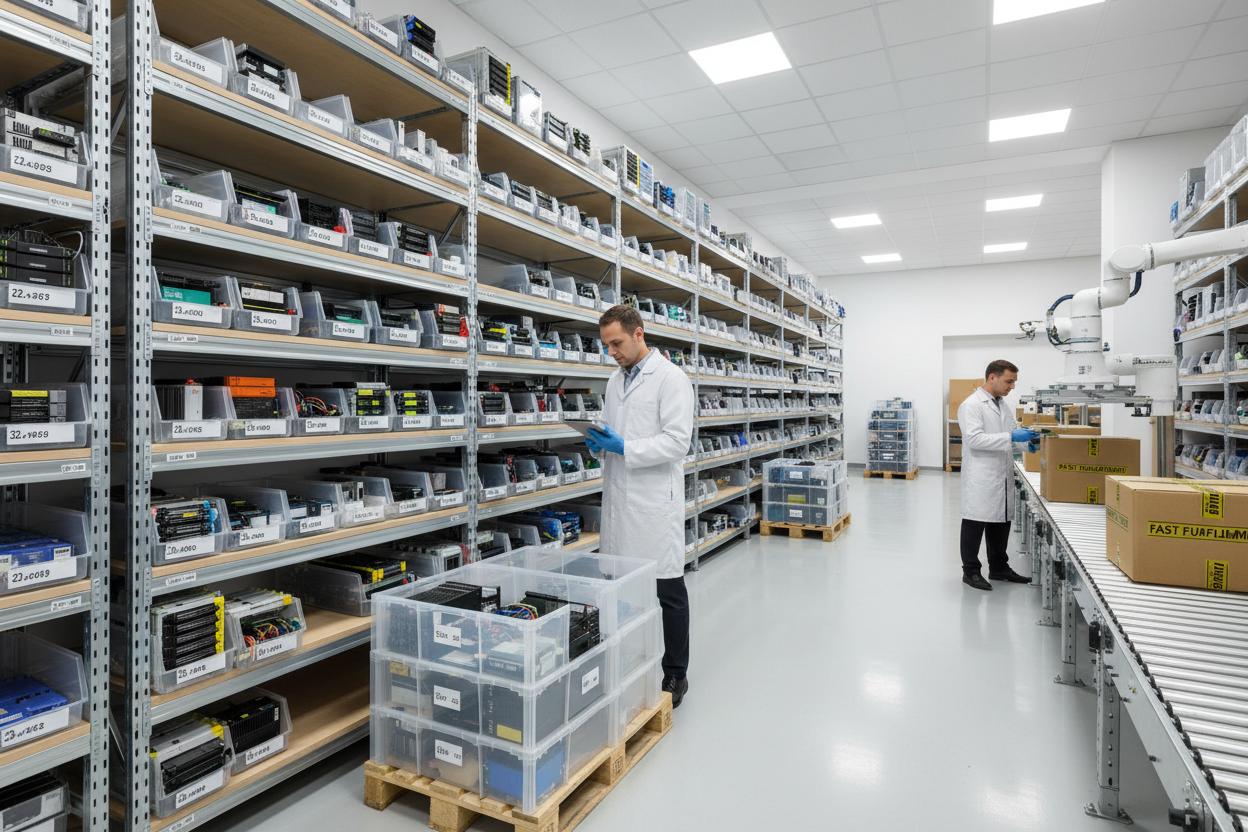
For companies evaluating multiple LiDAR suppliers, a weighted scorecard can make purchasing decisions more consistent and easier to justify internally.
The following example can be adapted to different procurement policies.
| Evaluation Category | Suggested Weight |
|---|---|
| Technical compliance | 25% |
| Total procurement cost | 20% |
| Product availability and lead time | 15% |
| Supplier reliability and transparency | 15% |
| Warranty and technical support | 10% |
| Commercial terms and payment conditions | 10% |
| Communication and responsiveness | 5% |
| Total | 100% |
Each supplier can be scored from 1 to 5 for every category.
A score of 1 indicates poor performance, while 5 indicates excellent performance.
The weighted score can be calculated using:
Weighted Score = (Supplier Rating ÷ 5) × Category Weight
For example, a supplier receiving a rating of 4 out of 5 for technical compliance, with a category weight of 25%, receives 20 points.
The final score helps procurement teams compare suppliers using a consistent framework.
Important: The weighting is illustrative, not an industry standard. Mandatory technical, legal, quality, and compliance requirements should be treated as pass/fail conditions rather than allowing a high commercial score to compensate for a critical failure.
For automotive programs, additional requirements such as quality management systems, product traceability, change notification, and customer-specific supplier approval may need separate assessment.
8. Review Commercial Terms Before Purchase Order Approval
Even after selecting a supplier, procurement teams should review the commercial terms carefully.
A complete quotation should clearly identify:
- Exact product model and quantity
- Unit price and total amount
- Currency
- Incoterms and named delivery destination
- Estimated lead time
- Payment conditions
- Quotation validity
- Warranty conditions
- Shipping arrangements
- Applicable taxes and additional charges
For larger procurement projects, it may also be useful to define:
Partial Shipment Arrangements
Can the supplier deliver the available quantity first and ship the remaining balance later?
Price Validity
How long will the quoted price remain valid, and can volume pricing be maintained across scheduled deliveries?
Product Change Management
How will the supplier communicate changes in product revisions, accessories, or product lifecycle status?
Order Cancellation and Modification
What happens if the project schedule or required quantity changes?
These details should be clarified before the purchase order is issued.
A well-defined purchasing agreement reduces misunderstandings and provides a clearer basis for managing the order.
9. Common LiDAR Procurement Mistakes to Avoid
Even experienced purchasing teams can encounter problems when sourcing specialized sensing equipment.
Here are seven common mistakes.
1. Selecting a supplier based only on unit price
A lower price does not necessarily mean lower total procurement cost.
2. Comparing quotations with different configurations
Missing accessories or different product revisions can make the comparison misleading.
3. Treating estimated inventory as confirmed stock
Always clarify whether the quantity is physically available or dependent on future production.
4. Ignoring engineering approval
A cheaper alternative may require additional integration work or validation.
5. Overlooking Incoterms
Unclear shipping responsibilities can create unexpected costs and delivery disputes.
6. Failing to verify the contracting entity
The supplier’s legal identity, invoice details, payment beneficiary, and export arrangements should be consistent and verified.
7. Not planning for future product requirements
Prototype purchasing and long-term production procurement should be considered as parts of the same project lifecycle.
Avoiding these mistakes can improve purchasing transparency and reduce unnecessary procurement risks.
10. How LIDARSEEK Supports Professional LiDAR Procurement
LIDARSEEK works with international customers sourcing LiDAR sensors and intelligent perception products for automotive, robotics, and industrial applications.
We understand that professional procurement teams need more than a list of products and a unit price.
They need clear product information, responsive communication, availability coordination, and practical support throughout the purchasing process.
Our capabilities include:
Multi-Brand LiDAR Sourcing
We provide access to products from manufacturers including Hesai, RoboSense, Seyond, Livox, and other sensing technology providers.
Project-Based Quotation
We help customers evaluate product options and prepare quotations based on model requirements, quantities, and delivery destinations.
Product Availability Coordination
We assist with stock checks, manufacturer coordination, and estimated delivery planning.
Technical Consultation
Our technical team can help with product specifications, documentation, configuration questions, and integration-related support.
International Shipping Coordination
We support overseas customers with shipping arrangements and clear delivery terms.
Support Across Project Stages
From prototype evaluation and engineering validation to bulk purchasing and production preparation, we aim to make LiDAR sourcing more efficient.
Whether you are purchasing a small quantity for engineering evaluation or preparing a larger order for commercial deployment, our team can help coordinate the sourcing process.
Request a Professional LiDAR Quotation
Are you comparing LiDAR suppliers for an automotive, robotics, AMR, AGV, autonomous driving, or industrial automation project?
Send your RFQ to LIDARSEEK.
To help our team prepare an accurate commercial proposal, please include:
- Manufacturer and exact model number, if already selected.
- Required quantity and estimated future demand.
- Application or project background.
- Delivery country and destination.
- Required delivery schedule.
- Preferred Incoterms, if applicable.
If you are still evaluating different LiDAR models, you can also share your technical requirements and allow our team to help identify suitable options.
We welcome both individual product inquiries and project-based bulk procurement requests.
Contact LIDARSEEK
Website: https://lidarseek.com/
Email: lidarseektech@gmail.com
WhatsApp / WeChat: +86 159 5882 2714
Looking for a reliable LiDAR sourcing partner? Contact LIDARSEEK to discuss your procurement requirements and request a quotation.









