
Introduction
Choosing the right computing platform is one of the most important decisions when developing an autonomous robot.
A platform that is too weak may struggle with AI inference, sensor fusion or computer vision. A platform that is unnecessarily powerful can increase system cost, power consumption and thermal requirements.
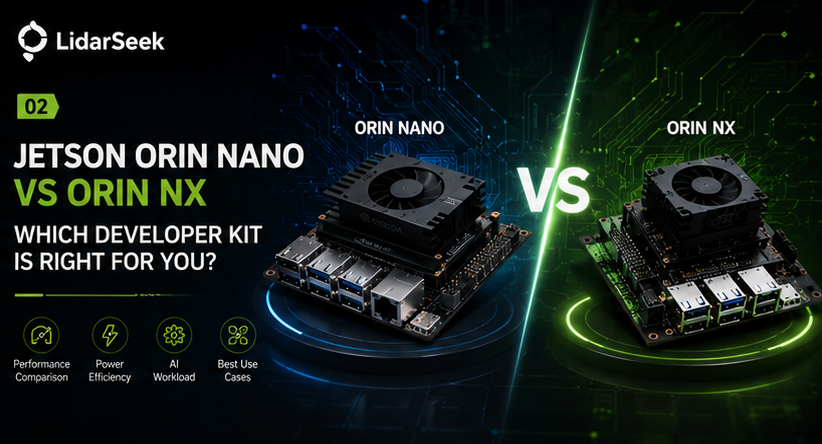
Two important NVIDIA Jetson options for edge AI development are the Jetson Orin Nano and Jetson Orin NX.
LidarSeek’s NVIDIA Jetson Dev Kit category includes both Orin Nano and Orin NX development products.
NVIDIA’s current platform information places Orin NX above Orin Nano in performance, with Orin NX reaching up to 100 TOPS and Orin Nano reaching up to 67 TOPS in the current lineup.

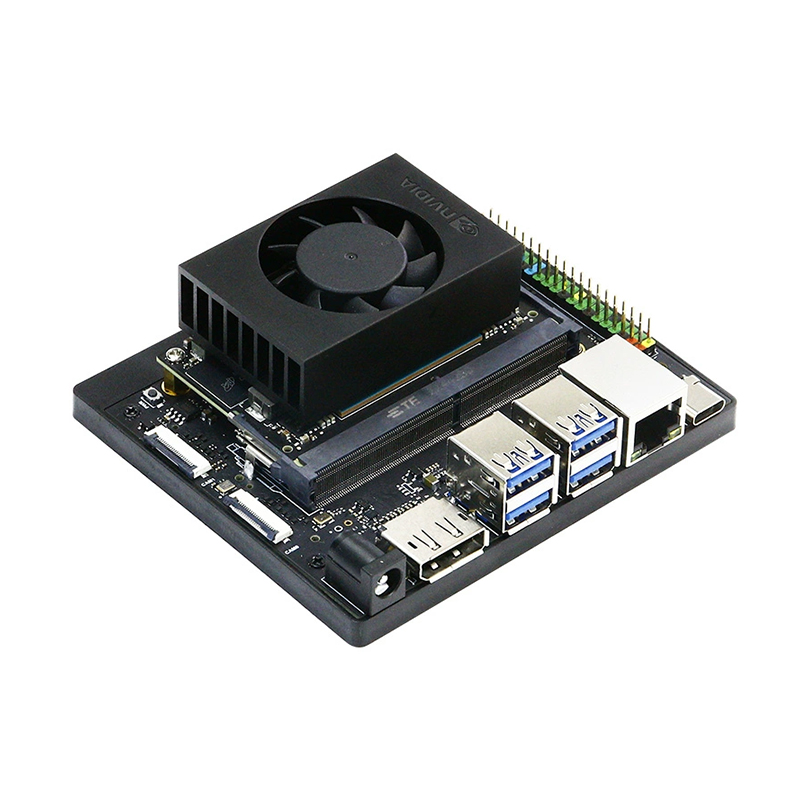
Jetson Orin Nano
Jetson Orin Nano is designed for compact edge AI applications.
Its relatively small form factor and lower power requirements make it attractive for:
- Small robots
- AI cameras
- Autonomous mobile robots
- Educational robotics
- Research platforms
- Compact LiDAR systems
- Computer vision prototypes
The current Jetson Orin Nano Super Developer Kit documentation states that it can deliver up to 67 INT8 TOPS, with configurable power from 7W to 25W.
This makes it particularly interesting for developers who need AI processing in a compact robot.
Jetson Orin NX
Jetson Orin NX is designed for higher-performance edge AI workloads.
NVIDIA lists Orin NX modules with up to 100 TOPS of AI performance and configurable power between 10W and 25W.
That additional performance can be valuable when a robot needs to run multiple workloads simultaneously.
For example:
LiDAR processing + camera inference + object detection + navigation + sensor fusion
A more powerful Jetson platform can provide additional headroom for these workloads.
Jetson Orin Nano vs Orin NX
| Feature | Jetson Orin Nano | Jetson Orin NX |
|---|---|---|
| Target | Compact edge AI | Higher-performance edge AI |
| AI workload | Moderate | More demanding |
| Robotics | Excellent | Excellent |
| LiDAR | Yes | Yes |
| AI Vision | Yes | Yes |
| Sensor Fusion | Suitable | Better for complex workloads |
| Power efficiency | Excellent | Excellent |
| Compact systems | Excellent | Excellent |
| High-performance AI | Limited compared with NX | Better |
| Budget-sensitive projects | Attractive | Higher-performance option |
The actual system choice should be based on workload rather than TOPS alone.
When Should You Choose Orin Nano?
Choose Orin Nano when:
- Your robot has limited power
- Your AI models are relatively lightweight
- You use one or two major perception workloads
- The robot has strict size requirements
- Development cost is important
- You are building a prototype
- You need a compact edge AI computer
For example, an indoor AMR using a 2D LiDAR for navigation and a camera for basic object detection may not need the computing resources of a high-end platform.
When Should You Choose Orin NX?
Orin NX becomes more attractive when the system requires:
- Multiple AI models
- More advanced object detection
- LiDAR-camera fusion
- High-resolution camera processing
- Multiple simultaneous perception tasks
- More complex autonomous navigation
- Additional AI headroom
For a sophisticated autonomous robot, having extra computing capacity can simplify future software development.
Jetson + LiDAR Architecture
A common architecture can be:
3D LiDAR → Ethernet → Jetson Orin NX → Perception → Planning
while a smaller system might use:
2D LiDAR → Jetson Orin Nano → SLAM → Navigation
The choice depends on the sensor data rate, AI model complexity and required processing speed.
Don’t Choose Only by TOPS
TOPS is useful, but it should not be the only selection criterion.
Before purchasing a Jetson platform, consider:
1. AI model
What models will you run?
YOLO-based detection, segmentation, transformers and multimodal AI can have very different computing requirements.
2. Camera count
One camera is very different from multiple high-resolution cameras.
3. LiDAR data
Consider:
- Point rate
- Scan frequency
- Resolution
- Number of sensors
- Processing pipeline
4. Power
A mobile robot has a limited battery.
5. Thermal design
Higher workloads generate more heat.
6. Future requirements
If your project will later add more cameras or AI models, selecting a platform with more headroom can be beneficial.
Jetson Orin Nano and Orin NX at LidarSeek
LidarSeek’s category currently lists multiple NVIDIA Jetson development products, including Orin Nano and Orin NX development kits.
This makes it possible to compare different development platforms according to your application.
For businesses buying several units for robotics development, laboratory testing or product prototyping, LidarSeek also provides a quotation process.
FAQ
Is Orin NX better than Orin Nano?
Orin NX provides higher AI performance, but that does not mean it is always the better choice. Orin Nano can be more appropriate for compact and cost-sensitive applications.
Which is better for LiDAR?
Both can work with LiDAR. The right choice depends on LiDAR data volume and the amount of additional AI processing.
Is Orin Nano good for autonomous robots?
Yes. Its compact size and edge AI capabilities make it suitable for many autonomous robotics applications.
Should I buy Orin NX for future-proofing?
If you expect your application to add more AI models, cameras or sensor-fusion workloads, the additional performance of Orin NX may provide useful headroom.
Can LidarSeek help select the model?
Yes. Customers can provide their application, sensor configuration, quantity and project requirements when requesting a quotation from LidarSeek.
Conclusion
The decision between Jetson Orin Nano and Orin NX should be based on the actual workload.
Orin Nano: compact, efficient and attractive for many robotics prototypes.
Orin NX: higher performance and better suited to demanding multi-sensor AI applications.
For LiDAR robotics, autonomous machines and edge AI development, choosing the correct Jetson platform early can help control both system cost and development complexity.
Contact LidarSeek to compare Jetson Orin Nano and Orin NX options for your robotics project.









