
Introduction
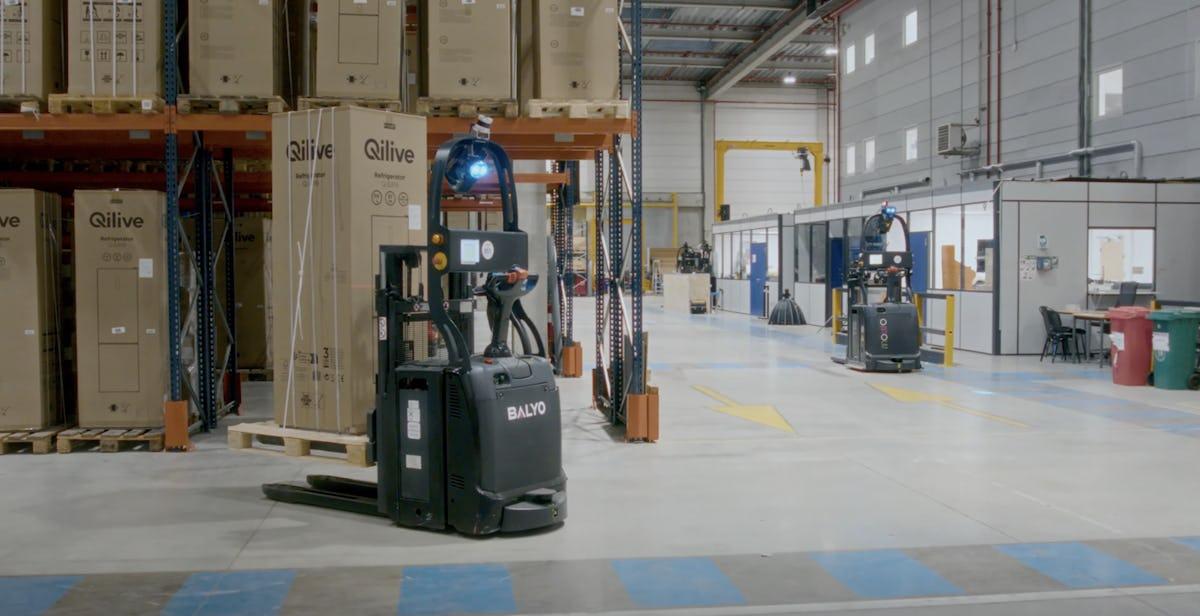
Autonomous forklifts are becoming an important part of modern warehouse automation and intelligent material handling systems.
From distribution centers and manufacturing facilities to logistics hubs and automated warehouses, autonomous forklifts help businesses improve operational efficiency, reduce repetitive manual tasks, and optimize material transportation.
However, reliable autonomous forklift operation depends heavily on accurate environmental perception.
LiDAR sensors play a critical role in this process by providing distance measurements, obstacle detection, environmental mapping, and positioning information.
For forklift manufacturers, robotics developers, and warehouse automation integrators, choosing the right LiDAR sensor is not simply a hardware purchasing decision. It requires careful consideration of detection performance, installation position, field of view, communication interfaces, software compatibility, and operational safety requirements.
This guide explains how to select and integrate LiDAR sensors for autonomous forklift applications, helping engineering teams make more informed technical and procurement decisions.
1. Why Do Autonomous Forklifts Need LiDAR Sensors?
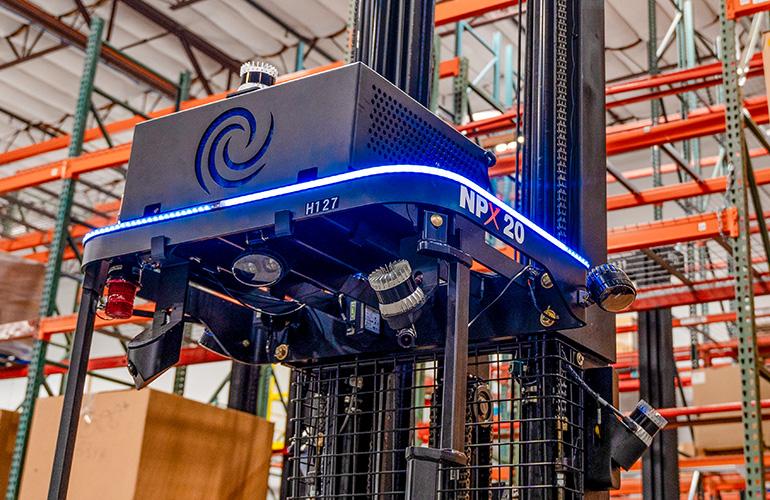
Unlike conventional industrial forklifts, autonomous forklifts must continuously perceive their surroundings and make navigation decisions without relying entirely on human operators.
They may operate in environments containing:
- Warehouse racks and storage systems
- Pallets and transported materials
- Pedestrians and other workers
- Moving forklifts and mobile robots
- Narrow aisles and loading areas
- Temporary obstacles and changing layouts
LiDAR sensors provide real-time distance information that helps autonomous systems understand the surrounding environment.
Depending on the system architecture, LiDAR can support several important functions.
Autonomous Navigation and Localization
LiDAR generates environmental measurements that can be used by SLAM algorithms to create maps and estimate the robot’s position.
This is particularly useful in warehouses where navigation accuracy and repeatability are important.
Obstacle Detection
Autonomous forklifts must identify static and moving obstacles along their operating paths.
LiDAR can provide geometric information about nearby objects, supporting obstacle detection and path planning.
Environmental Mapping
3D LiDAR can capture spatial information about warehouse structures, racks, pallets, and surrounding objects.
This can be useful in applications requiring three-dimensional environmental understanding.
Safety-Related Perception
LiDAR may contribute to protective field monitoring and obstacle detection systems.
However, a general-purpose LiDAR sensor should not automatically be considered a certified safety device. Applications requiring personnel protection must use appropriately certified safety systems and complete the relevant risk assessment.
2. How to Choose the Right LiDAR Type for an Autonomous Forklift
Different autonomous forklift designs have different sensing requirements.
The appropriate LiDAR configuration depends on the vehicle structure, navigation method, working environment, and safety architecture.
2D LiDAR Sensors
2D LiDAR measures distances within a horizontal scanning plane.
It is widely used in mobile robot navigation and can be suitable for autonomous forklifts operating in relatively structured environments.
Typical applications include:
- Warehouse navigation
- Horizontal obstacle detection
- SLAM-based positioning
- Navigation in narrow aisles
- Environmental mapping at a specific height
When selecting a 2D LiDAR sensor, engineers should evaluate scanning angle, detection range, angular resolution, scan frequency, and mounting height.
3D LiDAR Sensors
3D LiDAR generates point cloud data containing spatial information across multiple vertical and horizontal angles.
This allows the system to perceive objects at different heights.
Potential applications include:
- Three-dimensional obstacle detection
- Complex warehouse environments
- Pallet and rack perception
- Outdoor material handling
- Advanced autonomous navigation
For forklifts carrying loads of different sizes, 3D sensing may provide additional environmental information that a single horizontal scanning plane cannot capture.
Solid-State LiDAR
Solid-state LiDAR uses different optical scanning architectures and can offer design advantages for certain compact or embedded sensing applications.
Its suitability depends on field of view, detection performance, integration requirements, and the operating environment.
Engineers should compare actual model specifications rather than assuming all solid-state LiDAR products provide equivalent performance.
3. LiDAR Installation Position: An Important Engineering Consideration
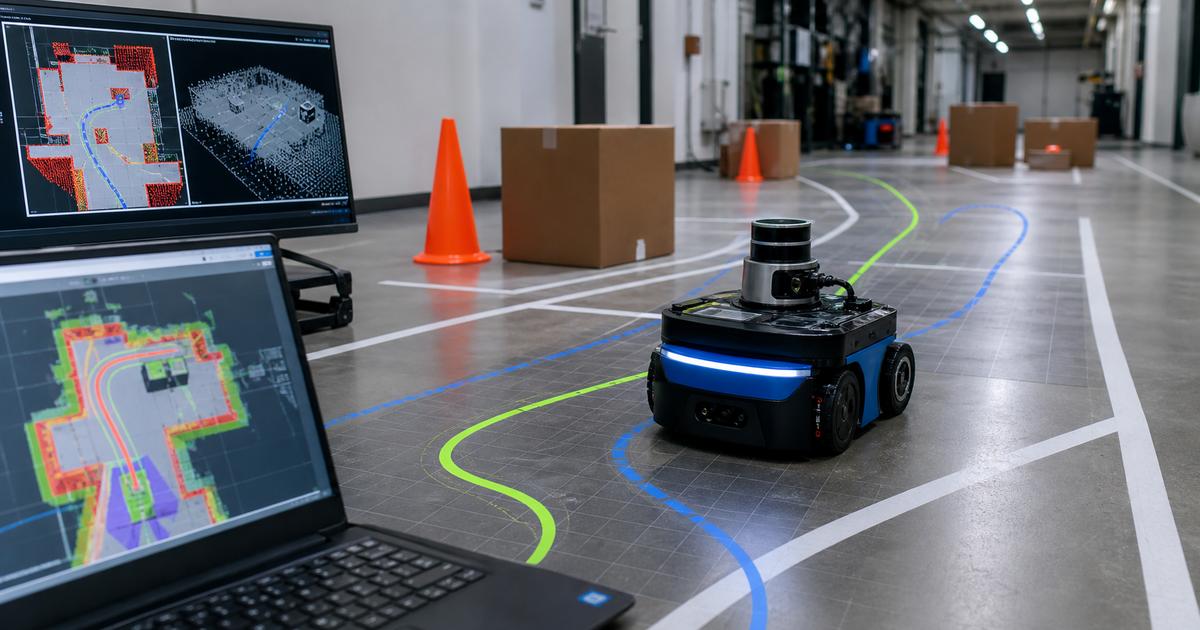
Even a high-performance LiDAR sensor may produce insufficient results if it is installed incorrectly.
Sensor placement affects visibility, blind spots, environmental coverage, and the quality of the data used by navigation algorithms.
Front-Mounted LiDAR
<Insert an image of a front-mounted LiDAR sensor on an autonomous forklift>
Front-mounted LiDAR can support forward obstacle detection and navigation.
Important considerations include:
- Mounting height
- Forward field of view
- Fork and load obstruction
- Detection of low-profile obstacles
- Vibration and mechanical stability
The installation should ensure that the forklift’s structure and transported materials do not unnecessarily obstruct the sensing area.
Rear-Mounted LiDAR
Rear-mounted sensing may be useful when the forklift needs to navigate in reverse or operate in environments with frequent direction changes.
Depending on the vehicle design, rear sensing can help reduce blind areas and improve environmental awareness.
Multi-Sensor Configuration
Some autonomous forklift platforms use multiple LiDAR sensors to provide wider environmental coverage.
For example, a combination of front, rear, or side-mounted sensors may be considered depending on vehicle geometry and operating requirements.
However, additional sensors introduce integration challenges, including:
- Sensor-to-sensor calibration
- Timestamp synchronization
- Coordinate transformation
- Data fusion
- Increased processing requirements
The final configuration should be determined through system-level evaluation rather than simply increasing the number of sensors.
4. Key LiDAR Specifications for Forklift Applications
Before purchasing LiDAR sensors, engineering and procurement teams should compare specifications against the actual operating requirements.
The following parameters deserve particular attention.
| Technical parameter | Why it matters |
|---|---|
| Detection range | Determines how far the system can observe objects |
| Field of view | Influences environmental coverage and blind areas |
| Angular resolution | Affects the spatial detail of measured objects |
| Scan frequency | Influences environmental update frequency |
| Measurement accuracy | Affects distance estimation |
| Minimum detection distance | Important for close-range obstacle perception |
| Operating temperature | Determines environmental suitability |
| Protection rating | Relevant to dust and water exposure |
| Communication interface | Determines hardware integration compatibility |
| SDK and driver support | Influences software development efficiency |
Detection Range and Target Reflectivity
Maximum detection range is one of the most visible specifications in LiDAR product descriptions.
However, the actual detection distance depends on several factors, including target reflectivity, object size, ambient light, and measurement conditions.
For warehouse applications, engineers should consider the ability to detect different types of objects, including dark surfaces, pallets, metal structures, and irregularly shaped obstacles.
A sensor’s maximum range should always be evaluated alongside its specified test conditions.
Field of View and Blind Spot Management
Field of view determines the area covered by the sensor.
For autonomous forklifts, the required coverage depends on vehicle dimensions, turning radius, travel direction, and load configuration.
Engineers should assess the complete sensing coverage of the vehicle rather than considering each sensor independently.
Environmental Protection
Industrial warehouses may contain dust, vibration, temperature fluctuations, and other environmental challenges.
Outdoor forklifts may also encounter rain, sunlight, and changing weather conditions.
Check the manufacturer’s specifications for:
- IP protection rating
- Operating temperature range
- Vibration resistance
- Shock resistance
- Environmental operating limitations
These specifications should be matched to the actual operating environment.
5. LiDAR Integration with ROS and Autonomous Navigation Systems
For autonomous forklift developers, software compatibility can be just as important as sensor hardware performance.
Many robotics platforms use ROS or ROS 2 to manage sensor data, localization, mapping, and navigation.
Before selecting a LiDAR model, engineering teams should verify the following.
ROS and ROS 2 Driver Availability
Check whether the selected sensor model has an official or supported driver.
Important questions include:
- Which ROS distributions are supported?
- Is ROS 2 supported?
- Are configuration parameters accessible?
- Can the driver publish the required point cloud or scan data?
- Is the driver compatible with the target operating system?
SLAM and Localization Compatibility
LiDAR data is commonly used by SLAM algorithms for mapping and localization.
The suitability of a sensor depends on the algorithm, scanning characteristics, environmental conditions, and movement of the vehicle.
Developers should test the complete system under representative operating conditions.
Integration with Embedded Computing Platforms
Autonomous forklift platforms may use embedded computing systems for perception and navigation.
NVIDIA Jetson platforms are one example of computing hardware used in robotics and edge AI applications.
When integrating LiDAR with an embedded computer, consider:
- Ethernet or other interface compatibility
- SDK and driver support
- Data transmission bandwidth
- Processing requirements
- Memory consumption
- Software environment compatibility
A complete integration test should verify continuous data acquisition and stable system operation.
6. LiDAR and Camera Fusion for Advanced Forklift Perception
LiDAR and camera systems provide complementary information.
LiDAR provides spatial distance measurements, while cameras provide visual information.
Combining these technologies can support more advanced perception applications.
Potential applications include:
- Pallet recognition
- Object classification
- Load detection
- Warehouse environment monitoring
- Intelligent obstacle recognition
- Automated material handling
However, successful sensor fusion requires accurate calibration and synchronization.
Technical Requirements for Sensor Fusion
Extrinsic Calibration
The relative position and orientation of the LiDAR and camera must be established accurately.
Timestamp Synchronization
Data from different sensors should be aligned appropriately, especially when the forklift is moving.
Coordinate Transformation
The system must correctly transform measurements into a common coordinate frame.
Computing Performance
The processing platform must have sufficient resources to handle point cloud data, image processing, and perception algorithms.
For developers building advanced autonomous material handling systems, selecting compatible LiDAR and camera hardware early can simplify later integration.
7. Safety and Reliability Considerations
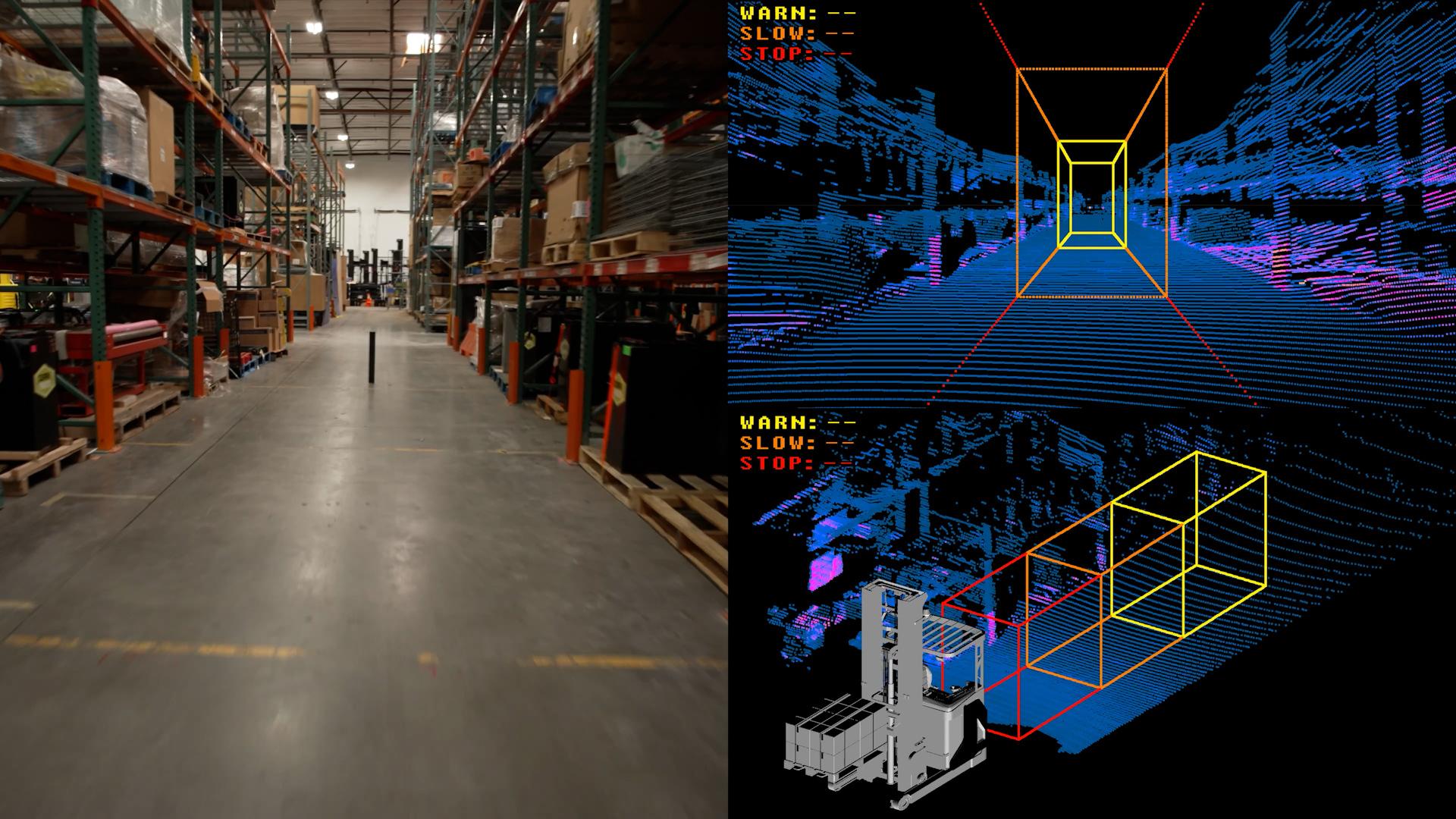
Safety is one of the most important considerations in autonomous forklift development.
Forklifts frequently operate near workers, warehouse equipment, and other vehicles.
Therefore, the sensing and control architecture must be designed around the applicable industrial safety requirements.
Engineering teams should distinguish between:
- General-purpose LiDAR used for navigation and environmental perception.
- Safety-rated sensing devices designed and certified for specific protective functions.
- The complete machine safety system, including controllers, protective devices, braking, and emergency functions.
A conventional navigation LiDAR should not be treated as a substitute for certified personnel protection equipment.
Depending on the application and target market, manufacturers should evaluate applicable standards and regulations, including relevant ISO 3691-4 requirements for driverless industrial trucks and their systems.
The complete vehicle must undergo appropriate risk assessment and validation.
8. Procurement Considerations for Forklift Manufacturers and OEMs
Technical selection is only one part of a successful industrial automation project.
For OEM manufacturers and large system integrators, purchasing decisions also need to consider long-term product availability, supplier reliability, and technical support.
Before placing an order, procurement teams should evaluate:
Product Availability
- Is the model currently available?
- Are there any product lifecycle changes?
- Can the supplier support prototype and production quantities?
- Are alternative models available if the original model becomes unavailable?
Technical Documentation
- Product datasheets
- User manuals
- SDK documentation
- Communication protocols
- Mechanical drawings
- Relevant compliance documentation
Supply and Delivery
- Sample availability
- Bulk purchasing lead time
- International shipping arrangements
- Order quantity flexibility
- Delivery schedule coordination
Technical Support
- Product selection assistance
- Compatibility evaluation
- Documentation support
- Integration consultation
- After-sales service
For projects involving multiple vehicles or production facilities, these factors should be evaluated before finalizing the hardware architecture.
9. How LIDARSEEK Supports Autonomous Forklift and Warehouse Automation Projects
LIDARSEEK supplies LiDAR sensors and intelligent perception products for robotics developers, industrial automation companies, OEM manufacturers, and system integrators.
Our product portfolio covers multiple sensing technologies and development platforms, including:
- 2D industrial LiDAR
- 3D mechanical LiDAR
- Solid-state LiDAR
- Automotive LiDAR
- AI vision cameras
- NVIDIA Jetson development platforms
- Related robotics and perception products
We understand that industrial customers often need more than a product catalogue.
They need to identify compatible hardware, verify technical specifications, obtain samples, and coordinate purchasing schedules.
LIDARSEEK can support customers with:
Product Selection
Compare different sensor models based on detection range, field of view, resolution, interfaces, and application requirements.
Multi-Brand Sourcing
Evaluate suitable products from different manufacturers according to project specifications.
Sample Procurement
Support prototype and engineering evaluation before larger purchasing commitments.
Technical Consultation
Help review product documentation, interface compatibility, SDK availability, and integration requirements.
Commercial Support
Provide quotations, product availability information, lead-time coordination, and international shipping assistance.
Whether you are developing an autonomous forklift, upgrading an existing warehouse robot, or sourcing LiDAR sensors for an industrial vehicle production program, our team can help you evaluate suitable products.
10. Request a LiDAR Solution for Your Autonomous Forklift Project
Selecting a suitable LiDAR sensor requires a clear understanding of the vehicle architecture and operating environment.
To help our team identify suitable products, please provide the following information:
- Application: Autonomous forklift, AGV, AMR, reach truck, or another industrial vehicle.
- Operating environment: Indoor warehouse, factory, outdoor logistics area, or mixed environment.
- Detection requirements: Required detection range and field of view.
- Sensor type: 2D LiDAR, 3D LiDAR, solid-state LiDAR, or currently undecided.
- Integration platform: ROS, ROS 2, NVIDIA Jetson, or another embedded system.
- Quantity: Prototype samples, engineering evaluation, or production volume.
- Target delivery schedule: Expected purchasing timeline.
Already have a preferred LiDAR model or manufacturer?
Send us the model number and required quantity for a quotation.
Contact LIDARSEEK
Website: https://lidarseek.com/
Email: lidarseektech@gmail.com
For technical consultation, product selection, and commercial quotations, contact our team.
Developing an autonomous forklift or warehouse automation system?
Let LIDARSEEK help you evaluate suitable LiDAR sensors and sourcing options for your project.
Frequently Asked Questions
1. What type of LiDAR is best for autonomous forklifts?
There is no single best LiDAR for every autonomous forklift. 2D LiDAR is commonly considered for planar navigation, while 3D LiDAR can provide additional vertical information for more complex environments. The final choice depends on vehicle architecture and application requirements.
2. How many LiDAR sensors does an autonomous forklift need?
The number depends on the required sensing coverage, vehicle dimensions, travel directions, and safety architecture. Some systems use one primary navigation sensor, while others use multiple sensors to reduce blind areas.
3. Can LiDAR detect pallets and warehouse obstacles?
LiDAR can provide geometric measurements of pallets and obstacles. Detection performance depends on object dimensions, surface reflectivity, sensor position, and software algorithms.
4. Can LiDAR work with ROS 2?
Many LiDAR models support ROS 2 through official or supported drivers. Always confirm compatibility with the specific model, ROS distribution, and operating environment.
5. Can LIDARSEEK supply LiDAR sensors for OEM production?
LIDARSEEK supports product sourcing for prototype evaluation and commercial purchasing. Customers can share their model requirements and estimated quantities to discuss product availability, quotations, and delivery arrangements.









