
Executive Summary
The industrial robotics and intelligent infrastructure sectors are characterized by extraordinary diversity. A sensor configuration that works perfectly for an autonomous forklift navigating narrow warehouse aisles may be entirely unsuitable for a roadside unit monitoring a highway intersection. Conversely, the wide vertical field of view required for near-field obstacle detection on a delivery robot is wasted on a mapping vehicle focused on distant features. For years, system integrators have been forced to compromise—selecting a single sensor and accepting that its fixed specifications would be suboptimal for some portion of their application requirements.
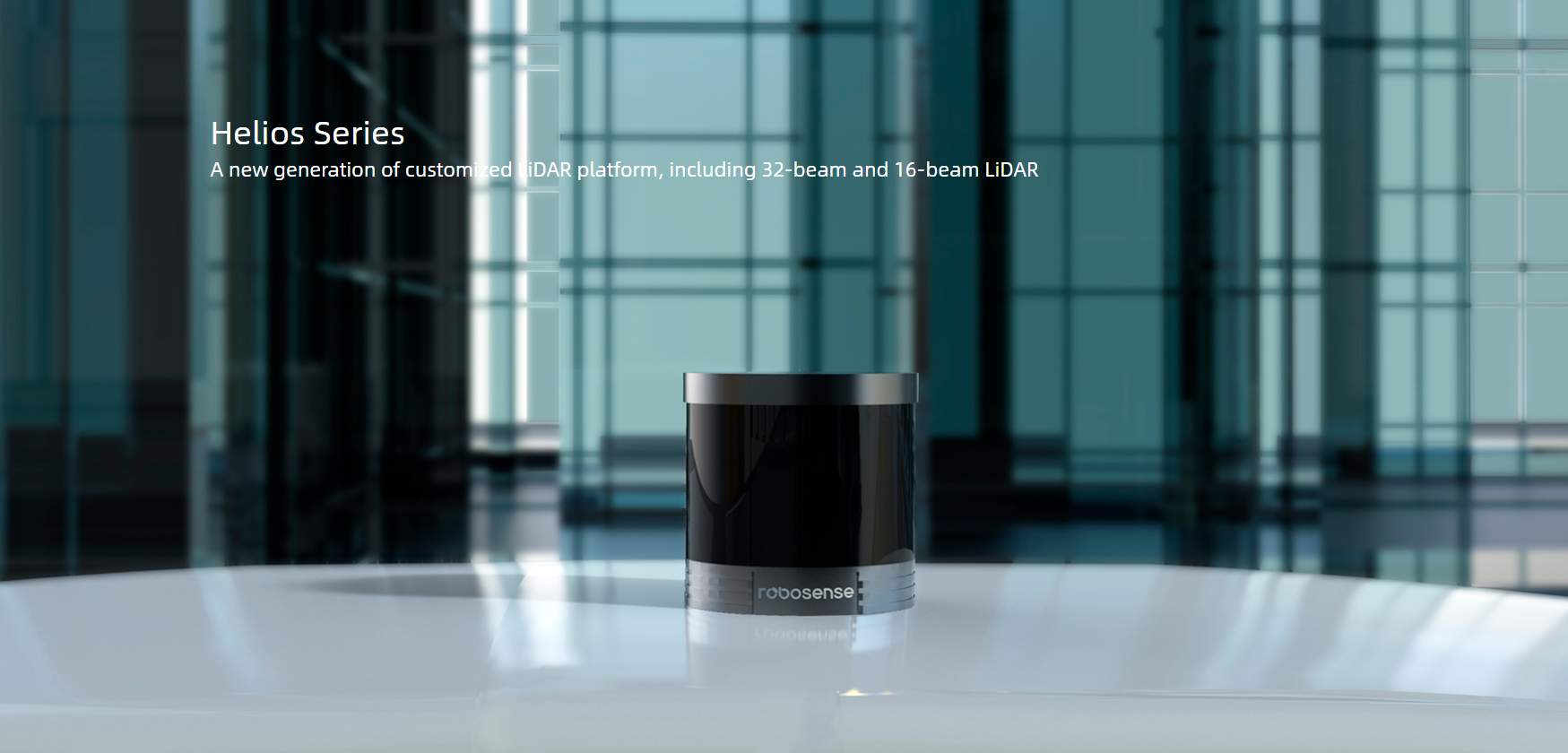
RoboSense’s Helios 32 shatters this compromise. As the 32-beam flagship of the Helios series, this sensor introduces a revolutionary tri-modal customization capability, offering three distinct vertical field-of-view configurations within a single hardware platform . Whether an application demands the ultra-wide 70° FOV for combined perception and blind-spot elimination, the high-resolution 26° FOV for long-range detection, or the balanced 31° FOV for general-purpose use, the Helios 32 provides a purpose-optimized solution without requiring a complete sensor redesign.
Built on RoboSense’s modular architecture, the Helios 32 achieves a 29% reduction in volume and 60% cost reduction compared to its predecessor, the RS-LiDAR-32, while simultaneously improving performance and reliability . With 150m range, ±1cm precision, and full automotive-grade environmental sealing, it delivers production-ready 3D perception for the world’s most demanding industrial and commercial applications.
This comprehensive report provides an in-depth analysis of the RoboSense Helios 32. We will examine its three customizable configurations in detail, explore its technical architecture and specifications, analyze its transformative applications across robotics, V2X infrastructure, and industrial automation, and evaluate its unique value proposition for sophisticated clients in Russia, Europe, and North America. For system integrators and technology leaders seeking a single LiDAR platform that can adapt to diverse deployment scenarios, the Helios 32 represents the new standard in application-optimized perception.
1. Introduction: The Case for Customization in Industrial Perception
The LiDAR industry has historically followed a one-size-fits-all model. Manufacturers produce sensors with fixed fields of view and resolution profiles, and integrators must adapt their applications to accommodate these constraints. This approach works when applications are homogeneous, but the reality of modern robotics and intelligent infrastructure is anything but uniform.
Consider the perceptual requirements of three common applications:
- Autonomous Delivery Vehicle: Needs to detect pedestrians and obstacles immediately in front of the vehicle while also seeing the ground directly ahead to navigate curbs and uneven terrain. A wide vertical FOV with significant downward tilt is essential .
- Highway Traffic Monitoring: Requires long-range detection of vehicles traveling at high speeds, with fine angular resolution to distinguish between cars, trucks, and motorcycles at distance. A narrow, high-resolution FOV optimized for distance is preferable.
- Industrial AGV: Must navigate structured warehouse environments with predictable obstacle geometries. A balanced FOV providing good situational awareness without excessive data volume is ideal.
The RoboSense Helios 32 was engineered specifically to address this diversity. Rather than forcing customers to adapt their applications to a fixed sensor, RoboSense adapted the sensor to the application—offering three distinct optical configurations within a common mechanical, electrical, and software framework .
This approach delivers profound advantages:
- Optimized Performance: Each application receives a sensor tuned to its specific perceptual requirements, maximizing detection range, resolution, or coverage as needed.
- Simplified Integration: All three configurations share identical dimensions (φ100mm × H100mm), mounting interfaces, electrical connections, and data protocols . A system designed for the 70° version can accept the 26° version with zero mechanical or electrical modification.
- Reduced Qualification Effort: Because the core hardware platform is common, customers can qualify the Helios 32 once and deploy multiple variants across different applications.
- Scalable Deployment: Organizations managing fleets of diverse robots or multiple infrastructure installations can standardize on a single LiDAR family, simplifying spares management, training, and support.
2. Helios 32: The Tri-Modal Architecture
2.1 Three Configurations, One Platform
The Helios 32 is available in three distinct vertical field-of-view configurations, each optimized for specific application profiles :
Each configuration shares the same core specifications :
- Number of Lines: 32 beams
- Horizontal FOV: 360°
- Maximum Range: 150m (110m @ 10% reflectivity NIST standard)
- Range Accuracy: ±1 cm typical
- Blind Spot: ≤0.2 m
- Horizontal Resolution: 0.1°/0.2°/0.4° (configurable)
- Frame Rate: 5Hz / 10Hz / 20Hz (configurable)
- Points per Second: 576,000 (single return) / 1,152,000 (dual return)
- Laser Wavelength: 905 nm (Class 1 eye-safe)
- Power Consumption: 12W
- Operating Temperature: -40°C to +60°C
- Ingress Protection: IP67, IP6K9K
- Dimensions: φ100mm × H100mm
- Weight: ~1.0 kg
2.2 Configuration 1: The 70° Ultra-Wide FOV
The 70° configuration is the most distinctive member of the Helios 32 family. With a vertical field of view spanning from 55° below the horizon to 15° above, it provides extraordinary near-field coverage .
Key Characteristics:
- Downward Tilt: The 55° downward-looking capability ensures that the sensor sees the ground immediately in front of the vehicle or robot, eliminating the near-field blind spot that plagues many LiDAR designs.
- Application-Specific Tuning: This configuration was originally developed in collaboration with Alibaba for their “Xiaomanlv” (Little Donkey) delivery robot, which required both forward perception and near-field obstacle detection from a single sensor .
- Simplified System Design: By combining perception and blind-spot coverage in one sensor, the 70° Helios 32 can replace two separate sensors (a forward LiDAR and a near-field blind-spot sensor), reducing system complexity and cost.
Ideal Applications:
- Autonomous Delivery Vehicles: Detects pedestrians, cyclists, and obstacles at distance while simultaneously seeing curbs, potholes, and the ground surface immediately ahead.
- Last-Mile Logistics Robots: Navigates sidewalks and crosswalks with complete awareness of both distant and immediately adjacent obstacles.
- Low-Speed Shuttles: Provides comprehensive forward perception for vehicles operating in pedestrian-rich environments.
- Mobile Manipulators: Enables robots with arms to perceive both the environment and the workspace directly in front of the base.
2.3 Configuration 2: The 26° High-Resolution FOV
At the opposite end of the spectrum, the 26° configuration prioritizes angular resolution and range over wide vertical coverage .
Key Characteristics:
- 0.5° Vertical Resolution: The 26° version achieves the highest vertical angular resolution in the Helios series (0.5°), providing exceptional detail for object classification at distance.
- Center-Enhanced Beam Distribution: The 32 beams are concentrated in the center of the FOV, where they matter most for forward-facing perception, rather than being evenly distributed.
- Optimized for Distance: The narrow FOV concentrates the sensor’s 1.15 million points per second into a smaller vertical window, increasing point density on distant targets.
Ideal Applications:
- Highway Traffic Monitoring: Detects and classifies vehicles at ranges up to 150m, with sufficient resolution to distinguish between sedans, SUVs, and motorcycles.
- V2X Infrastructure: Roadside units monitoring intersections benefit from the long-range precision of the 26° configuration.
- Autonomous Trucking: Long-haul trucks require maximum detection range for highway-speed operation; the 26° Helios 32 delivers.
- Mapping and Surveying: Applications requiring detailed reconstruction of distant structures benefit from the high angular resolution.
2.4 Configuration 3: The 31° Balanced FOV
The 31° configuration represents the general-purpose workhorse of the Helios 32 family . While less frequently discussed than its more specialized siblings, it offers an excellent balance of vertical coverage and resolution for a wide range of applications.
Key Characteristics:
- Balanced Coverage: With approximately 0.97° average vertical resolution across a 31° FOV, this configuration provides good situational awareness without excessive data volume.
- Versatility: Suitable for applications where neither extreme wide-angle coverage nor maximum range is the primary requirement.
- Simplified Integration: The balanced FOV works well with standard mounting positions and orientations.
Ideal Applications:
- AGV Navigation: Warehouse robots navigating structured environments benefit from the balanced coverage.
- Industrial Automation: Fixed-position sensors monitoring production lines or safety zones.
- General Robotics: Research platforms and custom robotic applications where requirements may evolve over time.
- Fleet Standardization: Organizations deploying robots across multiple applications can standardize on the 31° version for simplicity.
3. Technical Architecture and Core Capabilities
3.1 Modular Platform Design
The Helios 32 is built on RoboSense’s modular R-platform architecture, which represents a significant evolution from the previous RS-LiDAR-32 generation . Key platform advantages include:
- 29% Volume Reduction: The Helios 32 measures just φ100mm × H100mm, a substantial reduction that simplifies integration into space-constrained applications .
- 60% Cost Reduction: Through design optimization and manufacturing scale, RoboSense has dramatically reduced the cost of 32-beam LiDAR, making high-quality 3D perception accessible for a vastly wider range of applications .
- Common Ecosystem: All three Helios 32 configurations share the same mechanical footprint, electrical interface, and software stack, enabling true platform-level standardization.
3.2 Advanced Environmental Resilience
Industrial and outdoor applications demand sensors that can withstand harsh conditions. The Helios 32 is engineered for this reality :
| Capability | Specification | Benefit |
|---|---|---|
| Operating Temperature | -40°C to +60°C | Functions in Arctic winters and desert summers without auxiliary heating or cooling |
| Ingress Protection | IP67, IP6K9K | Dust-tight, waterproof, and resistant to high-pressure washdowns—essential for outdoor and industrial environments |
| Shock & Vibration | Automotive-grade testing | Withstands the mechanical stresses of continuous operation on vehicles and machinery |
| EMC Protection | Comprehensive shielding | Operates reliably in electrically noisy industrial environments |
3.3 Intelligent Environmental Adaptation
The Helios 32 incorporates several advanced features that enhance real-world performance :
Rain, Fog, Snow, and Dust Denoising:
Adverse weather introduces noise into LiDAR point clouds as precipitation and particulates generate false returns. The Helios 32 includes advanced filtering algorithms that suppress this environmental clutter, providing cleaner data to downstream perception systems . For clients in regions with challenging weather—such as Northern Europe’s frequent precipitation or Russia’s winter snow—this capability is essential for reliable year-round operation.
Multi-LiDAR Anti-Interference:
In applications where multiple LiDARs operate in close proximity—such as robotaxi fleets or vehicles with multiple sensors—interference between sensors can corrupt data. The Helios 32 incorporates proprietary shielding that minimizes cross-talk, ensuring clean point clouds even in dense multi-sensor environments .
Dual Operating Modes:
The sensor supports both high-performance and low-power operating modes, allowing system designers to balance data density against energy consumption . For battery-powered robots, low-power mode extends operational time without sacrificing essential perception capability.
Web-Based Configuration and Monitoring:
The Helios 32 includes a built-in web server that enables configuration and real-time monitoring through any standard web browser . This simplifies installation, troubleshooting, and field maintenance—technicians can verify sensor operation and adjust settings without specialized software or training.
3.4 Precision Time Synchronization
For applications requiring fusion with cameras, IMUs, or other sensors, precise temporal alignment is critical. The Helios 32 supports multiple synchronization protocols :
- $GPRMC with 1PPS: Traditional GPS-based synchronization
- PTP (Precision Time Protocol): IEEE 1588 standard for network-based timing
- gPTP (generalized PTP): Automotive-grade precision timing
This flexibility ensures that the Helios 32 can be seamlessly integrated into any multi-sensor architecture, from simple research platforms to complex production systems.
3.5 Automotive-Grade Connectivity
The Helios 32 employs 100Base-T1 automotive Ethernet for data transmission . This interface offers:
- Noise Immunity: Designed for the electrically challenging environments of vehicles and industrial machinery
- High Bandwidth: 100 Mbit/s full-duplex capacity handles the sensor’s 1.15 million points per second data stream
- Simplified Wiring: Single twisted-pair cabling reduces weight and complexity
- Long Cable Runs: Supports distances sufficient for large vehicles and infrastructure installations
Data is output as standard UDP packets containing spatial coordinates (x, y, z), intensity values, and timestamps, ensuring compatibility with a wide range of computing platforms and middleware (including ROS) .
4. Transformative Application Scenarios
The Helios 32’s tri-modal customization capability makes it applicable across an extraordinary range of industrial, robotic, and infrastructure applications.
4.1 Autonomous Mobile Robots (AMRs) and Automated Guided Vehicles (AGVs)
The warehouse and logistics industry is undergoing rapid automation, with AMRs and AGVs becoming essential for material handling. The Helios 32’s combination of 360° coverage, 150m range, and customizable FOV makes it ideally suited for these applications .
Application Requirements:
- Navigation and Localization: The 360° horizontal FOV enables continuous SLAM-based mapping and localization. The 0.2m blind spot ensures that the robot can navigate right up to walls and obstacles .
- Obstacle Detection: The 150m range (110m at 10% reflectivity) provides ample warning time for dynamic obstacle avoidance, even at higher speeds.
- Pallet Engagement: ±1cm accuracy enables reliable detection and engagement of pallets, racks, and other handling equipment.
Optimal Configuration:
- 70° Version: For robots operating in cluttered environments with significant near-field obstacles (forklifts, pallet movers)
- 31° Version: For general-purpose AGV navigation in structured warehouse environments
4.2 Unmanned Forklifts and Industrial Vehicles
In manufacturing and heavy industrial settings, unmanned forklifts and tuggers must operate reliably amid steel structures, heavy machinery, and variable lighting conditions.
Application Requirements:
- Narrow Aisle Navigation: The 360° coverage ensures awareness of racking and obstacles in all directions during tight maneuvers.
- Load Handling: The vertical FOV must see both the floor (for pallet engagement) and the rack structure above.
- Safety Zone Monitoring: Real-time detection of personnel entering the vehicle’s operating area is essential.
Optimal Configuration:
- 70° Version: The wide vertical FOV provides both floor-level perception for pallet detection and upward visibility for high racks, all from a single sensor.
4.3 V2X and Smart Infrastructure
Intelligent transportation systems rely on accurate, real-time data about traffic flow. The Helios 32 serves as an exceptional sensor for roadside infrastructure .
Application Requirements:
- Long-Range Detection: Monitoring approaching traffic requires detection at distances sufficient for advance warning systems.
- High Resolution: Distinguishing between vehicle types (car, truck, motorcycle) requires fine angular resolution.
- All-Weather Operation: Infrastructure sensors must function reliably in rain, snow, and fog, 24/7.
- Multi-Sensor Synchronization: Precise timing alignment across multiple roadside units is essential for tracking vehicles through intersections.
Optimal Configuration:
- 26° Version: The high-resolution configuration maximizes detection range and classification capability for traffic monitoring.
- 31° Version: Provides balanced performance for general intersection monitoring.
Real-World Validation: The Helios series has been specified for research and development applications by institutions such as Taiwan’s Industrial Technology Research Institute, which sought the 70° version for its combination of range, precision, and environmental ruggedness .
4.4 Autonomous Delivery and Last-Mile Logistics
The partnership between RoboSense and Alibaba’s “Xiaomanlv” (Little Donkey) delivery robot demonstrates the Helios 32’s capabilities in last-mile delivery .
Application Requirements:
- Pedestrian Detection: Must reliably detect and track pedestrians, cyclists, and other dynamic obstacles in crowded urban environments.
- Curb and Obstacle Navigation: Needs to see the ground immediately ahead to navigate curbs, potholes, and uneven surfaces.
- Near-Field Safety: Must detect obstacles within centimeters of the vehicle to prevent collisions during tight maneuvers.
Optimal Configuration:
- 70° Version: The 55° downward tilt provides exceptional near-field ground perception while maintaining forward obstacle detection capability .
4.5 Autonomous Shuttles and Low-Speed People Movers
Airport shuttles, campus transport vehicles, and urban people movers operate in environments with high pedestrian density and complex obstacle geometries.
Application Requirements:
- 360° Situational Awareness: Vehicles operating in pedestrian zones need awareness in all directions.
- Pedestrian Tracking: Must reliably track multiple pedestrians simultaneously, predicting their trajectories.
- All-Weather Operation: Outdoor shuttles must function in rain, snow, and varying light conditions.
Optimal Configuration:
- 31° Version: Balanced coverage provides good pedestrian detection while maintaining reasonable data volume.
- 70° Version: For applications with particular concern for near-field obstacles.
4.6 Security and Surveillance
Fixed-position LiDAR sensors are increasingly used for perimeter security, area monitoring, and intrusion detection.
Application Requirements:
- Long-Range Detection: Must detect intruders at distances sufficient for response.
- Classification: Must distinguish between humans, vehicles, and animals.
- Weather Resilience: Must function in all environmental conditions.
- Covert Operation: Passive sensing with no visible light emission.
Optimal Configuration:
- 26° Version: Maximizes detection range for perimeter monitoring.
- 31° Version: Provides balanced coverage for area surveillance.
4.7 Research and Development
Universities, research institutions, and corporate R&D labs require flexible, well-supported sensor platforms for developing and testing new algorithms .
Application Requirements:
- Data Quality: Clean, consistent point clouds with accurate timestamping.
- Software Support: ROS integration, comprehensive documentation, and sample code.
- Flexibility: Configurable parameters to support diverse research objectives.
- Reliability: Consistent performance across long-duration experiments.
Optimal Configuration:
- All Versions: Research groups can select the configuration matching their specific investigation, or acquire multiple variants to explore different perception approaches.
5. Value Proposition and Cost-Effectiveness for International Clients
For sophisticated clients in European, North American, and Russian markets, the Helios 32 offers compelling advantages across multiple dimensions.
5.1 Application-Optimized Performance
The most fundamental value of the Helios 32 is its ability to match sensor characteristics to application requirements. Rather than compromising with a one-size-fits-all solution, integrators can select the precise configuration that optimizes their system’s performance:
- 70° Version: Eliminates the need for separate blind-spot sensors in low-speed robotics, reducing system cost and complexity .
- 26° Version: Maximizes detection range and classification capability for long-range applications .
- 31° Version: Provides balanced performance for general-purpose use.
This optimization directly translates to improved system performance, reduced development time, and lower total system cost.
5.2 Exceptional Price-to-Performance Ratio
The Helios 32 delivers a remarkable combination of capabilities at a compelling price point. With a European market price of approximately €2,400-2,668 (depending on configuration and distributor) and availability through distributors serving the Indian market at approximately ₹347,779 (with backorder lead times of 25-30 days) , the sensor provides:
- 150m Range: Sufficient for most industrial and robotic applications
- ±1cm Precision: Enables precise localization and object manipulation
- 360° Coverage: Eliminates blind spots with a single sensor
- Automotive-Grade Reliability: Ensures long-term, maintenance-free operation
- Customizable FOV: Adapts to specific application requirements
When compared to the cost of developing custom perception solutions or integrating multiple lower-performance sensors to achieve equivalent coverage, the Helios 32 presents an exceptionally compelling economic case.
5.3 Platform Standardization Benefits
For organizations deploying multiple robots or infrastructure installations, the ability to standardize on a single LiDAR platform delivers substantial benefits:
- Reduced Qualification Effort: Qualify the Helios 32 once, deploy multiple configurations across different applications.
- Simplified Spares Management: Stock a single sensor type (in multiple FOV variants) rather than multiple distinct models.
- Common Training and Support: Technicians need training on only one sensor family.
- Volume Pricing: Standardization enables volume purchasing, reducing per-unit costs.
5.4 Global Availability and Support
The Helios 32 is available through RoboSense’s global distribution network, ensuring that clients in Russia, Europe, and North America can access the sensor with local support:
- North America: Available through distributors such as InDro Robotics at $2,668 USD
- India/South Asia: Available through Robu.in with local inventory and support
- Europe: Accessible through multiple distributors serving the EU market
- Asia-Pacific: Available through regional distributors including Nevis Technology
5.5 Future-Proof Platform
As a member of the Helios series, the 32 benefits from RoboSense’s ongoing investment in the R-platform architecture. Improvements in manufacturing, signal processing, and firmware will benefit all Helios series sensors, ensuring that customers’ investments remain current.
6. Competitive Positioning: Helios 32 vs. Alternatives
In the landscape of 32-beam mechanical LiDARs, the Helios 32 occupies a distinctive position:
7. Conclusion: The Adaptable Foundation for Industrial Perception
The RoboSense Helios 32 represents a fundamentally different approach to industrial LiDAR—one that recognizes the diversity of real-world applications and provides the flexibility to address them without compromise. Its tri-modal customization capability, with three distinct vertical field-of-view configurations sharing a common hardware platform, enables system integrators to select the precise perceptual characteristics their application demands while maintaining platform-level standardization.
For clients in Russia, Europe, and North America—markets characterized by demanding environmental conditions, rigorous performance requirements, and diverse application needs—the Helios 32 offers a proven, production-ready solution:
- 70° Version for low-speed robotics and applications requiring exceptional near-field awareness
- 26° Version for long-range detection, traffic monitoring, and high-resolution classification
- 31° Version for general-purpose robotics and balanced performance requirements
All three versions deliver the same core capabilities: 150m range, ±1cm precision, 360° coverage, automotive-grade environmental sealing, and the cost efficiency enabled by RoboSense’s modular platform architecture .
In an industry where the gap between “available” and “optimal” can determine project success, the Helios 32 successfully bridges the divide. It is more than a sensor; it is a platform—one that adapts to the application rather than forcing the application to adapt to it. For system integrators, robotics manufacturers, and infrastructure developers seeking a single LiDAR family that can span their entire portfolio of applications, the Helios 32 stands as the definitive choice.









