
For more than a decade, the LiDAR industry has been obsessed with one trend: bigger, denser, and more powerful 3D LiDAR systems.
Every month, manufacturers introduce new automotive-grade sensors featuring hundreds of channels, longer ranges, and increasingly dense point clouds.
Yet a surprising reality exists inside the robotics industry.
Thousands of autonomous mobile robots, warehouse AGVs, service robots, cleaning robots, delivery robots, and inspection robots still rely on a much simpler technology:
While 3D perception continues to dominate headlines, practical robotic deployment often depends on sensors that are smaller, more affordable, easier to integrate, and optimized specifically for navigation.
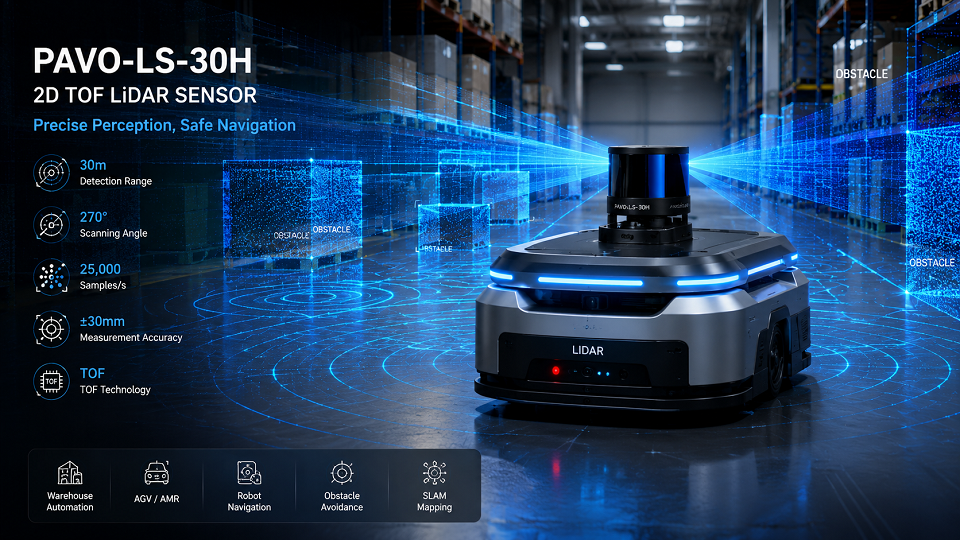
This is exactly why products such as the Pavo-LS-30H continue to attract attention among robotics engineers and automation developers.
Instead of asking:
“How many channels does this LiDAR have?”
Engineers increasingly ask:
“Can it navigate reliably?”
In many real-world applications, that answer still comes from a high-performance 2D TOF LiDAR.
The Hidden Problem Most Robot Developers Face
Building a robot is not difficult.
Building a robot that can reliably move through dynamic environments is difficult.
A robot operating in:
- warehouses
- hospitals
- shopping malls
- airports
- hotels
- factories
must constantly answer three questions:
Where am I?
What is around me?
How do I move safely?
This is where robot lidar becomes essential.
Without environmental awareness, autonomous navigation is impossible.
Traditional ultrasonic sensors provide only limited directional information.
Cameras suffer from changing lighting conditions.
Infrared sensors often struggle with accuracy and environmental interference.
LiDAR solves these challenges by directly measuring distance.
Using laser pulses and precise timing calculations, a TOF LiDAR sensor creates a detailed map of nearby objects and obstacles. Time-of-flight sensing remains one of the foundational ranging methods used across modern depth-sensing systems.
Why 2D LiDAR Is Experiencing a Second Growth Wave
Many industry observers predicted that 3D LiDAR would completely replace 2D systems.
That prediction never became reality.
Instead, the robotics industry discovered an important truth:
Most mobile robots spend their entire operational life moving on relatively flat surfaces.
Examples include:
- AGV vehicles
- AMR robots
- Hotel delivery robots
- Hospital logistics robots
- Cleaning robots
- Security patrol robots
These robots primarily need horizontal environmental awareness.
A high-quality 2D scan plane is often sufficient for:
- localization
- path planning
- obstacle detection
- wall following
- navigation
As a result, 2D LiDAR remains one of the most cost-effective sensing technologies available for autonomous robots.
Why Pavo-LS-30H Is Designed for Practical Robotics
The Pavo-LS-30H belongs to a new generation of TOF-based 2D LiDAR sensors designed specifically for navigation applications.
Key characteristics include:
- High scanning frequency
- Wide field of view
- High sampling rate
- Accurate ranging performance
- ROS compatibility
The PAVO platform uses TOF ranging technology combined with rotating scanning to create high-precision two-dimensional environmental maps suitable for robotics applications.
For robot manufacturers, these capabilities translate into:
- faster deployment
- reduced algorithm complexity
- more reliable navigation
- easier SLAM implementation
The New Generation of Autonomous Mobile Robots
Modern AMRs no longer operate in controlled environments.
Today they share spaces with humans.
This creates entirely new challenges.
A robot must recognize:
- moving pedestrians
- shopping carts
- temporary obstacles
- open doors
- unexpected objects
within milliseconds.
LiDAR-based navigation allows robots to continuously update environmental maps and adjust routes dynamically.
This capability is becoming increasingly important as automation expands into public environments.
Why AGV Manufacturers Continue Choosing 2D LiDAR
Warehouse automation is one of the fastest-growing sectors in industrial robotics.
AGVs must navigate:
- narrow aisles
- dynamic inventory layouts
- forklift traffic
- human workers
A reliable 2D laser radar often provides all necessary perception data while minimizing system complexity.
Compared with multi-sensor systems, a single LiDAR solution can significantly simplify navigation architecture.
This is one reason many AGV manufacturers continue to buy lidar sensor solutions optimized specifically for navigation tasks.
SLAM: The Technology That Changed Robotics Forever
One of the most important advances in robotics is SLAM.
Simultaneous Localization and Mapping allows robots to build maps while determining their own position.
LiDAR-based SLAM offers several advantages:
- High accuracy
- Strong environmental robustness
- Consistent performance
- Reliable long-term operation
The widespread adoption of ROS and open-source SLAM frameworks has accelerated deployment across industries. Many robotics platforms are designed around LiDAR-compatible mapping and localization workflows.
The Future Is Not About More Sensors
Many robotics companies are discovering that adding more sensors does not always improve performance.
Additional cameras.
Additional radar.
Additional depth sensors.
All increase:
- computational load
- power consumption
- software complexity
In contrast, a high-quality TOF LiDAR often delivers the most important information directly:
accurate distance measurements.
For many mobile robots, simplicity creates reliability.
And reliability creates commercial success.
Related LiDAR Products
Explore more professional LiDAR solutions:
https://lidarseek.com/product-category/2d-lidar-sensor
Recommended categories:
- 2D LiDAR Sensors
- Robot LiDAR Solutions
- AGV Navigation LiDAR
- Industrial Automation LiDAR
- Autonomous Mobile Robot Sensors
FAQ
1. What is a 2D TOF LiDAR sensor?
A sensor that measures distance using laser pulse travel time and generates a two-dimensional scan of the environment.
2. Why is 2D LiDAR popular in robots?
Because it provides accurate navigation data while maintaining low system complexity.
3. Can Pavo-LS-30H support SLAM?
Yes, it is suitable for mapping and localization applications.
4. Is 2D LiDAR enough for AGVs?
For many warehouse and logistics AGVs, 2D LiDAR is sufficient for navigation and obstacle avoidance.
5. What is the advantage of TOF technology?
TOF provides accurate distance measurements and stable environmental perception.
6. Can LiDAR work in low-light environments?
Yes, LiDAR actively emits laser signals and is not dependent on ambient lighting.
7. Is LiDAR better than ultrasonic sensors?
LiDAR generally provides higher precision and richer environmental information.
8. Does Pavo-LS-30H support ROS?
Yes, it is designed for easy integration into mainstream robotic development environments.
9. What industries use robot lidar?
Warehousing, healthcare, hospitality, manufacturing, logistics, and service robotics.
10. Can LiDAR be used for indoor navigation?
Absolutely. Indoor navigation is one of the most common applications.
11. How does LiDAR help obstacle avoidance?
It continuously scans the environment and detects nearby objects for path planning.
12. Is LiDAR suitable for autonomous delivery robots?
Yes. Many delivery robots use LiDAR as their primary perception sensor.
13. What is laser radar?
Laser radar is another commonly used term for LiDAR technology.
14. Why buy a LiDAR sensor instead of using cameras only?
LiDAR provides direct distance measurements and often performs more consistently in varying lighting conditions.
15. Where can I buy LiDAR sensors for robotics?
You can explore professional solutions at:https://lidarseek.com/shop
While the market focuses heavily on high-channel automotive LiDAR systems, the future of robotics still depends on efficient and reliable perception technologies.
For autonomous mobile robots, AGVs, service robots, and industrial automation platforms, the Pavo-LS-30H demonstrates why 2D TOF LiDAR continues to play a critical role in navigation and obstacle avoidance.
Sometimes the smartest solution is not the most complex one.
It is the one that works reliably every day.









