
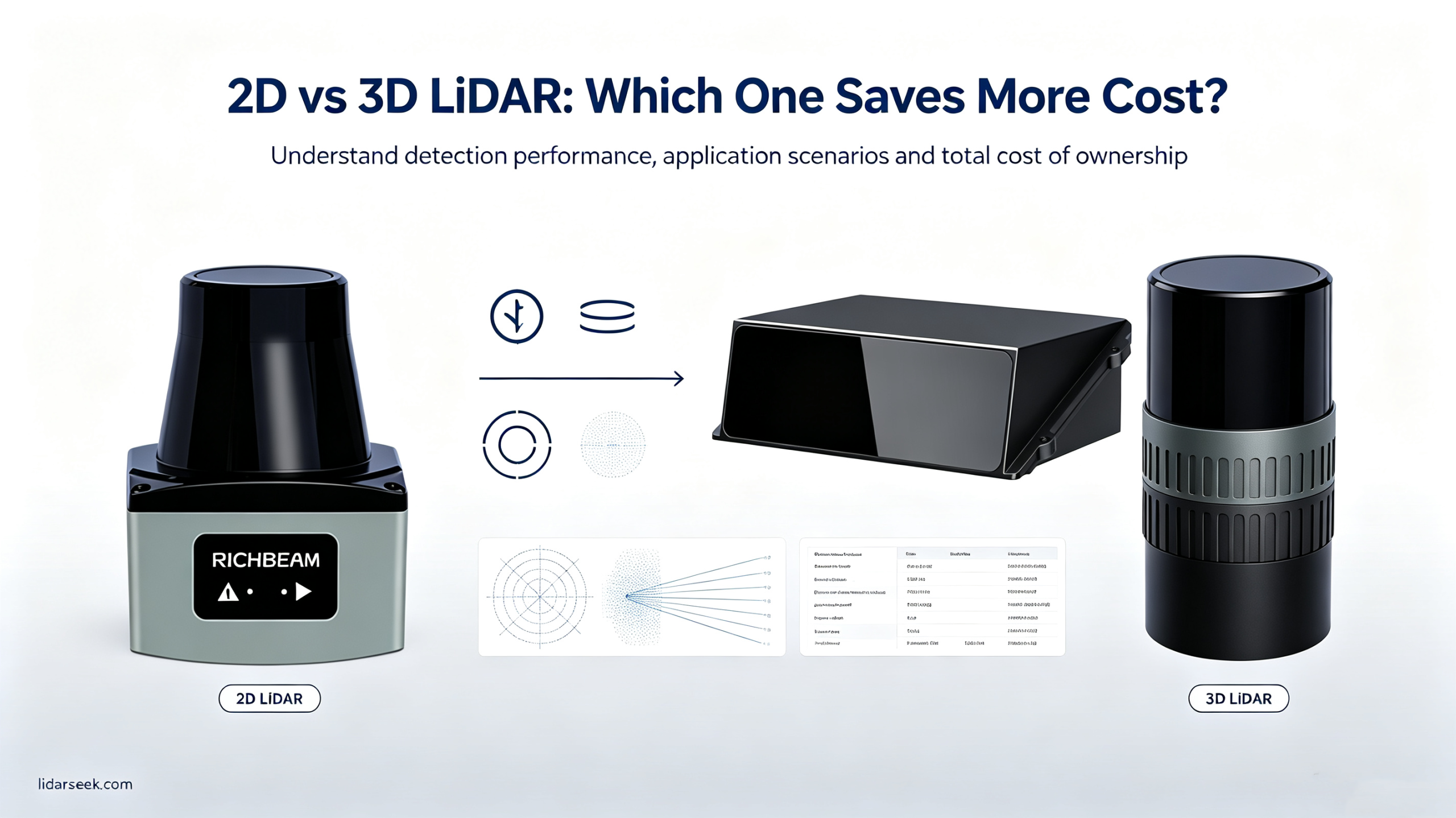
When purchasing LiDAR sensors for a robotics, automation, mapping, or autonomous vehicle project, one of the first questions buyers often ask is:
Should we use 2D LiDAR or 3D LiDAR? Request a Quote →
At first glance, the answer may appear simple.
2D LiDAR is generally associated with lower-cost applications, while 3D LiDAR provides more detailed environmental information and is typically more expensive.
However, choosing the cheapest sensor is not always the same as choosing the most cost-effective solution.
A low-cost 2D LiDAR may be the ideal choice for an indoor AGV that only needs obstacle detection. But using that same sensor for a 3D mapping project could result in additional sensors, software development, integration work, and engineering costs.
On the other hand, purchasing an expensive 3D LiDAR for a simple warehouse navigation application could unnecessarily increase the bill of materials.
For international buyers, robotics manufacturers, system integrators, engineers, and procurement managers, the real question should therefore be:
Which LiDAR provides the required performance at the lowest total project cost?
This guide compares 2D and 3D LiDAR from both a technical and purchasing perspective.
We will examine:
- 2D LiDAR vs 3D LiDAR
- LiDAR sensor price
- Total cost of ownership
- Robotics applications
- AMR and AGV applications
- Mapping applications
- Integration costs
- Performance requirements
- Bulk purchasing
- Supplier selection
- How to reduce LiDAR procurement costs
The goal is not to determine whether 2D or 3D LiDAR is universally better.
The goal is to help you determine which one makes more financial and technical sense for your project.
1. What Is the Difference Between 2D and 3D LiDAR?
The fundamental difference is the amount of spatial information generated by the sensor.
2D LiDAR
A 2D LiDAR sensor primarily measures objects along a scanning plane.
The resulting data can be represented as a two-dimensional scan showing the distance between the sensor and surrounding objects.
This is particularly useful for applications where the robot or machine only needs information about its environment at a particular height.

Typical applications include:
- AGV navigation
- AMR navigation
- Warehouse robots
- Industrial automation
- Obstacle detection
- Safety monitoring
- Factory logistics
- Indoor positioning
- Robot navigation
For these applications, a 2D sensor can often provide enough information without the additional cost and processing requirements associated with 3D perception.
2. 2D LiDAR Explained
2D LiDAR is one of the most established and cost-effective LiDAR technologies used in industrial robotics.
A typical 2D LiDAR continuously scans an area around the sensor and generates distance measurements.
For example, an AMR moving through a warehouse may use a 2D LiDAR to detect:
- Pallets
- Shelves
- Walls
- People
- Boxes
- Other vehicles
- Obstacles
The robot’s navigation software can then use this information to determine whether it should continue moving, slow down, or change direction.
Why Is 2D LiDAR Popular?
The biggest advantage is simplicity.
Compared with many 3D systems, 2D LiDAR can provide:
- Lower sensor cost
- Lower data volume
- Easier integration
- Lower computing requirements
- Simpler navigation algorithms
- Compact hardware
- Lower overall system cost
For many indoor robotics applications, this combination is extremely attractive.
3. 3D LiDAR Explained
3D LiDAR provides significantly more spatial information.
Instead of generating information primarily across one scanning plane, a 3D LiDAR can generate a three-dimensional point cloud.
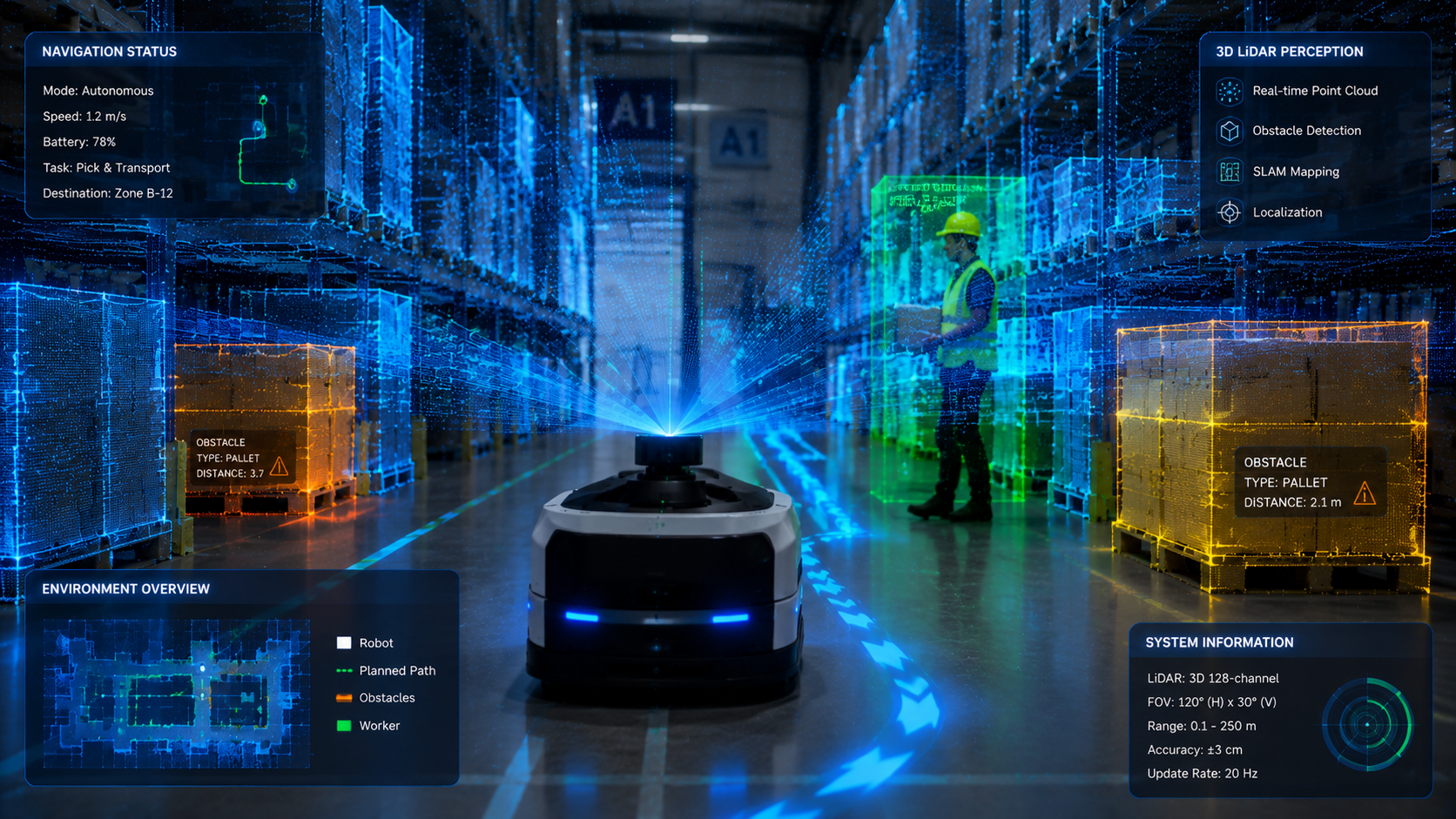
This allows the system to understand objects in terms of:
- X position
- Y position
- Z position
- Distance
- Spatial structure
This additional information is useful when the environment cannot be adequately represented by a single horizontal scanning plane.
Typical applications include:
- Autonomous driving
- 3D mapping
- Mobile mapping
- Outdoor robotics
- Autonomous navigation
- Infrastructure inspection
- Advanced perception
- Surveying
- Research and development
The additional capability, however, generally comes with higher hardware and system costs.
4. 2D vs 3D LiDAR Price Comparison
One of the biggest reasons companies investigate 2D LiDAR is price.
For many applications, 2D LiDAR can provide a lower-cost entry point.
However, it is important to understand that LiDAR price is not determined only by whether the sensor is 2D or 3D.
Pricing can also depend on:
- Manufacturer
- Model
- Detection range
- Accuracy
- Resolution
- Field of view
- Scan frequency
- Point rate
- Environmental rating
- Interface
- Processing capabilities
- Quantity
- Availability
- Application
A basic 2D LiDAR and a high-performance industrial 2D LiDAR can have very different prices.
Likewise, not every 3D LiDAR has the same price.
Therefore, instead of asking:
“Is 2D LiDAR cheaper?”
the better question is:
“Which LiDAR architecture meets my requirements at the lowest total cost?”
5. Why 2D LiDAR Is Often More Affordable
There are several reasons why 2D LiDAR can be more economical.
Lower Hardware Complexity
A 2D sensor generally has a simpler sensing architecture than a 3D system.
This can reduce the hardware cost.
Lower Data Output
3D LiDAR can generate large point clouds.
Processing this data may require more powerful:
- CPUs
- GPUs
- Embedded computers
- Network infrastructure
- Storage
2D LiDAR typically generates less data.
That can reduce the cost of the complete perception system.
Simpler Software
Many robotic navigation systems can process 2D LiDAR data using relatively mature algorithms.
This can simplify software development.
Easier Integration
For a basic AMR or AGV, integrating a 2D LiDAR may be relatively straightforward.
This can reduce engineering time.
And engineering time is a real project cost.
6. When 2D LiDAR Is the Better Choice
2D LiDAR can be an excellent choice when your project has relatively simple perception requirements.
Indoor AMR
Consider an indoor warehouse robot.
The robot needs to:
- Navigate aisles
- Avoid obstacles
- Detect people
- Avoid collisions
- Navigate around shelving
If the relevant obstacles can be detected effectively within a horizontal scanning plane, 2D LiDAR may be sufficient.
There may be no financial reason to purchase a high-end 3D LiDAR.
AGV
Many industrial AGVs operate in relatively structured environments.
The vehicle may follow predefined routes or navigation paths.
In these environments, 2D LiDAR can provide an attractive balance between:
Performance + Reliability + Cost
Factory Automation
Industrial environments can also be suitable for 2D LiDAR.
For example:
- Production lines
- Warehouse transport
- Material handling
- Restricted areas
- Machine safety zones
If the system only needs to detect objects crossing a specific plane, 3D perception may not be necessary.
7. When 3D LiDAR Is Worth the Additional Cost
There are many situations where the additional cost of 3D LiDAR is justified.
Outdoor Autonomous Robots
Outdoor environments are generally less structured.
Terrain may contain:
- Slopes
- Curbs
- Rocks
- Trees
- Uneven surfaces
- Vehicles
- Pedestrians
- Complex structures
A 3D point cloud can provide much more useful information than a single scanning plane.
Autonomous Vehicles
For autonomous vehicles, environmental perception is a major consideration.
Vehicles need to understand objects at different heights and distances.
A 3D LiDAR can provide information about:
- Cars
- Trucks
- Pedestrians
- Road structures
- Barriers
- Objects above the ground
The additional perception capability can justify the higher sensor cost.
Mapping
If your project requires a 3D representation of an environment, a 2D LiDAR may simply not provide enough information.
In this situation, using a 2D sensor to save money could actually increase total project cost because additional equipment or sensors may be required.
8. 2D vs 3D LiDAR for AMR and AGV
AMR and AGV manufacturers are particularly sensitive to LiDAR costs.
Imagine a company developing a fleet of 500 mobile robots.
If one robot requires two LiDAR sensors, the company needs:
500 × 2 = 1,000 LiDAR sensors
Even a small difference in unit price can become significant at this scale.
For example, if one sensor costs $100 less, the potential hardware difference across 1,000 units would be:
1,000 × $100 = $100,000
This is why procurement strategy becomes increasingly important as production volume grows.
However, manufacturers should not simply choose the cheapest sensor.
The sensor must still meet:
- Required detection range
- Accuracy
- Reliability
- Environmental conditions
- Interface requirements
- Software requirements
The correct strategy is to find the lowest-cost sensor that meets the required performance.
9. 2D vs 3D LiDAR for Robotics
Robotics applications vary significantly.
A small indoor robot and an outdoor autonomous robot may have completely different requirements.
Indoor Service Robot
A compact 2D LiDAR may be sufficient for:
- Navigation
- Obstacle detection
- Mapping
- Localization
This can keep hardware costs low.
Outdoor Delivery Robot
An outdoor delivery robot may benefit from 3D perception.
It may need to detect:
- Curbs
- Pedestrians
- Vehicles
- Poles
- Uneven terrain
In this scenario, 3D LiDAR can provide valuable information that 2D LiDAR cannot easily reproduce.
Robotic Arm
For industrial robotic arms, the requirement depends on the application.
If LiDAR is being used for simple presence detection, 2D may be enough.
If the robot needs detailed 3D object recognition or spatial inspection, 3D LiDAR may be more appropriate.
10. 2D vs 3D LiDAR for Mapping
Mapping is one of the clearest examples where the application should determine the technology.
2D Mapping
2D LiDAR can be highly effective for:
- Indoor floor-plan mapping
- Robot navigation maps
- Warehouse maps
- Basic SLAM
If the goal is primarily navigation, 2D mapping may provide excellent value.
3D Mapping
For:
- Buildings
- Construction sites
- Roads
- Bridges
- Terrain
- Infrastructure
- Digital twins
3D LiDAR may be necessary.
The additional information allows users to build a much richer representation of the environment.
11. Hidden Costs of Choosing the Wrong LiDAR
The initial sensor price is only one part of the cost.
This is one of the most important lessons for LiDAR buyers.
Suppose a company purchases a low-cost sensor that does not fully meet its application requirements.
The company may later need to spend additional money on:
- Additional sensors
- Custom software
- Mechanical redesign
- Additional computing
- Engineering hours
- Testing
- Replacement hardware
The final cost could become higher than simply choosing the correct sensor at the beginning.
Example
Imagine a robot requires 3D environmental perception.
A company chooses an inexpensive 2D LiDAR because the unit price is lower.
During testing, the engineering team discovers that the robot cannot reliably distinguish certain obstacles.
The company may then need:
- Additional sensors
- New mounting hardware
- Additional processing
- Software changes
- More testing
The original saving may disappear.
This is why professional procurement should focus on total system cost, not just the purchase price.
12. How to Calculate the Total LiDAR Cost
A useful way to evaluate LiDAR procurement is to calculate:
Total Cost of Ownership (TCO)
A simple model is:
TCO = Hardware + Shipping + Integration + Computing + Software + Maintenance
For some applications, the difference can be substantial.
Hardware Cost
This is the LiDAR purchase price.
It is usually the easiest component to compare.
Shipping Cost
For international buyers, shipping can affect the final cost.
Consider:
- Destination
- Quantity
- Shipping method
- Packaging
- Insurance
- Import requirements
Integration Cost
Ask:
How many engineering hours will be required to integrate this sensor?
If one sensor saves $100 but requires 30 additional engineering hours, it may not be the economical choice.
Computing Cost
3D LiDAR can generate substantial data.
Your system may need more powerful computing hardware.
That should be included in the project budget.
13. How to Reduce LiDAR Procurement Costs
If your primary objective is to purchase affordable LiDAR, there are several strategies that can help.
Strategy 1: Define the Minimum Required Specifications
Do not start with a brand.
Start with the application.
Write down:
- Required range
- FOV
- Accuracy
- Resolution
- Environment
- Interface
- Temperature
- Quantity
Then identify suitable products.
Strategy 2: Compare Multiple Models
Do not assume the most recognizable brand is automatically the best value.
Compare several products with similar specifications.
Strategy 3: Ask for Project Pricing
This is particularly important for B2B procurement.
If you need:
- 10 units
- 50 units
- 100 units
- 500 units
ask for project or volume pricing.
The unit price may be different from the standard sample price.
Strategy 4: Consider Alternative Models
If your preferred LiDAR exceeds your budget, ask the supplier:
Do you have a lower-cost alternative with similar specifications?
This is one of the most effective ways to identify affordable LiDAR solutions.
14. Bulk LiDAR Purchasing
For commercial robotics manufacturers, bulk procurement can significantly change the economics of LiDAR.
A company buying one unit for research has different requirements from an OEM purchasing hundreds or thousands of units.
Before requesting a bulk quotation, prepare the following information:
Product
- Preferred model
- Alternative model
- Required specifications
Quantity
- Sample quantity
- Pilot quantity
- Expected production quantity
Application
- AMR
- AGV
- Autonomous vehicle
- Mapping
- Industrial automation
- Other
Destination
- United States
- Canada
- Germany
- France
- UK
- Italy
- Spain
- Japan
- Australia
- Other
Delivery
- Required delivery date
- Preferred shipping method
This information helps suppliers provide a more accurate quotation.
15. How to Select a LiDAR Supplier
Price is important.
But it should not be the only factor.
A reliable LiDAR supplier should ideally provide:
Competitive Pricing
Can the supplier provide project-based pricing?
Product Availability
Is the product actually available?
Lead Time
How quickly can the products be shipped?
Product Selection
Can the supplier offer different LiDAR brands and technologies?
Technical Support
Can someone help with product selection and integration questions?
International Shipping
Can the supplier efficiently ship to your destination?
Communication
Can you receive clear answers to technical and commercial questions?
For international buyers, these factors can significantly reduce procurement risk.
16. Why Consider LIDARSEEK for LiDAR Procurement?
LIDARSEEK is positioned around a simple objective:
Help customers source suitable LiDAR products at competitive prices.
Instead of requiring customers to search through multiple suppliers individually, LIDARSEEK provides access to a range of LiDAR products for different applications.
Our product selection includes categories such as:
- 2D LiDAR
- 3D LiDAR
- Automotive LiDAR
- Industrial LiDAR
- Mapping LiDAR
- Robotic LiDAR
For customers who already know the required model, we can help check:
- Current pricing
- Availability
- Quantity
- Lead time
- International shipping
For customers who do not know which model to select, providing the application and technical requirements allows our team to identify suitable options.
Looking for a Lower LiDAR Price?
If your project has a strict budget, tell us what you are trying to achieve.
For example:
“We need an affordable 2D LiDAR for an indoor AMR. Detection range should be around 25–30 meters, and we need 50 units.”
This is much more useful than simply asking:
“How much is LiDAR?”
With application and quantity information, LIDARSEEK can help identify products that better match your technical and budget requirements.
17. 2D vs 3D LiDAR Buyer’s Checklist
Before purchasing, compare the following:
| Requirement | 2D LiDAR | 3D LiDAR |
|---|---|---|
| Basic obstacle detection | Excellent | Excellent |
| Indoor AMR | Excellent | Good |
| AGV navigation | Excellent | Good |
| Basic SLAM | Excellent | Excellent |
| 3D mapping | Limited | Excellent |
| Outdoor perception | Application dependent | Excellent |
| Autonomous driving | Limited | Excellent |
| Data volume | Lower | Higher |
| Computing requirements | Lower | Higher |
| Integration complexity | Generally lower | Generally higher |
| Typical system cost | Lower | Higher |
| Detailed 3D perception | Limited | Excellent |
This table should not be interpreted as an absolute rule.
Actual suitability depends on the exact sensor and application.
18. The Cheapest LiDAR Is Not Always the Cheapest Solution
This is perhaps the most important conclusion of this entire guide.
When evaluating 2D vs 3D LiDAR, many buyers focus exclusively on the unit price.
But professional procurement should consider:
Purchase Price
Shipping
Integration
Computing
Software
Engineering
Maintenance
=
Total Project Cost
A slightly more expensive sensor may actually reduce the total project cost if it is easier to integrate and provides the required performance immediately.
Likewise, a high-end 3D LiDAR may be unnecessary for an application that can be completed effectively with a lower-cost 2D sensor.
The objective is therefore not:
Buy the cheapest LiDAR.
The objective is:
Buy the most cost-effective LiDAR for the application.
19. 2D vs 3D LiDAR: Final Recommendation
For most basic indoor robotics, warehouse automation, AGV, and obstacle-detection applications, 2D LiDAR should be one of the first technologies you evaluate if minimizing hardware cost is a priority.
For applications requiring detailed environmental perception, 3D mapping, outdoor autonomy, advanced robotics, or autonomous driving, 3D LiDAR may justify its higher initial price.
The correct decision should be based on:
- Application
- Required range
- Accuracy
- FOV
- Resolution
- Environment
- Computing capability
- Integration requirements
- Production quantity
- Total project cost
If you are unsure which technology to choose, you do not necessarily need to select a sensor first.
Instead, provide the project requirements to your LiDAR supplier and ask for suitable options.
Frequently Asked Questions
FAQ
Is 2D LiDAR cheaper than 3D LiDAR?
In many cases, 2D LiDAR is more affordable than 3D LiDAR, particularly for basic industrial and robotic applications. However, actual pricing depends on the model, specifications, manufacturer, quantity and purchasing channel.
Is 2D LiDAR good for AMR?
Yes. 2D LiDAR is widely suitable for indoor AMR navigation, obstacle detection and mapping when the robot’s perception requirements can be satisfied by a scanning plane.
Is 3D LiDAR worth the extra cost?
It can be. If your application requires three-dimensional environmental perception, outdoor navigation, advanced mapping or autonomous driving, the additional information provided by 3D LiDAR can justify the higher cost.
Which LiDAR is best for an AGV?
For many indoor AGV applications, 2D LiDAR can provide an excellent balance between performance and cost. However, the final choice should depend on range, environment, navigation requirements and integration compatibility.
Which LiDAR is best for robotics?
There is no universal best LiDAR for robotics. Indoor robots may benefit from affordable 2D LiDAR, while outdoor autonomous robots and advanced perception systems may require 3D LiDAR.
How can I reduce my LiDAR sensor cost?
Start by defining the minimum required specifications, compare multiple models, request project pricing, consider alternative models, and evaluate total system cost instead of only the sensor price.
Can I get bulk pricing for LiDAR?
Yes. If you are purchasing multiple units, provide the quantity and application when requesting a quotation. Project and volume pricing may differ from sample pricing.
Should I buy 2D or 3D LiDAR for mapping?
For basic indoor navigation maps, 2D LiDAR can be sufficient. For detailed three-dimensional mapping, outdoor mapping, surveying or digital-twin applications, 3D LiDAR is generally more appropriate.
Does 3D LiDAR require more computing power?
Generally, yes. 3D LiDAR can generate substantially more data than a basic 2D LiDAR system, so the overall system may require greater computing and data-processing capabilities.
Can a 2D LiDAR be used outdoors?
Some 2D LiDAR products are suitable for outdoor applications, depending on their range, environmental specifications, optical performance and intended operating conditions. Always check the individual product specifications.
How do I compare LiDAR prices from different suppliers?
Compare the same or equivalent specifications and consider the complete commercial package, including unit price, quantity, shipping, lead time, warranty and technical support.
Can LIDARSEEK help me find a lower-cost LiDAR alternative?
Yes. If you provide your target specifications, application and budget, LIDARSEEK can help identify suitable products and alternative options for comparison.
Need a Lower LiDAR Price?
If you are currently comparing 2D LiDAR vs 3D LiDAR, send us your requirements before making a purchase.
We can help you evaluate suitable products based on:
Application + Specifications + Quantity + Budget + Destination
Whether you need one sample for testing or hundreds of units for production, getting a project quotation can help you understand your actual procurement cost.
Get Our Best LiDAR Price
Tell us your required model, quantity and application.
Our team can check available products, pricing, lead time and shipping options.









