
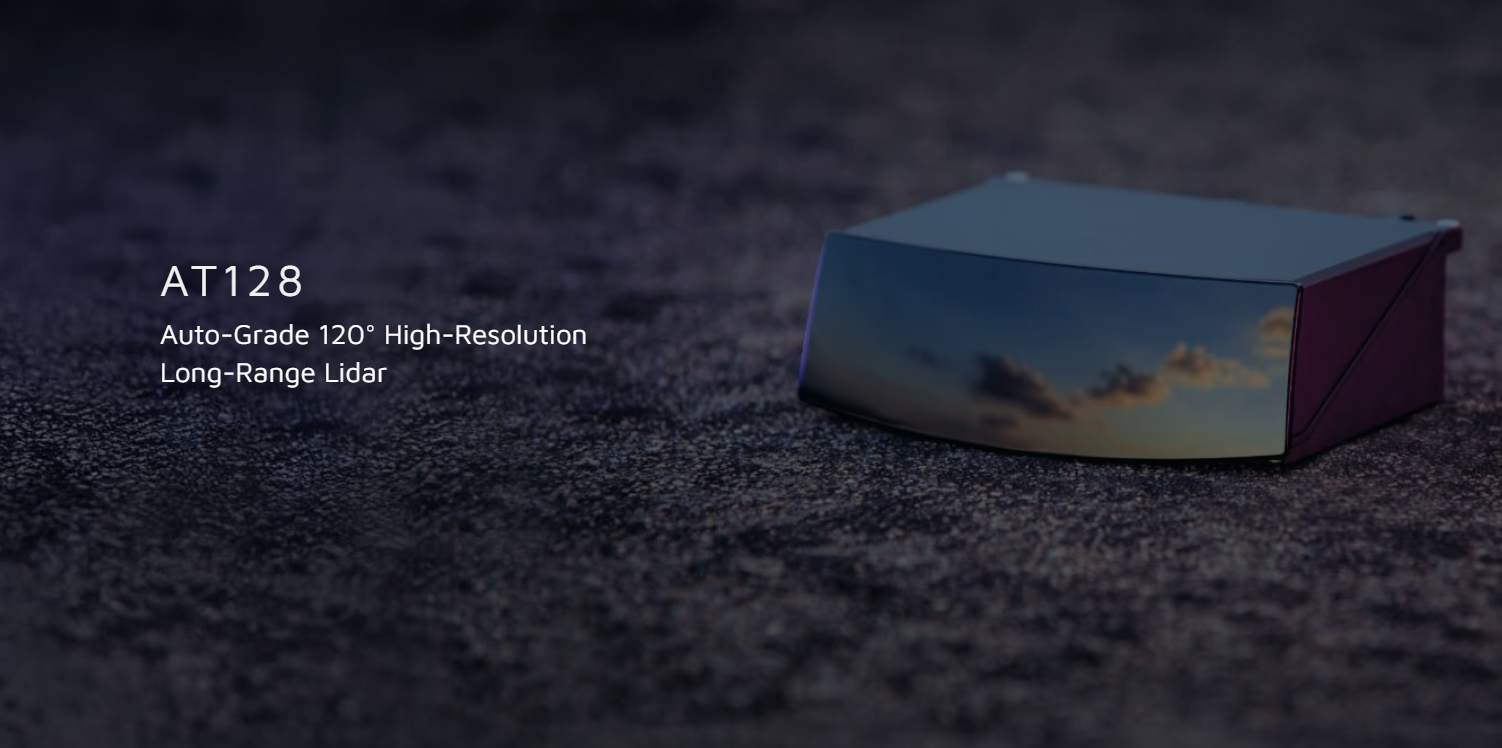
The Hesai AT128 earns a 4.8/5 rating — making it the most compelling forward-facing automotive LiDAR available for high-speed ADAS deployment today.
| Spec | Value |
| Range | Up to 200m (10% reflectivity) |
| Resolution | 1.53 million points per second |
| Field of View | 120° x 25.4° |
According to Yole Intelligence, Hesai Technology held a significant share of the global automotive ADAS LiDAR market in 2023 — and the AT128 is a primary reason why. Its hybrid solid-state architecture integrates 128 laser channels onto a single silicon chip, delivering point cloud density that mechanical and lower-channel alternatives simply can’t match at highway speeds.
The AT128’s true competitive edge is its “True Solid-State” reliability — no rotating parts, dramatically reduced failure risk, and automotive-grade durability validated against the harshest road conditions. As S&P Global Mobility notes, “the transition from Level 2 to Level 3 autonomous driving is fundamentally dependent on the redundancy provided by high-resolution LiDAR like the AT128.”
For those evaluating the broader Hesai ecosystem, it’s worth understanding how short-range solid-state designs differ before committing to a forward-facing configuration.
he AT128 sets the benchmark for long-range ADAS LiDAR — if highway-speed detection accuracy is your priority, the specs that follow will show you exactly why.
Key Features: 128 Channels of Silicon-Integrated Precision
The AT128 LiDAR’s hardware architecture sets a new technical baseline for production automotive sensors — one that competing approaches simply haven’t matched at scale.
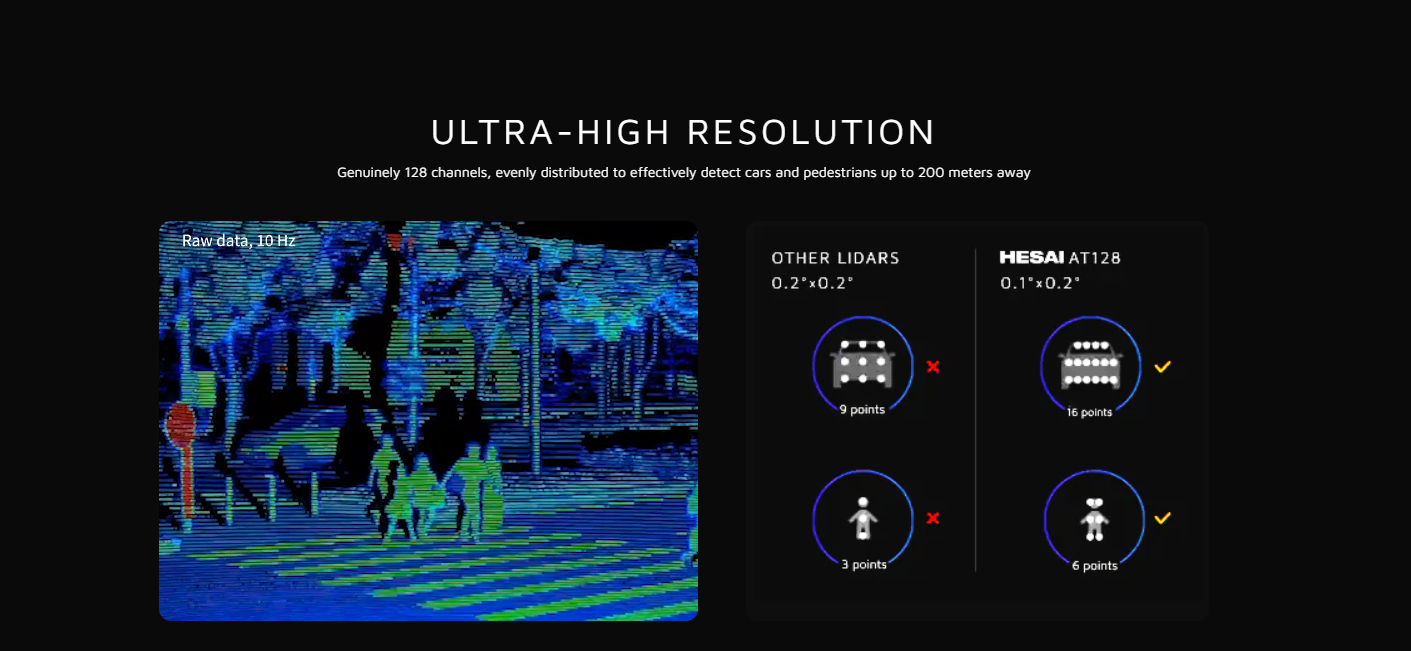
At the core: 128 independent laser channels integrated onto a single silicon chip, a design confirmed by teardown analysis from TechInsights. According to Yole Group, this monolithic integration eliminates the mechanical alignment tolerances that plague multi-component designs, directly improving long-term reliability in automotive environments.
Point Cloud Density
Where the AT128 LiDAR truly separates itself is sheer data throughput. The sensor generates 1.53 million points per second — a figure that translates directly into obstacle resolution at distance. Lower-channel alternatives (typically 32- or 64-line units) produce point clouds too sparse to reliably classify pedestrians or debris beyond 80 meters.
Killer Specs at a Glance:
- 128 channels — silicon-integrated for vibration resistance
- 1.53 million points per second — dense enough for fine object classification
- 120° × 25.4° Field of View — wide horizontal sweep for full-lane highway coverage
- Hybrid solid-state design — no spinning motor, reduced failure points
The 120° horizontal FOV is particularly significant for highway ADAS: it captures adjacent lanes simultaneously, giving fusion algorithms more context for lane-change decisions. If you’re evaluating how the AT128 fits within a broader sensor stack, this overview of automotive LiDAR selection provides useful framing.
Remember: raw channel count means little without silicon integration — the AT128’s architecture delivers both density and durability in a single package.
Performance Analysis: Solving the 10% Reflectivity Challenge
Detecting dark, low-reflective objects at highway speeds is the defining challenge for automotive lidar sensors — and it’s exactly where the AT128 earns its reputation.
The AT128 achieves a 200-meter detection range at just 10% reflectivity, according to Hesai’s official product specifications. That benchmark matters because real-world hazards — worn asphalt, dark clothing, debris — rarely reflect cleanly. Most competing approaches struggle below 15% reflectivity at comparable ranges.
At highway speeds above 100 km/h, a vehicle travels roughly 28 meters per second. Detecting an obstacle at 200 meters gives the vehicle approximately 7 seconds to initiate braking — enough margin to execute a full emergency stop with distance to spare. Compress that detection range to 80 meters, and that safety window collapses to under 3 seconds.
Lighting conditions compound the problem further. Camera-only perception degrades sharply in direct glare, tunnel entry, and low-light environments. As S&P Global Mobility notes, LiDAR functions regardless of ambient lighting, providing genuine redundancy where cameras go blind. The AT128’s active illumination means tunnel transitions — a classic “blind spot” for vision systems — present no detection gap.
For a broader look at how range and reflectivity specs shape real-world sensor selection, this overview of LiDAR performance factors is worth reviewing.
When evaluating long-range safety performance, the 200-meter/10% reflectivity threshold should be your minimum benchmark — anything less introduces unacceptable margin compression at highway speeds.
That said, raw range and lighting resilience are only part of the picture — the AT128’s real-world value also depends on its durability and how cleanly those strengths translate into deployable hardware.
Pros and Cons: Where the AT128 Wins (and Where it Doesn’t)
The AT128 delivers a compelling package for Autonomous Driving and ADAS applications — but like any specialized tool, it comes with meaningful trade-offs worth understanding before committing.
- ✅ Pros
- Automotive-grade durability built for mass-produced passenger vehicles, not just experimental fleets
- 128-channel resolution enables reliable classification of pedestrians versus road debris at distance
- High-volume production readiness reduces per-unit cost at scale
- Proven in real-world deployment on consumer vehicles
- ❌ Cons
- Fixed forward field of view requires pairing with additional sensors for full 360° coverage
- Dense point cloud output demands significant onboard compute resources
- Not a standalone perception solution for all driving scenarios
- Higher integration complexity compared to simpler, lower-resolution alternatives
The coverage limitation is worth emphasizing. For 360-degree perception, the AT128 must be paired with complementary sensors — a common multi-LiDAR architecture that adds system complexity. Those interested in how sensor fusion shapes full-coverage designs will find the trade-offs familiar.
The AT128’s strengths are narrow but deep — it excels precisely where automotive perception is hardest: long-range, high-resolution object detection in production conditions.
If your priority is forward-facing highway perception at scale, the AT128’s advantages are hard to match — but plan your sensor architecture accordingly.
Frequently Asked Questions about Hesai AT128
The AT128 answers some of the most common questions buyers have about automotive-grade LiDAR — here’s what you actually need to know.
Is the Hesai AT128 a true solid-state LiDAR?
No — the AT128 is a hybrid solid-state design, using a micro-oscillating mirror rather than a fully mechanical spinning assembly. This gives it greater durability than traditional rotating lidar while maintaining the wide field of view that pure solid-state units struggle to achieve.
How does the AT128 compare to the QT128 for mapping?
They’re built for different jobs. The QT128 is optimized for 360° short-range perception, making it the go-to for close-proximity mapping and parking scenarios, while the AT128 is the forward-facing long-range specialist. Teams needing full surround coverage often deploy both — a common pattern in production ADAS stacks today.
Can the AT128 be used for non-automotive 3D mapping?
In practice, it can — but it’s overspecified for most robotics or survey applications. If you’re sourcing sensors for non-automotive environments, broader LiDAR options for robotics will likely offer better value.
What makes the AT128 “automotive grade”?
Automotive grade (Automotive LiDAR) means ISO 26262 functional safety compliance, extreme temperature tolerance, and mass-production consistency. Hesai has already hit million-unit production milestones, which validates the supply chain reliability that OEMs demand.
Before drawing final conclusions, it’s worth consolidating exactly who the AT128 is built for — and whether its trade-offs align with your specific deployment needs.
Key Takeaways: The Bottom Line on the AT128
The Hesai AT128 sets the benchmark for production-ready automotive LiDAR, combining long-range detection, chip-level reliability, and mass-production scale that few alternatives can match.
Here’s what matters most after everything covered above:
- Market leadership is earned, not assumed. According to Yole Intelligence, Hesai ranks as the top-selling provider for passenger car ADAS LiDAR — a position the AT128 has directly contributed to.
- 200m range at 10% reflectivity is a highway safety game-changer. In practice, this gives ADAS systems critical extra seconds to react to low-visibility obstacles at speed.
- Chip-level integration eliminates legacy weak points. By consolidating components at the silicon level, the AT128 addresses the long-standing durability concerns that held earlier LiDAR designs back.
- OEM-grade stability makes it mass-production ready. For automakers building vehicles at scale, consistent unit performance matters as much as peak specs — and the AT128 delivers both.
- It powers the intelligent driver-assistance LiDAR use case that L2+/L3 vehicles demand most: reliable, always-on highway perception.
The AT128 is the clearest answer available today for OEMs that need automotive LiDAR they can actually ship. For teams evaluating sensor options, exploring vetted LiDAR suppliers is a logical next step before finalizing any integration decision.
If your program requires proven range, ASIL-rated reliability, and production-scale availability, the AT128 belongs at the top of your shortlist.
Sources and Technical References
The AT128’s technical claims are backed by a strong body of independent teardowns, manufacturer data, and industry analysis — here’s where the evidence comes from.
- Hesai Technology Official Announcement (PR Newswire) — Primary source for AT128 debut specifications, field-of-view parameters, and automotive-grade design intent as announced at CES 2022.
- TechInsights AT128 Teardown — Independent chip-level teardown analysis covering internal architecture, semiconductor components, and manufacturing quality assessments.
- EE Times Hardware Breakdown — Editorial teardown providing real-world context on how the AT128 integrates into production vehicles like the Li Auto L9.
- Lidarseek Product Intelligence — Comparative context on 128-channel solid-state LiDAR platforms, integration support, and procurement guidance. Lidarseek exports LiDAR sensors to 26 countries, including the US, EU, and Japan, offering buyers localized sourcing and technical support.
The AT128 is one of the most thoroughly documented production LiDAR sensors available — and these sources confirm that its performance claims hold up under independent scrutiny.
If you’re evaluating the AT128 for a production program or integration project, start with the TechInsights teardown and reach out to a verified distributor to confirm regional availability and pricing.









