

Introduction
Autonomous Mobile Robots (AMRs) are transforming modern logistics, manufacturing, and warehouse operations.
Unlike traditional Automated Guided Vehicles (AGVs), AMRs are designed to operate independently without relying only on fixed routes or physical guidance systems. They can understand their environment, avoid obstacles, create maps, and make real-time navigation decisions.
One of the most important technologies enabling this capability is 3D LiDAR sensing.
A high-performance LiDAR sensor allows an AMR to accurately perceive its surroundings, detect obstacles, perform SLAM mapping, and safely navigate in complex environments.
For robot manufacturers, choosing the right LiDAR sensor is a critical decision. The sensor directly affects:
- Navigation accuracy
- Safety performance
- Operating efficiency
- System reliability
- Customer experience
This guide explains everything you need to know about selecting the right LiDAR sensor for autonomous mobile robots.
What Is AMR LiDAR?
AMR LiDAR is a laser-based perception technology specifically used for autonomous robot navigation.
The sensor emits thousands of laser pulses per second and measures the reflected signals to calculate the distance between the robot and surrounding objects.
The collected data is converted into a detailed 3D point cloud, allowing the robot to understand:
- Walls
- Shelves
- Machines
- Human workers
- Vehicles
- Boxes
- Unexpected obstacles
Compared with traditional sensors, LiDAR provides accurate depth information and works independently from environmental lighting conditions.
This makes it one of the most reliable perception solutions for industrial robots.
Why Do AMRs Need 3D LiDAR Sensors?
1. Accurate Environment Perception
AMRs operate in constantly changing environments.
A warehouse may contain:
- Moving workers
- Temporary obstacles
- Changing inventory locations
- Other autonomous robots
A LiDAR sensor provides real-time environmental awareness, allowing robots to make safer navigation decisions.
2. Reliable SLAM Navigation
Most advanced AMRs use SLAM (Simultaneous Localization and Mapping) technology.
SLAM allows robots to:
- Build maps of unknown environments
- Locate their position accurately
- Optimize navigation paths
- Adapt to environmental changes
High-quality LiDAR data is essential for accurate SLAM performance.
Poor-quality sensor data can result in:
- Navigation errors
- Position drift
- Collision risks
- Reduced efficiency
3. Enhanced Safety
Safety is one of the biggest requirements for industrial robots.
AMRs often work alongside humans, meaning they must detect obstacles quickly and accurately.
LiDAR enables:
- Real-time obstacle detection
- Collision avoidance
- Human detection
- Emergency stopping
This helps create safer human-robot collaboration environments.
How LiDAR Enables Autonomous Robot Navigation
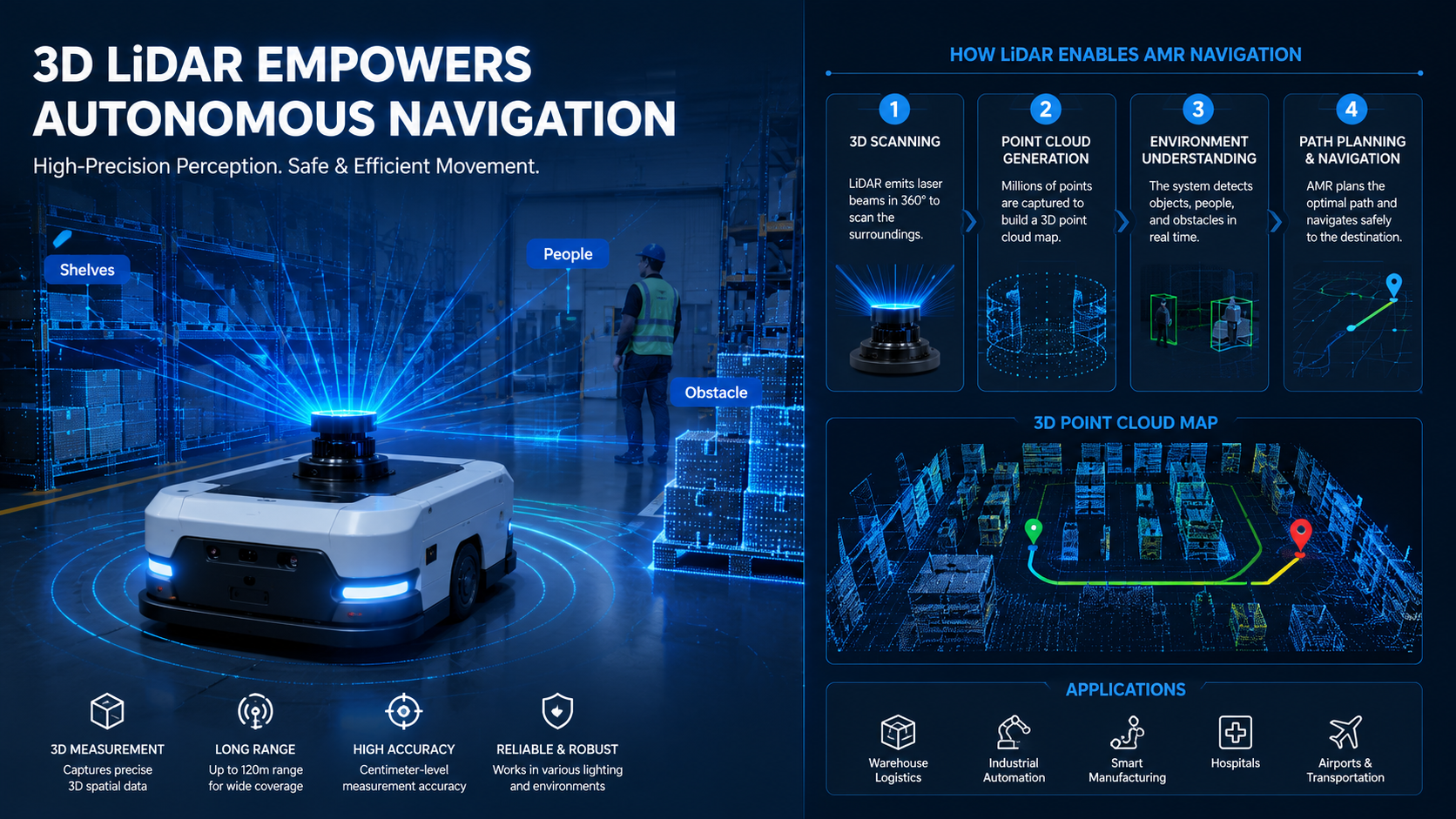
A modern AMR navigation system usually includes several components:
LiDAR Sensor
Collects environmental information through laser scanning.
Computing Unit
Processes point cloud data and runs perception algorithms.
SLAM Algorithm
Creates maps and calculates robot location.
Navigation Software
Plans routes and controls robot movement.
Motor System
Executes movement commands.
The LiDAR sensor acts as the robot’s “eyes,” providing the information required for intelligent decision-making.
Key Features of the Best LiDAR Sensors for AMRs
When selecting a LiDAR sensor for an AMR platform, manufacturers should evaluate several important specifications.
1. Detection Range
The required range depends on the robot environment.
Indoor warehouse robots:
Usually require:
- 10–50 meters detection range
Large industrial environments:
May require:
- 50–150 meters detection range
Longer detection range provides more time for robots to react to obstacles.
2. Field of View
A wider field of view helps robots understand their surroundings.
Many AMR applications benefit from:
- 360° horizontal scanning
- Wide vertical coverage
This reduces blind spots and improves navigation reliability.
3. Point Cloud Density
Point cloud density determines how much environmental detail the LiDAR can capture.
Higher density helps robots:
- Detect smaller objects
- Recognize complex structures
- Improve mapping accuracy
For advanced AMR applications, high-resolution 3D LiDAR is becoming increasingly important.
4. Compact Design
Robot manufacturers must consider sensor size and weight.
A compact LiDAR sensor provides:
- Easier mechanical integration
- Lower power consumption
- More flexible robot design
5. Software Compatibility
A good AMR LiDAR solution should support:
- ROS
- ROS 2
- SDK development
- Ethernet communication
- Point cloud APIs
Software compatibility can significantly reduce development time.
3D LiDAR Applications in Warehouse Robotics
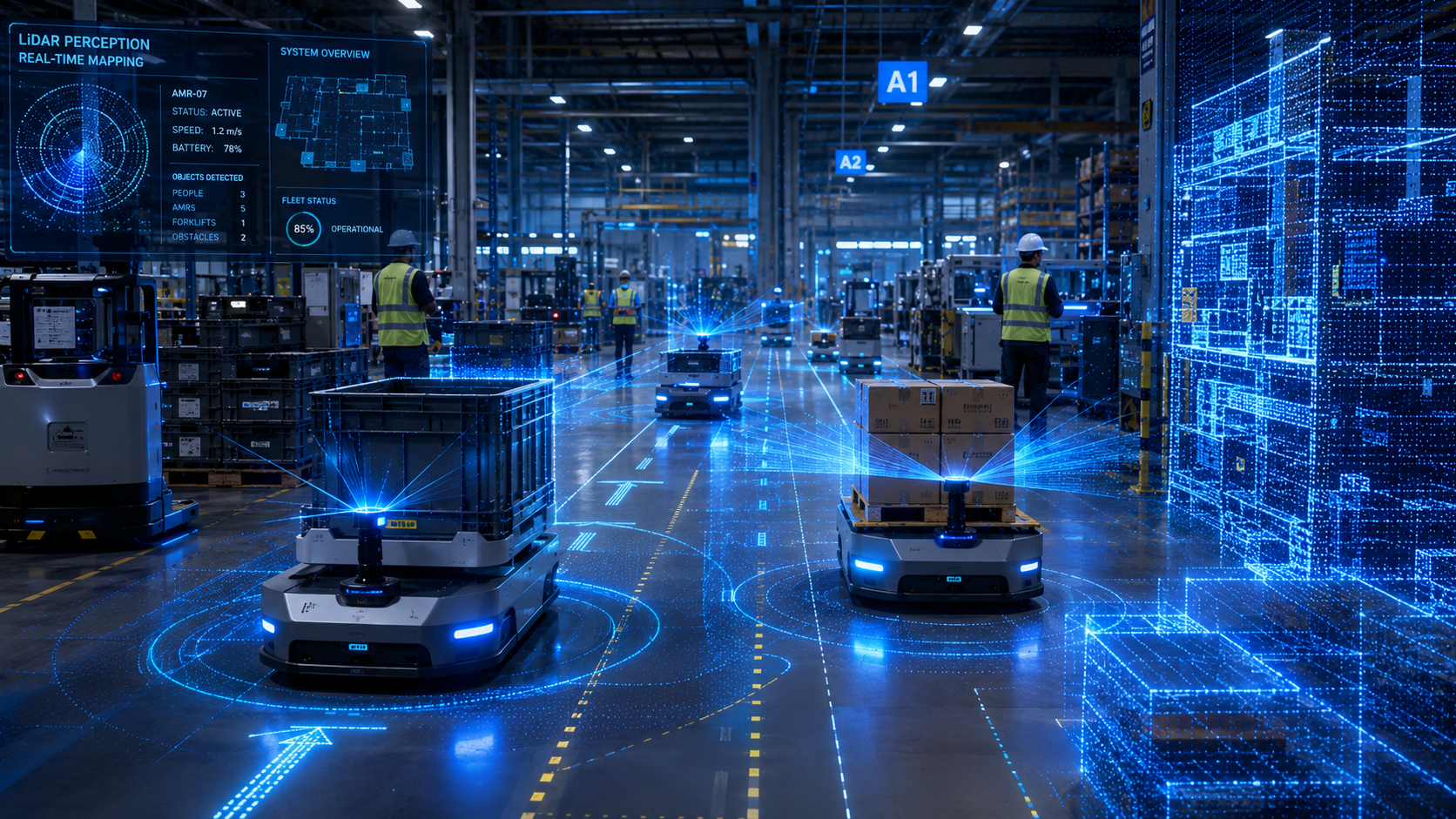
The rapid growth of e-commerce, smart manufacturing, and automated logistics has created a strong demand for intelligent warehouse robots.
AMRs equipped with LiDAR sensors are becoming essential tools for improving efficiency, reducing labor costs, and increasing operational flexibility.
Below are the most common applications of LiDAR-powered AMRs.
1. Goods-to-Person Warehouse Robots
Goods-to-person systems allow robots to automatically transport shelves, containers, or products to warehouse operators.
In these environments, LiDAR helps robots:
- Navigate through narrow aisles
- Detect people and equipment
- Avoid collisions
- Maintain accurate positioning
High-quality 3D LiDAR enables smooth operation even in busy warehouses with constantly changing conditions.
2. Material Handling Robots
Manufacturing facilities use AMRs to transport components, tools, and finished products between production areas.
Typical applications include:
- Automotive factories
- Electronics manufacturing
- Pharmaceutical production
- Food processing
LiDAR sensors provide reliable perception, allowing robots to operate safely around workers and machinery.
3. Autonomous Forklift Systems
Autonomous forklifts require advanced perception because they operate with heavy loads and in complex industrial environments.
LiDAR helps autonomous forklifts:
- Detect obstacles
- Identify pallet locations
- Navigate warehouse routes
- Improve positioning accuracy
Long-range industrial LiDAR sensors are especially valuable for these applications.
4. Inspection and Patrol Robots
Many factories and facilities use autonomous robots for inspection tasks.
With LiDAR technology, robots can:
- Create facility maps
- Navigate independently
- Monitor equipment areas
- Detect environmental changes
This reduces manual inspection costs and improves operational efficiency.
2D LiDAR vs 3D LiDAR for AMR Robots
When selecting sensors for AMR development, many companies ask:
Should we use 2D LiDAR or 3D LiDAR?
The answer depends on the complexity of the application.
| Feature | 2D LiDAR | 3D LiDAR |
|---|---|---|
| Dimension | Single scanning plane | Full 3D environment |
| Cost | Lower | Higher |
| Data Volume | Lower | Higher |
| Mapping Accuracy | Moderate | Excellent |
| Object Detection | Limited | Advanced |
| Multi-level Detection | Poor | Excellent |
| Complex Environment | Limited | Strong |
Advantages of 2D LiDAR
2D LiDAR is commonly used in basic navigation applications.
Advantages:
- Lower cost
- Simple integration
- Lower computing requirements
Suitable for:
- Simple indoor robots
- Basic AGVs
- Fixed environments
Advantages of 3D LiDAR
3D LiDAR provides much richer environmental information.
Advantages:
- Full spatial perception
- Better obstacle recognition
- More accurate SLAM
- Improved navigation reliability
Suitable for:
- Advanced AMRs
- Autonomous forklifts
- Outdoor robots
- Complex industrial environments
As robot intelligence continues to improve, more manufacturers are upgrading from 2D LiDAR to 3D LiDAR solutions.
How to Select the Right LiDAR Sensor for Your AMR Project
Choosing a LiDAR sensor should start with understanding your robot’s requirements.
1. Define Your Operating Environment
Ask:
Is the robot operating indoors or outdoors?
Indoor environments usually require:
- Compact sensors
- Medium range
- High accuracy
Outdoor environments may require:
- Longer detection range
- Strong environmental protection
- Higher durability
2. Determine Required Navigation Accuracy
Different applications require different accuracy levels.
For example:
Warehouse transportation:
- Standard navigation accuracy
Autonomous forklift:
- Higher positioning accuracy
Industrial inspection:
- High-resolution mapping
3. Consider Computing Requirements
Higher-resolution LiDAR generates more data.
Before selecting a sensor, ensure your computing platform can handle:
- Point cloud processing
- SLAM algorithms
- Real-time navigation
4. Evaluate Long-Term Availability
For commercial robot production, supply stability is extremely important.
Robot manufacturers should consider:
- Product lifecycle
- Production capacity
- Supplier reliability
- Technical support
A sensor that performs well but becomes unavailable later can create serious production problems.
Recommended LiDAR Solutions for AMR Manufacturers
Different AMR platforms require different LiDAR characteristics.
Compact AMR Platforms
Recommended features:
- Small form factor
- Low power consumption
- High integration flexibility
Typical applications:
- Indoor logistics robots
- Service robots
- Small autonomous platforms
Industrial Warehouse AMRs
Recommended features:
- Medium detection range
- High reliability
- Strong SLAM performance
Typical applications:
- Warehouse automation
- Factory logistics
- Material transportation
Outdoor Autonomous Robots
Recommended features:
- Long-range detection
- Weather resistance
- High environmental adaptability
Typical applications:
- Delivery robots
- Agriculture robots
- Security robots
Leading LiDAR Brands for Robotics Applications
The robotics market includes several leading LiDAR manufacturers.
Hesai LiDAR for AMR Applications
Hesai Technology is one of the world’s recognized LiDAR manufacturers, providing sensors for autonomous driving, robotics, and industrial applications.
Hesai LiDAR products are known for:
- High-quality point clouds
- Long detection range
- Strong reliability
- Professional developer support
Common applications include:
- AMRs
- Autonomous vehicles
- Mapping systems
- Industrial robotics
RoboSense LiDAR Solutions for Robotics
RoboSense develops intelligent LiDAR perception solutions for autonomous systems.
Its products are widely used in:
- Robotics
- Smart transportation
- Autonomous driving
- Industrial automation
Key advantages:
- Advanced perception technology
- High-resolution scanning
- Flexible integration options
Livox LiDAR for Robotics and Mapping
Livox provides cost-effective LiDAR solutions for robotics, mapping, and autonomous applications.
Livox sensors are often selected for:
- Research projects
- Robotics development
- 3D mapping
- UAV applications
Why Choose LIDARSEEK for AMR LiDAR Solutions?
Selecting the right LiDAR sensor can significantly impact your robot development timeline.
At LIDARSEEK, we help robotics companies find suitable LiDAR solutions based on their technical requirements and application scenarios.
Our support includes:
Product Selection Support
We help customers compare:
- Detection range
- Resolution
- Field of view
- Application suitability
- Integration requirements
Engineering Assistance
Our team can assist with:
- Product specifications
- Technical documents
- Sensor selection
- Application consultation
Global Supply Capability
LIDARSEEK supports international customers with:
- Global shipping
- Prototype quantities
- Engineering samples
- Production supply
Multi-Brand LiDAR Options
We provide access to multiple LiDAR solutions, helping customers select the most suitable sensor instead of being limited to one product line.
Frequently Asked Questions About AMR LiDAR Sensors
1. Why do AMR robots need LiDAR sensors?
AMRs use LiDAR sensors to perceive their environment, create maps, detect obstacles, and navigate autonomously.
2. Is 3D LiDAR better than 2D LiDAR for AMR robots?
For advanced AMRs operating in complex environments, 3D LiDAR generally provides better perception and navigation performance.
3. What range does an AMR LiDAR sensor need?
Most indoor AMRs require approximately 10–50 meters, while larger industrial robots may require longer ranges.
4. Can LiDAR detect people?
Yes. LiDAR can detect human movement and obstacles, helping AMRs operate safely around workers.
5. Does LiDAR work in darkness?
Yes. LiDAR does not depend on visible light, allowing reliable operation in dark environments.
6. Can LiDAR be used with ROS?
Many industrial LiDAR sensors support ROS and ROS 2 integration.
7. How many LiDAR sensors does an AMR need?
The number depends on robot design, blind spots, and safety requirements. Some robots use one sensor, while others combine multiple sensors.
8. What is the best LiDAR for warehouse robots?
The best choice depends on range, accuracy, environment, and integration requirements.
9. How much does an AMR LiDAR sensor cost?
Pricing depends on technology, performance, specifications, and quantity requirements.
10. Where can I buy LiDAR sensors for AMR development?
Companies can purchase industrial LiDAR sensors through specialized suppliers such as LIDARSEEK, which provides product sourcing, technical support, and global delivery.
Conclusion
LiDAR has become one of the most important sensing technologies for autonomous mobile robots.
As warehouses, factories, and logistics systems become increasingly automated, AMR manufacturers need reliable perception solutions that provide accurate mapping, safe navigation, and stable long-term operation.
Choosing the right LiDAR sensor requires careful consideration of:
- Detection range
- Resolution
- Field of view
- Software compatibility
- Environmental conditions
- Supplier reliability
With the right LiDAR solution, robot manufacturers can accelerate development and build safer, smarter, and more efficient autonomous systems.
Need the Right LiDAR Sensor for Your AMR Project?
LIDARSEEK provides professional LiDAR solutions for:
- Autonomous Mobile Robots
- AGVs
- Warehouse Automation
- Industrial Robotics
- Autonomous Vehicles
- Mapping Systems
Contact our LiDAR specialists today to:
✔ Compare suitable LiDAR models
✔ Request technical specifications
✔ Get a quotation
✔ Receive application recommendations
Build your next-generation autonomous robot with the right LiDAR technology.









