
Introduction: Why Automotive LiDAR Supplier Qualification Matters
As automotive manufacturers accelerate the development of ADAS, autonomous driving, and intelligent vehicle platforms, LiDAR technology is becoming an increasingly important part of advanced perception systems.
However, selecting a LiDAR sensor is only one part of the sourcing process.
For automotive OEMs and Tier 1 suppliers, approving a LiDAR supplier involves a much broader assessment of technical capability, quality management, product traceability, manufacturing readiness, documentation, and supply continuity.
A sensor may meet the engineering team’s initial performance requirements but still fail to meet the purchasing organization’s supplier qualification requirements.
This creates an important distinction between two decisions:
- Product qualification: Does the LiDAR meet the technical and application requirements?
- Supplier qualification: Can the supplier meet the customer’s commercial, quality, documentation, and supply requirements?
Both are important before a product moves toward production deployment.
This guide provides a practical framework for procurement managers, supplier quality engineers, commodity managers, and automotive engineering teams evaluating LiDAR suppliers.
1. Understand the Difference Between Product Approval and Supplier Approval
One of the first steps in automotive sourcing is separating product-level evaluation from supplier-level evaluation.
These processes are related, but they are not interchangeable.
Product Qualification
Product qualification focuses on whether the proposed LiDAR sensor meets the engineering requirements.
Typical evaluation areas include:
- Detection range and measurement performance
- Horizontal and vertical field of view
- Point cloud characteristics
- Environmental operating conditions
- Power consumption
- Communication interfaces
- Mechanical dimensions
- Software and system compatibility
Engineering teams may conduct laboratory testing, vehicle testing, integration trials, and application-specific validation.
Supplier Qualification
Supplier qualification evaluates whether the company providing the product can meet the customer’s purchasing and quality requirements.
Typical evaluation areas include:
- Legal business identity
- Quality management system
- Product sourcing and traceability
- Manufacturing and supply capabilities
- Quality documentation
- Engineering change management
- Warranty and after-sales support
- Delivery performance
- Contractual and compliance requirements
A supplier may offer a technically suitable product but still require additional qualification before becoming an approved source.
Procurement recommendation: Establish separate technical and supplier qualification checklists. This helps engineering, purchasing, and quality departments evaluate suppliers using clearly defined responsibilities.
2. Evaluate Quality Management Systems and IATF 16949 Requirements
Quality management is a central consideration in automotive supply chains.
IATF 16949 is an automotive quality management system standard designed to support defect prevention, variation reduction, and continuous improvement across the automotive supply chain.
However, procurement teams should understand that certification requirements depend on the supplier’s role, manufacturing activities, customer-specific requirements, and applicable contractual scope.
Not every independent trading or sourcing company automatically needs to hold the same certification as a manufacturer.
For LiDAR procurement, buyers should clarify:
- Who is the actual product manufacturer?
- Which legal entity is responsible for the quotation and contract?
- Which company is responsible for product quality?
- Does the customer require IATF 16949 certification from the direct supplier, manufacturer, or a particular production site?
- Are additional customer-specific quality requirements applicable?
A supplier should provide accurate information about its own certifications and should not present a manufacturer’s certification as its own.
Questions for Supplier Quality Teams
- Is the manufacturer’s quality management system documented?
- Is the relevant certification valid and applicable to the production site?
- Are product quality responsibilities clearly assigned?
- Are customer-specific requirements understood?
- Is there a defined process for handling nonconforming products?
For automotive sourcing, the IATF Global Oversight website provides access to OEM-specific requirements that may be relevant to supplier qualification.
Reference: https://www.iatfglobaloversight.org/oem-requirements/customer-specific-requirements/
3. Understand PPAP and Production Approval Requirements
Production Part Approval Process (PPAP) is an important quality process in the automotive industry.
It is used to establish confidence that production processes can consistently manufacture parts meeting engineering design records and specification requirements.
AIAG publishes the PPAP reference manual and related training resources.
However, procurement teams should not assume that every LiDAR purchasing transaction automatically requires a complete PPAP submission.
Whether PPAP applies, and the required submission level, should be determined by the customer’s supplier quality requirements, product scope, contractual obligations, and program requirements.
For a LiDAR sourcing project, buyers may need to clarify whether the following documentation is required:
- Approved product specifications
- Engineering drawings and revision information
- Product performance test reports
- Material or component information, where applicable
- Manufacturing process documentation, where applicable
- Inspection and test records
- Product identification and traceability information
- Engineering change records
- Production approval documentation
What Should Procurement Ask?
Before requesting PPAP documentation, clarify:
- Is the LiDAR manufacturer expected to submit PPAP?
- Is the direct supplier responsible for collecting and coordinating documentation?
- Which PPAP submission level is required?
- Are customer-specific forms or additional documents necessary?
- What is the approval process before production release?
The objective is to establish a realistic documentation plan before the purchasing process reaches the production stage.
4. Verify Product Traceability and Configuration Control

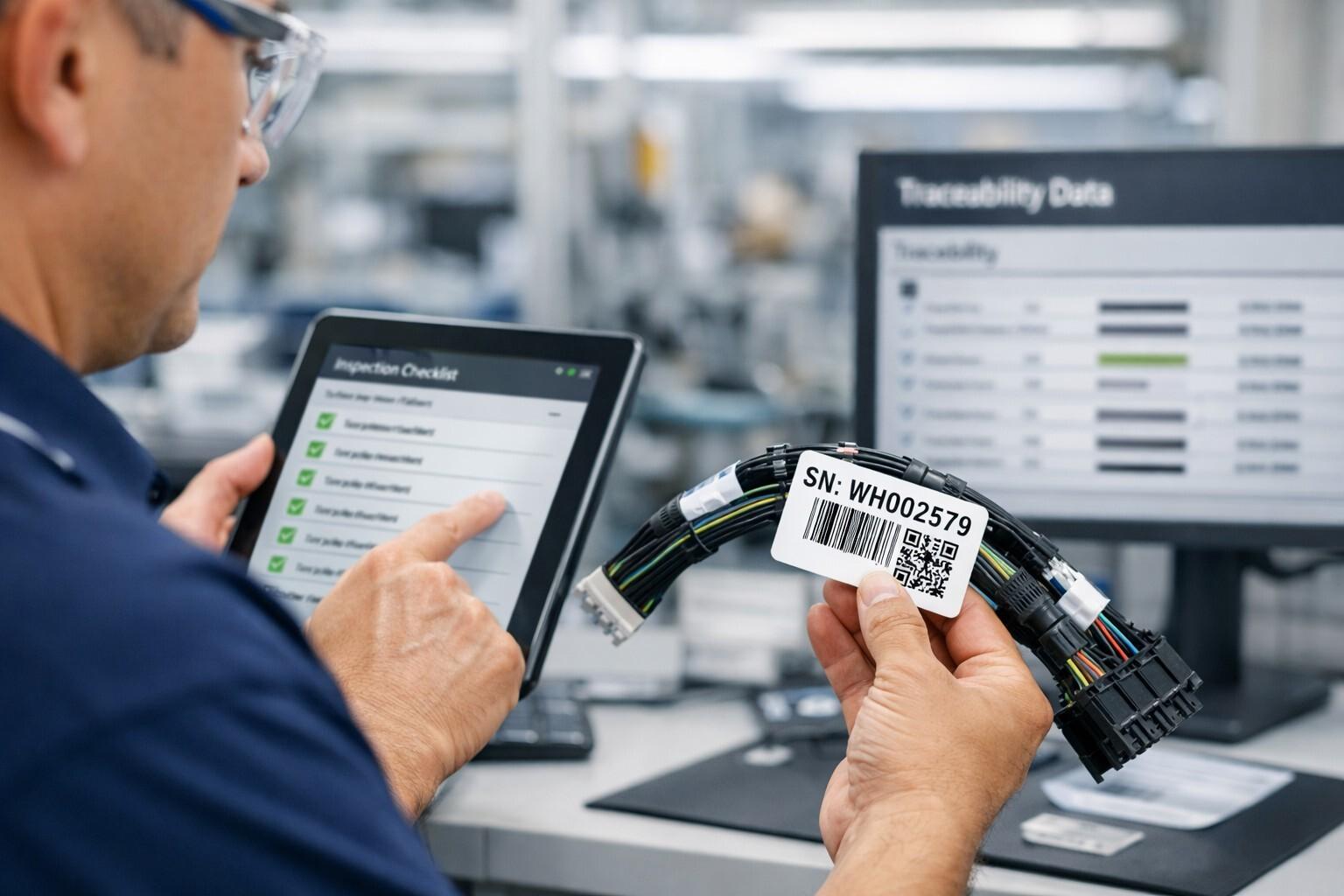
Traceability is particularly important when LiDAR sensors are deployed across multiple vehicles, production batches, or engineering programs.
If a technical issue occurs after deployment, the customer may need to identify the exact products involved.
A professional procurement process should establish which product identification information is available.
Depending on the manufacturer’s system and customer requirements, relevant information may include:
- Product model number
- Serial number
- Hardware revision
- Firmware version
- Manufacturing or production date
- Production batch or lot identification
- Associated quality inspection records
Why Does This Matter?
Consider an automotive project that purchases 500 LiDAR sensors over several months.
If the manufacturer introduces a hardware revision during the purchasing period, the engineering and quality teams need to understand which units belong to which configuration.
Without proper identification and revision control, investigating a field issue or comparing performance across batches becomes more difficult.
Procurement teams should therefore ask suppliers how product identity, revision information, and applicable inspection records are maintained.
Practical recommendation: Request a sample product identification record before placing a large order. Confirm that the available information meets the customer’s traceability requirements.
5. Establish Engineering Change Notification Procedures
Engineering changes are an important consideration for automotive electronics.
Changes may occur during a product’s lifecycle, including:
- Hardware component changes
- PCB revisions
- Optical component modifications
- Firmware updates
- Connector or cable changes
- Mechanical structure modifications
- Manufacturing process changes
- Product discontinuation or successor model introduction
Not every engineering change has the same impact.
A minor change may have no effect on the customer’s application, while another change could require additional testing or engineering approval.
For this reason, automotive buyers should establish a formal change notification process.
Key Questions for LiDAR Suppliers
- How are product revisions identified?
- How are customers notified about significant changes?
- Is advance notification available for planned changes?
- Can the supplier provide a description of the change?
- Is supporting validation information available?
- Will the customer be informed before a product is discontinued?
- Can existing approved configurations be maintained for an agreed period?
The purchasing agreement should clarify which changes require prior customer notification or approval.
This is particularly important for automotive projects with long development cycles and strict configuration control requirements.
6. Assess Production Capacity and Supply Continuity
A supplier that can provide engineering samples may not necessarily be ready to support a large production program.
The transition from prototype purchasing to commercial production introduces additional requirements.
Procurement teams should evaluate the supplier’s ability to support the expected demand profile.
Important considerations include:
Current Availability
Is the required quantity physically available, or does it depend on future production?
Manufacturing Capacity
Can the manufacturer support the expected purchasing volume?
Production Planning
Can the supplier coordinate deliveries according to the customer’s production schedule?
Batch Consistency
Can products be supplied with the required approved configuration and identification?
Lifecycle Management
Is the product currently in production? Are there known lifecycle changes that could affect future procurement?
Contingency Planning
What happens if production is delayed or the required model becomes unavailable?
For projects requiring hundreds or thousands of sensors, procurement teams should request realistic availability information rather than relying on general statements about supply capability.
Where appropriate, discuss forecast sharing, planned order schedules, and partial delivery arrangements.
7. Review Technical Documentation and Engineering Support
Automotive engineering teams require more than a product datasheet.
Depending on the application and integration stage, relevant technical resources may include:
- Product datasheets
- User manuals
- Interface specifications
- Communication protocols
- SDK documentation
- ROS or ROS 2 integration resources
- CAD files and mechanical drawings
- Configuration instructions
- Firmware information
- Performance test reports
- Environmental specifications
The exact documentation package should be agreed with the manufacturer and customer.
Engineering Support Evaluation
Procurement and engineering teams should also understand how technical questions will be handled.
For example:
- Who is responsible for answering technical questions?
- Can questions be escalated to the manufacturer’s engineering team?
- Is integration assistance available?
- Are firmware and configuration questions supported?
- What is the process for investigating reported product issues?
A clear technical support process can help reduce communication delays during system integration and validation.
For automotive projects, distinguish between standard technical assistance and formal product development or functional safety responsibilities.
These are not necessarily included in a standard product supply agreement.
8. Understand ISO 26262 and Functional Safety Considerations
ISO 26262 is an international functional safety standard for safety-related electrical and electronic systems in road vehicles.
It addresses potential hazards caused by malfunctioning behavior of safety-related systems and covers activities across the safety lifecycle.
However, an important distinction must be made:
A LiDAR sensor being used in an automotive application does not automatically mean that the sensor itself must carry a particular ASIL rating or that every LiDAR supplier must hold ISO 26262 certification.
The applicable requirements depend on the vehicle-level safety architecture, intended safety function, system integration, and customer requirements.
Procurement teams should work with functional safety and engineering teams to clarify:
- Is the LiDAR part of a safety-related function?
- What safety requirements apply to the complete system?
- What evidence or documentation is required from the component manufacturer?
- Are safety manuals or assumptions of use available?
- What hardware and software information is needed?
- Are there specific supplier development or assessment requirements?
For safety-related applications, these requirements should be addressed during the early sourcing and system architecture stages rather than after a product has already been selected.
9. Evaluate Warranty, Nonconformance Handling, and After-Sales Responsibilities
Supplier qualification should also cover what happens when a product does not meet the agreed requirements.
Before approving a supplier, purchasing and quality teams should clarify:
Warranty
- What is the applicable warranty period?
- When does the warranty period begin?
- Which product failures are covered?
- What conditions may exclude warranty coverage?
Nonconforming Products
- How should quality issues be reported?
- What evidence is required?
- Who coordinates technical investigation?
- Is there a defined replacement or repair process?
Corrective Actions
- Can the responsible party investigate the root cause?
- Can corrective actions be documented?
- Is a formal corrective action report available when required?
After-Sales Support
- Who is the customer’s main contact?
- How are technical issues escalated?
- What is the expected response process?
- Are spare parts or replacement products available?
For large automotive programs, these responsibilities should be defined contractually wherever possible.
A clear process is much more useful than a general promise of after-sales support.
10. Create a Structured LiDAR Supplier Qualification Scorecard
For procurement teams evaluating multiple suppliers, a standardized scorecard can improve consistency and support internal approval decisions.
The following framework is an example that companies can adapt to their own supplier qualification procedures.
| Evaluation Category | Suggested Weight |
|---|---|
| Technical product compliance | 20% |
| Quality management and documentation | 20% |
| Product traceability and change control | 15% |
| Production and supply capability | 15% |
| Commercial and legal compliance | 10% |
| Warranty and nonconformance handling | 10% |
| Technical support and communication | 10% |
| Total | 100% |
Each supplier can be evaluated on a 1–5 scale.
A higher score indicates stronger evidence of compliance with the evaluation criteria.
However, the score should not replace mandatory qualification requirements.
For example, if a customer requires a specific certification, legal document, or formal engineering approval, a high score in other categories cannot compensate for the missing requirement.
A practical supplier qualification process should use:
- Mandatory pass/fail requirements.
- Supporting documentation review.
- Technical and commercial evaluation.
- Risk assessment.
- Formal approval by the responsible departments.
This makes the supplier selection process more transparent and easier to audit.
11. Common Mistakes in Automotive LiDAR Supplier Qualification
Even experienced purchasing teams can overlook important details.
Here are several issues worth avoiding.
Mistake 1: Treating the product manufacturer and direct supplier as the same legal entity
Always identify who manufactures the product and who is responsible for the commercial transaction.
Mistake 2: Assuming a supplier’s certification covers every entity in the supply chain
Verify the certificate holder, scope, and applicable production site.
Mistake 3: Requesting PPAP without defining the required submission scope
Clarify customer-specific requirements, applicable submission levels, and responsible parties.
Mistake 4: Ignoring product revision control
A technically approved model may change during the project lifecycle.
Mistake 5: Treating an engineering sample as proof of mass-production readiness
Prototype availability does not automatically demonstrate production capacity or batch consistency.
Mistake 6: Overlooking the manufacturer’s lifecycle policy
A product discontinuation can create additional engineering and procurement work.
Mistake 7: Failing to define warranty and quality responsibilities
Clarify how product issues, investigations, and corrective actions will be handled before placing a production order.
12. A Practical Supplier Qualification Workflow for Automotive Buyers
A structured process can help purchasing, quality, and engineering teams work together more efficiently.
Stage 1: Initial Supplier Screening
Review the supplier’s legal identity, product portfolio, supply channel, and commercial capabilities.
Stage 2: Technical Evaluation
Confirm the exact LiDAR model, technical specifications, interfaces, and application compatibility.
Stage 3: Quality Documentation Review
Request applicable quality certifications, product identification information, inspection records, and other required documentation.
Stage 4: Supplier Quality Assessment
Evaluate manufacturing responsibility, quality processes, change notification, traceability, and nonconformance handling.
Stage 5: Sample Validation
Coordinate sample testing and engineering approval based on predefined application requirements.
Stage 6: Commercial Evaluation
Review pricing, payment terms, delivery conditions, warranty, and project-specific purchasing requirements.
Stage 7: Production Readiness Review
Confirm approved configuration, required documentation, quantity availability, and delivery planning.
Stage 8: Ongoing Supplier Performance Monitoring
Monitor delivery performance, product quality, communication, and change management throughout the supply relationship.
This approach helps organizations identify potential risks before they affect production schedules.
How LIDARSEEK Supports Automotive and Industrial LiDAR Sourcing
LIDARSEEK provides international customers with access to LiDAR sensors and intelligent perception products for automotive, robotics, and industrial applications.
We understand that professional customers need more than product availability and competitive pricing.
They also need accurate product information, clear sourcing arrangements, technical communication, and reliable coordination throughout the purchasing process.
Our support includes:
Multi-Brand Product Sourcing
Access to LiDAR products from manufacturers including Hesai, RoboSense, Seyond, Livox, and other sensing technology providers.
Product and Documentation Coordination
Assistance with product specifications, available technical documentation, model identification, and product configuration questions.
Project-Based Procurement
Support for prototype quantities, engineering evaluation, pilot projects, and larger purchasing requirements.
Availability and Delivery Coordination
Assistance with inventory checks, lead-time coordination, and international shipping arrangements.
Technical Support
Professional assistance with product selection, technical documentation, configuration questions, and integration-related inquiries.
We believe that transparent communication and clearly defined purchasing requirements are essential to building successful long-term business relationships.
We also recognize that customer-specific automotive qualification requirements must be evaluated individually. Certification, formal PPAP submissions, and quality documentation should be confirmed with the relevant manufacturer and contracting parties rather than assumed to be available for every product.
Request LiDAR Product and Supplier Information
Are you evaluating LiDAR suppliers for an automotive OEM, Tier 1, ADAS, autonomous driving, robotics, or industrial vehicle project?
LIDARSEEK welcomes inquiries from purchasing departments, engineering teams, and supplier development professionals.
Send us your requirements to discuss:
- Available LiDAR models and manufacturers
- Product specifications and technical documentation
- Required quantities and project schedules
- Available quality and product identification information
- Commercial quotations and international delivery options
- Technical questions and application requirements
To help us respond efficiently, please include your company, target application, required model or technical specifications, estimated quantity, and delivery destination.
Contact LIDARSEEK
Website: https://lidarseek.com/
Email: lidarseektech@gmail.com
WhatsApp: +86 159 5882 2714
Looking for a LiDAR sourcing partner for your next automotive or industrial project? Contact LIDARSEEK to discuss your technical and procurement requirements.









