

Introduction: Why LiDAR Has Become Essential for AMR Robots
Autonomous Mobile Robots (AMRs) are transforming warehouses, factories, logistics centers, hospitals, and industrial environments. Unlike traditional automated guided vehicles (AGVs), AMRs can navigate dynamically, avoid obstacles, and adapt to changing environments without requiring fixed paths.
At the core of modern AMR navigation systems is 3D LiDAR technology.
A high-performance LiDAR sensor provides autonomous robots with accurate environmental perception by generating real-time 3D point clouds. This allows robots to understand their surroundings, detect obstacles, perform mapping, and safely navigate complex environments.
For companies developing AMR robots, selecting the right LiDAR sensor is one of the most important decisions during product development. The wrong sensor choice can affect navigation accuracy, system stability, development costs, and production scalability.
This guide explains how to choose the best LiDAR sensor for AMR robots in 2026, including key specifications, application requirements, and recommended LiDAR solutions.
Table of Contents
- What Is a LiDAR Sensor for AMR Robots?
- Why AMR Robots Need 3D LiDAR Sensors
- Key Factors When Choosing LiDAR for AMR Applications
- Recommended LiDAR Sensors for Autonomous Mobile Robots
- 2D LiDAR vs 3D LiDAR for AMR Robots
- How to Select LiDAR Based on Robot Application
- Why Choose LIDARSEEK as Your LiDAR Supplier
- Frequently Asked Questions About AMR LiDAR Sensors
- Request a LiDAR Solution for Your Robot Project
What Is a LiDAR Sensor for AMR Robots?
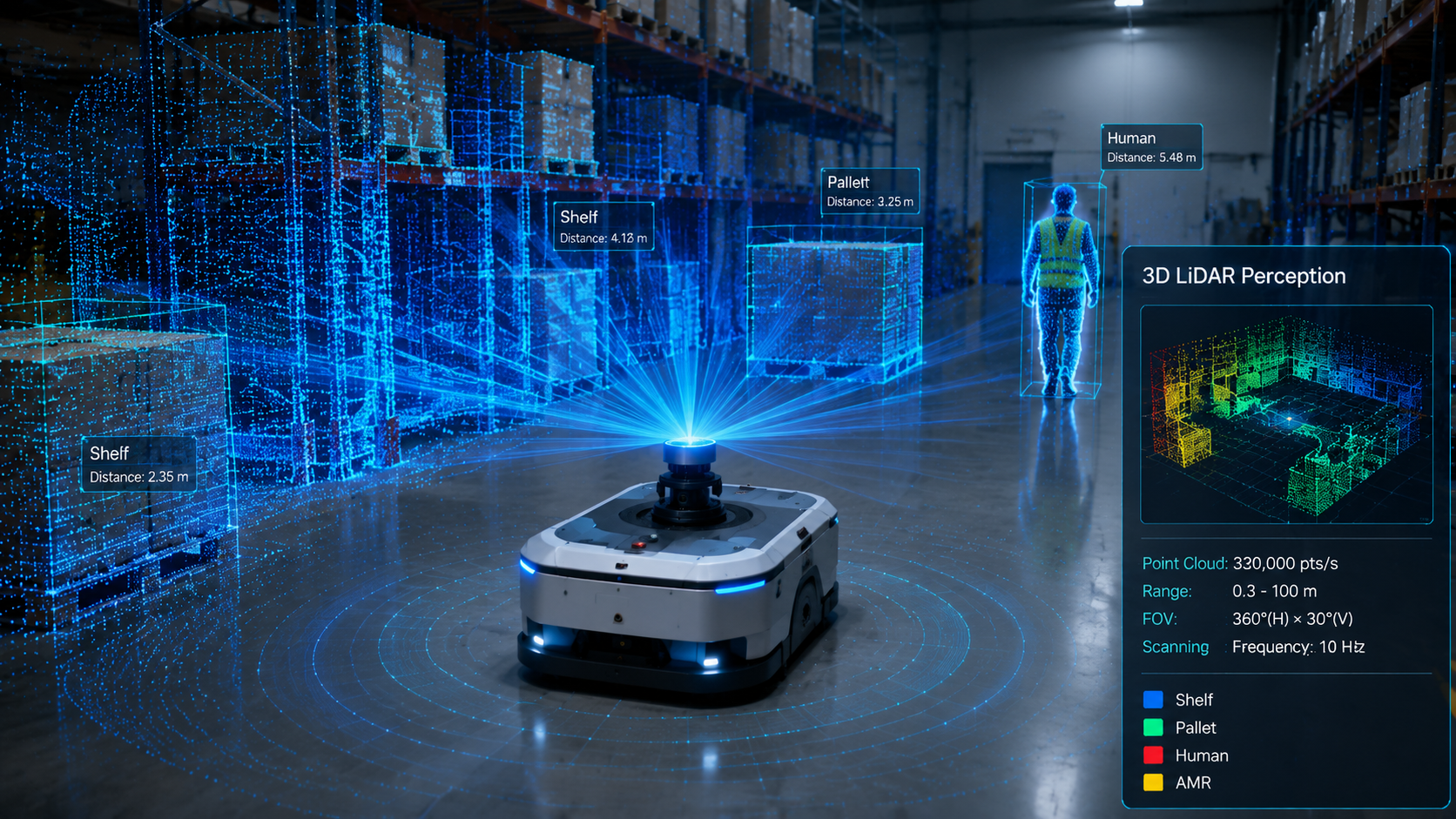
A LiDAR sensor (Light Detection and Ranging) is an advanced perception device that measures distances by emitting laser pulses and calculating the time required for reflected signals to return.
For AMR robots, LiDAR creates a detailed 3D representation of the surrounding environment. The robot uses this information together with algorithms such as SLAM (Simultaneous Localization and Mapping) to understand its location and plan safe routes.
Modern industrial LiDAR sensors provide:
- High-resolution 3D point clouds
- Long-range detection
- Wide field of view
- Fast scanning frequency
- Accurate obstacle detection
- Reliable operation in industrial environments
These capabilities make LiDAR one of the most widely used perception technologies in autonomous robotics.
Why Do AMR Robots Need 3D LiDAR Sensors?
AMR robots operate in environments where conditions constantly change.
For example:
- Warehouse workers move around randomly
- Pallets may be placed in different locations
- Equipment positions can change
- Narrow spaces require precise navigation
Traditional navigation methods cannot always handle these challenges.
3D LiDAR enables AMRs to:
1. Perform Accurate Mapping
LiDAR sensors capture surrounding structures and create detailed maps of warehouses, factories, and industrial facilities.
This allows robots to:
- Understand the environment
- Identify navigation routes
- Improve positioning accuracy
2. Detect Obstacles in Real Time
Safety is critical for autonomous robots.
LiDAR allows AMRs to detect:
- People
- Vehicles
- Boxes
- Equipment
- Unexpected obstacles
The robot can then automatically slow down, stop, or change direction.
3. Improve Navigation Reliability
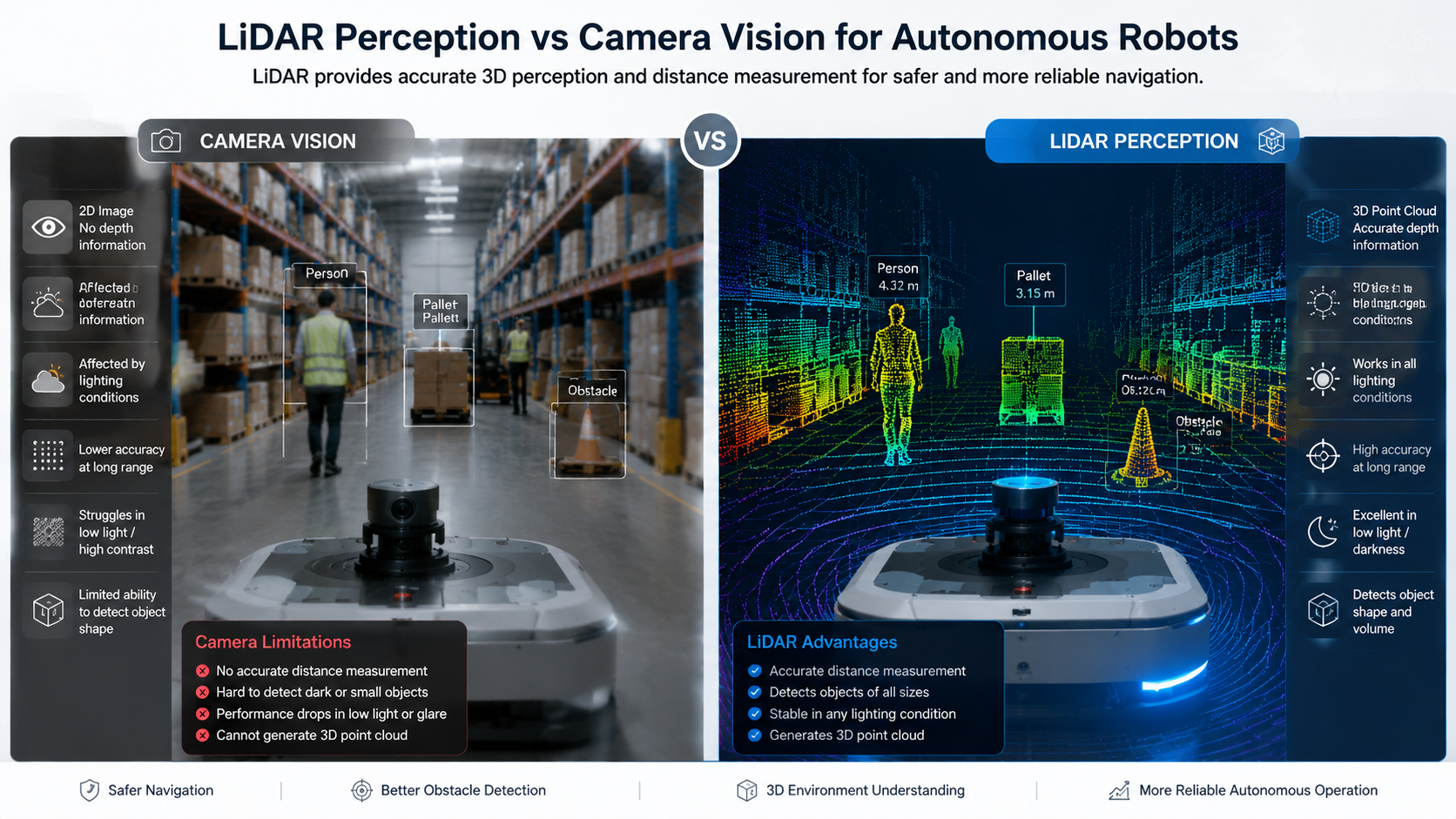
Compared with cameras alone, LiDAR provides accurate distance measurement even in:
- Low-light environments
- Large warehouses
- Industrial areas
- Complex indoor spaces
This improves robot reliability and operational efficiency.
Key Factors When Choosing LiDAR for AMR Robots
Choosing a LiDAR sensor requires more than comparing price and specifications.
The following factors are important for AMR developers.
1. Detection Range
The required LiDAR range depends on robot speed and operating environment.
For example:
Small indoor robots
Typical requirements:
- Short to medium range detection
- Compact size
- Low power consumption
Industrial AMRs
May require:
- Longer detection distance
- Wider coverage
- Higher point cloud density
A longer detection range gives robots more time to react to obstacles.
2. Field of View (FOV)
Field of view determines how much surrounding area the LiDAR can observe.
A wider FOV helps AMRs:
- Detect obstacles from multiple directions
- Navigate narrow environments
- Improve safety performance
For mobile robots, wide-angle LiDAR sensors are often preferred.
3. Point Cloud Resolution
Higher resolution provides more detailed environmental information.
Important parameters include:
- Channel number
- Point rate
- Angular resolution
- Scanning frequency
High-resolution LiDAR is especially useful for:
- Large warehouses
- Complex industrial environments
- Outdoor autonomous robots
4. Size and Integration Requirements
AMR manufacturers often have strict mechanical requirements.
Important considerations:
- Sensor dimensions
- Weight
- Communication interface
- Mounting method
- Power consumption
Compact LiDAR sensors are easier to integrate into commercial robot designs.
Recommended LiDAR Sensors for AMR Robots
LIDARSEEK provides a range of LiDAR solutions suitable for autonomous robots, industrial automation, and robotics development.
Hesai XT16 LiDAR
Hesai XT16 is a compact 3D LiDAR sensor suitable for robotics applications requiring reliable environmental perception.
Applications:
- AMR robots
- Service robots
- Indoor navigation
- Autonomous platforms
Advantages:
- Compact design
- Stable performance
- Suitable for robot integration
Hesai XT32 LiDAR
Hesai XT32 is a higher-performance 3D LiDAR sensor designed for applications requiring improved resolution and detection capability.
Suitable for:
- Industrial robots
- Autonomous vehicles
- Mapping systems
- Advanced robotics platforms
Advantages:
- Higher point cloud density
- Long-range perception
- Reliable industrial performance
RoboSense LiDAR Solutions
RoboSense provides advanced LiDAR sensors widely used in autonomous driving and robotics applications.
Their LiDAR products offer:
- High-resolution perception
- Strong environmental adaptability
- Advanced point cloud processing capability
They are suitable for:
- AMR development
- Autonomous systems
- Industrial automation
3D LiDAR vs 2D LiDAR for AMR Robots
2D LiDAR
Advantages:
- Lower cost
- Simple integration
- Common in basic indoor robots
Limitations:
- Limited height detection
- Cannot fully understand 3D environments
3D LiDAR
Advantages:
- Full environmental perception
- Better obstacle detection
- More accurate mapping
- Suitable for advanced autonomous robots
Limitations:
- Higher cost
- Requires more computing capability
For next-generation AMR robots, 3D LiDAR is becoming the preferred solution because of its superior perception capability.
How to Select the Right LiDAR Based on Robot Application
Different robots require different LiDAR solutions.
Warehouse AMR Robots
Recommended requirements:
- Reliable indoor navigation
- Obstacle avoidance
- High mapping accuracy
Suitable LiDAR:
- Hesai XT16
- Livox MID-360
- RoboSense robotics LiDAR solutions
Industrial Inspection RobotsRecommended requirements:
- Long-range detection
- High-resolution point clouds
- Stable operation
Suitable LiDAR:
- Hesai XT32
- RoboSense high-performance LiDAR
Autonomous Delivery Robots
Recommended requirements:
- Wide FOV
- Human detection
- Outdoor adaptability
Suitable LiDAR:
- Multi-sensor LiDAR configurations
Why Choose LIDARSEEK as Your LiDAR Supplier?
LIDARSEEK specializes in providing LiDAR sensors and perception solutions for robotics, autonomous systems, and industrial applications.
We support customers with:
Global LiDAR Sourcing Expertise
We provide access to leading LiDAR brands including Hesai, RoboSense, and Livox, helping customers select suitable sensors based on their project requirements.
Reliable Supply Channels
We help customers obtain genuine LiDAR products with stable supply support for prototypes and production projects.
Engineering Support
Our team assists customers with:
- LiDAR selection
- Specification comparison
- Application recommendations
- Project requirements
Prototype to Production Supply
Whether you need one evaluation unit for testing or multiple units for commercial deployment, LIDARSEEK supports your development process.
Global Shipping Support
We serve customers worldwide and provide efficient quotation, logistics coordination, and export support.
Frequently Asked Questions About AMR LiDAR Sensors
1. What is the best LiDAR sensor for AMR robots?
The best LiDAR depends on robot requirements, environment, range, and budget. Compact sensors such as Hesai XT16 are suitable for many indoor robots, while higher-performance sensors such as Hesai XT32 are designed for more demanding applications.
2. Why do AMR robots use LiDAR instead of cameras?
LiDAR provides accurate distance measurement and works reliably in different lighting conditions, making it highly suitable for autonomous navigation.
3. Can LiDAR be used for warehouse robots?
Yes. LiDAR is widely used in warehouse AMRs for mapping, localization, and obstacle avoidance.
4. What information does a LiDAR sensor provide?
LiDAR provides 3D point cloud data containing distance and spatial information about surrounding objects.
5. How many LiDAR sensors does an AMR robot need?
The number depends on robot design. Some robots use one primary LiDAR sensor, while advanced systems may combine multiple sensors for wider coverage.
6. Is 3D LiDAR suitable for indoor robots?
Yes. Modern compact 3D LiDAR sensors are designed specifically for indoor robotics applications.
7. Can I buy LiDAR sensors for prototype development?
Yes. LIDARSEEK supports evaluation units and prototype projects.
8. Do you provide international shipping?
Yes. LIDARSEEK supports customers worldwide with international shipping solutions.
9. Can you recommend a LiDAR based on my robot project?
Yes. Our team can recommend suitable LiDAR models based on your application, range requirements, and integration needs.
10. Do you support OEM robotics companies?
Yes. We support OEM customers from prototype development to production supply.
Conclusion: Choosing the Right LiDAR Accelerates AMR Innovation
LiDAR is becoming a fundamental technology for autonomous mobile robots. As AMR applications expand from warehouses to factories, logistics, and intelligent manufacturing, selecting the right LiDAR sensor is essential for achieving reliable autonomous operation.
The ideal LiDAR solution depends on:
- Required detection range
- Field of view
- Resolution
- Robot application
- Integration requirements
LIDARSEEK helps robotics companies, engineers, and researchers find suitable LiDAR sensors for their autonomous projects.
Need a LiDAR sensor for your AMR robot project?
Contact LIDARSEEK today for:
✓ LiDAR model recommendations
✓ Technical consultation
✓ Prototype supply
✓ Production procurement support
Request your LiDAR quotation now and accelerate your autonomous robotics project.









