
Introduction
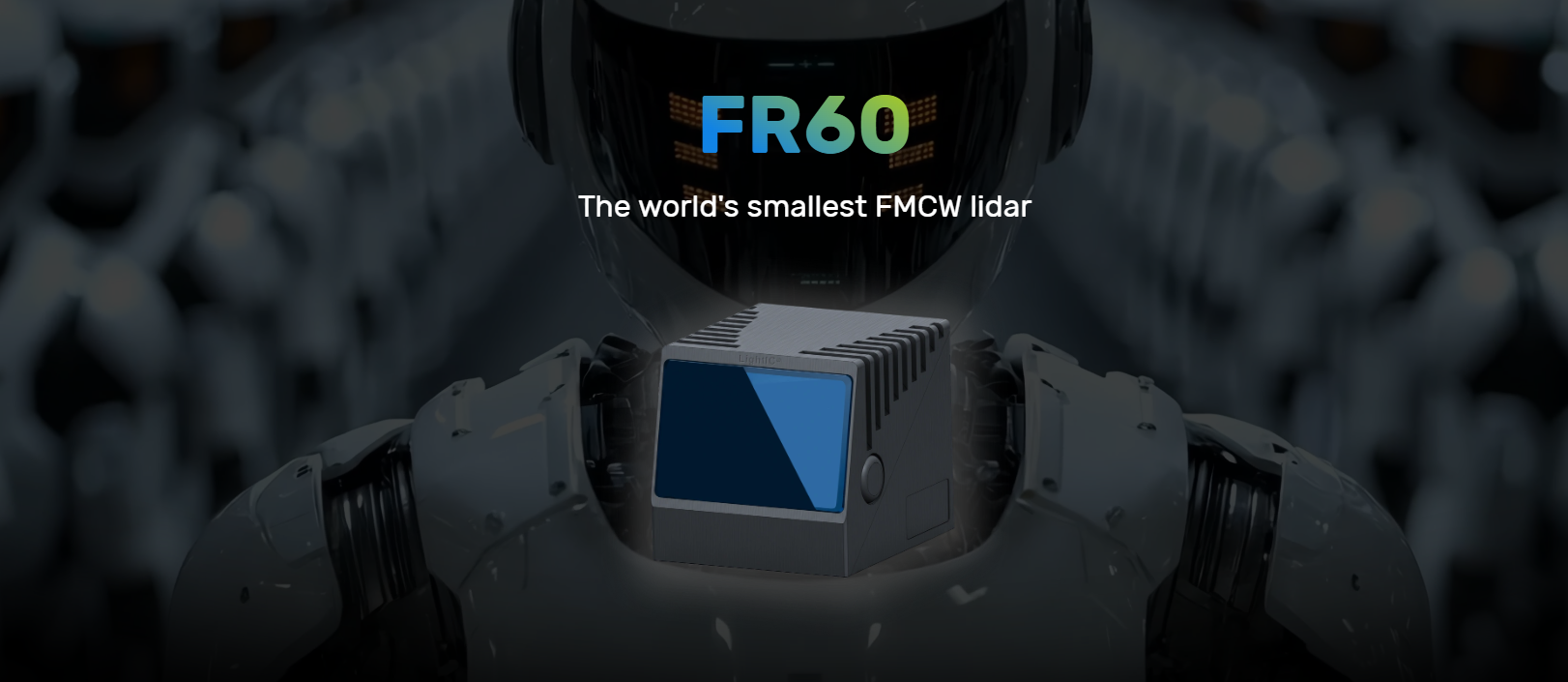
The field of robotics is rapidly evolving from structured environments to unstructured, dynamic real-world settings. This evolution demands sensing technologies that go beyond simple distance measurement. FMCW LiDAR has emerged as a critical enabler for advanced robotics, offering a combination of precision, interference immunity, and unique velocity data that traditional sensors cannot match. This article provides a technical deep dive into FMCW LiDAR for robotics, exploring its advantages, integration considerations, and practical applications.

Section 1: The Unique Needs of Robotic Perception
Robots operating in dynamic environments—such as delivery drones, autonomous mobile robots (AMRs), and humanoid robots—face several perception challenges:
- Distinguishing Moving vs. Static Objects: A robot must know if an obstacle is a stationary wall or a moving person to plan its path correctly.
- Operating in Crowded Sensor Spaces: Warehouses and urban environments are filled with other robots, vehicles, and devices emitting various signals.
- Reliable Long-Range Detection: To move efficiently at speed, a robot needs to perceive obstacles at a sufficient distance to plan and execute safe maneuvers.
Traditional lidar for robotics solutions often struggle with these challenges. ToF sensors can misinterpret moving objects and are susceptible to interference. Cameras require significant computational power and struggle in poor lighting. FMCW LiDAR directly addresses these gaps.
Section 2: How FMCW LiDAR Enhances Robotic Perception
2.1 4D Point Clouds: The Power of Velocity
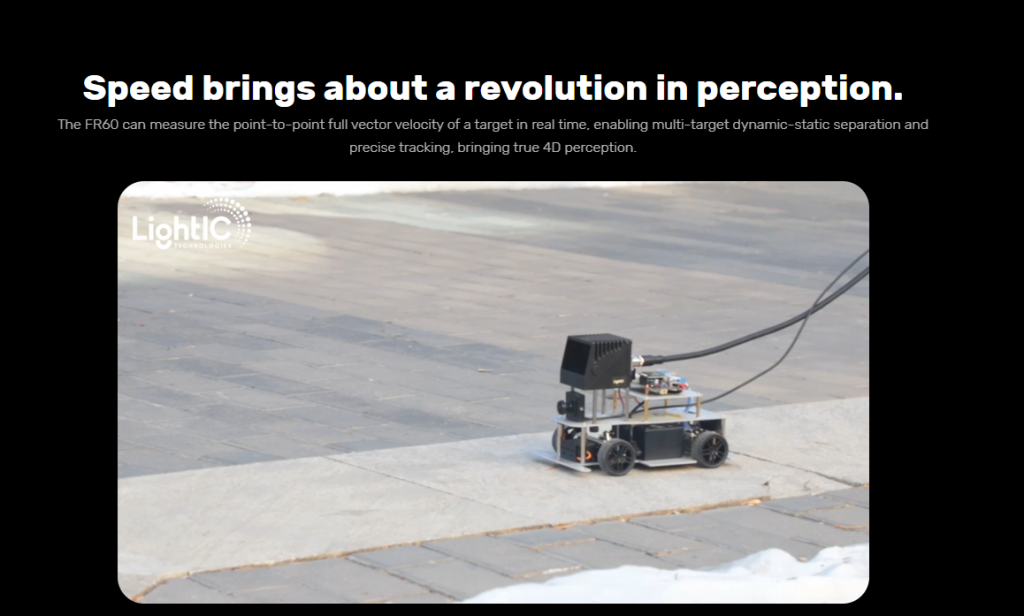
A standard 3d lidar sensor provides a point cloud—a set of coordinates representing the environment. An FMCW lidar scanner adds a fourth dimension: velocity. For every point detected, the sensor provides its instantaneous radial velocity. This transforms perception from “there is an object there” to “there is an object there, and it is moving at X m/s in Y direction.”
Impact on Robotic Algorithms:
- SLAM (Simultaneous Localization and Mapping): Velocity data improves odometry, making localization more robust even in feature-poor environments or during rapid motion.
- Object Detection and Tracking: Velocity data simplifies the tracking problem, allowing robots to predict future positions with higher accuracy.
- Safety: A robot can instantly identify fast-moving objects (e.g., a forklift) and take evasive action, rather than waiting to detect a change in position over multiple frames.
2.2 Overcoming Interference for Fleet Operations
In a warehouse with dozens of robot lidar units, interference can cause phantom points and missed detections. FMCW LiDAR’s coherent detection ensures that each unit’s signal is distinct, eliminating cross-talk. This makes FMCW an ideal industrial lidar solution for large-scale robotic deployments.
2.3 Reliable Performance in Challenging Conditions
Robotics applications often involve dust, smoke, and varying lighting conditions. FMCW LiDAR maintains performance where cameras fail. Its ability to detect low-reflectivity objects (such as black pallets or dark floors) ensures consistent safety and operational reliability.
Section 3: Integrating FMCW LiDAR into Robotic Systems
3.1 Data Processing and Fusion
The output from an FMCW lidar sensor integrates seamlessly with existing robotic architectures. The data can be treated as a standard point cloud for geometric mapping, while the velocity channels can be used as a separate input stream for motion analysis. This data can be fused with other sensors like IMUs and cameras to create a robust perception stack.
3.2 Power and Compute Considerations
Modern FMCW sensors are designed with system integration in mind. They typically offer standard interfaces (like Ethernet) and are increasingly efficient in power consumption. While the on-sensor processing is minimal, the wealth of data they provide can actually reduce the computational load on the main processor by simplifying tracking and segmentation algorithms.
FAQ:
Q1: How does the velocity measurement in FMCW LiDAR work?
A: FMCW LiDAR uses the Doppler effect. The emitted frequency is modulated in a known pattern. When the laser reflects off a moving object, the frequency of the returned signal shifts. By analyzing this shift, the lidar scanner calculates the object’s radial velocity with each measurement, providing instantaneous velocity data.
Q2: Can FMCW LiDAR be used outdoors for autonomous drone navigation?
A: Absolutely. FMCW LiDAR’s interference immunity makes it particularly well-suited for outdoor use. Drones face challenges from sunlight and can operate in swarms where multiple lidar sensor units are active. FMCW provides the reliability needed for safe beyond-visual-line-of-sight (BVLOS) operations.
Q3: What is the typical frame rate of an FMCW LiDAR sensor for robotics?
A: Frame rates vary by model, but many FMCW sensors offer 10-20 Hz frame rates, suitable for real-time control. The continuous wave nature of the system allows for very high measurement density, often resulting in richer data per frame than equivalent ToF systems.
Q4: How does FMCW LiDAR compare to radar for robotics?
A: While radar also uses Doppler, LiDAR offers much higher angular resolution. FMCW LiDAR provides the velocity advantage of radar with the high-resolution 3D mapping capability of LiDAR, making it a superior solution for applications requiring detailed environmental understanding, such as lidar for mapping and precise navigation.
Q5: Is FMCW LiDAR suitable for small, low-power robots?
A: Early FMCW systems were large and power-hungry, but recent advances have led to more compact and efficient units. While the smallest ToF sensors still have a size advantage, FMCW is becoming viable for a growing range of robotic platforms. We expect the trend toward miniaturization to continue rapidly.
Q6: As a lidar supplier, what support do you offer for robotics integration?
A: At lidarseek.com, we understand that choosing the right robot lidar is only the first step. We provide technical documentation, sample code, and integration support to help engineers quickly get our 3d lidar sensor products up and running. We also offer guidance on mounting, data interface selection, and software compatibility.
Q7: What is the total cost of ownership for FMCW versus ToF in robotics?
A: While the initial purchase price of an FMCW lidar sensor may be higher, the total cost of ownership can be lower in complex deployments. The reduced need for additional sensors, lower computational demands for tracking, and increased reliability reducing downtime all contribute to a compelling ROI, especially for industrial lidar applications.
As robots move into increasingly complex and dynamic environments, the limitations of conventional sensing become critical bottlenecks. FMCW LiDAR offers a paradigm shift, providing the 4D perception that enables robots to understand not just their static environment, but the motion within it. For developers and engineers seeking to push the boundaries of what robots can achieve, FMCW technology represents a powerful tool.
As a dedicated lidar supplier for advanced sensing solutions, lidarseek.com is here to support your innovation. Contact us to learn more about integrating FMCW LiDAR into your robotics platform and to explore our selection of cutting-edge industrial lidar products.









