
Selecting the right lidar supplier for FMCW technology is crucial for project success. This guide covers evaluation criteria, technical specifications, and global sourcing considerations for automotive lidar and industrial lidar applications.
Introduction
The transition from prototype to production for FMCW LiDAR-based systems requires more than just a superior lidar sensor; it demands a reliable partner. Whether you are an automotive OEM developing a Level 4 autonomous vehicle or an industrial automation company deploying a fleet of intelligent robots, your choice of lidar supplier will significantly impact your project’s timeline, performance, and cost. This guide provides a comprehensive framework for evaluating FMCW LiDAR suppliers and making an informed procurement decision.
Section 1: Understanding Your FMCW LiDAR Requirements
1.1 Defining Technical Specifications
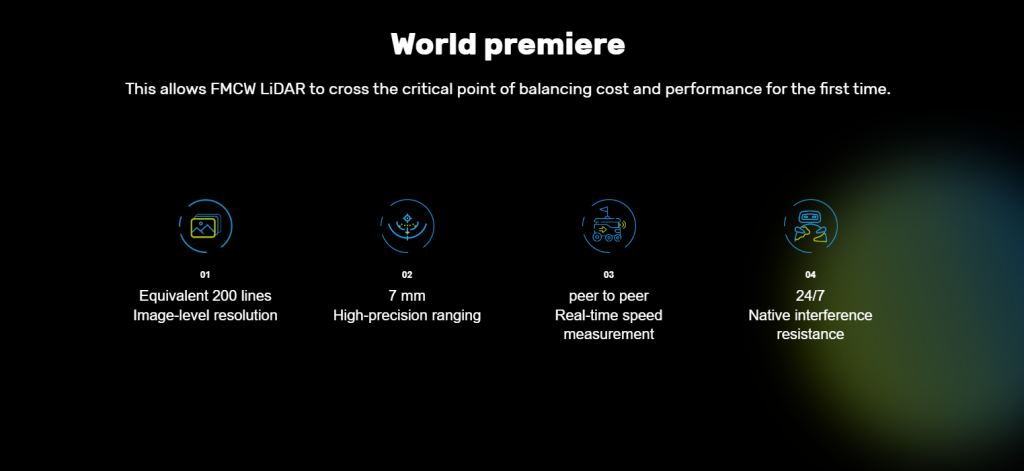
Before evaluating suppliers, you must define your application’s specific needs. Key parameters for any 3d lidar sensor include:
- Range: Maximum detection distance, especially for low-reflectivity targets.
- Field of View (FoV): Horizontal and vertical coverage needed.
- Resolution: Angular resolution required for object detection and classification.
- Frame Rate: Data update frequency for real-time control.
- Velocity Accuracy: Precision of Doppler measurements for motion tracking.
- Operating Environment: Temperature range, vibration tolerance, and ingress protection (IP) rating.
For automotive lidar applications, AEC-Q100 qualification and ISO 26262 functional safety compliance may be mandatory. For industrial lidar, ruggedness and long-term reliability are paramount.
1.2 Determining the Right Form Factor
FMCW LiDAR sensors come in various form factors. Some are designed as compact units for robot lidar integration, while others are built as robust modules for vehicle integration. Consider the physical constraints of your system.
Section 2: Criteria for Evaluating a LiDAR Supplier
2.1 Technical Capability and Product Maturity
- Proven Performance: Look for suppliers with demonstrated performance data, including point cloud samples, range tests, and environmental testing results.
- Technology Roadmap: Assess whether the supplier’s technology aligns with your long-term goals. Are they investing in miniaturization, cost reduction, and performance improvements?
- Reference Designs: Ask for case studies of similar applications where their lidar mapping system or sensing solutions have been successfully deployed.
2.2 Supply Chain and Manufacturing Readiness
- Scalability: Can the supplier meet your volume requirements, whether it’s 100 units for a pilot or 100,000 for mass production?
- Quality Systems: Look for suppliers with ISO 9001 certification and robust quality control processes. For automotive, IATF 16949 is critical.
- Component Sourcing: Understand the supply chain for key components like lasers and photonics. A strong lidar supplier will have diversified sourcing to mitigate risks.
2.3 Support and Integration
- Technical Support: Does the supplier provide comprehensive documentation, sample code, and direct engineering support?
- Software Ecosystem: Assess the software tools and drivers provided. Compatibility with ROS (Robot Operating System) is essential for lidar for robotics projects.
- Customization: Can the supplier modify firmware, optics, or mechanical interfaces to suit your unique needs?
2.4 Global Sourcing Capabilities
For global organizations, a lidar supplier with international logistics and support capabilities is invaluable. Key considerations include:
- Shipping and Logistics: Fast, reliable delivery to your location.
- Regulatory Compliance: Products should meet regional certifications (CE, RoHS, FCC, etc.).
- Local Support: Availability of technical support in your time zone.
Section 3: Cost Considerations
The cost of an FMCW lidar sensor is more than its purchase price. A thorough total cost of ownership (TCO) analysis should include:
- Integration Costs: Engineering time to integrate the sensor.
- Computational Costs: FMCW’s velocity data can reduce processing needs for tracking algorithms.
- Operational Costs: Reliability and mean time between failures (MTBF) impact maintenance costs.
- Scalability Costs: Unit pricing should be evaluated against projected volumes.
FAQ:
Q1: How do I verify the specifications of an FMCW LiDAR sensor before purchase?
A: Reputable lidar supplier should provide detailed datasheets with performance curves. We recommend requesting a demo or evaluation unit to test performance in your specific environment. At lidarseek.com, we can facilitate these evaluation processes with our partner manufacturers.
Q2: What certifications should an automotive-grade FMCW LiDAR have?
A: For automotive lidar, look for AEC-Q102 (or Q100) qualification for the components, and IATF 16949 certification for the manufacturing facility. ISO 26262 ASIL (Automotive Safety Integrity Level) compliance is also critical for safety-critical applications.
Q3: Can I use an FMCW LiDAR sensor for both indoor and outdoor applications?
A: Many FMCW sensors are designed for outdoor use with weather-resistant housings. However, you should check the specific IP rating and operating temperature range. For industrial lidar applications that transition between indoors and outdoors, look for sensors with robust environmental sealing.
Q4: How do I handle data output from an FMCW LiDAR sensor?
A: Most FMCW sensors output data via Ethernet using UDP packets. The data typically includes a point cloud with intensity and velocity channels. Suppliers should provide a software development kit (SDK) and drivers for common platforms. For lidar for mapping applications, look for sensors that output synchronized data with GPS timestamps.
Q5: What is the typical lead time for FMCW LiDAR sensors?
A: Lead times vary based on the supplier and order volume. For evaluation units, we typically see 2-4 weeks. For production volumes, lead times should be discussed directly with the lidar supplier during the procurement process. At lidarseek.com, we help streamline this process to minimize delays.
Q6: Is FMCW LiDAR technology mature enough for production deployments?
A: Yes. While FMCW technology is newer than ToF, it has reached a maturity level suitable for production deployments, particularly in automotive lidar and advanced industrial lidar applications. Leading automotive OEMs have announced integration of FMCW LiDAR into their production vehicles. As a trusted lidar supplier, we ensure that the products we offer are production-ready and supported by robust quality systems.
Q7: How does lidarseek.com add value as a FMCW LiDAR supplier?
A: As a specialized platform, lidarseek.com offers several advantages:
- Curated Selection: We partner with innovative FMCW manufacturers to offer proven, high-quality 3d lidar sensor products.
- Global Reach: Our logistics network enables fast, reliable delivery worldwide.
- Expert Support: Our team provides pre-sales and post-sales support to help you select and integrate the right lidar sensor for your application.
- Competitive Pricing: Our direct partnerships allow us to offer competitive pricing for both evaluation and production volumes.
Choosing the right lidar supplier for FMCW technology is a strategic decision that will shape your product’s capabilities and market competitiveness. By carefully evaluating technical specifications, supplier capabilities, and total cost of ownership, you can select a partner that not only provides a superior lidar sensor but also supports your long-term success.
At lidarseek.com, we are committed to being that partner. Whether you need a single lidar scanner for R&D or volume supply for production, our platform connects you with cutting-edge FMCW solutions and the expertise to integrate them effectively. Contact us today to discuss your FMCW LiDAR requirements and explore how we can help bring your autonomous systems to life.









