
1. Introduction: Why Automotive LiDAR Is Essential for Next-Generation ADAS
The automotive industry is undergoing a major transformation. Advanced Driver Assistance Systems (ADAS), autonomous driving, and intelligent vehicle technologies are changing how modern vehicles perceive their surroundings and respond to potential hazards.
As vehicle manufacturers move toward higher levels of driving automation, reliable environmental perception has become increasingly important. Cameras, radar, and LiDAR are three major sensing technologies used in modern automotive perception systems. Each provides different information, and combining them can help create a more comprehensive understanding of road environments.
Among these technologies, automotive LiDAR has attracted significant attention because it generates accurate three-dimensional spatial information using laser-based distance measurements.
For automotive engineers and autonomous driving developers, selecting the right LiDAR sensor is an important decision. Detection range, field of view, point cloud density, environmental reliability, mechanical dimensions, and integration requirements can all influence the performance of a perception system.
The Hesai AT128 LiDAR is designed to address these requirements.
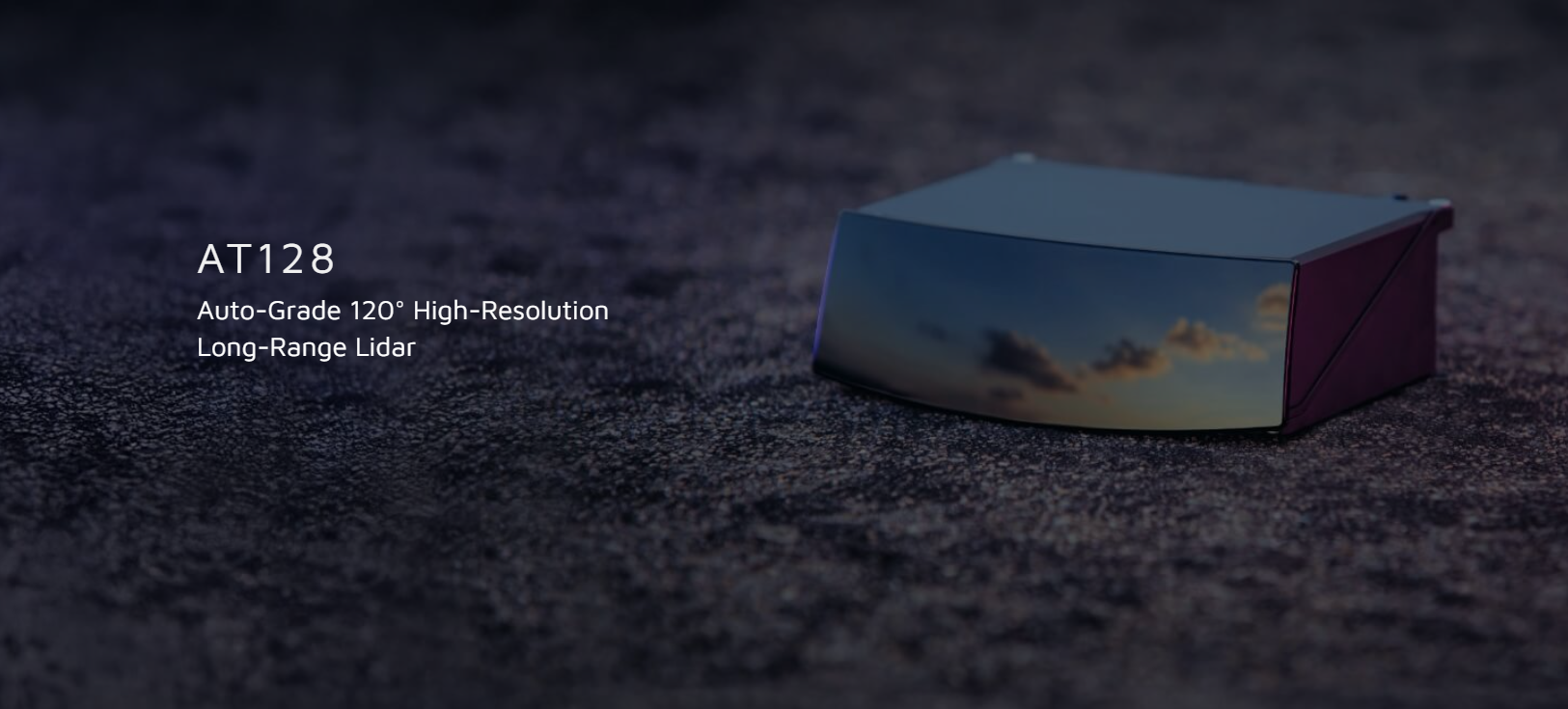
Developed by Hesai Technology, the AT128 is an automotive-grade, 128-channel long-range LiDAR featuring a 120-degree horizontal field of view, 25.4-degree vertical field of view, and a detection range of 210 meters at 10% reflectivity.
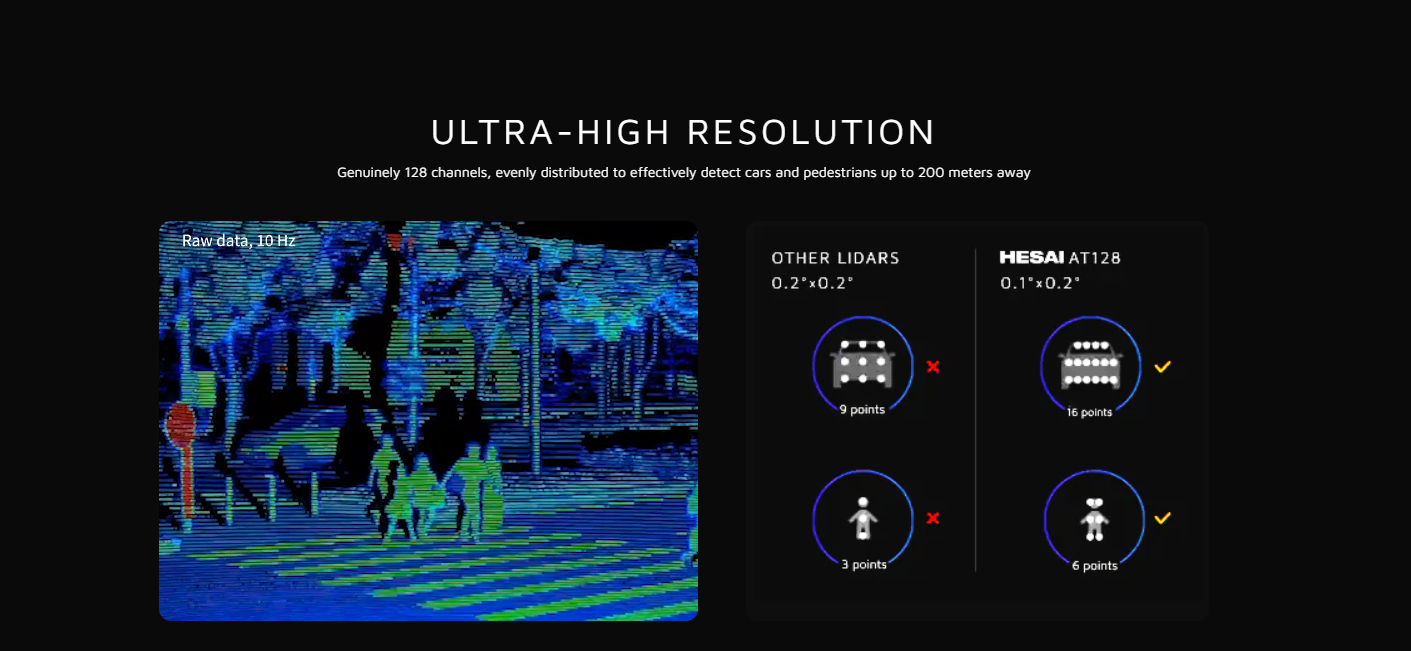
With a point generation rate of 1.536 million points per second in single-return mode, the AT128 provides high-resolution 3D environmental information for forward-facing automotive perception.
Its compact dimensions and automotive-oriented engineering make it particularly relevant to ADAS development and autonomous driving applications.
In this guide, we will explore the Hesai AT128’s technical characteristics, advantages, application scenarios, and purchasing considerations for customers in North America and Europe.
2. What Is the Hesai AT128 LiDAR?
The Hesai AT128 is a 128-channel automotive-grade long-range LiDAR designed primarily for forward-facing vehicle perception.
Unlike conventional cameras that capture visual information or radar systems that measure the distance and relative velocity of surrounding objects, LiDAR generates three-dimensional point cloud data representing the geometry of the environment.
Each point in a LiDAR point cloud contains spatial information that can help perception algorithms identify vehicles, pedestrians, road structures, and other obstacles.
The AT128 uses a hybrid solid-state architecture and Hesai’s proprietary technology to generate dense point cloud information without relying on conventional multi-sensor stitching.
Its primary design characteristics include:
- 128-channel laser scanning architecture.
- 120° horizontal field of view.
- 25.4° vertical field of view.
- 210 m detection at 10% reflectivity.
- 1.536 million points per second in single-return mode.
- Compact automotive-oriented design.
- Class 1 laser eye safety.
- Automotive reliability validation.
For vehicle manufacturers and autonomous driving developers, these characteristics provide a foundation for building forward-facing perception systems.
The AT128 is particularly suitable for applications requiring long-range object detection, wide forward coverage, and detailed environmental information.
3. Key Technical Features of Hesai AT128
3.1 128-Channel Architecture for High-Resolution 3D Perception
Channel count is an important specification when evaluating a 3D LiDAR sensor.
A 128-channel LiDAR generates multiple vertical scanning lines, allowing the sensor to collect detailed spatial information about surrounding objects.
The Hesai AT128 features 128 vertical channels with a point generation rate of 1,536,000 points per second in single-return mode.
This dense point cloud can support perception algorithms that need to identify objects and understand their spatial characteristics.
For example, in highway driving scenarios, a vehicle’s perception system may need to distinguish between:
- Passenger cars.
- Heavy-duty trucks.
- Motorcycles.
- Pedestrians.
- Roadside barriers.
- Traffic infrastructure.
- Other obstacles.
A high-resolution point cloud provides useful geometric information for these tasks.
For ADAS developers, the AT128 offers a sensing foundation for investigating object detection, 3D classification, tracking, and environmental understanding.
It is important to remember that the quality of final object recognition also depends on the perception software, processing hardware, sensor calibration, and operating environment.
3.2 210-Meter Long-Range Detection
Long-range detection is one of the most important requirements for automotive LiDAR.
At highway speeds, a vehicle needs sufficient time to identify potential hazards and allow its driving assistance system to respond.
The Hesai AT128 provides a ranging capability of 210 meters at 10% reflectivity.
This specification is particularly relevant because target reflectivity influences the amount of laser energy returned to the sensor.
Low-reflectivity objects can be more challenging to detect than highly reflective targets.
A longer detection range can provide additional perception distance, helping automotive systems identify distant objects earlier.
Potential development applications include:
- Highway obstacle detection.
- Forward collision warning research.
- Autonomous highway driving.
- Vehicle detection.
- Long-range 3D mapping.
- Roadside infrastructure perception.
For automotive engineers, the 210-meter detection specification makes the AT128 an interesting candidate for forward-facing ADAS perception.
However, detection performance in actual driving conditions depends on target size, reflectivity, weather, installation angle, and other environmental factors.
3.3 Wide 120° Horizontal Field of View
The field of view determines how much of the surrounding environment a LiDAR sensor can observe.
The AT128 offers a 120° horizontal field of view and a 25.4° vertical field of view.
This wide horizontal coverage is useful for forward-facing automotive applications because the sensor can capture more than just the area directly ahead of the vehicle.
For example, it can provide spatial information about:
- Vehicles in adjacent lanes.
- Traffic entering from side roads.
- Pedestrians near intersections.
- Roadside obstacles.
- Objects approaching the vehicle’s forward path.
A wider field of view can reduce perception blind areas within the sensor’s viewing region.
For automotive system designers, the 120° coverage offers a practical balance between forward-facing long-range perception and wider surrounding visibility.
3.4 High Point Rate for Detailed Environmental Information
The AT128 generates up to 1.536 million points per second in single-return mode.
Point rate describes how many measurement points a LiDAR produces within a given period.
Higher point density can provide more detailed geometric information, although the final point distribution also depends on angular resolution, scanning frequency, object distance, and return characteristics.
In autonomous driving systems, detailed point clouds can help developers analyze object boundaries, road geometry, and obstacle positions.
This is particularly useful for:
- 3D object detection.
- Point cloud segmentation.
- Vehicle tracking.
- Road boundary estimation.
- Autonomous driving algorithm development.
The AT128 supports high-resolution forward-facing perception for modern automotive applications.
3.5 Compact Design for Automotive Integration
Physical integration is another important factor when selecting an automotive LiDAR.
Vehicle manufacturers must consider styling, aerodynamics, mounting position, thermal conditions, wiring, and maintenance requirements.
The Hesai AT128 measures approximately 136 × 114 × 49 mm and weighs approximately 940 grams.
Its compact form factor supports vehicle integration planning.
Depending on vehicle architecture, mounting strategies may involve the windshield area, grille region, roofline, or other manufacturer-approved positions.
For automotive engineers, compact dimensions can provide greater flexibility when evaluating sensor placement.
Actual integration must still account for optical coverage, field-of-view obstruction, thermal management, vibration, and vehicle-specific design requirements.
4. Why Choose Hesai AT128 for ADAS Development?
The development of advanced driver assistance systems requires reliable information about the environment.
ADAS applications such as automatic emergency braking, adaptive cruise control, and highway assistance depend on accurate perception of vehicles, pedestrians, obstacles, and road conditions.
LiDAR can provide three-dimensional distance information that complements camera and radar sensing.
The Hesai AT128 offers several characteristics worth considering.
4.1 Improved Forward Environmental Awareness
A forward-facing LiDAR can provide detailed spatial information about the road ahead.
The AT128’s 120° horizontal coverage and long detection range make it suitable for investigating forward perception systems.
Developers can use point cloud information to support object detection and environmental modeling.
4.2 Support for Sensor Fusion
Modern ADAS systems frequently combine multiple sensing technologies.
Cameras provide rich visual information, radar contributes distance and velocity measurements, and LiDAR generates detailed 3D geometry.
Sensor fusion algorithms combine these different data sources to improve environmental understanding.
The AT128 can be evaluated as part of a multi-sensor perception architecture involving:
- Automotive cameras.
- Millimeter-wave radar.
- GNSS and IMU systems.
- Automotive computing platforms.
- AI-based perception software.
For European and North American automotive developers, evaluating the AT128 within a complete perception architecture is more useful than assessing the LiDAR independently.
4.3 Automotive Reliability and Safety
Automotive electronics must operate under demanding environmental conditions.
Temperature fluctuations, vibration, moisture, dust, and mechanical shock can all affect sensor performance.
Hesai’s official AT128 documentation lists reliability validation items including high-temperature testing, low-temperature wakeup, vibration, salt spray, thermal shock, and ingress protection.
The official product information also identifies Class 1 laser eye safety and ISO 26262 ASIL B functional safety product certification.
These characteristics are important considerations for automotive applications.
However, customers should always request the applicable certification documents and confirm whether the specific purchased hardware revision and configuration meet their project requirements.
5. Hesai AT128 Applications in North America and Europe
5.1 Passenger Vehicles and Advanced Driver Assistance Systems
The passenger vehicle market is an important application area for automotive LiDAR.
Vehicle manufacturers are integrating advanced perception technologies into increasingly sophisticated driver assistance systems.
The AT128 can be evaluated for forward-facing perception applications involving:
- Highway assistance.
- Forward obstacle detection.
- Vehicle recognition.
- Pedestrian perception.
- Autonomous driving development.
- Multi-sensor fusion.
For automotive suppliers in Germany, France, the United Kingdom, the United States, and Canada, the AT128 offers a relevant product to evaluate when developing next-generation vehicle perception architectures.
5.2 Robotaxis and Autonomous Mobility
Robotaxi developers need to understand complex urban environments.
Unlike controlled highway environments, cities contain pedestrians, cyclists, parked vehicles, traffic signals, and unpredictable road users.
A forward-facing long-range LiDAR can provide important spatial information for autonomous driving systems.
The AT128 can be considered for perception development in:
- Autonomous passenger vehicles.
- Robotaxi prototypes.
- Autonomous shuttles.
- Urban mobility platforms.
- Autonomous driving research vehicles.
System designers should evaluate whether a forward-facing 120° sensor provides sufficient coverage for their complete vehicle architecture or whether additional LiDAR units are required.
5.3 Autonomous Trucks and Commercial Vehicles
Heavy-duty vehicles have different perception requirements from passenger cars.
Large trucks require reliable environmental awareness around the vehicle, particularly during highway operation, lane changes, and interactions with smaller vehicles.
The AT128’s long-range forward perception makes it relevant to autonomous truck development and commercial vehicle safety research.
Potential applications include:
- Highway perception.
- Forward obstacle detection.
- Autonomous trucking research.
- Fleet vehicle automation.
- Commercial vehicle ADAS development.
For full vehicle coverage, engineers may combine forward-facing LiDAR with additional side and rear sensing systems.
5.4 Automotive Testing and Research
Universities, automotive laboratories, and technology companies frequently need high-quality sensor data for algorithm development.
The AT128 can be evaluated in projects involving:
- 3D point cloud processing.
- Object detection.
- Autonomous navigation.
- Sensor fusion.
- Road environment reconstruction.
- Perception algorithm validation.
Its high-resolution point cloud output provides useful data for testing and research workflows.
6. Hesai AT128 Technical Specifications
The following specifications are based on Hesai’s official product information.
| Parameter | Hesai AT128 |
|---|---|
| Product Type | Automotive-Grade Long-Range LiDAR |
| Channels | 128 |
| Detection Range | 210 m @ 10% Reflectivity |
| Horizontal FOV | 120° |
| Vertical FOV | 25.4° |
| Angular Resolution | 0.1° (H) × 0.2° (V) |
| Point Rate | 1,536,000 pts/s, single return |
| Global Resolution | 1200 × 128 |
| Wavelength | 905 nm |
| Power Consumption | 13.5 W |
| Dimensions | 136 × 114 × 49 mm |
| Weight | 940 g |
| Laser Safety | Class 1 |
Note: Specifications are typical values under specified test conditions. Confirm the final hardware revision, operating conditions, and official datasheet before integration.
7. How to Choose an Automotive LiDAR Supplier
Selecting an automotive LiDAR supplier involves more than comparing advertised detection distances.
For B2B buyers in Europe and North America, several additional factors should be considered.
Product Authenticity
Confirm that the sensor is genuine and sourced through an appropriate supply channel.
Technical Documentation
Request the official datasheet, interface information, installation guidelines, and available certification documents.
Inventory and Lead Time
Confirm sample availability, production lead time, and delivery expectations before placing an order.
International Shipping
Discuss available shipping options, customs documentation, and trade terms.
Engineering Compatibility
Check communication interfaces, power requirements, synchronization, mounting conditions, and software integration.
After-Sales Support
A reliable supplier should be able to assist with product selection, technical questions, and order-related support.
These factors can help reduce purchasing risks and improve the efficiency of automotive development projects.
8. Buy Hesai AT128 LiDAR from LidarSeek
Are you looking for a high-resolution automotive LiDAR sensor for ADAS, autonomous driving, or automotive perception development?
LidarSeek provides access to Hesai LiDAR products and other sensing technologies for automotive, robotics, and industrial applications.
We help international customers explore suitable LiDAR configurations based on their project requirements.
When sourcing the Hesai AT128 through LidarSeek, you can contact our team to discuss:
- Current product availability.
- Model and hardware configuration.
- Technical datasheets.
- Sample and bulk order pricing.
- Estimated lead time.
- International shipping options.
- Project-specific sourcing requirements.
Whether you are an automotive engineering company, autonomous driving developer, university laboratory, or system integrator, we can help you evaluate the Hesai AT128 for your project.
Explore the product:
Explore all Hesai LiDAR products:
Contact LidarSeek today to request a quotation for the Hesai AT128 automotive LiDAR.
9. Frequently Asked Questions About Hesai AT128 LiDAR
Q1. What is the Hesai AT128 LiDAR?
The Hesai AT128 is a 128-channel automotive-grade long-range LiDAR designed primarily for forward-facing ADAS and autonomous driving perception.
Q2. What is the detection range of Hesai AT128?
The AT128 offers a detection range of 210 meters at 10% reflectivity under specified test conditions.
Q3. How many channels does the Hesai AT128 have?
The AT128 features 128 vertical channels for high-resolution 3D point cloud generation.
Q4. What is the field of view of the AT128?
Its horizontal field of view is 120 degrees, and its vertical field of view is 25.4 degrees.
Q5. What is the point rate of Hesai AT128?
The AT128 generates approximately 1.536 million points per second in single-return mode.
Q6. Is Hesai AT128 suitable for autonomous driving?
Yes. It is designed as an automotive-grade long-range LiDAR for ADAS and autonomous driving perception applications.
Q7. Can Hesai AT128 be used for ADAS development?
Yes. It can be evaluated for forward-facing perception applications, including obstacle detection, vehicle recognition, and multi-sensor fusion.
Q8. Is Hesai AT128 suitable for robotaxis?
The AT128 can be considered for robotaxi perception systems, particularly for forward-facing long-range sensing. Complete vehicle coverage may require additional sensors.
Q9. What is the power consumption of Hesai AT128?
Its typical operating power consumption is 13.5 W according to the manufacturer’s product information.
Q10. What are the dimensions and weight of AT128?
The sensor measures approximately 136 × 114 × 49 mm and weighs approximately 940 grams.
Q11. Is Hesai AT128 eye-safe?
The AT128 is classified as Class 1 laser eye-safe according to its official product information.
Q12. What is the difference between Hesai AT128 and OT128?
The AT128 provides a 120-degree forward-facing horizontal field of view and is designed for long-range automotive perception. The OT128 provides 360-degree horizontal coverage and is designed for applications requiring full surrounding environmental perception.
Q13. Can I purchase Hesai AT128 outside China?
International customers can contact LidarSeek to discuss product sourcing, availability, quotations, and international shipping arrangements.
Q14. How can I get a quotation for Hesai AT128?
Visit the LidarSeek AT128 product page and submit your requirements, including quantity, destination country, and application.
Final Recommendation
The Hesai AT128 is a compelling option for automotive engineering teams seeking a 128-channel forward-facing LiDAR with long-range detection and wide horizontal coverage.
If your project involves ADAS, autonomous vehicles, or automotive perception research, contact LidarSeek to discuss the Hesai AT128 and request a competitive quotation.









