
1. Introduction: Why 360-Degree LiDAR Matters for Autonomous Systems
Autonomous vehicles and intelligent robots need to understand what is happening around them.
Whether an autonomous car is navigating a busy urban street, a mobile robot is moving through a warehouse, or an autonomous industrial vehicle is operating in a complex outdoor environment, environmental awareness is essential.
A forward-facing sensor can provide detailed information about objects ahead, but many autonomous applications also require awareness of the sides, rear, and surrounding environment.
This is where 360-degree LiDAR becomes particularly valuable.
Unlike a conventional forward-facing LiDAR that observes a limited horizontal area, a 360-degree LiDAR captures spatial information across the full horizontal perimeter.
For system integrators and autonomous technology developers, this wider coverage can simplify environmental perception and reduce the need for multiple overlapping sensors.
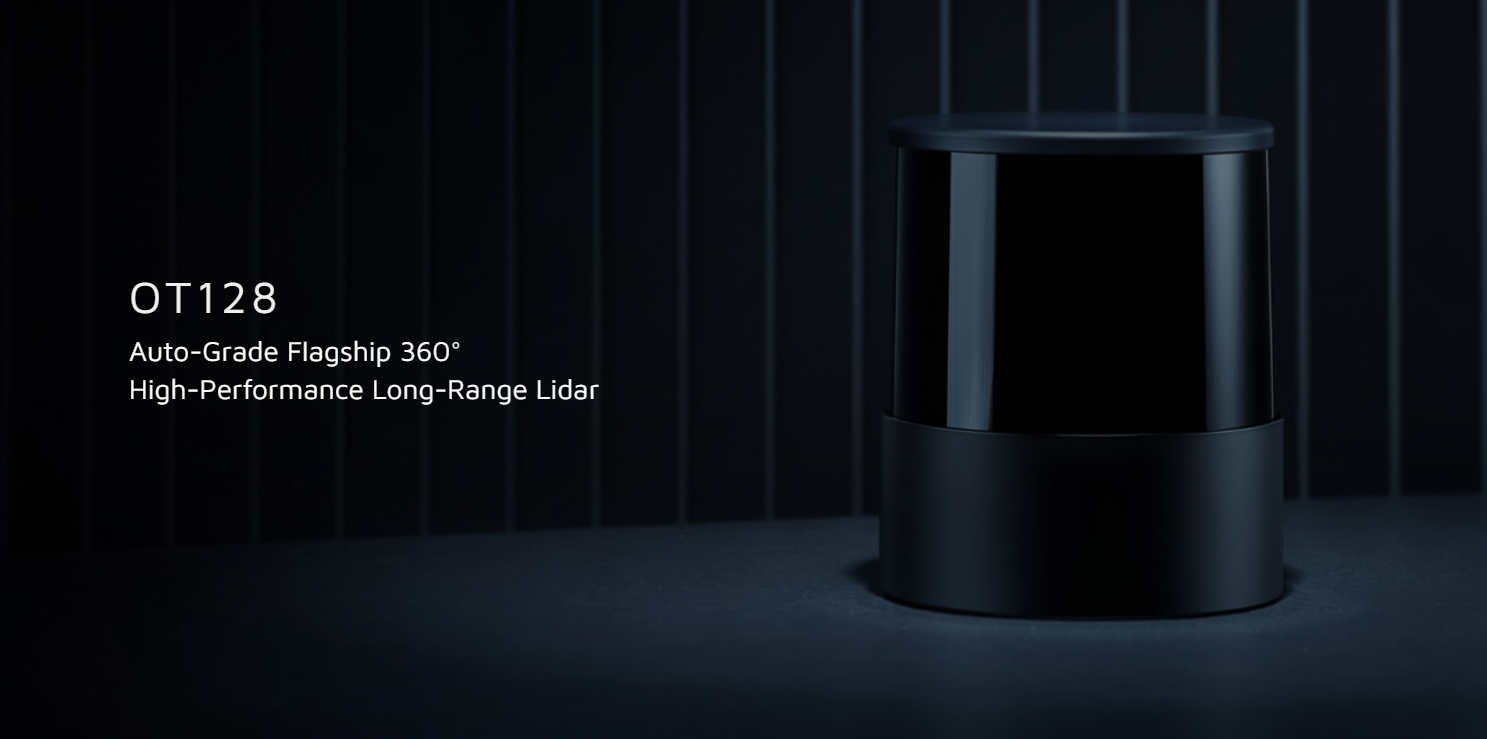
The Hesai OT128 LiDAR is a high-performance 128-channel rotating LiDAR designed to provide full 360-degree horizontal perception with a 40-degree vertical field of view.
It offers a detection range of 200 meters at 10% reflectivity, with a maximum range of 230 meters under specified conditions.
The sensor also generates up to 3.456 million points per second in single-return mode and 6.912 million points per second in dual-return mode.
With its high-resolution scanning architecture and Hesai’s Intelligent Point Cloud Engine (IPE), the OT128 is designed to support demanding environmental perception applications.
For customers in the United States, Canada, Germany, France, the United Kingdom, and other international markets, the OT128 deserves consideration when evaluating long-range 360-degree LiDAR solutions.
This article explores the product’s technical features, potential applications, advantages, and purchasing considerations.
2. What Is the Hesai OT128 LiDAR?
The Hesai OT128 is a 128-channel automotive-grade 360-degree rotating LiDAR designed for high-performance environmental perception.
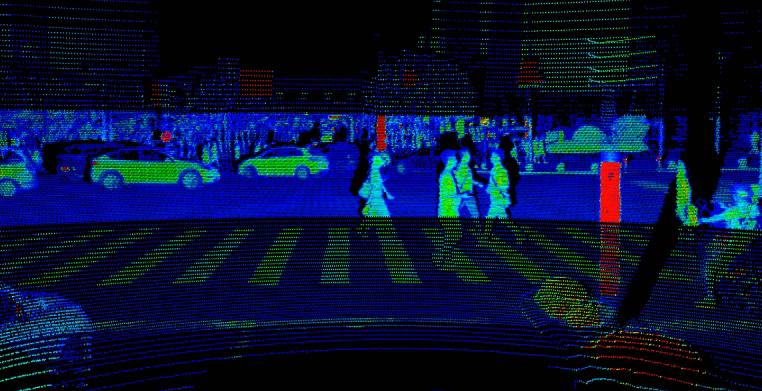
It uses laser-based distance measurement to generate three-dimensional point clouds of the surrounding environment.
These point clouds can be processed by perception software to identify objects, estimate their positions, and understand environmental geometry.
Unlike forward-facing automotive LiDAR systems, the OT128 provides complete horizontal coverage.
Its 360° horizontal field of view and 40° vertical field of view make it suitable for applications where the surrounding environment must be continuously monitored.
Key product characteristics include:
- 128-channel LiDAR architecture.
- 360° horizontal field of view.
- 40° vertical field of view.
- 200 m detection at 10% reflectivity.
- 230 m maximum detection range.
- 3.456 million points per second in single-return mode.
- 6.912 million points per second in dual-return mode.
- 0.1° horizontal angular resolution at 10 Hz.
- 0.125° vertical angular resolution in the central channel region.
- Intelligent Point Cloud Engine technology.
- Class 1 laser eye safety.
These characteristics make the OT128 an interesting option for autonomous driving, robotics, industrial automation, and other applications requiring detailed surrounding perception.
3. Key Technical Features of Hesai OT128
3.1 360-Degree Horizontal Field of View
One of the most important advantages of the Hesai OT128 is its full 360-degree horizontal field of view.
Environmental perception is not limited to what happens directly in front of an autonomous vehicle or robot.
Objects may approach from the sides, cross behind the platform, or appear in previously unobserved areas.
A 360-degree LiDAR can provide continuous horizontal spatial coverage through a single sensor.
This can help developers investigate:
- Surrounding obstacle detection.
- Object tracking.
- Environmental mapping.
- Autonomous navigation.
- Collision avoidance.
- Dynamic scene understanding.
For example, an autonomous mobile robot operating in a warehouse may encounter workers, forklifts, shelves, pallets, and other moving objects.
A full-surround perception system can provide more comprehensive environmental information than a single forward-facing sensor.
Similarly, autonomous vehicles operating in complex environments may benefit from 360-degree sensing when monitoring surrounding traffic and nearby obstacles.
An important engineering consideration is that 360-degree horizontal coverage does not automatically eliminate every blind area. Vertical coverage, installation position, sensor obstruction, and the complete perception architecture must also be considered.
3.2 128 Channels for High-Resolution 3D Point Clouds
The OT128 uses a 128-channel scanning architecture.
Channel count influences the vertical distribution of measurement points and therefore contributes to the sensor’s ability to represent objects at different heights.
With 128 channels, the OT128 can generate detailed 3D point cloud information for environmental perception.
Its point generation rate reaches:
- 3,456,000 points per second in single-return mode.
- 6,912,000 points per second in dual-return mode.
This high point rate can provide useful spatial information for perception algorithms.
For example, an autonomous vehicle may need to distinguish between road users, roadside objects, barriers, and overhead structures.
A robotics system may need to identify obstacles, estimate object dimensions, and construct a representation of its surroundings.
High-density point cloud data can support these development tasks.
However, final perception performance depends on point distribution, object distance, software algorithms, and computing resources.
3.3 Long-Range Detection up to 230 Meters
Detection range is an important factor for autonomous systems operating at higher speeds or across large outdoor environments.
The Hesai OT128 offers a ranging capability of 200 meters at 10% reflectivity, with a maximum detection range of 230 meters under specified conditions.
Long-range sensing can help an autonomous system identify distant objects before they enter the immediate operating area.
This is relevant to:
- Autonomous highway perception.
- Outdoor robotic navigation.
- Commercial vehicle automation.
- Long-distance obstacle detection.
- Industrial vehicle perception.
- Large-area 3D mapping.
For autonomous vehicle developers, longer detection distance can provide additional spatial information for planning and decision-making.
For industrial applications, it can help support perception over larger operating areas.
Actual detection performance should be evaluated against target reflectivity, size, environmental conditions, and manufacturer test specifications.
3.4 40-Degree Vertical Field of View
In addition to 360-degree horizontal coverage, the OT128 provides a 40-degree vertical field of view.
This vertical coverage is important because autonomous systems need to perceive objects at different heights.
For example, an outdoor autonomous vehicle may encounter:
- Passenger vehicles.
- Pedestrians.
- Road barriers.
- Road surfaces.
- Elevated structures.
- Objects near the ground.
A wider vertical field of view can provide more complete information about the environment within the sensor’s viewing region.
The OT128’s vertical angular resolution is not uniform across all channels. The central region provides the finest specified resolution of 0.125 degrees, while outer channel regions use different angular spacing.
This channel distribution should be considered when designing perception algorithms.
3.5 Intelligent Point Cloud Engine for Environmental Noise Filtering
Outdoor LiDAR applications frequently encounter environmental interference.
Rain, fog, dust, exhaust fumes, and water splashes can introduce unwanted returns into point cloud data.
These environmental effects can create additional challenges for autonomous perception algorithms.
The Hesai OT128 incorporates Hesai’s proprietary Intelligent Point Cloud Engine, commonly referred to as IPE.
This technology identifies and marks certain environmental phenomena at the pixel level, helping systems distinguish environmental noise from relevant objects.
According to Hesai, the technology can identify conditions such as:
- Rain.
- Fog.
- Exhaust fumes.
- Water splashes.
- Other environmental interference.
This capability is particularly relevant to autonomous vehicles and outdoor robotics.
For developers building perception systems for real-world environments, managing environmental interference is an important part of achieving reliable operation.
It is worth noting that environmental filtering does not make any LiDAR completely immune to severe weather. System-level testing remains essential.
3.6 Automotive-Grade Reliability
Autonomous vehicle and industrial perception systems often operate in challenging environments.
Temperature variation, humidity, vibration, dust, and water exposure can affect sensor performance.
The Hesai OT128 is designed with automotive-oriented reliability requirements.
Its official product information lists IP6K7 and IP6K9K protection and validation tests involving:
- High-temperature operation.
- Low-temperature wakeup.
- Vibration.
- Mechanical shock.
- Salt spray.
- Thermal shock with water splash.
- Humidity and thermal cycling.
The OT128 is also listed as Class 1 eye-safe and associated with ISO 26262 and ISO 21434 development compliance.
Customers should request the applicable certificates and technical documentation for their exact hardware version before using the sensor in safety-related projects.
4. Why Choose a 360-Degree LiDAR Instead of a Forward-Facing LiDAR?
Choosing between 360-degree and forward-facing LiDAR depends on the application’s perception requirements.
A forward-facing sensor such as the Hesai AT128 is optimized for wide-angle forward perception and long-range detection.
A 360-degree sensor such as the OT128 provides full horizontal coverage for surrounding environmental monitoring.
These two architectures solve different problems.
4.1 Full Surrounding Awareness
A 360-degree LiDAR can observe objects across the entire horizontal perimeter.
This is useful for mobile robots and autonomous vehicles that must continuously monitor their surroundings.
4.2 Reduced Need for Multiple Horizontal Viewing Directions
In some applications, full 360-degree coverage can reduce the need to install several separate sensors simply to obtain different horizontal viewing directions.
This may simplify certain system architectures.
However, additional sensors may still be required to address blind spots, improve redundancy, or provide different vertical coverage.
4.3 Simplified Spatial Mapping
A complete horizontal point cloud can provide useful input for 3D mapping and localization workflows.
This is particularly relevant to autonomous mobile robots, outdoor mapping platforms, and autonomous vehicle research.
4.4 More Comprehensive Object Tracking
Objects may move around an autonomous platform rather than remaining in front of it.
A 360-degree LiDAR can provide spatial observations from all horizontal directions, supporting surrounding object tracking and environmental modeling.
5. Hesai OT128 Applications in Autonomous Driving and Robotics
5.1 Autonomous Vehicles and Robotaxis
Autonomous vehicles need to understand surrounding traffic conditions.
A 360-degree LiDAR can provide environmental information about vehicles, pedestrians, and obstacles across the horizontal perimeter.
The OT128 can be evaluated for:
- Autonomous vehicle perception.
- Robotaxi research.
- Surrounding obstacle detection.
- Urban driving development.
- Autonomous mobility platforms.
- Multi-sensor fusion.
For automotive engineering teams, the OT128 offers a high-performance sensing option when full-surround LiDAR perception is required.
5.2 Autonomous Mobile Robots (AMRs)
Autonomous mobile robots are increasingly used in factories, warehouses, distribution centers, and commercial facilities.
Unlike stationary industrial robots, AMRs need to move through changing environments.
They must identify obstacles, monitor surrounding objects, and navigate safely around people and equipment.
The OT128’s 360-degree field of view can support development projects involving:
- Warehouse navigation.
- Dynamic obstacle detection.
- 3D mapping.
- Localization research.
- Autonomous material movement.
- Mobile robot perception.
For AMR manufacturers, the OT128 can be considered when evaluating higher-resolution long-range environmental perception.
Its suitability will depend on the robot’s size, power budget, computing architecture, and required operating range.
5.3 Industrial Automation and Autonomous Equipment
Industrial facilities increasingly use autonomous machines to improve operational efficiency.
These environments may include forklifts, autonomous transport vehicles, mining equipment, and outdoor industrial platforms.
A 360-degree LiDAR can provide useful environmental information for machines that operate around obstacles and moving equipment.
Potential applications include:
- Autonomous industrial vehicles.
- Smart factory equipment.
- Material transportation.
- Outdoor industrial navigation.
- Perimeter obstacle detection.
- Large-area mapping.
The OT128’s long-range perception and environmental filtering capabilities make it worth evaluating for these applications.
5.4 Mining and Heavy-Duty Vehicles
Mining environments often involve large vehicles, changing terrain, dust, and complex operating conditions.
Autonomous mining equipment needs to monitor nearby objects and understand the surrounding environment.
A high-performance 360-degree LiDAR may support research and development involving:
- Autonomous mining vehicles.
- Heavy-duty equipment perception.
- Obstacle detection.
- Outdoor mapping.
- Autonomous navigation.
- Vehicle safety systems.
For mining technology developers, sensor selection should include detailed environmental testing and integration validation.
5.5 Robotics Research and 3D Mapping
Universities and research institutions use LiDAR sensors to develop algorithms for autonomous systems.
The OT128 can support research involving:
- 3D point cloud processing.
- SLAM development.
- Object recognition.
- Environmental reconstruction.
- Sensor fusion.
- Autonomous navigation.
- Dynamic object tracking.
Its high point generation rate makes it relevant to projects that require detailed 3D environmental information.
6. Hesai OT128 Technical Specifications
The following table summarizes the main specifications from Hesai’s official product documentation.
| Parameter | Hesai OT128 |
|---|---|
| Product Type | 360° Automotive-Grade LiDAR |
| Channels | 128 |
| Detection Range | 200 m @ 10% Reflectivity |
| Maximum Detection Range | 230 m |
| Horizontal FOV | 360° |
| Vertical FOV | 40° |
| Horizontal Resolution | 0.1° at 10 Hz |
| Finest Vertical Resolution | 0.125° in central channel region |
| Single Return Point Rate | 3,456,000 pts/s |
| Dual Return Point Rate | 6,912,000 pts/s |
| Wavelength | 905 nm |
| Power Consumption | 29 W |
| Range Accuracy | ±3 cm |
| Operating Temperature | -40°C to 75°C |
| Protection Rating | IP6K7 & IP6K9K |
| Weight | Approximately 2.2 kg |
| Laser Safety | Class 1 |
Note: Specifications represent manufacturer-published values under specified test conditions. Actual performance may vary with hardware revisions, operating conditions, and product configurations. Confirm the official datasheet before integration.
7. Hesai OT128 vs. Hesai AT128: Which One Should You Choose?
Both products feature 128 channels, but they have different sensing architectures and application priorities.
| Comparison | Hesai AT128 | Hesai OT128 |
|---|---|---|
| Main Design | Forward-Facing Automotive LiDAR | 360° Rotating LiDAR |
| Channels | 128 | 128 |
| Horizontal FOV | 120° | 360° |
| Vertical FOV | 25.4° | 40° |
| Detection at 10% Reflectivity | 210 m | 200 m |
| Maximum Detection | 210 m at specified condition | 230 m maximum |
| Single Return Point Rate | 1.536 million pts/s | 3.456 million pts/s |
| Dual Return Point Rate | Check configuration | 6.912 million pts/s |
| Power Consumption | 13.5 W | 29 W |
| Weight | 940 g | Approximately 2.2 kg |
| Main Application | Forward ADAS Perception | Surrounding Environmental Perception |
When Should You Choose AT128?
Choose the AT128 when your project primarily requires:
- Forward-facing automotive perception.
- Long-range detection ahead of the vehicle.
- Compact sensor integration.
- Lower power consumption.
- ADAS development.
When Should You Choose OT128?
Choose the OT128 when your project requires:
- Full 360-degree horizontal coverage.
- High-density surrounding point clouds.
- Long-range environmental monitoring.
- Autonomous mobile robot perception.
- Outdoor robotic mapping.
- Full-surround sensing architectures.
For some advanced autonomous systems, using different LiDAR types together may provide a more comprehensive perception architecture.
8. Why Buy Hesai OT128 from LidarSeek?
Finding a reliable LiDAR supplier is an important consideration for international B2B customers.
Automotive developers, robotics manufacturers, research institutions, and industrial automation companies need more than a product listing. They need accurate technical information, sourcing assistance, clear pricing, and dependable order coordination.
LidarSeek provides access to Hesai LiDAR products and other sensing solutions for automotive, robotics, and industrial applications.
When sourcing the OT128 through LidarSeek, customers can contact our team to discuss:
- Product availability.
- Official technical datasheets.
- Model and hardware configuration.
- Sample and bulk purchase quotations.
- Estimated delivery lead times.
- International shipping options.
- Application-specific product selection.
We aim to help customers identify suitable sensing hardware for their projects, whether they are developing autonomous vehicles, mobile robots, or industrial perception systems.
Product Page:
Hesai Product Range:
Contact LidarSeek to request a quotation for the Hesai OT128 360-degree LiDAR.
9. Request a Hesai OT128 Quotation Today
Are you developing an autonomous vehicle, industrial mobile robot, or advanced environmental perception system?
The Hesai OT128 offers a combination of 128-channel scanning, 360-degree horizontal coverage, long-range detection, and high-density point cloud generation.
It is a compelling candidate for projects requiring detailed surrounding environmental information.
Contact LidarSeek to discuss your project requirements and request:
- Current OT128 pricing.
- Product availability.
- Technical specifications.
- Sample order options.
- Bulk purchase quotations.
- International shipping arrangements.
Tell us your application, required quantity, and destination country. Our team can help you evaluate the appropriate LiDAR solution.
10. Frequently Asked Questions About Hesai OT128 LiDAR
Q1. What is the Hesai OT128 LiDAR?
The Hesai OT128 is a 128-channel 360-degree rotating LiDAR designed for high-performance environmental perception in autonomous driving and other intelligent systems.
Q2. What is the maximum detection range of OT128?
The OT128 has a maximum detection range of 230 meters. Its specified detection range at 10% reflectivity is 200 meters.
Q3. Does Hesai OT128 provide 360-degree coverage?
Yes. It offers a 360-degree horizontal field of view and a 40-degree vertical field of view.
Q4. How many points per second can the OT128 generate?
It generates approximately 3.456 million points per second in single-return mode and 6.912 million points per second in dual-return mode.
Q5. How many channels does Hesai OT128 have?
The OT128 features 128 channels.
Q6. Is Hesai OT128 suitable for autonomous driving?
Yes. It is designed as an automotive-grade 360-degree LiDAR and can be evaluated for autonomous vehicle perception and surrounding environmental monitoring.
Q7. Can the OT128 be used for robotics?
Yes. Its 360-degree coverage and high-density point clouds make it relevant to robotics applications, including AMRs, autonomous navigation, mapping, and obstacle detection.
Q8. What is the difference between Hesai OT128 and AT128?
The AT128 is a forward-facing 120-degree automotive LiDAR designed for long-range ADAS perception. The OT128 provides 360-degree horizontal coverage and is more suitable for full-surround perception requirements.
Q9. What is the vertical field of view of OT128?
The OT128 has a 40-degree vertical field of view, extending from approximately -25 degrees to +15 degrees.
Q10. What is the power consumption of OT128?
Its typical operating power consumption is approximately 29 W according to the manufacturer’s product specifications.
Q11. Does Hesai OT128 support dual-return mode?
Yes. It supports dual-return operation, with a point generation rate of up to 6.912 million points per second.
Q12. What is the Intelligent Point Cloud Engine?
IPE is Hesai’s proprietary Intelligent Point Cloud Engine technology. It can identify and mark certain environmental interference, including rain, fog, exhaust fumes, and water splashes, at the pixel level.
Q13. Is the OT128 suitable for outdoor applications?
It can be evaluated for outdoor autonomous perception applications. Its listed IP6K7 and IP6K9K protection ratings and environmental reliability validation are relevant considerations. Actual operating suitability should be confirmed through application-specific testing.
Q14. Is Hesai OT128 eye-safe?
The OT128 is classified as Class 1 laser eye-safe according to the manufacturer’s product information.
Q15. Where can I buy Hesai OT128?
You can contact LidarSeek to discuss product availability, technical documentation, quotations, and international shipping.
Visit:
Q16. Can I buy OT128 for a research project or sample evaluation?
Contact LidarSeek with your required quantity and project details to discuss sample availability and purchasing arrangements.
Final Recommendation
For autonomous driving developers, robotics manufacturers, and industrial automation companies seeking 360-degree environmental perception, the Hesai OT128 offers a high-performance 128-channel LiDAR platform worth evaluating.
Contact LidarSeek today to explore the OT128 and find the right LiDAR solution for your next autonomous system.









