
Executive Summary
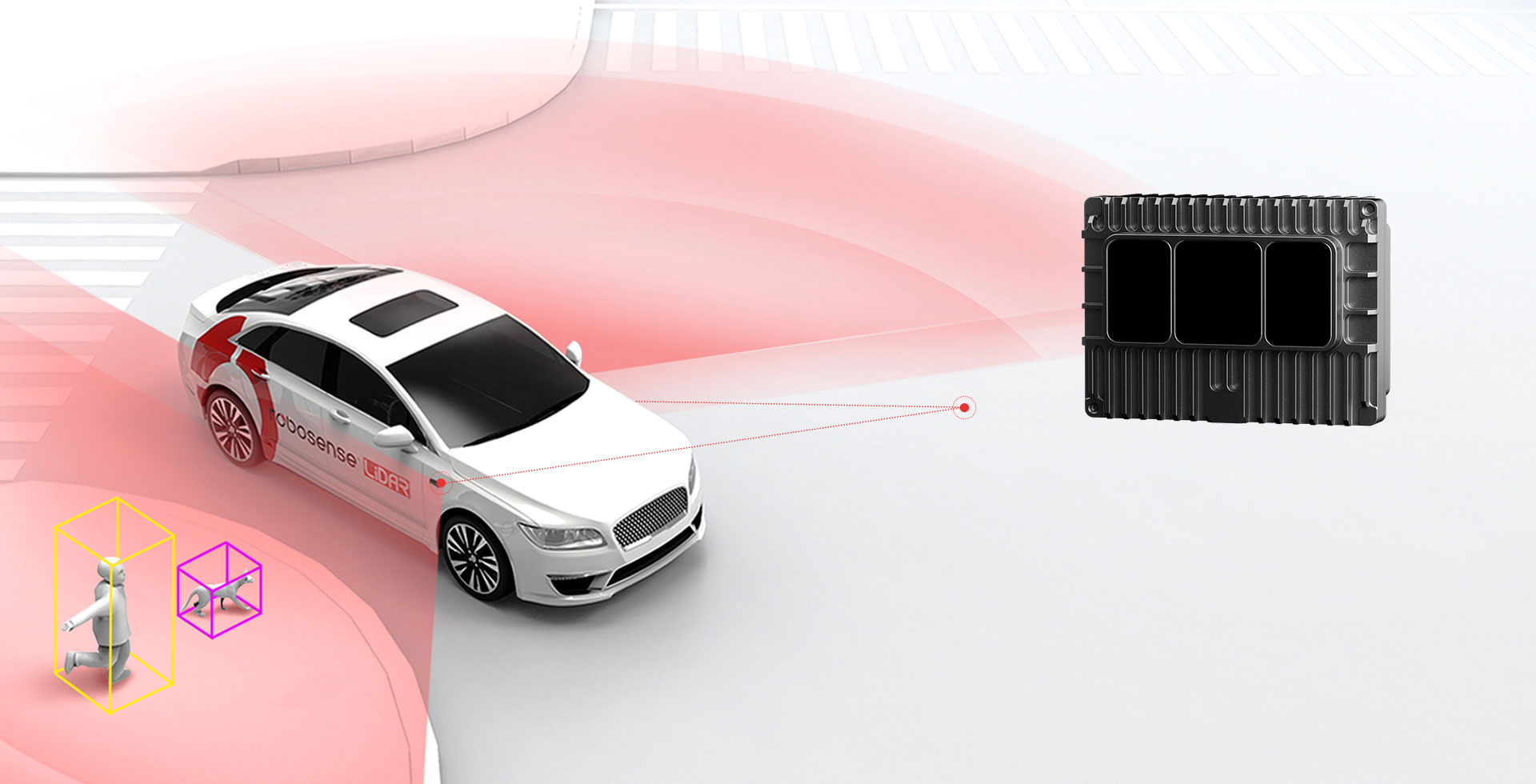
The journey toward full autonomy has long been focused on what lies ahead. Forward-facing long-range LiDARs have captured the industry’s imagination, enabling vehicles to see hundreds of meters down the highway. Yet a critical piece of the perception puzzle has remained stubbornly unsolved: the near-field blind spots immediately surrounding the vehicle. These blind zones—along the sides, around the fenders, and close to the bumpers—represent a significant safety gap that becomes increasingly critical as vehicles maneuver in complex urban environments, execute unprotected turns, and navigate tight spaces.
RoboSense’s E1 is the definitive answer to this challenge. As the world’s first mass-produced fully solid-state digital blind-spot LiDAR, the E1 represents a milestone in automotive perception technology . Built on RoboSense’s proprietary SPAD-SoC and VCSEL chip architecture, it contains no moving parts, delivering exceptional reliability while providing a 120° × 90° wide field of view that eliminates near-field blind spots with just two sensors per vehicle . With 30-meter detection at 10% reflectivity, 25Hz+ high frame rate, and automotive-grade ruggedization, the E1 completes the 360° perception coverage required for safe L3+ autonomous driving.
This comprehensive report provides an in-depth analysis of the RoboSense E1. We will examine its revolutionary fully solid-state chip-based architecture, dissect its industry-leading specifications, explore its critical role in enabling safe Robotaxi operations, and evaluate its unique value proposition for sophisticated automotive and robotics clients in Russia, Europe, and North America. For vehicle manufacturers, autonomous driving developers, and robotics integrators seeking to eliminate blind spots and achieve true 360° situational awareness, the E1 represents the gold standard in near-field perception.
1. Introduction: The Blind Spot Imperative
The history of autonomous vehicle development has been characterized by a natural focus on forward perception. After all, the most critical safety scenarios—highway collisions, rear-end accidents, obstacle avoidance—involve what lies ahead. This focus has yielded remarkable progress: today’s forward LiDARs can detect dark-colored vehicles at 200 meters and small obstacles at distances that provide ample reaction time.
Yet as autonomous vehicles graduate from highway piloting to full urban operation, a different set of challenges has emerged. Consider the following scenarios:
- Unprotected Left Turn: A Robotaxi must execute a left turn across oncoming traffic, requiring precise awareness of vehicles approaching from multiple directions, including the blind spot to the left-rear.
- Roadside Pickup: A passenger hails a ride from the curb. The vehicle must pull over safely while tracking cars, cyclists, and pedestrians approaching from behind on the right side—a classic blind spot scenario .
- Lane Change in Traffic: Merging into dense highway traffic requires confidence that no vehicle is lurking in the adjacent lane just beyond the side mirror’s view.
- Parking and Maneuvering: Navigating tight parking structures demands awareness of obstacles within centimeters of the bumpers and fenders.
Traditional solutions have proven inadequate. Corner radars provide range but lack the angular resolution to precisely locate and classify obstacles. Side-view cameras offer visual information but struggle in low light and cannot provide accurate 3D positioning. Even short-range LiDARs often lack the frame rate and resolution to capture the precise speed and trajectory of nearby moving targets, hindering the vehicle’s ability to make proactive decisions .
RoboSense recognized that what the industry needed was not an incremental improvement to existing sensor types, but a purpose-built solution designed from the ground up for near-field blind-spot perception. The E1 is that solution .
2. E1: Technical Architecture and Core Innovations
2.1 Fully Solid-State Digital Architecture
The E1 represents a fundamental departure from conventional LiDAR designs. It is built on RoboSense’s E Platform, the company’s first fully solid-state digital LiDAR architecture, leveraging proprietary chip technology developed entirely in-house .
No Moving Parts for Ultimate Reliability
Unlike mechanical spinning LiDARs or even MEMS-based solid-state sensors, the E1 contains no macroscopic moving parts whatsoever . It employs a Flash LiDAR architecture, illuminating the entire field of view simultaneously and capturing the return signal with a high-sensitivity detector array. This design eliminates the wear mechanisms that limit the lifespan of mechanical sensors and provides exceptional long-term reliability—a critical requirement for mass-produced vehicles and continuous-duty robotics applications.
Chip-Level Integration: SPAD-SoC and VCSEL
At the heart of the E1 lie two custom-developed chips that represent the culmination of RoboSense’s years of investment in semiconductor design capability :
- SPAD-SoC Receiver Chip: The receiving system uses an advanced 3D stacking process to integrate a large-array Single Photon Avalanche Diode (SPAD) detector with a high-performance System-on-Chip (SoC) onto a single die. This integration achieves several transformative benefits:
- The SPAD array exceeds 250,000 pixels, providing 20% higher receiving efficiency than conventional designs .
- On-chip signal processing eliminates the noise and distortion inherent in analog signal chains, delivering cleaner, more reliable point clouds.
- The highly integrated design dramatically simplifies the system architecture, reducing component count, cost, and power consumption.
- 2D VCSEL Transmitter Chip: The transmitting system employs a 2D addressable surface-array Vertical-Cavity Surface-Emitting Laser (VCSEL) chip. This enables flexible scanning patterns and dynamic power allocation:
- Peak power consumption is just one-tenth that of 1D scanning alternatives, dramatically improving energy efficiency and simplifying thermal management .
- The 2D addressing capability allows real-time adjustment of local emission power based on ranging requirements, optimizing energy allocation across the field of view.
- Flexible scanning modes enable sophisticated perception strategies impossible with fixed-pattern illuminators.
This chip-level integration—combining transmitting, receiving, and processing functions into just two core components—represents a paradigm shift in LiDAR design. It delivers exceptional performance while dramatically simplifying circuit design, reducing manufacturing complexity, and lowering cost .
2.2 Detailed Technical Specifications
The following specifications are compiled from RoboSense official documentation and verified by multiple industry sources :
2.3 The 120° × 90° Field of View Advantage
The E1’s 120° horizontal by 90° vertical field of view is carefully optimized for blind-spot coverage .
Horizontal Coverage (120°):
This wide horizontal FOV enables a significant system-level advantage: just two E1 sensors, mounted on the left and right sides of the vehicle, can provide complete 360° near-field coverage when combined with forward and rear sensors . This “minimum sensor count” approach delivers three benefits:
- Cost Efficiency: Fewer sensors reduce bill-of-materials cost.
- Simplified Integration: Lower system complexity reduces development effort.
- Enhanced Reliability: Fewer components mean fewer potential failure points.
The 120° horizontal FOV is specifically chosen to align with the coverage of typical forward-facing LiDARs (also 120°), enabling seamless “handoff” between forward and side perception zones .
Vertical Coverage (90°):
The 90° vertical FOV is equally carefully designed :
- Downward Tilt for Ground Visibility: The lower portion of the FOV extends to -81.5°, bringing the ground blind spot down to just 15cm from the vehicle . This enables reliable detection of curbs, speed bumps, small obstacles, and even road surface features that are invisible to sensors with narrower vertical coverage.
- Upward Tilt for Vehicle Detection: The upper portion retains approximately 8.5° of upward visibility, ensuring that the sensor can see the full profile of vehicles passing alongside—from tire to roof—enabling accurate classification and tracking .
2.4 High Frame Rate for Dynamic Object Tracking
The E1 supports frame rates up to 30Hz, with 25Hz+ typical operation . This high update rate delivers critical advantages for blind-spot applications:
- Acceleration Perception in 200ms: At 25Hz, the sensor can detect changes in an object’s velocity within 200 milliseconds, enabling rapid assessment of collision risk .
- Improved Small Object Detection: Higher frame rates provide more temporal samples, increasing the probability that small, fast-moving objects will be detected .
- Reduced Latency for Safety Systems: Lower perception latency translates directly to faster reaction times for safety-critical functions like blind-spot intervention and cross-traffic alert.
2.5 30-Meter Detection at 10% Reflectivity
The E1’s 30-meter detection capability at 10% reflectivity is carefully matched to blind-spot application requirements :
- Intersection Coverage: 30 meters is sufficient to completely cover a 6-lane intersection, detecting vehicles approaching from cross streets with ample time for decision-making .
- Lane Change Safety: At highway speeds, 30 meters provides approximately 0.8 seconds of warning time—sufficient for most blind-spot monitoring applications.
- Urban Maneuvering: In city driving, 30 meters covers multiple vehicle lengths, enabling safe lane changes and turns in traffic.
The 120-meter maximum range extends capability to larger objects, providing additional safety margin when conditions permit.
3. Transformative Application Scenarios
The E1’s unique combination of wide field of view, high frame rate, and solid-state reliability makes it applicable across a wide spectrum of automotive and robotics applications.
3.1 Robotaxi and L4 Autonomous Vehicles
The E1 has rapidly become the industry standard for blind-spot perception in L4 autonomous vehicles, with adoption by leading global Robotaxi developers .
Didi Autonomous Driving Partnership
In April 2025, RoboSense announced a major partnership with Didi Autonomous Driving, one of China’s leading L4 technology companies. The collaboration focuses on Didi’s first L4 Robotaxi model, developed in partnership with GAC Aion .
Key details of the partnership:
- 33 Total Sensors: The Didi L4 Robotaxi features 33 sensors in total, including 6 E1 blind-spot LiDARs .
- 360° Full-Scenario Perception: The E1s work in concert with other sensors to provide comprehensive 360° coverage in all operating conditions .
- Industry First: This vehicle is the industry’s first to achieve mass production with fully solid-state blind-spot LiDARs onboard .
In November 2025, RoboSense and Didi expanded their collaboration with a new (design win) for Didi’s next-generation Robotaxi models. Each vehicle will be equipped with 10 digital LiDARs, including both EM4 main sensors and E1 blind-spot sensors, to create a comprehensive all-weather, 24/7 perception suite .
The “EM4 + E1” Preferred Configuration
RoboSense’s combination of EM4 ultra-long-range main LiDAR and E1 blind-spot LiDAR has emerged as the “preferred configuration” accelerating Robotaxi commercial deployment .
The rationale is compelling:
- EM4 (Main): Provides long-range precision detection of distant vehicles, pedestrians, and obstacles, offering up to 70% more reaction time in high-speed scenarios.
- E1 (Blind-Spot): Eliminates near-field blind spots around the vehicle with dense point cloud coverage, ensuring no obstacle escapes detection .
In a typical Robotaxi configuration, four EM4 sensors cover the front, rear, and sides, while four E1 sensors focus exclusively on 360° short-range blind spots. This dual-layer approach—”long-range precise detection plus short-range blind-spot elimination”—meets the continuous, full-range perception needs of complex scenarios like roadside passenger pickup, where the vehicle must simultaneously track approaching traffic from behind while maneuvering close to the curb .
Industry Leadership
RoboSense reports that it collaborates with over 90% of the world’s leading L4 autonomous driving companies, including Didi, WeRide, Pony.ai, Baidu Apollo, and Waymo . The E1 is a key component of this leadership position, providing the blind-spot coverage essential for safe Robotaxi operation.
3.2 L2+ and L3 Passenger Vehicles
Beyond Robotaxis, the E1 is equally valuable for mass-production passenger vehicles equipped with L2+ and L3 driving assistance systems.
Blind-Spot Elimination for Highway Assist
Highway driving assistance systems require reliable detection of vehicles in adjacent lanes, particularly those approaching from the rear in the driver’s blind spot. The E1’s 120°×90° FOV, when mounted on the vehicle’s sides, provides comprehensive coverage of these critical zones .
Cross-Traffic Alert
When backing out of parking spaces or driveways, vehicles must detect approaching cross-traffic. The E1’s wide FOV and high frame rate enable rapid detection of vehicles, cyclists, and pedestrians entering the path.
Intersection Assistance
At intersections, particularly those with limited visibility, the E1 can detect approaching vehicles that would otherwise be hidden until the last moment. The 30-meter detection range at 10% reflectivity covers typical intersection geometries with ample safety margin .
3.3 Robotics Applications: E1R
Building on the E1’s success in automotive applications, RoboSense has introduced E1R, a variant optimized for robotics applications .
E1R Key Features:
- Fully Solid-State Design: Inherits the E1’s chip-based architecture with no moving parts.
- 120° × 90° Ultra-Wide FOV: Same hemispherical-like coverage as E1.
- Compact Form Factor: Small (optical window) for easy integration.
- Car-Level Reliability: Built to automotive-grade standards, ensuring long-term durability in demanding applications.
- Real-Time Detection: Capable of detecting object size, (contour), distance, and other information in real-time .
Target Robotics Applications:
- Industrial Robots: AGVs, AMRs, and forklifts requiring comprehensive obstacle detection.
- Commercial Robots: Delivery robots, cleaning robots, and service robots operating in dynamic environments.
- Embodied Intelligence: Humanoid robots and other advanced robotics platforms requiring detailed near-field perception.
E1R is positioned as a core product for RoboSense’s 2025 robotics LiDAR (shipment volume) growth .
3.4 V2X and Smart Infrastructure
Beyond on-vehicle applications, the E1 is suitable for roadside infrastructure deployment in V2X (Vehicle-to-Everything) systems .
Intersection Monitoring:
Mounted at intersections, E1s can provide comprehensive coverage of approaching traffic, cyclists, and pedestrians, feeding real-time data to traffic management systems and connected vehicles.
Pedestrian Crosswalk Protection:
E1s positioned at crosswalks can detect pedestrians waiting to cross or entering the roadway, triggering warnings to approaching vehicles.
3.5 Autonomous Mobile Robots (AMRs) and Automated Guided Vehicles (AGVs)
For industrial and commercial robots, the E1’s combination of wide FOV, solid-state reliability, and cost-effectiveness makes it an ideal perception solution .
Warehouse Navigation:
AMRs navigating narrow aisles in warehouses benefit from the E1’s ability to detect rack structures, obstacles, and personnel at all heights.
Collision Avoidance:
The 15cm ground blind spot ensures that robots can detect low obstacles—pallets, debris, floor markings—that might otherwise cause collisions .
Docking and Positioning:
Precise 3D data enables accurate positioning relative to charging stations, load transfer points, and other infrastructure.
4. Automotive-Grade Validation and Reliability
The E1 has undergone rigorous validation to ensure it meets the demanding requirements of automotive production.
4.1 CNAS-Certified LiDAR Laboratory
RoboSense operates the industry’s first and only CNAS . This facility enables comprehensive testing of LiDAR performance and reliability under controlled, accredited conditions.
4.2 Comprehensive Reliability Testing
Drawing on experience from the M1—described as “the single radar product with the most stringent validation conditions, the most(thorough engineering validation), and the largest test sample size in the world”—RoboSense applies similarly rigorous standards to the E1 .
The M1 validation program, which informs E1 development, included:
- Over 36,000 hours of high-temperature durability testing
- Over 24,000 hours of high-temperature, high-humidity testing
- Over 21,000 hours of thermal cycling testing
- Over 40,000 hours of individual component testing
- Comprehensive coverage of HALT, HAST, thermal shock, EMC, high-altitude, salt spray, ice water immersion, dust/water ingress, and temperature极限 (extreme) testing
4.3 Mass Production Capability
RoboSense has demonstrated its ability to scale production to meet automotive demand:
- Luxsense Joint Venture: In partnership with Luxshare, RoboSense established Luxsense, a dedicated智造企业 (smart manufacturing enterprise) .
- Over ¥1 Billion Investment: Cumulative investment in the first phase of RoboSense’s智能制造系统 (smart manufacturing system) exceeded ¥1 billion .
- 55,000+ m² Plant Area: The manufacturing facility spans over 55,000 square meters.
- 20 Automated Production Lines: Nearly 20 automated lines achieve production of one LiDAR every 12 seconds .
This production capability ensures that E1 can be delivered at the scale required for mass-market vehicle programs.
5. Value Proposition and Cost-Effectiveness for International Clients
For sophisticated clients in European, North American, and Russian markets, the E1 offers compelling advantages across multiple dimensions.
5.1 True 360° Perception with Minimal Sensors
The E1’s 120° horizontal FOV enables complete 360° near-field coverage with just two sensors . This delivers significant system-level benefits:
- Reduced Bill of Materials: Fewer sensors mean lower hardware costs.
- Simplified Integration: Less complex mechanical and electrical integration reduces development time.
- Lower Computational Load: Processing data from two sensors is more efficient than processing from three or four.
5.2 Unmatched Reliability Through Solid-State Design
With no moving parts, the E1 eliminates the primary wear mechanism that limits the lifespan of conventional LiDARs . This delivers:
- Extended Operational Life: Suitable for vehicles designed for 10+ years of service.
- Reduced Maintenance: No mechanical components to wear out or fail.
- Enhanced Robustness: Better resistance to vibration, shock, and environmental stress.
5.3 Chip-Level Integration Driving Cost Efficiency
By integrating transmitting, receiving, and processing functions into just two custom chips, the E1 achieves dramatic cost advantages :
- Simplified Circuit Design: Fewer discrete components reduce board complexity.
- Streamlined Production: Simplified assembly and testing reduce manufacturing cost.
- Scalable Economics: As semiconductor volumes increase, costs follow Moore’s Law trajectories.
5.4 Application-Optimized Performance
Every aspect of the E1’s performance is carefully tuned for blind-spot applications:
- 30-Meter Range: Optimized for intersection coverage and lane-change safety, avoiding over-specification that would increase cost.
- 15cm Ground Blind Spot: Ensures detection of curbs,减速带 (speed bumps), and low obstacles that matter in near-field maneuvering .
- 25Hz+ Frame Rate: Fast enough for dynamic object tracking without generating excessive data.
5.5 Global Availability and Support
RoboSense maintains a global presence to support international clients:
- European Office: Stuttgart, Germany
- North American Offices: Detroit, Michigan and Silicon Valley, California
- Global Distribution Network: Partners serving markets worldwide
6. Competitive Positioning: E1 vs. Alternatives
In the landscape of blind-spot LiDAR sensors, the E1 occupies a unique position:
7. Conclusion: The Essential Component for True 360° Perception
The RoboSense E1 represents a fundamental advancement in automotive perception technology. As the world’s first mass-produced fully solid-state digital blind-spot LiDAR, it addresses the critical gap that has long existed in autonomous vehicle perception systems: reliable, high-performance near-field coverage of the areas traditional sensors miss.
For clients in the demanding automotive and robotics markets of Europe, North America, and Russia, the E1 offers a compelling value proposition:
- Unmatched Reliability: Fully solid-state design with no moving parts ensures long-term durability in continuous operation .
- Optimized Performance: 120°×90° FOV, 30m range, 25Hz+ frame rate, and ≤15cm ground blind spot are precisely tuned for blind-spot applications .
- Proven Commercial Adoption: Selected by Didi, WeRide, and over 90% of global L4 leaders, the E1 is not a prototype—it is a production-proven solution .
- Chip-Level Cost Efficiency: Proprietary SPAD-SoC and VCSEL integration delivers performance at a cost point suitable for mass-market deployment .
- Future-Proof Platform: The E platform’s digital architecture provides a foundation for ongoing capability enhancement.
In an industry where the difference between safe operation and collision often lies in the areas sensors cannot see, the E1 transforms blind spots into fully perceived, continuously monitored spaces. For any organization serious about achieving true 360° situational awareness—whether for Robotaxis, passenger vehicles, or advanced robotics—the RoboSense E1 is not merely an option to consider; it is the essential component that completes the perception puzzle.









