
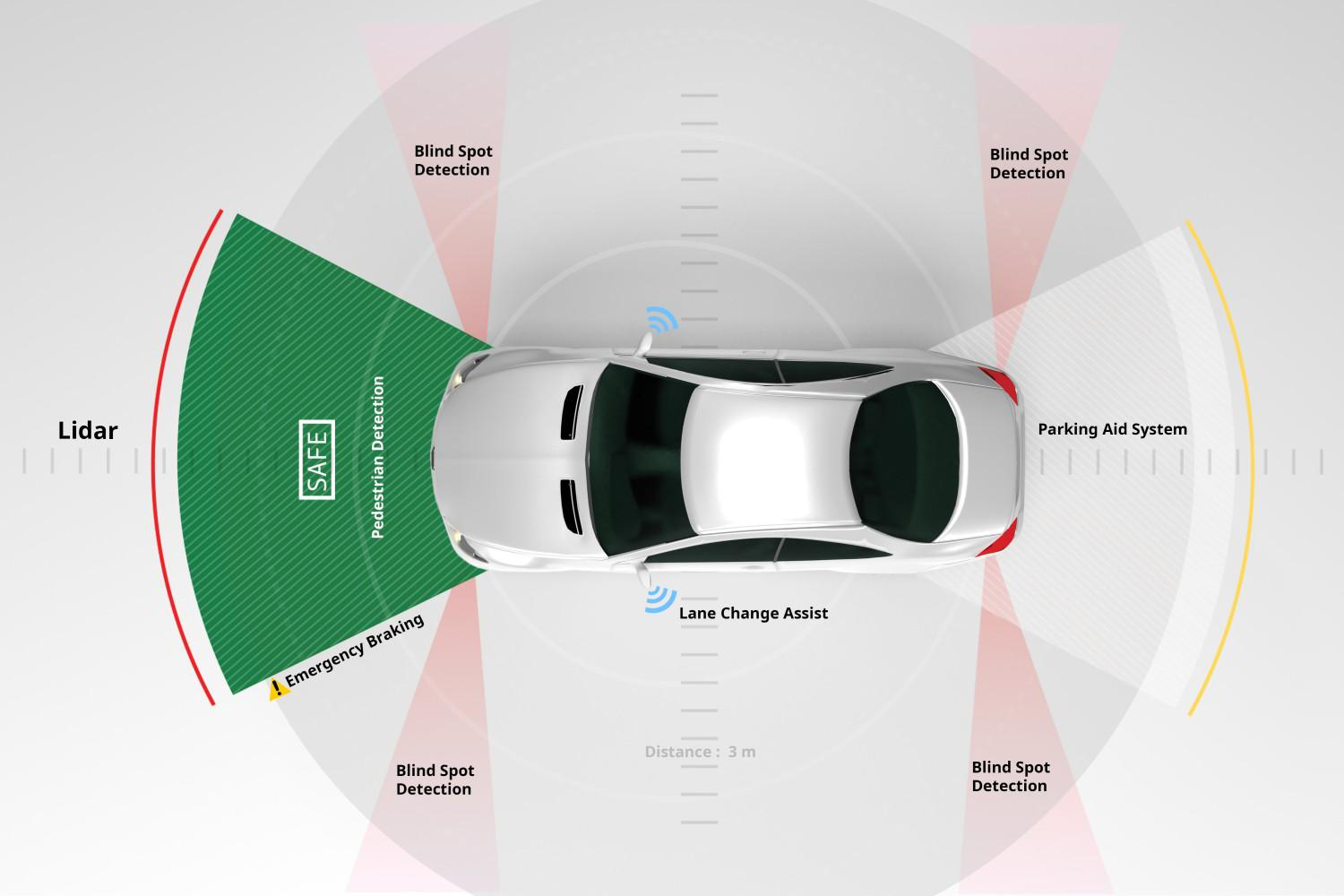
Introduction: Why Blind-Spot Detection Is Critical for Modern Vehicles
Automotive safety technology is evolving rapidly as vehicle manufacturers introduce more advanced driver assistance systems and autonomous driving capabilities.
Modern vehicles increasingly rely on multiple sensing technologies to understand their surroundings. Cameras, radar, ultrasonic sensors, and LiDAR systems work together to provide environmental information for object detection, collision warning, parking assistance, and automated driving functions.
However, one important challenge remains: blind-spot perception.
Even vehicles equipped with advanced forward-facing LiDAR sensors may have areas around their sides, rear corners, and close-range surroundings that are not sufficiently covered.
These areas become particularly important during:
- Lane changes
- Turning at intersections
- Reversing
- Low-speed parking
- Driving through narrow spaces
- Interacting with pedestrians and cyclists
- Operating in crowded urban environments
A vehicle may detect an object far ahead but still have difficulty observing a pedestrian or bicycle approaching from a nearby side area.
For this reason, automotive manufacturers are increasingly considering dedicated short-range LiDAR sensors to complement long-range perception systems.
The Hesai FTX is an automotive-grade fully solid-state short-range LiDAR designed specifically for wide-angle near-field perception and blind-spot coverage.
With up to 180° horizontal field of view, up to 140° vertical coverage, high-resolution point cloud output, and a compact design, FTX provides an additional sensing option for advanced driver assistance systems and autonomous vehicles.
In this article, we examine how Hesai FTX supports automotive blind-spot detection, why wide-angle short-range LiDAR is important, and how vehicle manufacturers can select the right FTX configuration.
1. What Is Automotive Blind-Spot LiDAR?
Automotive blind-spot LiDAR is a type of laser-based sensing technology designed to capture spatial information in areas around a vehicle that may not be sufficiently covered by other sensors.
Unlike traditional long-range LiDAR systems, which focus on detecting vehicles, pedestrians, and obstacles at greater distances, short-range blind-spot LiDAR concentrates on the immediate surroundings.
Its primary purpose is to provide detailed near-field perception.
For example, a vehicle changing lanes may need to detect a bicycle approaching from the rear side.
A passenger car reversing out of a parking space may need to identify a pedestrian or another vehicle positioned close to its rear corner.
An autonomous shuttle operating in a crowded urban environment may need to monitor pedestrians and objects near its bodywork.
These scenarios require wide-angle sensing and accurate near-field information.
Hesai FTX is designed for these requirements through:
- Fully solid-state electronic scanning
- Up to 180° horizontal FOV
- Up to 140° vertical FOV
- 20m or 30m detection range at 10% reflectivity, depending on configuration
- 492,000 points per second in single-return mode
- 10Hz scanning frequency
- Compact installation dimensions
- Class 1 eye-safety classification
- Automotive-grade reliability validation
By providing additional near-field point cloud data, FTX can complement other vehicle sensing technologies and help improve the overall environmental perception system.
2. Why Traditional Automotive Sensors May Need LiDAR Supplementation
Modern vehicles commonly use several sensing technologies.
Each technology has different advantages and limitations.
Understanding these differences helps explain why short-range LiDAR can play an important role in blind-spot detection.
Cameras
Cameras provide visual information and can identify traffic signs, lane markings, pedestrians, vehicles, and other objects.
However, camera performance can be influenced by:
- Direct sunlight
- Nighttime conditions
- Shadows
- Glare
- Rain and water on the lens
- Low-contrast objects
Cameras also need image-processing algorithms to estimate object distance.
Millimeter-Wave Radar
Radar is widely used in automotive applications because it can detect moving objects and measure their relative speed.
It is useful for adaptive cruise control, rear cross-traffic alerts, and blind-spot monitoring.
However, radar point clouds generally provide less detailed geometric information than high-resolution 3D LiDAR point clouds.
Ultrasonic Sensors
Ultrasonic sensors are commonly used for parking assistance and very close-range obstacle detection.
They are useful for detecting objects near bumpers and vehicle corners.
However, their coverage is generally limited, and they do not provide the same type of detailed 3D environmental reconstruction as LiDAR.
Short-Range LiDAR
Short-range LiDAR provides direct distance measurements and spatial point cloud information.
It can help identify the position, shape, and geometric distribution of nearby objects.
This makes it a valuable complement to cameras and radar in advanced perception systems.
Hesai FTX is designed to provide this type of wide-angle near-field sensing.
It should not be considered a universal replacement for cameras, radar, ultrasonic sensors, or long-range LiDAR. Instead, it can be integrated into a multi-sensor architecture to improve coverage and perception redundancy.

3. Hesai FTX: A Fully Solid-State Solution for Blind-Spot Coverage
Hesai FTX adopts a fully solid-state electronic scanning architecture.
This design removes the need for a conventional rotating optical assembly and enables a compact sensor structure.
For automotive applications, this offers several important advantages.
Compact Mechanical Structure
Automotive sensor installation space is often limited.
A LiDAR sensor may need to be installed behind a bumper, near a front grille, at a side corner, or in another suitable body position.
The compact FTX design supports embedded installation.
According to Hesai, its embedded installation can expose only approximately 2cm² of the optical window, helping maintain a clean vehicle exterior design.
Wide-Angle Near-Field Perception
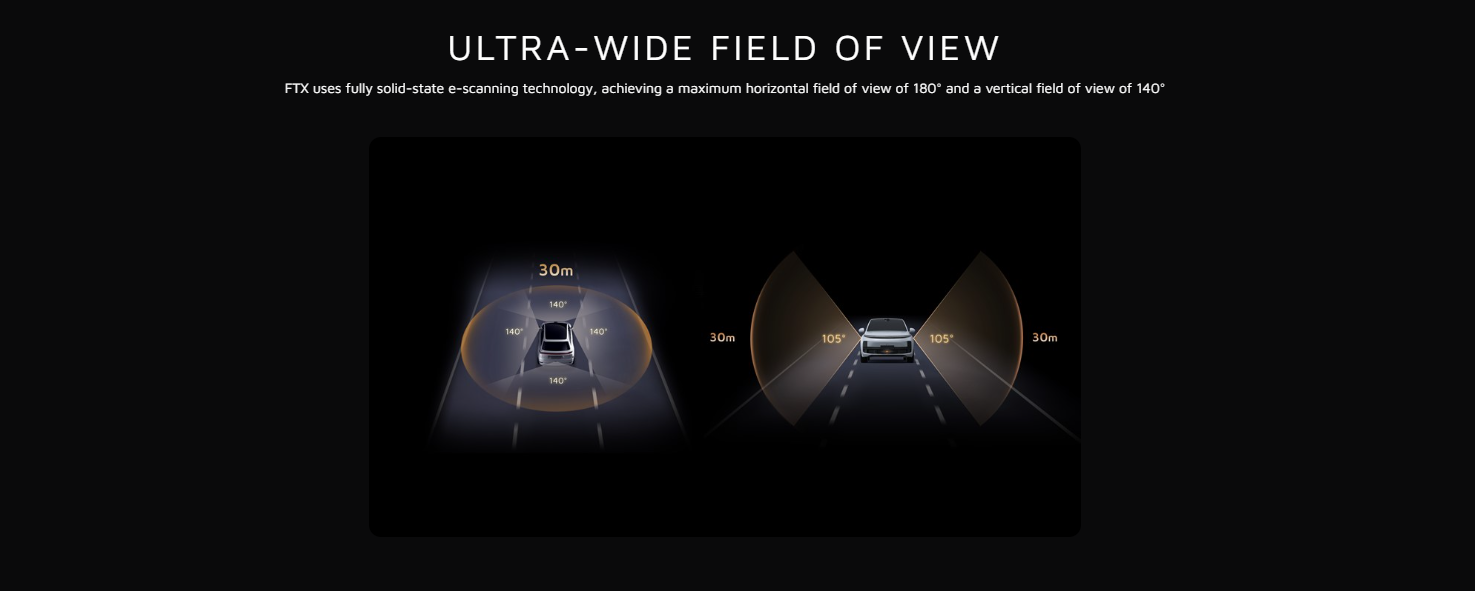
The FTX 180° configuration supports a 180° horizontal and 140° vertical field of view.
This is especially useful for monitoring large areas around a suitable installation position.
The FTX 140° version offers a 140° horizontal and 105° vertical field of view.
These configurations allow vehicle manufacturers to choose a suitable sensing angle according to their vehicle geometry.
Reduced Mechanical Complexity
The solid-state architecture avoids traditional rotating optical components.
This is beneficial for vehicle platforms that require compact and mechanically integrated sensor modules.
Automotive-Oriented Development
Hesai lists ISO 26262-compliant development process and ISO 21434-compliant development process information for FTX.
These development-process credentials are relevant when evaluating automotive electronic components.
However, the development-process statements should not be interpreted as automatic certification of an entire vehicle perception or safety system.
4. Up to 180° Wide-Angle Coverage for Vehicle Blind Spots
One of the most important features of Hesai FTX is its exceptionally wide field of view.
The FTX 180° model provides:
- 180° horizontal field of view
- 140° vertical field of view
The FTX 140° model provides:
- 140° horizontal field of view
- 105° vertical field of view
A wide horizontal field of view is especially useful for automotive blind-spot sensing.
Consider a vehicle equipped with a front-facing long-range LiDAR.
Although the front LiDAR may provide excellent detection performance ahead, it may not cover the entire near-field area around the vehicle.
By installing FTX in suitable front-side or corner positions, vehicle manufacturers can add sensing coverage to these areas.
Potential sensing zones include:
- Front-side blind zones
- Side approach areas
- Near-field corner regions
- Areas close to vehicle body panels
- Selected rear-side areas, depending on installation
A wide vertical field of view can also provide additional information about objects located at different heights.
This is important when detecting pedestrians, bicycles, low obstacles, and other objects near the vehicle.
The actual coverage area depends on mounting position, orientation, vehicle body geometry, and sensor occlusion. A 180° FOV specification does not automatically mean that one sensor provides complete 360° vehicle coverage.
5. Detecting Pedestrians, Bicycles and Small Obstacles
Automotive blind-spot systems must detect more than other passenger vehicles.
In crowded urban environments, vulnerable road users can enter a vehicle’s path unexpectedly.
Examples include:
- Pedestrians
- Children
- Bicycles
- Electric bicycles
- Electric scooters
- Motorcycles
- Strollers
- Small roadside obstacles
Hesai’s official product information specifically highlights objects such as strollers, e-bikes, and pedestrians as examples of near-field targets for FTX.
The sensor’s high-resolution point cloud data can provide geometric information that helps downstream perception algorithms identify these objects.
For example, when a bicycle approaches from the side, a LiDAR system may capture its spatial structure and position relative to the vehicle.
A perception algorithm can then combine this information with camera and radar data to determine whether a potential collision risk exists.
This is especially useful in urban environments where different road users may move unpredictably.
The sensor does not independently make the final safety decision. That function belongs to the complete vehicle perception and control system.
6. How Hesai FTX Supports Different ADAS Functions
Hesai FTX can be considered for several automotive near-field perception applications.
6.1 Lane Change Assistance
Changing lanes requires monitoring the surrounding traffic environment.
Vehicles, bicycles, and motorcycles may approach from the side or rear.
A short-range LiDAR installed in an appropriate vehicle position can provide additional geometric information about nearby objects.
The data can support:
- Side obstacle detection
- Near-field object localization
- Lane-change risk assessment
- Sensor fusion with radar and cameras
6.2 Intersection Collision Avoidance
Intersections are complex environments where vehicles, pedestrians, and cyclists may approach from different directions.
A wide-angle near-field sensor can provide additional information around the vehicle’s front corners.
This can support perception functions designed to identify objects entering the vehicle’s intended path.
6.3 Automated Parking
Automated parking requires accurate awareness of nearby obstacles.
Vehicles may need to maneuver close to walls, pillars, parked cars, curbs, and pedestrians.
FTX can provide short-range 3D distance information that complements cameras and ultrasonic sensors.
6.4 Low-Speed Collision Prevention
During low-speed driving, the vehicle may encounter objects positioned very close to its front or side panels.
A dedicated near-field LiDAR can provide additional sensing information to the vehicle’s collision warning and control system.
6.5 Autonomous Shuttle Perception
Autonomous shuttles often operate in environments with pedestrians and other vehicles nearby.
Their large body structures may create additional blind areas.
FTX can be considered as a compact near-field sensing component to supplement the main autonomous driving LiDAR system.
7. High Point Rate and Resolution for Detailed Near-Field Sensing
For automotive blind-spot detection, a wide field of view must be combined with sufficient spatial resolution.
Hesai FTX provides up to 492,000 points per second in single-return mode.
The sensor operates at a scanning frequency of 10Hz.
The two configurations offer different pixel resolutions:
| Parameter | FTX 180° | FTX 140° |
|---|---|---|
| Point Rate | 492,000 pts/s | 492,000 pts/s |
| Pixel Resolution | 216 × 192 | 256 × 192 |
| Angular Resolution | 0.62° finest | 0.56° × 0.56° |
| Frame Rate | 10Hz | 10Hz |
This level of spatial information can help perception systems identify the location and shape of nearby objects.
For example, a low obstacle near the vehicle’s side may produce a different point cloud pattern from a larger vehicle or wall.
The perception software can analyze these spatial characteristics and combine them with other sensor information.
For automotive applications, the complete system should be tested for detection reliability, latency, false positives, false negatives, and performance across different object types.
8. FTX 180° vs. FTX 140°: Which Automotive LiDAR Should You Choose?
Both versions are designed for short-range perception, but they have different field-of-view and range characteristics.
| Specification | Hesai FTX 180° | Hesai FTX 140° |
|---|---|---|
| Horizontal FOV | 180° | 140° |
| Vertical FOV | 140° | 105° |
| Range @10% Reflectivity | 20m | 30m |
| Point Rate | 492,000 pts/s | 492,000 pts/s |
| Pixel Resolution | 216 × 192 | 256 × 192 |
| Angular Resolution | 0.62° finest | 0.56° × 0.56° |
| Dimensions | 60 × 38.7 × 55mm | 60 × 32 × 55mm |
| Weight | Approx. 180g | Approx. 160g |
| Power Consumption | Below 6W | Below 6W |
Choose FTX 180° If Your Priority Is Wider Blind-Spot Coverage
FTX 180° is suitable for applications requiring very wide horizontal and vertical sensing coverage.
It may be particularly useful for:
- Wide front-side perception
- Vehicle corner monitoring
- Near-field obstacle detection
- Low-speed autonomous driving
- Wide-area robotic sensing
Choose FTX 140° If You Need a Longer Specified Detection Range
FTX 140° provides a specified range of 30m at 10% reflectivity.
It is suitable for applications requiring a balance between wide-angle coverage, higher angular resolution, and longer short-range detection.
Potential applications include:
- Side blind-spot monitoring
- Front-side obstacle detection
- Autonomous vehicle perception
- Compact vehicle integration
- Robotic near-field sensing
The final selection should be based on vehicle dimensions, sensor placement, target distance, and required coverage.
9. Automotive-Grade Reliability and Environmental Validation
Automotive sensors must operate in challenging environments.
They may experience:
- High and low temperatures
- Mechanical vibration
- Water exposure
- Dust
- Humidity
- Chemical contamination
- Electromagnetic interference
Hesai’s official FTX product information lists several reliability validation tests, including:
- UV aging
- High-temperature testing
- IP6K7 and IP6K9K testing
- Mechanical shock
- Thermal shock with water splash
- Low-temperature wakeup
- Humid heat cycling
- Vibration with thermal cycling
- Electrical and electronic testing
The product also lists Class 1 eye safety and development-process credentials associated with ISO 26262 and ISO 21434.
These characteristics make FTX relevant to automotive applications requiring compact and robust near-field sensing components.
For production vehicle projects, buyers should request the current product certification documentation and verify that the specific hardware configuration meets their vehicle-level requirements.
10. Hesai FTX Technical Specifications
The following table summarizes the main manufacturer-published technical parameters.
| Parameter | FTX 180° | FTX 140° |
|---|---|---|
| Product Type | Automotive-Grade Fully Solid-State LiDAR | Automotive-Grade Fully Solid-State LiDAR |
| Laser Wavelength | 940nm | 940nm |
| Laser Safety | Class 1 | Class 1 |
| Detection Range | 20m @10% Reflectivity | 30m @10% Reflectivity |
| Point Rate | 492,000 pts/s | 492,000 pts/s |
| Horizontal FOV | 180° | 140° |
| Vertical FOV | 140° | 105° |
| Pixel Resolution | 216 × 192 | 256 × 192 |
| Angular Resolution | 0.62° finest | 0.56° × 0.56° |
| Scanning Frequency | 10Hz | 10Hz |
| Power Consumption | Below 6W | Below 6W |
| Dimensions | 60 × 38.7 × 55mm | 60 × 32 × 55mm |
| Weight | Approx. 180g | Approx. 160g |
| Environmental Validation | IP6K7 / IP6K9K | IP6K7 / IP6K9K |
These are typical manufacturer-published specifications under defined test conditions. Please consult the latest official datasheet for detailed electrical, communication, installation, and certification requirements.
11. Why Automotive Manufacturers and Integrators Should Consider Hesai FTX
When developing an automotive perception system, sensor selection affects not only detection capability but also vehicle structure, system cost, integration complexity, and long-term reliability.
Hesai FTX offers several advantages for projects requiring near-field perception.
Wide-Angle Coverage
The 180° configuration provides a broad field of view for short-range blind-spot sensing.
Compact Installation
The small dimensions and embedded installation approach help reduce the space required for sensor integration.
Solid-State Architecture
The electronic scanning design avoids a conventional rotating optical assembly.
High-Resolution Spatial Data
The point rate of up to 492,000 points per second provides detailed point cloud information for downstream perception algorithms.
Automotive-Oriented Development
Its automotive-grade design and listed reliability validation make it relevant to ADAS and autonomous driving development.
Flexible Configurations
FTX 180° and FTX 140° provide options for different vehicle layouts and near-field detection requirements.
12. Why Buy Hesai FTX LiDAR from LidarSeek?
For automotive developers and system integrators, obtaining suitable LiDAR products at competitive prices is an important part of project planning.
LidarSeek provides LiDAR sourcing services and intelligent perception products for global customers.
We support customers working on:
- Advanced driver assistance systems
- Autonomous driving platforms
- Autonomous shuttles
- Robotaxis
- Electric vehicle development
- Automotive blind-spot detection
- Mobile robotics
- Industrial automation
When purchasing Hesai FTX through LidarSeek, you can benefit from:
Competitive Pricing
We focus on competitive sourcing options for Hesai LiDAR products.
Model Selection Assistance
Our team can help evaluate FTX 180° and FTX 140° according to your sensing requirements.
Global Supply Support
We support international customers with product sourcing and shipping coordination.
Technical Information
Request technical datasheets, configuration details, and product information for your development project.
Bulk Order Quotations
For automotive development programs and multi-unit projects, contact our team for project-based pricing.
13. Request Hesai FTX Pricing from LidarSeek
Are you developing an automotive blind-spot detection system or looking for a compact solid-state LiDAR for near-field perception?
Hesai FTX provides wide-angle sensing, high-resolution point cloud output, and a compact automotive-oriented design.
Its 180° and 140° configurations offer flexible options for different vehicle platforms.
LidarSeek helps international customers source Hesai LiDAR products with competitive pricing and global shipping support.
Contact us to request:
- Latest Hesai FTX pricing
- FTX 180° and FTX 140° availability
- Technical specifications
- Product datasheets
- Integration information
- International shipping estimates
- Bulk order quotations
Looking for a competitive price for Hesai FTX?
Contact LidarSeek today to discuss your automotive sensing project.
Request a Quote Now – Find the Right Blind-Spot LiDAR Solution for Your Vehicle.
Frequently Asked Questions (FAQ)
Q1. What is Hesai FTX LiDAR used for?
Hesai FTX is designed for short-range automotive perception and blind-spot detection. It can be used in ADAS, autonomous driving, vehicle side perception, robotaxis, autonomous shuttles, and robotic applications.
Q2. How does Hesai FTX help reduce vehicle blind spots?
FTX provides wide-angle near-field point cloud data. When installed in suitable front, side, or corner positions, it can help detect objects in areas that may not be adequately covered by the vehicle’s primary long-range sensors.
Q3. What is the maximum field of view of Hesai FTX?
The FTX 180° version supports a maximum horizontal field of view of 180° and a vertical field of view of 140°.
The FTX 140° version supports 140° horizontal and 105° vertical coverage.
Q4. Can Hesai FTX detect pedestrians and bicycles?
Yes. FTX can capture 3D spatial information from nearby pedestrians, bicycles, and other obstacles. Object classification is handled by the vehicle’s perception software.
Q5. Is Hesai FTX suitable for ADAS applications?
Yes. Hesai positions FTX as an automotive-grade short-range LiDAR for near-field perception and blind-spot coverage. It can complement cameras, radar, and long-range LiDAR in an ADAS architecture.
Q6. What is the difference between FTX 180° and FTX 140°?
FTX 180° provides wider coverage with 20m specified detection range at 10% reflectivity.
FTX 140° provides 30m specified detection range at 10% reflectivity and a narrower field of view.
Both versions provide 492,000 points per second in single-return mode.
Q7. Does Hesai FTX use mechanical scanning?
No. FTX uses a fully solid-state electronic scanning architecture without a traditional rotating optical assembly.
Q8. Is Hesai FTX suitable for autonomous driving?
It can be used as a near-field perception and blind-spot sensing component in autonomous driving systems. It should be integrated with other sensors and vehicle-level perception and safety systems.
Q9. What is the operating power consumption of Hesai FTX?
The manufacturer’s official product page specifies power consumption below 6W.
Q10. What is the protection validation of Hesai FTX?
Hesai lists IP6K7 and IP6K9K environmental validation, together with several automotive reliability tests. Refer to the official product documentation for the applicable test details.
Q11. Can one FTX sensor provide complete 360° vehicle coverage?
No. The 180° field-of-view configuration does not provide complete 360° coverage by itself. Multiple sensors may be required depending on vehicle geometry and the desired coverage area.
Q12. Where can I buy Hesai FTX LiDAR?
You can contact LidarSeek for Hesai FTX product information, competitive pricing, technical documentation, and international shipping support.
Contact LidarSeek today to request a quotation for your automotive LiDAR project.









