
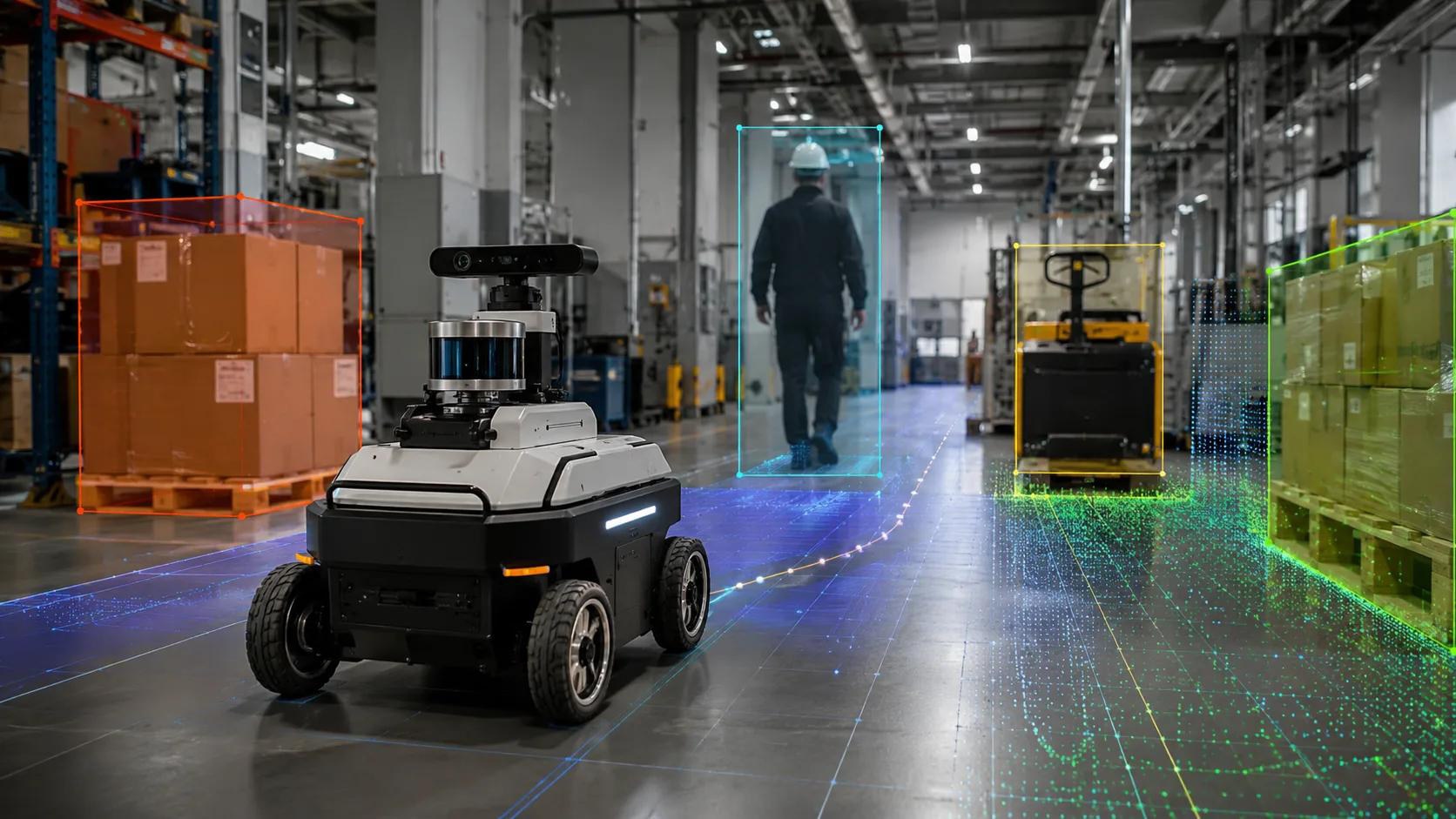
Introduction: Why Small Autonomous Vehicles Need Better Obstacle Detection
Small autonomous vehicles and mobile robots are becoming increasingly common in modern transportation, logistics, manufacturing, and commercial services. From automated guided vehicles (AGVs) operating in factories to autonomous mobile robots (AMRs) working in warehouses, these machines are transforming how goods and materials are transported.
Autonomous delivery vehicles, low-speed electric vehicles, and compact robotic platforms are also being introduced into more complex environments.
However, one important challenge remains: obstacle avoidance.
Unlike traditional vehicles operated by human drivers, autonomous vehicles must rely on sensors and perception algorithms to understand their surroundings. They need to identify pedestrians, bicycles, carts, curbs, walls, vehicles, and other obstacles before making navigation decisions.
For small autonomous vehicles, near-field perception is particularly important.
A robot may have sufficient forward visibility but still struggle to detect objects positioned close to its sides, rear corners, or low-mounted sensor blind zones. These areas can create collision risks during turning, reversing, docking, and navigating through narrow passages.
Traditional cameras provide visual information but may be affected by lighting conditions, shadows, glare, and limited depth perception. Ultrasonic sensors are useful for very short-range detection, but their limited angular coverage and spatial resolution can make it difficult to reconstruct complex surrounding environments.
This is why LiDAR technology is becoming an important component of modern autonomous perception systems.
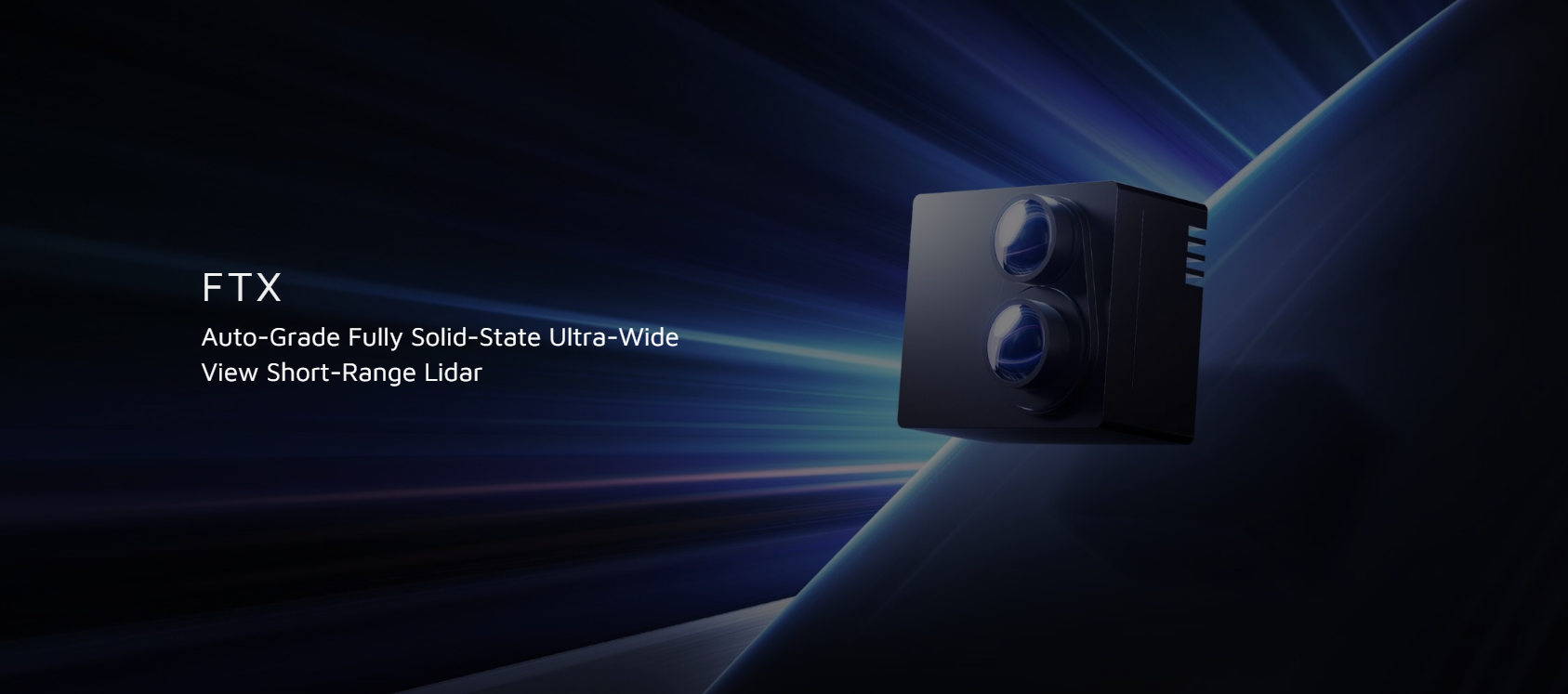
The Hesai FTX LiDAR is an automotive-grade, fully solid-state short-range LiDAR designed specifically for wide-angle near-field perception and blind-spot detection.
With selectable 180° and 140° horizontal field-of-view configurations, high-resolution point cloud output, compact dimensions, and low power consumption, FTX provides an effective sensing option for applications requiring wide-area obstacle detection at close distances.
In this article, we explore how Hesai FTX can support small autonomous vehicles, AGVs, AMRs, and delivery robots, and why wide-angle solid-state LiDAR is becoming an important technology for safer autonomous navigation.
1. What Is Hesai FTX LiDAR?
Hesai FTX is a fully solid-state short-range LiDAR sensor developed by Hesai Technology.
Unlike traditional mechanical LiDAR sensors that rely on rotating optical assemblies, FTX uses electronic scanning technology to capture surrounding environmental information.
Its main purpose is to provide detailed near-field perception for vehicles and robotic systems.
The sensor is designed to detect nearby objects and help autonomous systems identify potential collision hazards in areas that may not be sufficiently covered by conventional long-range perception sensors.
Key product characteristics include:
- Fully solid-state electronic scanning architecture
- Up to 180° horizontal field of view
- Up to 140° vertical field of view
- Up to 30m detection range at 10% reflectivity, depending on configuration
- 492,000 points per second in single-return mode
- 10Hz scanning frequency
- Compact dimensions
- Low power consumption below 6W
- Class 1 laser safety
- Automotive-grade reliability validation
The FTX series is available in two main configurations:
| Specification | FTX 180° | FTX 140° |
|---|---|---|
| Horizontal FOV | 180° | 140° |
| Vertical FOV | 140° | 105° |
| Detection Range @10% Reflectivity | 20m | 30m |
| Point Rate | 492,000 pts/s | 492,000 pts/s |
| Pixel Resolution | 216 × 192 | 256 × 192 |
| Angular Resolution | 0.62° finest | 0.56° × 0.56° |
| Scanning Frequency | 10Hz | 10Hz |
| Weight | Approx. 180g | Approx. 160g |
| Power Consumption | Below 6W | Below 6W |
These configurations allow system designers to select a suitable balance between detection range and surrounding environmental coverage.
2. Why Near-Field Obstacle Avoidance Is Important for Small Vehicles
Small autonomous vehicles often operate in environments where obstacles can appear unexpectedly and at very short distances.
For example, a warehouse AMR may travel between shelves, pallets, forklifts, and workers. A delivery robot may need to navigate sidewalks while avoiding pedestrians, bicycles, and temporary obstacles.
A compact autonomous vehicle may also need to turn in a narrow corridor or reverse into a docking station.
In these situations, a long-range forward-facing LiDAR alone may not provide sufficient coverage.
Several common challenges need to be considered.
2.1 Side Blind Spots
A vehicle’s front LiDAR may detect obstacles directly ahead but fail to provide complete coverage around its side panels.
When a vehicle turns, objects located near the front corners or sides may enter the collision path.
A wide-angle short-range LiDAR can provide additional environmental information in these regions.
2.2 Rear Blind Spots
During reversing and docking, nearby objects may be difficult to detect with front-facing sensors.
FTX can be installed at suitable rear or corner positions to provide additional short-range perception.
2.3 Low-Level Obstacles
Small robots frequently encounter objects close to ground level.
Examples include:
- Low curbs
- Pallets
- Boxes
- Small carts
- Ground-level obstacles
- Pedestrians’ legs
- Bicycle wheels
High-resolution near-field point cloud data can help perception systems identify these objects and estimate their positions.
2.4 Narrow Operating Spaces
In warehouses, factories, hospitals, and commercial buildings, robots often travel through narrow passages.
A wide field of view helps collect information about surrounding walls, equipment, shelves, and other obstacles.
This information can be used by navigation software to maintain safe travel distances and reduce collision risks.
3. Up to 180° Ultra-Wide FOV for Better Environmental Coverage
One of the most important advantages of Hesai FTX is its ultra-wide field of view.
The FTX 180° version supports a 180° horizontal field of view and a 140° vertical field of view.
The FTX 140° version provides a 140° horizontal field of view and a 105° vertical field of view.
This wide coverage allows one sensor to observe a large near-field region.
For small autonomous vehicles, wider coverage can help reduce blind zones around the vehicle and provide more information to the perception system.
Consider a compact delivery robot.
If the sensor is installed at the front of the robot, its wide horizontal field of view can help detect obstacles across a broad area in front of the platform.
Depending on the installation position, it may also cover portions of the front-side regions.
When combined with additional sensors installed at the rear or other corners, the system can achieve more comprehensive surrounding perception.
The wide vertical FOV is also valuable.
It allows the sensor to capture information across different heights, helping detect nearby structures and objects that may otherwise fall outside a narrow vertical sensing region.
This is especially important for compact robotic platforms operating around people and equipment.
4. High-Resolution Point Clouds for Accurate Obstacle Detection
Field of view is only one part of a successful obstacle detection system.
The quality and density of point cloud data also play an important role.
Hesai FTX provides up to 492,000 points per second in single-return mode.
This high point rate allows the sensor to collect detailed spatial information about surrounding objects.
For autonomous vehicles, point cloud information can help distinguish:
- Pedestrians
- Bicycles
- Small vehicles
- Boxes and pallets
- Walls and barriers
- Roadside structures
- Other nearby obstacles
The sensor also provides different pixel resolutions depending on the selected configuration.
FTX 180° provides 216 × 192 pixel resolution, while FTX 140° provides 256 × 192 pixel resolution.
These specifications are particularly useful when evaluating near-field detection requirements.
For example, an AMR moving through a warehouse may encounter a small object partially hidden behind a pallet.
A high-resolution sensing system can provide more spatial information to downstream perception algorithms.
However, LiDAR point cloud data alone does not automatically identify every object. Object classification and collision decisions depend on the perception software, sensor mounting, detection thresholds, and system configuration.

5. Fully Solid-State Architecture for Reliable Robotic Applications
Traditional mechanical LiDAR sensors often contain moving optical components.
Although mechanical designs can provide excellent sensing performance, moving components may introduce additional mechanical complexity.
Hesai FTX adopts a fully solid-state electronic scanning architecture.
This provides several advantages for compact autonomous platforms.
No Rotating Optical Assembly
The fully solid-state architecture removes the need for a traditional rotating optical assembly.
This can simplify mechanical integration and reduce concerns associated with moving optical components.
Compact Installation
The FTX has a small physical form factor, making it suitable for installation in limited spaces.
For vehicle manufacturers, compact sensors are easier to integrate into front bumpers, side panels, rear corners, and other suitable positions.
Reduced Mechanical Complexity
A compact solid-state sensing solution can help simplify the mechanical design of autonomous vehicles and robotic platforms.
Suitable for Mass-Production Design
The automotive-grade development and validation approach makes FTX relevant to vehicle applications that require consistent hardware integration and reliability evaluation.
For manufacturers developing autonomous vehicles or robotic platforms, these characteristics can be important when planning a scalable sensing architecture.
6. Hesai FTX for AGV and AMR Obstacle Avoidance
Automated guided vehicles and autonomous mobile robots are widely used in warehouses, manufacturing facilities, and logistics centers.
Their primary tasks include transporting goods, moving materials, and supporting automated production processes.
To operate safely, AGVs and AMRs must continuously detect surrounding obstacles.
Hesai FTX can be considered as a short-range perception sensor in these systems.
Warehouse Navigation
Warehouses contain many moving and stationary objects.
Robots may encounter:
- Storage racks
- Pallets
- Forklifts
- Workers
- Boxes
- Loading equipment
FTX can provide wide-angle near-field point cloud data to support obstacle detection and navigation algorithms.
Automated Docking
When an AMR approaches a charging station or loading position, precise near-field sensing becomes important.
A suitable FTX installation can provide additional spatial information around the docking area.
Narrow-Aisle Navigation
Small robots often operate between closely spaced shelves.
Wide-angle sensing can help identify nearby obstacles and support safer navigation.
Human-Robot Collaboration
In manufacturing environments, robots frequently operate near human workers.
Near-field LiDAR data can support pedestrian detection and collision avoidance systems.
Actual safety performance depends on the complete robot design, safety controller, perception software, and applicable machinery safety standards. FTX should not be treated as a standalone certified safety scanner unless the complete system has the relevant certification.
7. Applications in Autonomous Delivery Vehicles and Small Electric Vehicles
Autonomous delivery vehicles and compact electric vehicles are becoming increasingly common in commercial environments.
These platforms may operate on sidewalks, industrial campuses, residential roads, and logistics sites.
Their small size makes them flexible, but it also creates challenges related to sensor placement and surrounding perception.
Hesai FTX can help provide near-field sensing information for:
Pedestrian Detection
The sensor can capture spatial information about people near the vehicle.
Bicycle and Scooter Detection
Bicycles and electric scooters may approach from the sides or enter the vehicle’s path.
Wide-angle near-field perception can help the vehicle’s perception system monitor these areas.
Side Collision Prevention
When the vehicle turns or passes through narrow spaces, side-mounted sensors can provide additional obstacle information.
Low-Speed Maneuvering
Parking, reversing, docking, and turning all require reliable short-range perception.
FTX is designed for these types of near-field sensing requirements.
8. FTX 180° vs. FTX 140°: Which Version Is Better for Small Vehicles?
Selecting the correct FTX configuration depends on the vehicle’s geometry, installation position, and sensing requirements.
| Selection Factor | FTX 180° | FTX 140° |
|---|---|---|
| Main Advantage | Wider environmental coverage | Longer specified detection range |
| Horizontal Coverage | 180° | 140° |
| Vertical Coverage | 140° | 105° |
| Range @10% Reflectivity | 20m | 30m |
| Point Rate | 492k pts/s | 492k pts/s |
| Typical Application | Very wide near-field blind-zone coverage | Wider-range short-distance perception |
| Installation | Front, side, or suitable corner positions | Front, side, or suitable corner positions |
When to Choose FTX 180°
Consider FTX 180° when:
- You need extremely wide horizontal coverage.
- Your vehicle has limited sensor installation positions.
- You prioritize surrounding near-field perception.
- Your application involves low-speed operation and close-range obstacle detection.
When to Choose FTX 140°
Consider FTX 140° when:
- You need a longer specified detection range.
- Your installation geometry works better with a 140° horizontal field of view.
- You want a higher angular resolution specification.
- Your application needs a balance between range and wide-angle coverage.
Neither version is universally better. The best configuration depends on your actual vehicle design and application.
9. Key Technical Specifications of Hesai FTX
| Parameter | FTX 180° | FTX 140° |
|---|---|---|
| Product Type | Fully Solid-State Short-Range LiDAR | Fully Solid-State Short-Range LiDAR |
| Laser Wavelength | 940nm | 940nm |
| Laser Safety | Class 1 | Class 1 |
| Detection Range | 20m @10% Reflectivity | 30m @10% Reflectivity |
| Point Rate | 492,000 pts/s | 492,000 pts/s |
| Horizontal FOV | 180° | 140° |
| Vertical FOV | 140° | 105° |
| Pixel Resolution | 216 × 192 | 256 × 192 |
| Angular Resolution | 0.62° finest | 0.56° × 0.56° |
| Scanning Frequency | 10Hz | 10Hz |
| Power Consumption | Below 6W | Below 6W |
| Dimensions | 60 × 38.7 × 55mm | 60 × 32 × 55mm |
| Weight | Approx. 180g | Approx. 160g |
| Environmental Validation | IP6K7 / IP6K9K | IP6K7 / IP6K9K |
Specifications are manufacturer-published typical values under specified conditions. Please consult the latest official datasheet for the exact hardware version and integration requirements.
10. Why Choose Hesai FTX from LidarSeek?
Selecting the right LiDAR sensor is important for autonomous vehicle development, but procurement cost and product availability also influence project decisions.
LidarSeek provides LiDAR products and intelligent perception solutions for international customers.
We help engineers, robotics companies, vehicle manufacturers, and system integrators source suitable sensing hardware.
When purchasing Hesai FTX through LidarSeek, you can benefit from:
Competitive Pricing
We focus on competitive product sourcing and helping customers reduce unnecessary procurement costs.
Flexible Model Selection
We can help you evaluate the FTX 180° and FTX 140° versions according to your vehicle design and detection requirements.
Application Consultation
Our team can assist with product selection for AGVs, AMRs, autonomous delivery vehicles, and automotive blind-spot sensing projects.
Global Shipping Support
We support international customers with product sourcing and shipping coordination.
Project-Based Quotations
Whether you need one sensor for development or multiple units for production testing, contact us for a quotation.
11. Request the Best Price for Hesai FTX LiDAR
Are you developing a small autonomous vehicle, AGV, AMR, delivery robot, or robotic platform that requires reliable near-field obstacle detection?
Hesai FTX provides an ultra-wide field of view, fully solid-state sensing architecture, high-resolution point cloud output, and compact integration dimensions.
With FTX 180° and FTX 140° configurations available, developers can select the sensing solution that best matches their application.
LidarSeek provides competitive sourcing options for Hesai LiDAR products.
Contact our team to request:
- Latest Hesai FTX pricing
- FTX 180° and FTX 140° availability
- Technical datasheets
- Product configuration information
- Integration-related product support
- International shipping estimates
- Bulk order quotations
Looking for a competitive Hesai FTX LiDAR price?
Contact LidarSeek today and tell us about your vehicle or robotics project.
Request a Quote Now – Improve Your Autonomous Vehicle’s Near-Field Perception with Hesai FTX.
Frequently Asked Questions (FAQ)
Q1. What is Hesai FTX LiDAR mainly used for?
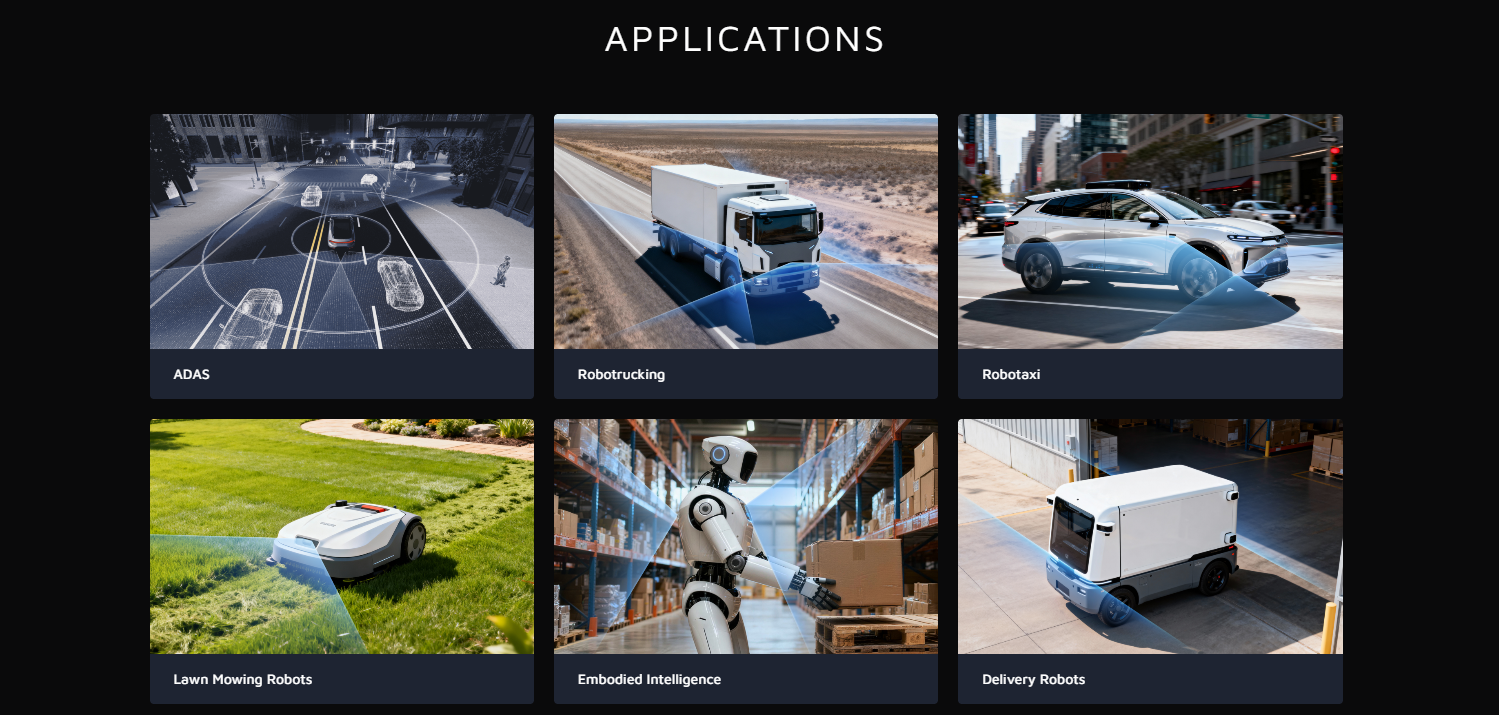
Hesai FTX is primarily designed for short-range environmental perception and blind-spot detection. Typical applications include autonomous vehicles, AGVs, AMRs, delivery robots, automotive ADAS, and robotic obstacle avoidance.
Q2. Can Hesai FTX be used for small vehicle obstacle avoidance?
Yes. Its wide field of view and high-resolution point cloud output make it suitable for near-field obstacle detection on small autonomous vehicles. It can help identify pedestrians, bicycles, curbs, walls, and other nearby obstacles when integrated with suitable perception software.
Q3. What is the difference between FTX 180° and FTX 140°?
FTX 180° provides a 180° × 140° field of view and a specified range of 20m at 10% reflectivity.
FTX 140° provides a 140° × 105° field of view and a specified range of 30m at 10% reflectivity.
Both versions support 492,000 points per second in single-return mode.
Q4. Is Hesai FTX suitable for AGV and AMR robots?
Yes. It can provide near-field point cloud data for warehouse navigation, obstacle detection, docking, and human-robot collaboration.
Q5. Can FTX detect pedestrians and bicycles?
FTX captures 3D spatial information from nearby objects, including pedestrians and bicycles. Object recognition and classification are performed by the vehicle’s perception software.
Q6. Does Hesai FTX have moving mechanical components?
No. FTX uses a fully solid-state electronic scanning architecture without a traditional rotating optical assembly.
Q7. What is the maximum detection distance of Hesai FTX?
The specified detection range at 10% reflectivity is 20m for FTX 180° and 30m for FTX 140°. Actual detection performance depends on target reflectivity, environmental conditions, and installation.
Q8. How much power does Hesai FTX consume?
The manufacturer’s product page specifies power consumption below 6W.
Q9. Can Hesai FTX replace all other LiDAR sensors on an autonomous vehicle?
Not necessarily. FTX is optimized for near-field sensing and blind-spot coverage. Many autonomous vehicle systems require a combination of long-range, medium-range, and short-range sensors to achieve comprehensive environmental perception.
Q10. Where can I buy Hesai FTX LiDAR?
You can contact LidarSeek for Hesai FTX 180° and 140° pricing, product availability, technical information, and international shipping support.









