
Industrial automation is moving rapidly toward flexible mobile robotics.
Traditional conveyor systems and fixed automation equipment remain important, but manufacturers increasingly use AGVs, AMRs, mobile robots, inspection robots, and intelligent logistics platforms to move materials and equipment.
The key challenge is perception.
A mobile robot cannot simply follow instructions. It must understand what is happening around it.
Is the path clear?
Is another robot blocking the route?
Is a pallet in front of the vehicle?
Where is the wall?
Where is the loading station?
Has the environment changed?
LiDAR is one of the technologies used to answer these questions.
For applications that primarily require horizontal environmental perception, a compact 2D LiDAR can offer a practical alternative to larger 3D sensing systems.
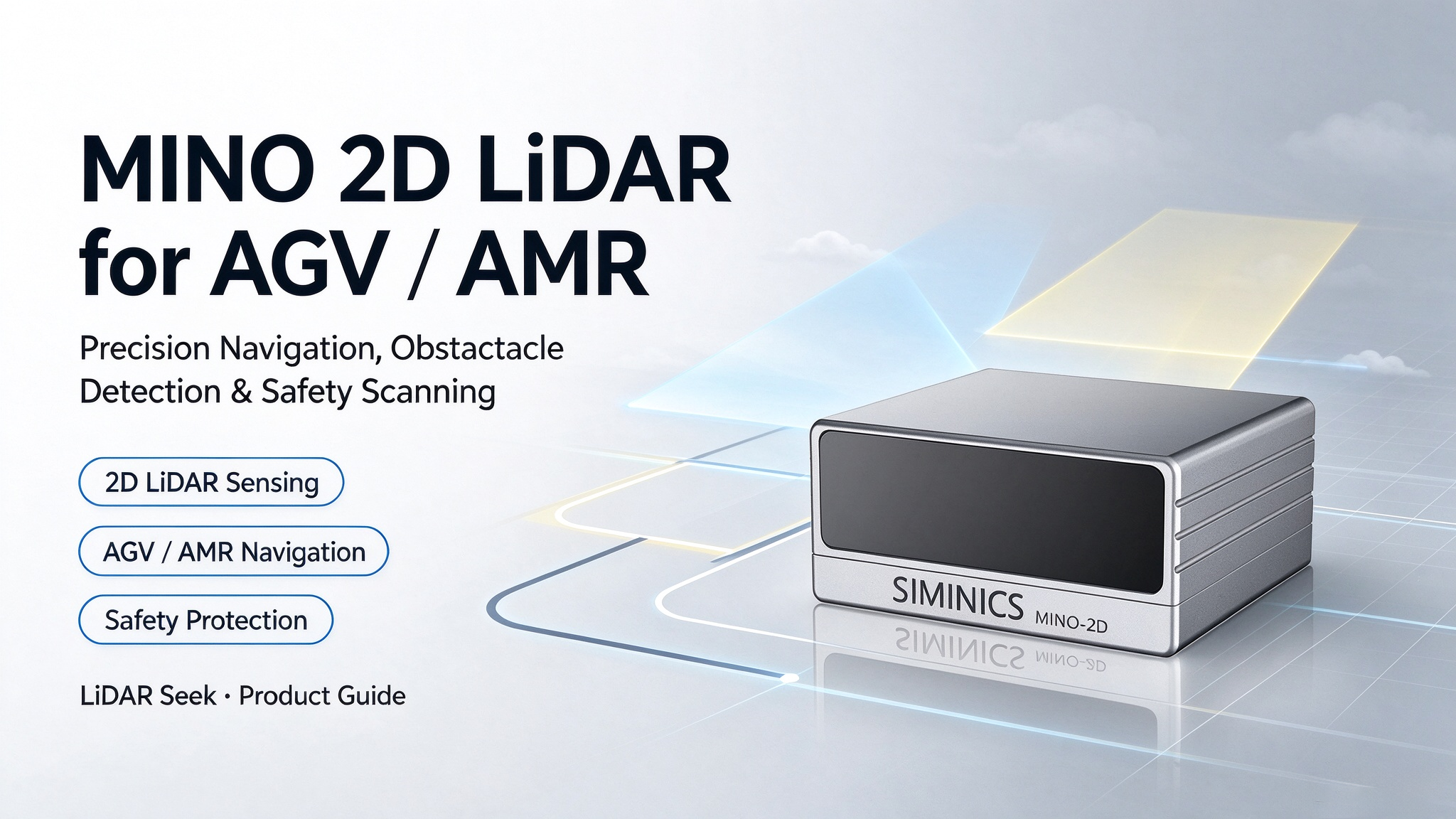
The MINO-Miniature 2D LiDAR is one example.
The sensor is designed around Time-of-Flight ranging and a rotating scanning mechanism. It provides a published detection range of 0.1–30 meters at 90% reflectivity, 120° scanning coverage, 15 Hz scanning, and a minimum angular resolution of 0.16°.
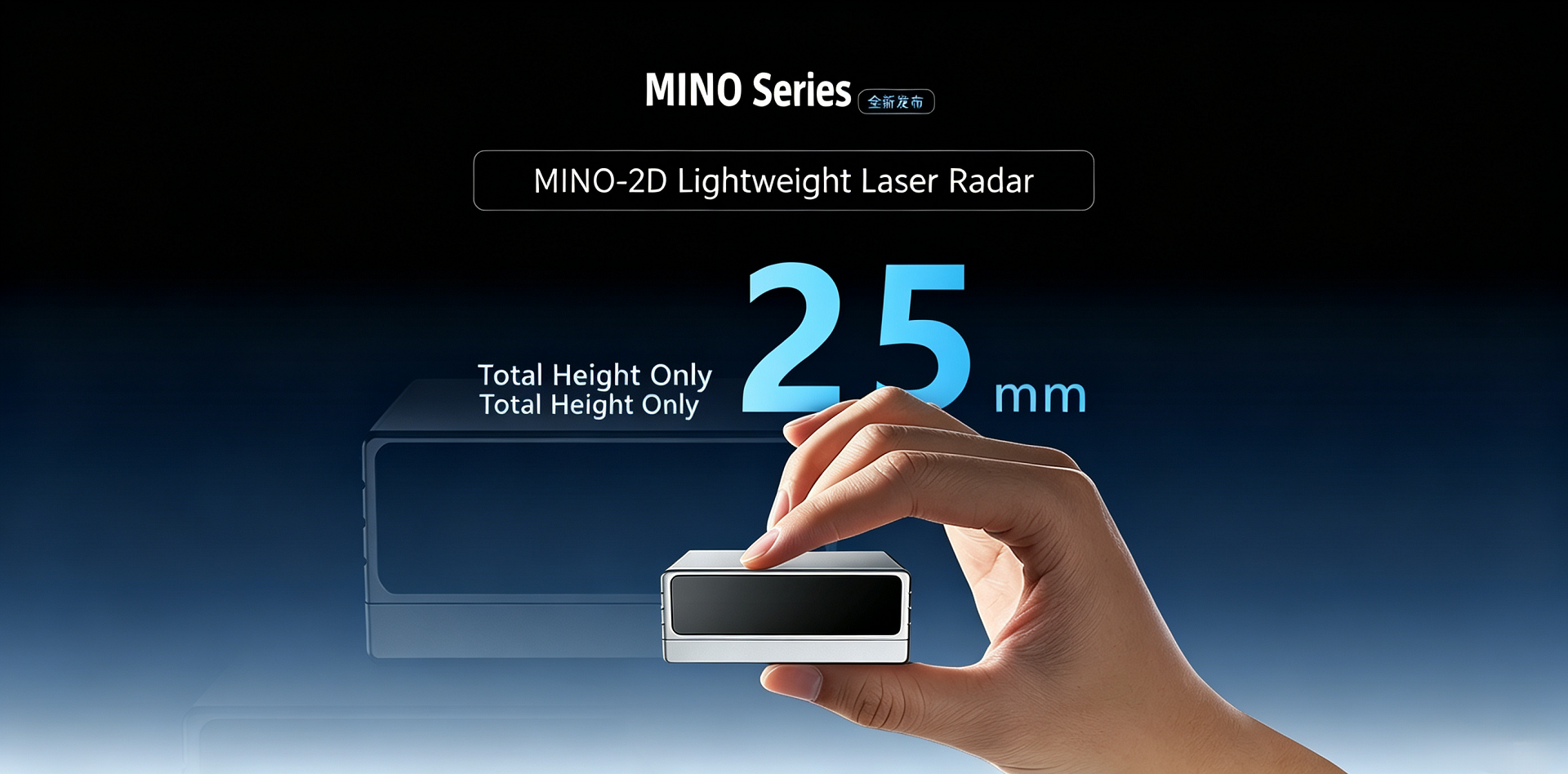
Its compact 50 × 56 × 25 mm form factor and less-than-180-gram weight also make it suitable for projects where installation space is limited.
Why AGVs Need LiDAR
AGVs are designed to transport materials automatically.
Typical applications include:
- Factory logistics
- Warehouse transportation
- Pallet movement
- Production-line supply
- Component transportation
- Material handling
Although AGVs may follow predefined routes, their operating environments are rarely completely static.
People move.
Forklifts move.
Pallets move.
Equipment changes.
Temporary obstacles appear.
A LiDAR sensor can provide continuous distance information to help the vehicle detect these changes.
Why AMRs Need LiDAR
AMRs generally require more flexible navigation than traditional AGVs.
An AMR may be expected to select routes, avoid obstacles, and navigate changing environments.
That requires environmental perception.
LiDAR can provide geometric information that supports:
- Mapping
- Localization
- Obstacle detection
- Free-space estimation
- Path planning
- Navigation
The sensing system can be integrated with an onboard computer and navigation software.
MINO Technical Specifications
For industrial automation engineers, the following specifications are particularly relevant.
| Parameter | MINO 2D LiDAR |
|---|---|
| Detection Range | 0.1–30 m @ 90% reflectivity |
| Repeatability | ±20 mm |
| Scan Range | 120° |
| Frame Rate | 15 Hz |
| Minimum Angular Resolution | 0.16° |
| Laser Wavelength | 905 nm |
| Laser Safety | Class 1 |
| Power | 2 W |
| Supply Voltage | DC 9–24 V |
| Interface | 100BASE-TX Ethernet |
| Protection | IP65 |
| Operating Temperature | -10°C to 55°C |
| Dimensions | 50 × 56 × 25 mm |
| Weight | <180 g |
These specifications are based on the current LidarSeek product page. Buyers should confirm the latest technical documentation before final production qualification.
Compact LiDAR for Space-Constrained AGVs
Industrial vehicle design often involves tight mechanical constraints.
A sensor may need to fit:
- Behind a bumper
- Inside a protective housing
- Under a robot cover
- Above a chassis
- Inside a navigation module
- Near the front edge of the vehicle
MINO‘s 25 mm height can be particularly useful for low-profile installations.
A compact LiDAR can also reduce the need to redesign the mechanical structure.
This matters when an engineering team is developing multiple robot models.
A standardized sensing module can potentially be reused across several platforms, subject to application validation.
Front Obstacle Detection
One common AGV application is forward obstacle detection.
Imagine an AGV transporting materials through a factory.
The AGV travels forward.
A worker walks into its path.
A pallet is left in the aisle.
Another vehicle stops ahead.
The LiDAR can continuously scan the forward environment.
The navigation system can then use the measured distances as one input for its obstacle-handling logic.
MINO’s 120° scanning range is designed for this type of directional perception.
Warehouse Navigation
Warehouses can contain long aisles, shelves, pallets, boxes, workers, forklifts, and mobile equipment.
LiDAR is useful because many of these objects create clear geometric boundaries.
For example, a robot may detect:
- Left wall
- Right wall
- Pallet
- Rack
- Box
- Human
- Vehicle
Navigation software can convert the LiDAR measurements into a local representation of the environment.
This can then be combined with a global map.
30 m Detection Range in Industrial Applications
MINO provides a published detection range of up to 30 meters at 90% reflectivity.
For indoor logistics, this can provide useful forward visibility.
However, the actual detection distance depends on target reflectivity and environmental conditions.
A dark or low-reflectivity target may produce different results than a highly reflective target.
Therefore, engineering teams should test representative objects before production.
A good LiDAR evaluation should include:
- White surfaces
- Dark surfaces
- Metal
- Plastic
- Glass
- Human clothing
- Pallets
- Boxes
Testing with real-world materials is more meaningful than relying only on laboratory specifications.
15 Hz Scanning and Robot Movement
A mobile robot is continuously moving.
Therefore, the environment observed at one moment is not necessarily the environment a second later.
MINO provides a published scanning frequency of 15 Hz.
This provides frequent environmental updates.
For AGV and AMR applications, scan frequency should be considered together with:
- Vehicle speed
- Braking distance
- Detection distance
- Processing latency
- Network latency
- Navigation algorithm
- Safety architecture
The LiDAR should be treated as one component of the complete perception and control system.
0.16° Angular Resolution
Angular resolution is another important parameter for AGV and AMR applications.
MINO specifies a minimum angular resolution of 0.16°.
Fine angular sampling can help the system capture more detailed information about object boundaries.
This can be useful when the robot needs to identify:
- Narrow objects
- Wall edges
- Openings
- Obstacles
- Equipment boundaries
The actual performance should be validated at the required detection distance.
Low Power for Autonomous Vehicles
Industrial mobile robots are battery-powered.
Energy is used by:
- Drive motors
- Computers
- Cameras
- LiDAR
- Wireless communication
- Control electronics
- Safety equipment
MINO’s published power consumption is 2 W.
This relatively low sensor power requirement can be useful when designing battery-powered systems.
For a fleet of hundreds of mobile robots, power efficiency can become an important engineering consideration.
Ethernet Connectivity
Industrial robots often use Ethernet-based communication architectures.
MINO uses a 100BASE-TX Ethernet interface.
A simplified system architecture could be:
MINO → Ethernet Network → Industrial Computer → Navigation Software → Vehicle Controller
The onboard computer can receive LiDAR data and combine it with:
- Wheel odometry
- IMU
- Camera
- Encoder
- Other LiDAR
- GNSS where applicable
This creates a multi-sensor perception architecture.
IP65 Protection
Industrial environments can be dusty.
Some robots may operate near loading areas, production equipment, or warehouse entrances where environmental conditions are less controlled.
MINO has an IP65 protection rating.
This makes environmental protection an important consideration during industrial system design.
However, IP65 does not eliminate the need for proper mechanical protection.
The final installation should consider:
- Direct water exposure
- Cleaning procedures
- Dust
- Condensation
- Mechanical impact
- Vibration
- Temperature
- Cable protection
Temperature Range
MINO’s published operating temperature range is -10°C to 55°C.
For most indoor factories and warehouses, this range may cover typical operating environments.
For extreme industrial applications, additional environmental testing may be required.
Engineers should evaluate:
- Minimum ambient temperature
- Maximum ambient temperature
- Heat generated inside the enclosure
- Continuous operating duration
- Thermal conditions near motors and computing equipment
MINO for Automated Warehouse Robots
Automated warehouses are one of the fastest-growing applications for mobile robotics.
A warehouse robot may need to:
- Locate itself.
- Navigate to a target.
- Detect obstacles.
- Avoid other vehicles.
- Reach a loading station.
- Transport goods.
- Return to a charging area.
LiDAR can support several of these functions.
A compact 2D LiDAR is particularly useful when the robot primarily requires horizontal environmental perception.
MINO for Factory AGVs
Factory AGVs often operate around:
- Production lines
- Storage areas
- Assembly stations
- Loading zones
- Material storage
- Human workers
The environment can change throughout the day.
A LiDAR can provide continuous information about nearby obstacles and structures.
Combined with predefined routes and other sensors, this can support automated transportation.
MINO for AMR Navigation
AMRs need to be more flexible than traditional fixed-route vehicles.
A typical AMR architecture may include:
LiDAR
↓
SLAM / Localization
↓
Global Planner
↓
Local Planner
↓
Motion Controller
↓
Drive Motors
MINO can serve as the LiDAR sensing component in a system architecture like this, subject to software and integration validation.
LiDAR and SLAM
SLAM is a key technology in mobile robotics.
The objective is to estimate the robot’s position while constructing or updating a map.
2D LiDAR is commonly associated with 2D SLAM applications.
The LiDAR observes environmental structures.
The software analyzes changes in the scan.
Odometry and IMU information can help estimate motion.
The algorithm combines these inputs to produce a map and position estimate.
For indoor AGVs and AMRs, this architecture can be highly useful.
Why Not Always Use 3D LiDAR?
3D LiDAR is powerful, but more sensing capability is not always necessary.
If an AGV only needs to know:
- Is there an obstacle?
- Where is the wall?
- Where is the open space?
- What is the robot’s position?
then 2D sensing may be sufficient.
Using a smaller 2D sensor can potentially reduce:
- Sensor cost
- Power requirements
- Data processing requirements
- Data bandwidth
- Mechanical complexity
For applications requiring height information or complete 3D perception, however, a 3D LiDAR may be more appropriate.
The correct choice depends on the application.
How Much Does MINO Cost for Industrial Projects?
LidarSeek currently lists MINO-Miniature 2D LiDAR at a displayed sale price of $320, compared with a displayed regular price of $360.
For industrial customers, unit price can change depending on:
- Quantity
- Project requirements
- Shipping destination
- Commercial terms
- Delivery schedule
For example, buying one sensor for development and purchasing hundreds of sensors for a production fleet are very different procurement situations.
LidarSeek states that it offers competitive direct manufacturer pricing and bulk rates.
Therefore, production customers should request a project quotation rather than assuming the online sample price is the final fleet price.
What Information Should You Include in an RFQ?
When contacting a LiDAR supplier, providing detailed information can speed up the quotation process.
A good RFQ should include:
Product
MINO-Miniature 2D LiDAR
Quantity
For example:
- 1–5 samples
- 20 units
- 100 units
- 500 units
- 1,000+ units
Application
AGV, AMR, warehouse robot, inspection robot, etc.
Operating environment
Indoor, outdoor, warehouse, factory, mixed environment.
Required range
For example, 10 m, 20 m, or 30 m.
Mounting
Front-mounted, side-mounted, embedded, protective housing, etc.
Computing platform
Industrial PC, embedded controller, NVIDIA platform, custom computer, etc.
Destination
Country and city for shipping calculation.
Providing this information allows the supplier to respond more accurately.
Sample Orders vs Production Orders
Engineering teams often need a few sensors before committing to production.
A good evaluation process can include:
Stage 1: Laboratory testing
Test communication, SDK, data output, and basic measurements.
Stage 2: Robot integration
Install the LiDAR on the actual robot.
Stage 3: Navigation testing
Evaluate SLAM, localization, and obstacle detection.
Stage 4: Environmental testing
Test dust, temperature, lighting, and other real-world conditions.
Stage 5: Pilot deployment
Deploy several robots in the actual facility.
Stage 6: Production
Scale to the required fleet quantity.
This approach can reduce integration risk.
MINO for Multi-Robot Fleets
When deploying dozens or hundreds of robots, procurement becomes more complex.
A fleet manager needs consistency.
The sensing hardware should ideally remain consistent across robot models where possible.
This can simplify:
- Spare parts
- Maintenance
- Software configuration
- Training
- Integration
- Troubleshooting
A compact sensor such as MINO can therefore be considered not only as an individual component but also as part of a standardized robot platform.
Why Purchase Through LidarSeek?
LidarSeek offers LiDAR sensors from multiple manufacturers and categories, including 2D LiDAR, 3D LiDAR, automotive LiDAR, and other perception technologies. Its website states that it supports customers in more than 42 countries and regions and provides product selection, technical consultation, application support, and global logistics.
For industrial buyers, this broader product portfolio can be useful when project requirements change.
For example, an engineering team may initially need a compact 2D LiDAR.
Later, another project may require:
- 3D LiDAR
- Automotive LiDAR
- Cameras
- NVIDIA Jetson
- GNSS/IMU
Having access to multiple sensing categories can simplify supplier management.
Questions to Ask Before Buying
Before purchasing MINO for an AGV or AMR, ask:
1. Is 30 m enough for my vehicle speed?
Calculate the required detection and stopping distance.
2. Is 120° enough?
If not, consider additional sensors.
3. Do I need 2D or 3D perception?
Do not purchase 3D capability unless the application actually requires it.
4. Is the installation space sufficient?
Check the 50 × 56 × 25 mm dimensions and cable routing.
5. Is IP65 sufficient?
Evaluate the actual environment.
6. Is 2 W power consumption acceptable?
Consider total system energy.
7. Does the interface fit my architecture?
Confirm Ethernet and software compatibility.
8. What quantity do I need?
Sample and production pricing may differ.
Final Recommendation for Engineering Evaluation
The MINO-Miniature 2D LiDAR is a compact sensing option for AGVs, AMRs, mobile robots, navigation systems, and industrial automation projects.
Its key published specifications include:
- 0.1–30 m detection range at 90% reflectivity
- 120° scanning range
- 15 Hz scanning rate
- 0.16° minimum angular resolution
- ±20 mm repeatability accuracy
- 2 W power consumption
- 9–24 V DC supply
- 100BASE-TX Ethernet
- IP65 protection
- 50 × 56 × 25 mm dimensions
- Less than 180 g weight
The combination of compact dimensions and practical sensing performance makes MINO worth evaluating for industrial mobile robotics.
For an engineering team, the best way to determine suitability is to test the sensor on the actual robot under representative conditions.
Need MINO 2D LiDAR for an AGV, AMR, or industrial robot project? Contact LidarSeek for current pricing, sample availability, bulk quotation, and technical support.









